It is impossible to live without failing at something, unless you live so cautiously that you might as well not live at all. In which case you fail by default.
Let me tell you what happened in Leicester Square tonight, because it was better than the film.
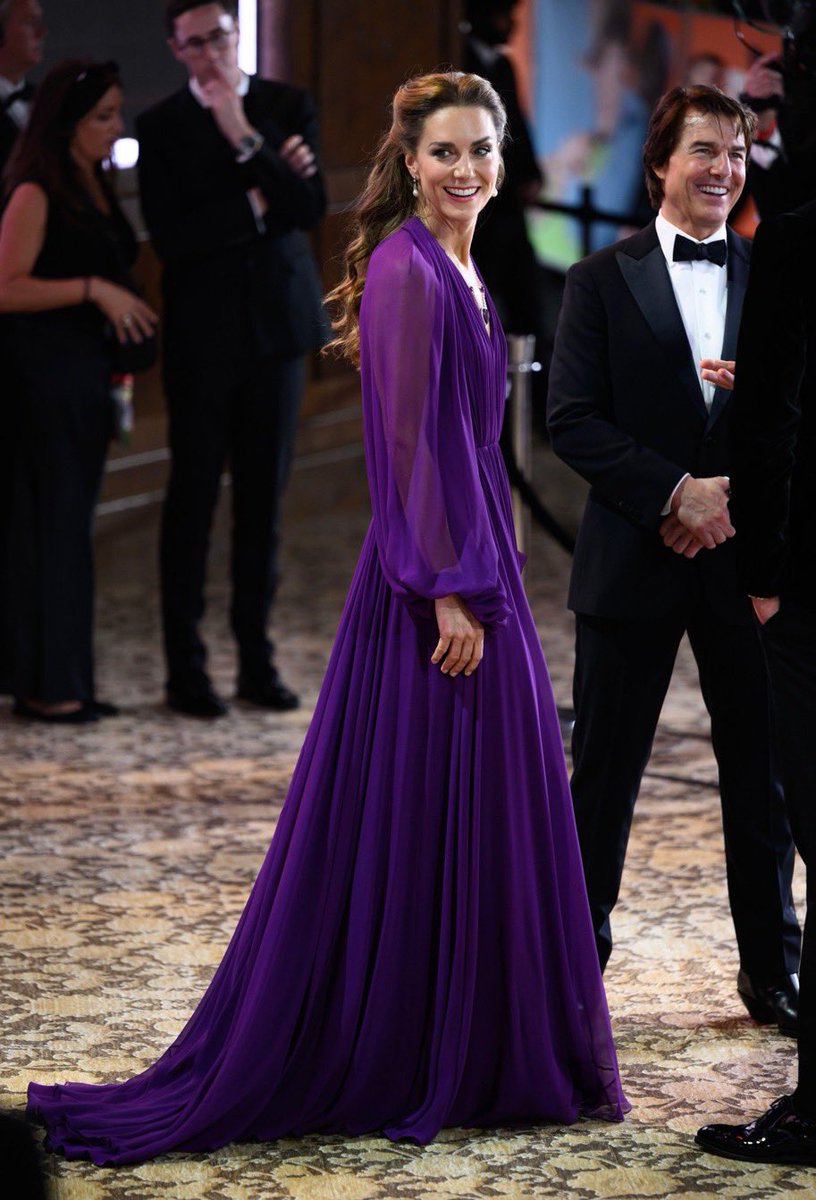
The Princess of Wales has not walked a red carpet since May 2022. In between came the year the family does not discuss: the surgery, the diagnosis, the video from the garden bench, the chemotherapy, the months when the country quietly counted the days. Tonight she walked one again.
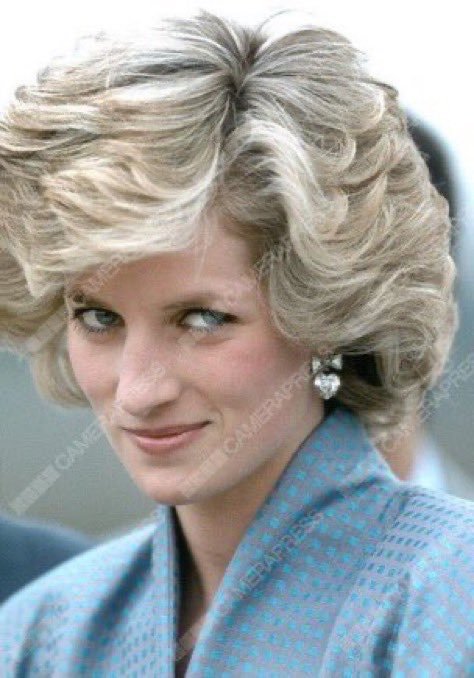
She wore purple. Deep plum, Jenny Packham, cut lower than she has ever dared, the colour of queens. Her hair was half up, so that you could see the earrings, and the earrings were Diana's pearls. At her throat, on a rope of pearls to the waist, hung an amethyst heart the size of a walnut. Queen Alexandra gave it to the Queen Mother in 1923, the year she married into the family. It has been worn through a war, an abdication and a century of clever men underestimating the women who wore it.
This morning a book went on sale calling that Queen petty and the King a lottery winner on the morning Diana died. The family's reply to a week of it has been one sentence. Tonight the future Queen answered without one: she wore the Queen Mother's heart and Diana's pearls at the same time, and let the flashbulbs do the talking.
And William. Black tie, half a step behind her on the carpet, in her light rather than his own, with the look of a man who walked behind a coffin at fifteen and has spent every year since making sure she would never be alone on a carpet, or in a hospital, or anywhere.
She looked magnificent. Not because of the dress, though it was perfect, and not because of the necklace, though it was a hundred years of the family on a single strand. She looked magnificent because she looked well, and happy, and unafraid.
The book will be in the bargain bins by Christmas. The amethyst goes back to the vault, until another woman wears it on another night for reasons nobody will need to explain. That is the difference between a family and a grievance. One of them lasts.
Stop treating the adult population like children and stop allowing adults who behave like despotic toddlers to decree what the rest of us are allowed to watch.
This is Thomas Jewitt, 32, who died after he was assaulted on the way home from Notting Hill Carnival.
"He was excited about marrying his fiancée next year."
Heartbreaking. @SadiqKhan will you ignore his death like you’ve ignored the 636 arrests at Notting Hill carnival??
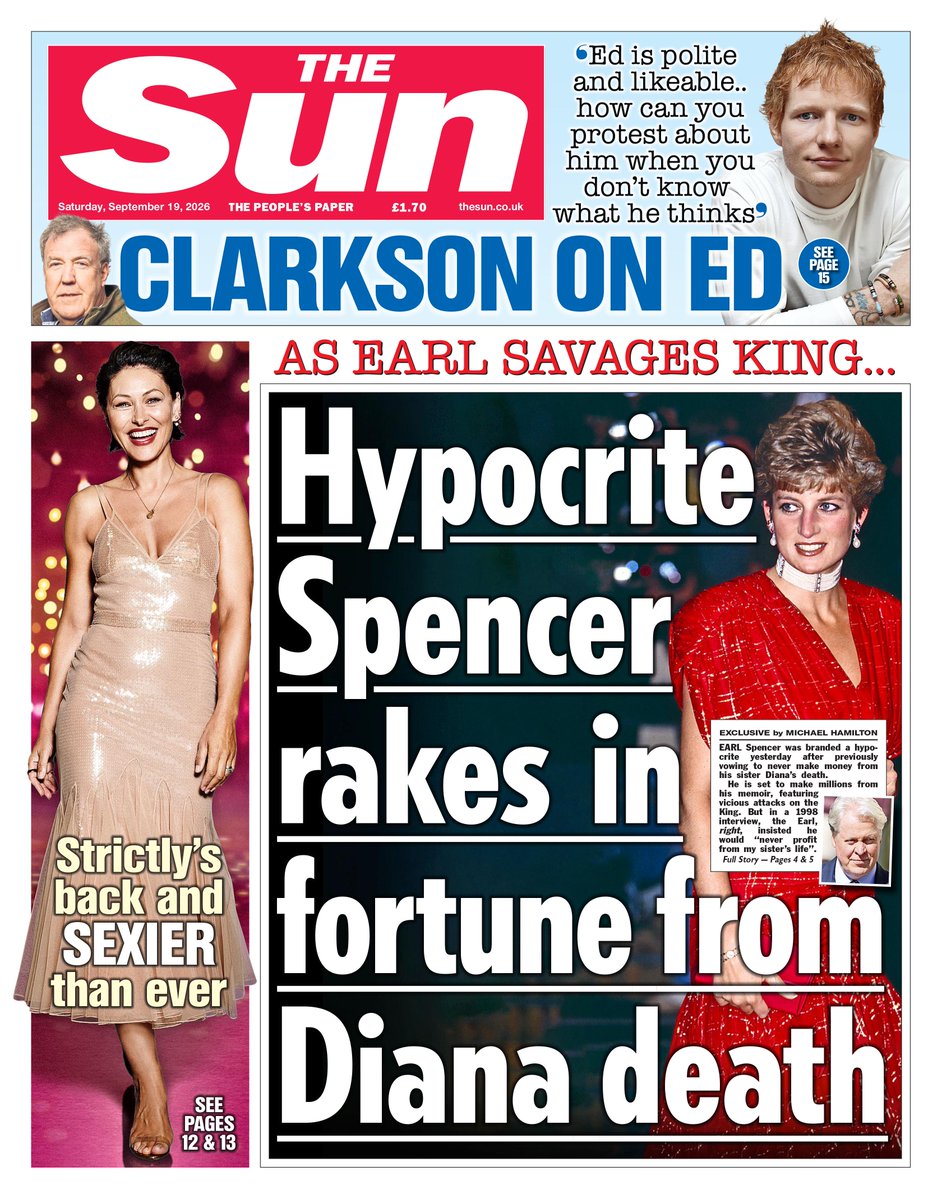
Charles Spencer waited twenty-nine years, three divorces, and a publishing contract before deciding that a fifteen-year-old boy’s composure on the worst day of his life was a reason to treat him as the secondary concern.
I am seething.
In Swan Song, Spencer writes that William “looked more self-possessed.” Tall. Handsome. Dignified. The image of his mother. And because the child did not collapse in public, because he held himself together while the world watched, his uncle decided Harry was the one who needed the fuss. William’s maturity, in other words, became the justification for ranking him second.
That is not grief talking. That is a man who has spent decades polishing a narrative in which one nephew is the wounded prince and the other is the inconveniently functional one.
Spencer’s own words give him away. He admits he “cared deeply” about what William was going through, then immediately explains why that care was deprioritized. The greater composure made him secondary.
For a relative who claims to care, how completely insensitive.
The uncle who delivered the funeral eulogy about blood family and duty decided, on the train to Althorp, that the boy who most resembled Diana was the one who could wait.
Twenty-nine years later he puts it in a book timed for the 30th anniversary market. Convenient. Financially convenient — it’s sickening.
Spencer now presenting William’s dignity as a reason to look away first is not brotherly concern. It is narrative management. Harry gets the “lack of obvious care” chapter. William gets the “he seemed fine, so I moved on” footnote.
That is not how you protect a sister’s sons. That is how you pick a favorite and call it memory.
William’s composure was not a luxury. It was the only armor a fifteen-year-old had left. Treating it as the reason he came second is one of the colder lines in a book already dripping with score-settling. Some of us still notice when a man waits almost three decades to tell the world that the boy who held it together was, therefore, less urgent.
That boy grew up. He is still holding it together. While the uncle is dining on the tragic death of his sister.
Saudi Arabia's East-West oil pipeline has been damaged by drone attacks. The strait of Hormuz is restricted, Houthi bandits threaten shipping routes into the Red Sea. Another oil shock is coming.
Yet our Prime Minister and his Cabinet are behaving like a flock of ostriches, heads buried so deep in the sand they could strike oil themselves.
The answer is simple: DRILL OUR OWN OIL AND GAS IN THE NORTH SEA.
Prince William, the silent son, remains dignified.
He knew his mother. He knows his father. And he knows all their flaws.
A prince who has a connection to British intelligent services and all their information has said nothing.
Oh he knows a lot!
But William is not a petty, vindictive twerp!
He is a king in the making.
I support this man.
Kemi Badenoch has accused Andy Burnham of “fiddling while Europe is at risk of burning” as Russia intensifies its hybrid war against the West.
Read this front page story here ⤵️
https://t.co/ygiT1eeRPj
She was seventy-two years old. She was losing her hair. She was losing weight. Between takes, she sat alone in her trailer and felt, in her own words, like she wouldn't have minded if it all just stopped.
And then her cue would come.
She would stand up, straighten her costume, walk back onto the set, and become Professor McGonagall.
Her name was Maggie Smith. And in 2007, right in the middle of filming Harry Potter and the Half-Blood Prince, she received a breast cancer diagnosis that would have ended most careers. She was deep into one of the most beloved film franchises in history. Daniel Radcliffe, Emma Watson, and Rupert Grint — three young actors who had grown up alongside her on set — still had a full year of work ahead. The production schedule was not going to move.
So she made a decision that most people simply would not make.
She would do the chemotherapy. She would do the filming. She would do them at the same time. And she would tell nobody.
The chemo hollowed her out. Her hair fell out completely. The tight grey wig she wore as Professor McGonagall — that stern bun pinned high on her head — quietly became something else entirely: a cover for a head that had been stripped bare by treatment. Her castmates assumed it was just costume. Not one of them suspected what was underneath it, or what was happening to her body between shots.
I was like a boiled egg, she said later, with the dry wit that had made her one of the great theatrical voices of the twentieth century.
The body beneath the joke was not laughing.
She finished the film. Then, instead of stepping back — instead of resting, recovering, disappearing for a while the way anyone would have been entitled to — she signed on for the final two films in the series. Harry Potter and the Deathly Hallows, Parts 1 and 2. During production, her immune system, already gutted by months of chemotherapy, collapsed again. She developed shingles.
She kept filming.
For two full years, she carried the secret entirely alone. No press release. No emotional interview. No carefully managed public announcement designed to soften the story and build sympathy. She simply went to work, did the job, and went home to be sick in private.
It wasn't until 2009 — after the filming was over, after the treatment was finished — that she quietly mentioned it to a journalist at the Daily Telegraph. The world, which had spent two years watching Professor McGonagall calmly hold the line at Hogwarts, suddenly understood that the woman playing her had been holding her own line the entire time.
The cancer was hideous, she said. It takes the wind out of your sails. It leaves you flattened.
She never returned to the stage. The chemotherapy had taken something from her that she couldn't get back. But at seventy-five, she walked onto a new set and into a new role: Violet Crawley, the Dowager Countess of Grantham, on a little period drama called Downton Abbey. Her one-liners went viral before the word viral fully existed. Her perfectly timed glances became a language of their own online. She won two Emmy Awards. She became, as she put it herself with genuine amusement, somebody people actually recognised.
I'd led a perfectly normal life until Downton Abbey, she once said. Nobody knew who the hell I was.
She kept going. At eighty-eight years old, she was still taking roles, still showing up, still doing the work. In September 2024, Dame Maggie Smith died peacefully in a London hospital, three months before her ninetieth birthday. Her sons noted that she had remained intensely private to the very end. King Charles called her a national treasure. Daniel Radcliffe said the word legend was overused — but that it applied to her completely, and without question.
She spent fifteen years working after a diagnosis that should have stopped her. She asked for no credit, no sympathy, and no accommodation. She just kept showing up.
The role the world knows is Professor McGonagall.
But the real performance was something else entirely.
It was a seventy-two-year-old woman, bald beneath a wig, walking back onto a film set because the job wasn't finished yet.
That was Maggie Smith.
-The Real History of America
Whatever you think about David Walliams or his potential bad behaviour… has this man been found guilty of a crime? This is just cancel culture yet again. We are going down a very slippery slope with trial by virtue signalling public opinion.
No, Ed Sheeran is not ‘complicit’
And yes, it is weird to say ‘Free Palestine’ to your kids every night
‘Pro-Palestine’ activism has become totally deranged
Me on Paloma Faith’s latest brain parp, for @spikedonline
As a kid, I was Hermione Granger every year for Halloween—and not just for Halloween but for every damn moment of my childhood. I made it my mission to read everything under the sun so I could be just like Hermione.
For the rest of elementary school, I looked up to @jk_rowling. Finishing the last Harry Potter book on the day of its release, I became convinced that I needed to be a writer, too.
Today, @jk_rowling still inspires me, but not just to chase my dreams of becoming a writer. Today, she gives me the courage to speak the truth even when it’s unpopular in the literary community. I never would have thought that my biggest childhood role model would still be my biggest role model today, but I guess that’s how magic works after all.