Famously (there is a beautiful Works in Progress piece on this) in 2016, Geoffrey Hinton told an audience in Toronto that medical schools should stop training radiologists, since AI would soon outperform them at reading scans. Ten years later, there are more radiologists than ever, and they earn more than they did then.
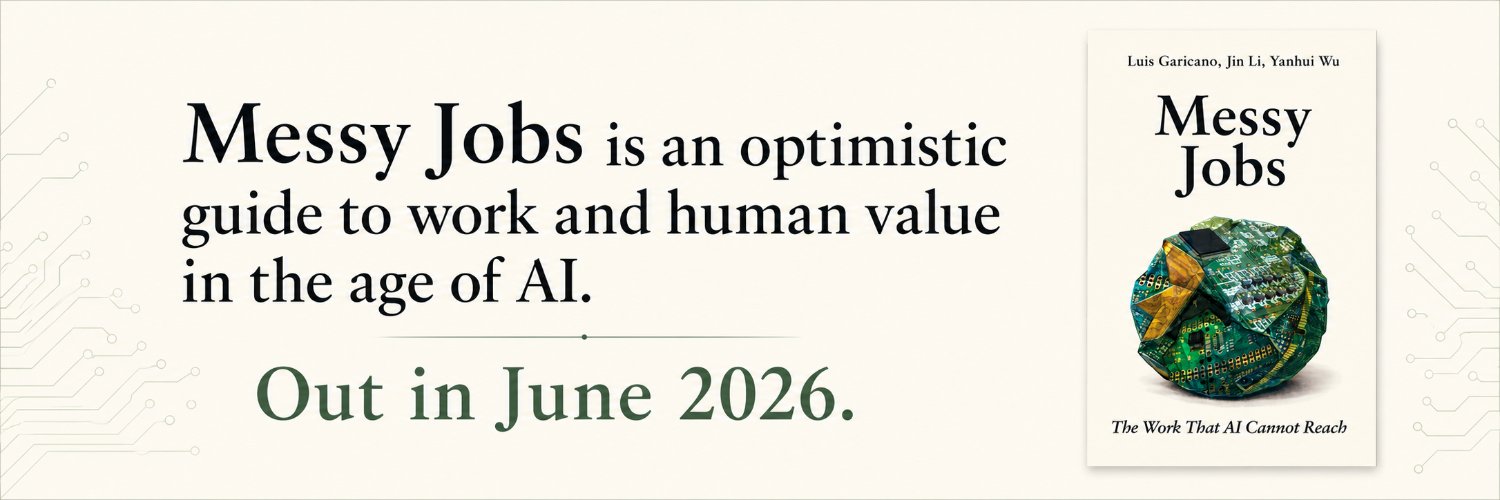
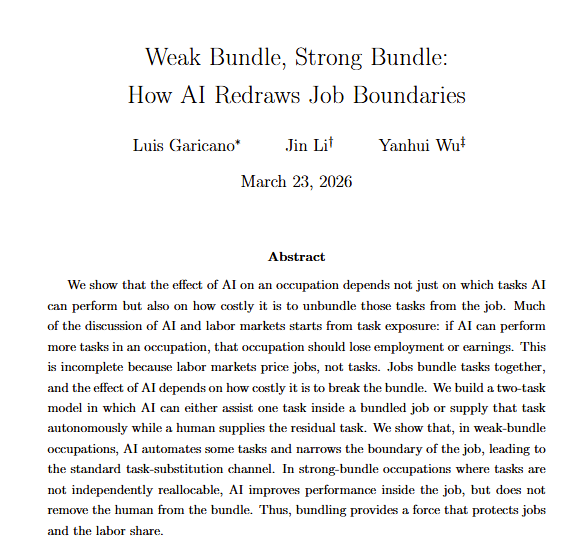
Hinton was right about the task, but he was wrong (so far!) on the future of the radiology profession. Times have never been better for them. The gap between those two claims, the difference between tasks and jobs, is the subject of a paper I have written with Jin Li and Yanhui Wu, and that we release today: "Weak Bundle, Strong Bundle: How AI Redraws Job Boundaries." (Very relatedly we are also finishing the first draft of our book "Messy Jobs" on AI and Jobs!! You will be the first to hear).
We start from the observation that the growing literature on AI and labor markets measures the AI shock by task exposure: people count how many tasks AI can perform in a given occupation AI can perform, and infer that more exposure means more displacement. Eloundou et al. published a paper in Science in 2024 that started this literature, and many follow the same logic. The inference they make is that the more exposed tasks, the worse the outcomes.
This is incomplete, because labor markets price jobs, not tasks. A radiologist does not just sell image classification, but does many other jobs: triages cases, communicates with other physicians, trains residents, makes the difficult decisions, and signs a diagnosis. The market buys a bundled service. The question AI poses is not whether it can do one task inside the bundle. The question is whether that task can be pulled out.
Thread (1/3)
https://t.co/wEYMfjGbeX
Great news from the UK's new government: @KanishkaNarayan promoted to Minister of State for AI. Apart from an impressive background (Stanford MBA, startup investing and advising) he has pushed AI infrastructure and research investment, as well as open evaluation tools that OpenAI, Google and Anthropic use to test their models. https://t.co/PLcSeVWxpV
Este es, quizás, el vídeo más descarado de la Final de la Copa del Mundo. Todos vimos cómo Enzo Fernández casi mata a Pau Cubarsí, pero si te fijas, más abajo, un jugador de Argentina, Nicolás Tagliafico, ve la tremenda patada de su compañero y, sabiendo que la ha cagado, se le ocurre tirarse al suelo y fingir una lesión. Enzo recibe la tarjeta roja, pero Messi se acerca al árbitro señalando a su compañero argentino caído (a Tagliafico) diciendo que está lesionado. Afortunadamente no coló. Son delincuentes, no jugadores de fútbol.
Having been involved in budgetary negotiations in Spain, I agree completely: investment is the residual once pensions and healthcare are funded. That is where the political pressure is, and the rest is leftovers. Policy in the West comes down to demographics.
This fantastic figure by @jburnmurdoch is Exhibit 1 of what an aging society means for the political game: public investment, which is choosing future rewards over present consumption, gets squeezed out.
Still not convinced this is a first-order challenge?
@CachoBellot La gente con talento, en España, está exprimida, sí, y se va. En particular, la ciencia es muy igualitaria, está muy mal pagada, y el que destaca, casi siempre, se tiene que ir. En vez de atracción de talento, se trata de expulsarlo.
Feliz de que España sea campeona del mundo desde anoche. También campeona de Europa, campeona del mundo femenina y sub-19 de Europa en las dos categorías. La razón: buenos incentivos y buena selección del talento.
Para el fútbol (y el tenis) aceptamos competencia dura, desigualdad salarial, cultura del esfuerzo de hijos y padres desde la infancia, mercados de trabajo muy flexibles y dinámicos y hasta creamos una ley fiscal para atraer talento: la ley Beckham. Para la escuela, la ciencia y la empresa exigimos lo contrario. El último Nobel de ciencia por trabajo hecho en España es de 1906. ¿Por qué no aplicamos la receta del fútbol a todo lo demás?
A form of "broken windows" theory. And it could be tested on the football data: calling for an entrepreneurial economist to use LLMs to test whether early uncarded fouls raise the foul rate for the rest of the match and future matches.
I do not have a very strong opinion on this, but this is a very interesting take. What intrigues me is the parallel to how small vile acts by politicians and leaders that go unpunished then start changing norms and institutions, and get amplified. Think of the US today.
Great point. Applies to the rest of Europe imo. Europeans relish competition in soccer. They embrace the ruthless selection of talent and they understand the importance of incentives. Off the soccer pitch, they forget about incentives, and they protect incumbents.
In sports, Spaniards (and everyone else) people instinctively understand and support the market, even if it delivers high inequality. They understand this is how talent gets identified and selected and how effort is motivated from early on. I find it illuminating to think of why the sport exception- my guess: people like markets when they trust the outcome is actually merit-based.
Feliz de que España sea campeona del mundo desde anoche. También campeona de Europa, campeona del mundo femenina y sub-19 de Europa en las dos categorías. La razón: buenos incentivos y buena selección del talento.
Para el fútbol (y el tenis) aceptamos competencia dura, desigualdad salarial, cultura del esfuerzo de hijos y padres desde la infancia, mercados de trabajo muy flexibles y dinámicos y hasta creamos una ley fiscal para atraer talento: la ley Beckham. Para la escuela, la ciencia y la empresa exigimos lo contrario. El último Nobel de ciencia por trabajo hecho en España es de 1906. ¿Por qué no aplicamos la receta del fútbol a todo lo demás?
Value creation and value capture are different things. Airlines transformed the world and never made money; the surplus went to passengers. Days after launching its best model, Anthropic includes it in existing plans. That is what competition does: the surplus goes to users, not to the labs. Profits will not justify these valuations.
Beginning July 20, Claude Fable 5 will be included in all Max and Team Premium plans, at 50% of limits.
Pro and Team Standard users will continue to have access to Fable via usage credits, and will receive a one-time $100 credit.
Demand for Fable has been challenging to predict, which is why we rolled it out to subscription plans in stages, extending access several times as we secured additional capacity.
Trial lawyers lobbying against safe cars. A textbook case for the hundreds of tech/econ people asking for more AI regulation: you are imagining the rules you would write. But this is the way the sausage gets made, and these are the rules that actually get written,
Trial lawyers are lobbying against self-driving cars because they're too safe. They need people to be killed and injured so that they have material for lawsuits.
Andrés Velasco became the founding dean of @LSEPublicPolicy in 2018. He was then only Full professor. He leaves the job this month with nine tenured faculty, five profs of practice and three teaching track faculty, over 450 students from 58 countries and five degree programmes, including double degrees with Sciences Po, Columbia and Toronto. Institution-building is one of the hardest jobs in academia, Andrés has succeeded in just 8 years. Happily, he remains on the faculty. Thank you, Andrés.
I like Dean Ball's writing and respect him, he's been a thoughtful voice, but I disagree with the logic in this piece really forcefully. Given that he's now one of the leading policy people at a trillion dollar frontier lab, I think these arguments warrant extra scrutiny.
"Open-weight models are inherently decelerationist"
This is simply not true. If OSS models are good and there is demand for them, this benefits the neoclouds at the expense of the labs' margins -- but margins aren't capex!! The GPUs still get bought to serve the tokens. My company is putting more inference through providers like @baseten and @FireworksAI_HQ and less through the labs lately, and we're using MORE tokens than before while delivering better value to our customers. How is this bearish for progress? Linux didn't decelerate computing -- it commoditized the OS layer and built the cloud, which is now the hyperscalers' most profitable business. Competition is good. If and when the labs deliver price-performant models, we will move more inference back to them.
"AI communism"
The implied chain (I think) is: open weights win -> model production isn't a viable business -> only states can fund frontier training -> state-provided AI -> communism. This strikes me as so fanciful it’s barely worth refuting, but: open ecosystems have historically been funded by commercial complements, not states: Linux by IBM and Google, Android, Chromium, Llama by Meta's ad business. Roads, GPS, and TCP/IP are public infrastructure and nobody calls them a dystopian hellscape. The chain only holds if you assume near-term AGI makes human intelligence irrelevant, a premise doing a lot of unstated work here. If you view AI as anything like normal technology, having it cheaper and more competition around producing it is strictly good for innovation and progress and the consumer and the economy. It's really that simple.
regulatory FUD
Dean frames this as a prediction, but he also calls it the administration's "best strategy" and sketches the playbook in some detail, including the observation that "it needn't be that well justified." Regulation by vague threat is how things work in banking and fintech, and it's precisely why those spaces are barren wastelands for innovation. Importing that model into AI and software generally would be disastrous.
The one who put it most memorably was Warren Buffet. He said the following in many ways
"If a capitalist had been present at Kitty Hawk back in the early 1900s, he should have shot Orville Wright. He would have saved his progeny money. But seriously, the airline business has been extraordinary. It has eaten up capital over the past century like almost no other business because people seem to keep coming back to it and putting fresh money in. You’ve got huge fixed costs, you’ve got strong labor unions and you’ve got commodity pricing. That is not a great recipe for success. I have an 800 (free call) number now that I call if I get the urge to buy an airline stock. I call at two in the morning and I say: ‘My name is Warren and I’m an aeroholic.’ And then they talk me down.”
https://t.co/8tYDvNUblH
Anthropic is panicking over the release of Kimi K3. In fact, the entire U.S. AI frontier lab ecosystem is panicking right now.
When investors figure out that U.S. frontier labs have no viable long-term revenue model from paying retail customers (because China's models are both better and cheaper), the AI investment bubble will crash.
As Jesús Saa-Requejo and me have been arguing in our Smart Second mover series (see e.g. https://t.co/dwX2FRwsuk), it looks increasingly likely (see e.g. Kimi, below, and Thinking Machines Inkling) that the LLM layer remains competitive. If this is the case, the profits will be captured by the infrastructure and the implementors. Europe can profit enormously from this technology by being a smart second mover and helping keep the market competitive.
The Kimi k3 benchmarks are absolutely insane.
DeepSWE is just behind Fable 5, and the Terminal benchmark is ahead of Opus 4.8. Open source is no longer lagging six months behind Western closed-source models.
Read that again, and think about what it all means. I’ll write a detailed post about it later, but just let that sink in.
We got open source 5.6/Fable 5 model from china. Today everything changed.
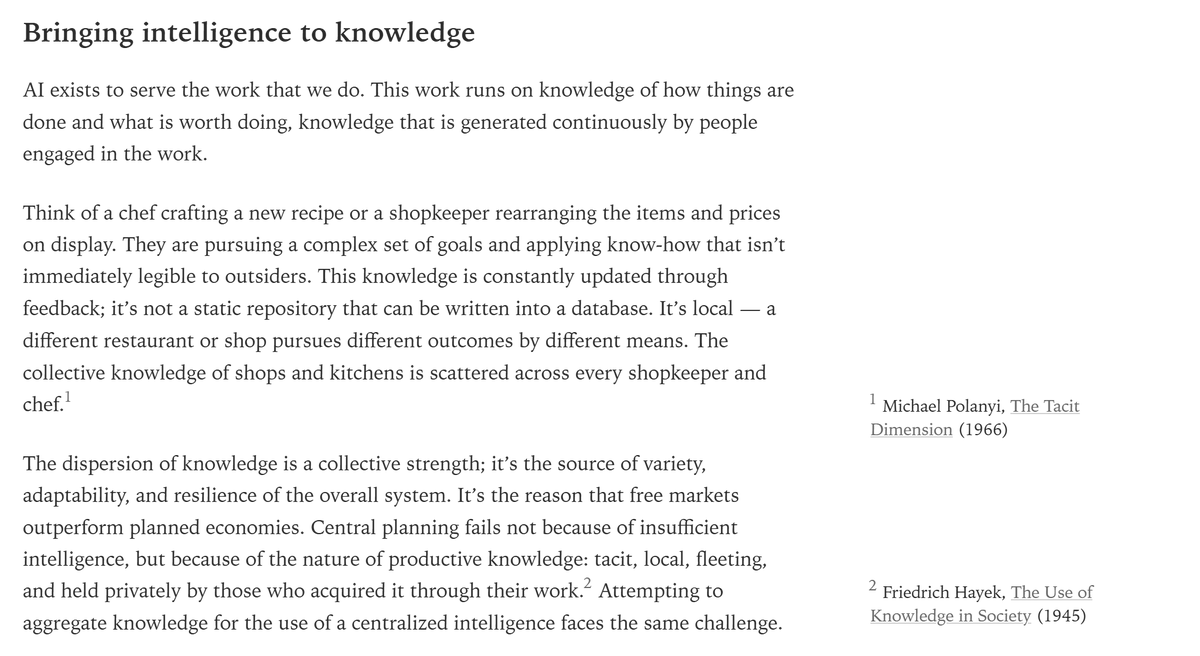
After years of dumb posts with bad economics and 0 knowledge about the world of work (what they call "computer use") from AI lab bosses, the Thinking Machines manifesto is refreshing in its acknowledgements of what the collective work of humans in markets is about: the use of decentralized knowledge. Beautiful project. A lab with a vision to root for.
https://t.co/Et3dRNVj7n