Love animals, especially Dogs! Beagle Dad! Love movies, sucker for Sci-Fi! Video Game Freak!! Musicphile, Hard Rock and Grunge are Favs!! 'Love the All of You'
Join us IN ONE HOUR at 6pm EST for Rise of a Full Circle, our preshow to Michael Shanks and David Reads podcast, A Full Circle. Before they regale you with the behind the scenes stories, join us with brand new Stargate viewers for a live watch through of the episode.
https://t.co/YwzA3Rerut
The red dot right in the center of the frame is not just a speck of dust on the sensor. It’s one of the most distant galaxies we have ever seen.
Its light has been traveling to us for 13.3 billion years. We are seeing it as it was only 420 million years after the Big Bang — at a time when the universe was less than 3% of its current age. The first stars were just beginning to ignite, galaxies were only starting to assemble from gas, and space was still filled with a fog of neutral hydrogen.
This tiny red point sits almost at the very edge of what we can detect. Its red color comes from extreme redshift: the ultraviolet light of young stars has been stretched into the infrared and shifted into the red part of the spectrum. What looks like a barely visible dot is actually an entire early galaxy that existed when the first structures in the cosmos were only beginning to form.
Every object like this is a window into the era of cosmic dawn. It is precisely these “red dots” that force astronomers to rethink how quickly and efficiently the first galaxies appeared in the universe.
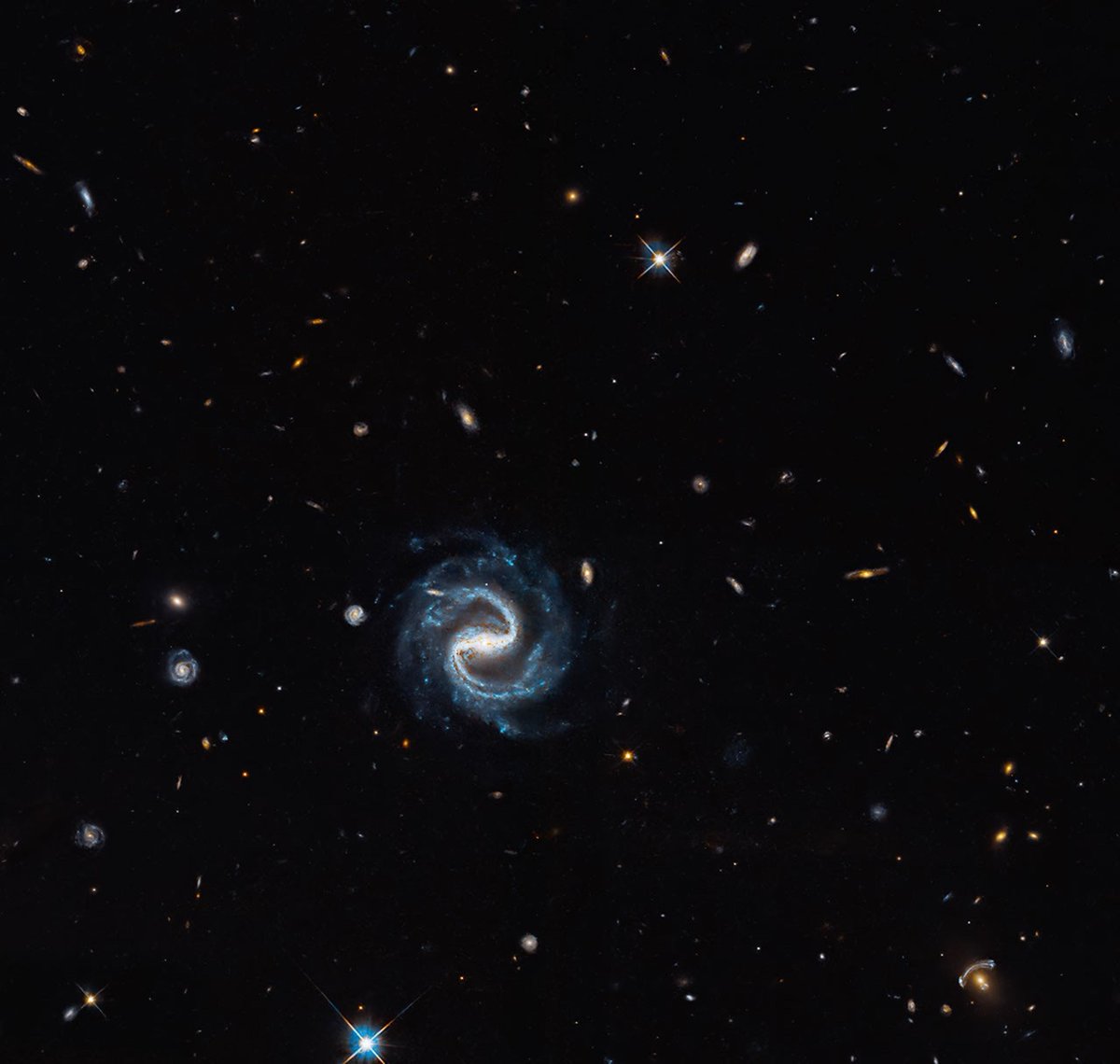
A gorgeous galaxy marks the spot in this image, but the real treasure is the gravitational lens in the lower-right corner, where a distant background galaxy is being magnified and distorted by the gravity of a closer galaxy: https://t.co/Y5Y3v8pxl4
The private space telescope Lazuli has selected 27 targets for its coronagraph 🔭
Lazuli is the first private orbital telescope equipped with three instruments: a wide-field optical camera, an integral field spectrograph, and an ESC (Exoplanet Spectroscopic Coronagraph). Its mission is to directly image exoplanets via reflected light, enabling the study of their atmospheres in more mature planetary systems and at closer proximity to their host stars than is possible through thermal-infrared observations.
In a recent study, astronomers presented a list of 27 targets for the ESC—all of which are gas giants. This selection includes planets that are cooler and more mature than those previously imaged. Furthermore, some of these targets will also be observable by the Roman Space Telescope (using its Coronagraph Instrument, CGI) and the ELT-METIS instrument, creating a synergy that will allow for comprehensive atmospheric characterization.
There are, however, certain constraints: the mission requires a contrast ratio on the order of $10^{-7}$ to $10^{-9}$ and exposure times ranging from tens to hundreds of hours. Consequently, the selected planets are those with well-known orbits, which allows for precise observation planning and increases the probability of detection. If realized, this project will open a new avenue in the search for potential biosignatures.
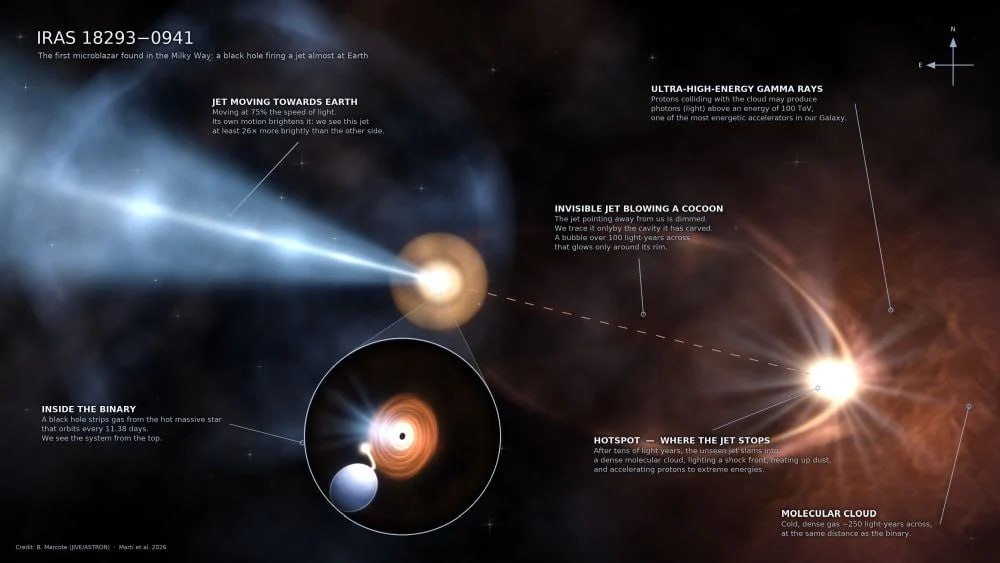
A Blazar in Miniature — Right Here in Our Galaxy
When a supermassive black hole at the center of a distant galaxy is actively "feeding," gas and dust swirl around it, forming a scorching accretion disk. However, it does not consume everything; some of the material is ejected in two opposing jets along the axis of rotation. If one of these jets points directly toward Earth, the object is known as a blazar. Astrophysicists had long hypothesized that a scaled-down version of this phenomenon—a "microblazar"—might exist within the Milky Way. Now, the first such object has been confirmed.
The object in question is IRAS 18293−0941. It was first detected in 1989 as a source of infrared radiation, but it proved difficult to study in detail because it lies within the galactic plane, where gas and dust obscure the view. A team of astronomers decided to investigate it thoroughly, employing the MeerKAT and VLA radio telescopes, as well as spectroscopic analysis and X-ray observatories.
It was revealed to be a binary system consisting of a black hole—with a mass approximately 10 times that of the Sun—and a massive blue star (a giant or supergiant). Both were once massive stars, but one eventually exploded as a supernova, leaving behind a black hole. Located in the constellation Scutum, the system lies about 11,700 light-years away. The most compelling evidence came from the jets: they are stable and long-lasting, rather than characterized by brief, sporadic bursts.
According to the researchers' estimates, the jets possess enough power to accelerate particles to energies in the teraelectronvolt (TeV) range, and potentially even the petaelectronvolt (PeV) range. Detectors have been recording particles with such high energies for years, but their origin had remained a mystery. The second jet, moving away from us, slams into a molecular cloud—a stellar nursery—and creates a "hot spot" there; the glow of this spot is produced by high-speed particles interacting with magnetic fields. The hot spot and the system itself are separated by tens of parsecs, effectively forming a natural laboratory for studying particle acceleration—a phenomenon that scientists intend to investigate further.