@lforesti "tutto commisurato all'esperienza sul tema". L'età potrebbe non essere una buona normalizzazione quanto l'esperienza accumulata (= anni sul problema * esposizione).
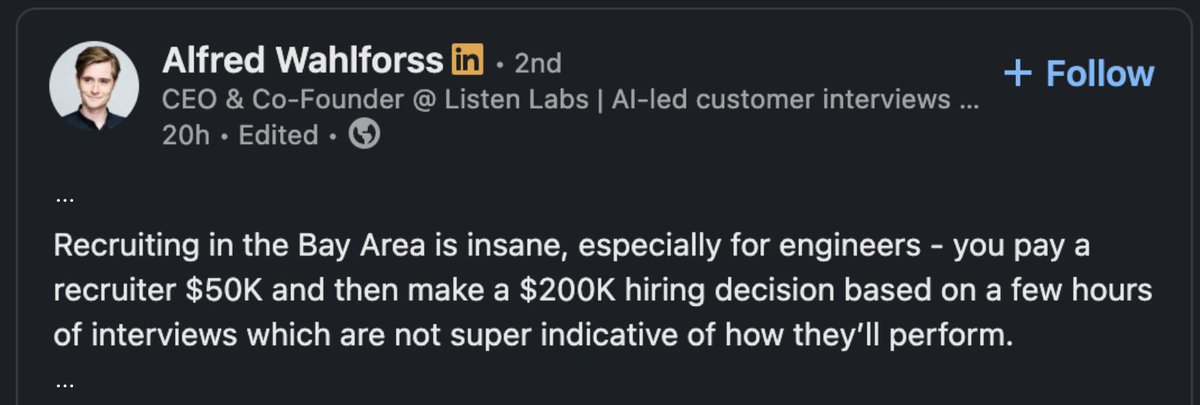
Business problem: 2-hour interview with domain experts isn’t enough.
Industry solution: Let’s have candidates talk to an AI for two minutes instead!
The problem is real and huge.
First-principle approach needed in a long sales cycle industry -> Contrarian VCs will take the bet
If you want to do that - if you want to be curious instead of clever - then I'm in.
I'm fascinated.
We can talk metrics, KPIs, business.
We can build something real.
But I don't think you want that, do you, sport?
You're terrified of what you might learn.
Your move, chief.
Founder:
I thought about what you said to me the other day.
About my product
Stayed up half the night thinking about it.
Then something occurred to me.
And I fell into the deepest, easiest sleep I've had in months.
Haven't thought about you since.
You know what occurred to me?
Because here's the truth:
I can't learn anything from you that I can't read in some book or some Medium post or LinkedIn carousel…
unless you actually want to talk.
To ask real questions.
To understand the market, the users, the opportunity.
To help build, not just critique.
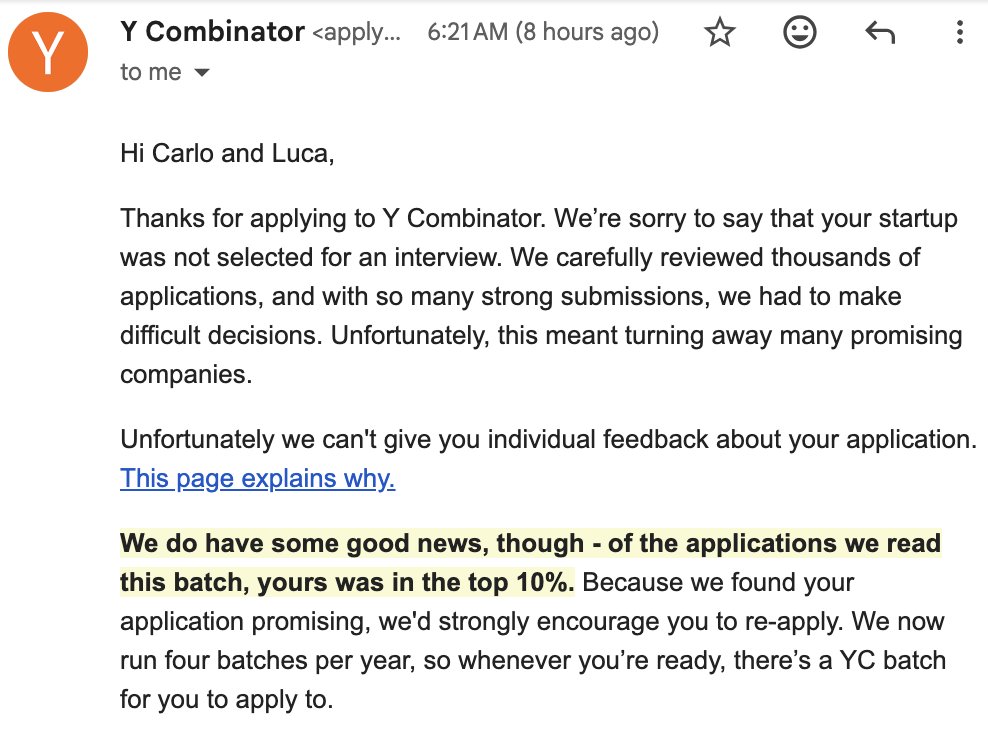
I've read 8,000 Y Combinator applications.
You would think the reviewers are thinking through a standard set of questions.
Is it a good idea?
Is it a large market?
Is it an experienced team?
Do they have traction?
During my time as a reviewer, we went back and tested which questions actually predicted success. The process was look at the best performing companies and then ask whether the application question would disqualify any of the biggest outcomes. If so, eliminate that question.
Is it a good idea? Well, Airbnb was a bad idea. Air bed and breakfast. Nobody thought it would work.
Is it a large market? Airbnb, Coinbase, Microsoft, Apple, Nvidia all started in tiny markets.
Experienced team? John and Patrick Collison had no experience in fintech when they built Stripe. Brian Chesky had never built a company. Brian Armstrong was just a product manager.
Do they have traction? We learned to invest in slope, not Y intercept. The initial traction doesn't tell you anything about the angle of ascent.
Sooooooooooooo...none of these standard questions worked.
The best question that predicted success was determination. Who is the most determined?
Even if they're not the smartest. Even if the market hasn't developed yet. Even if their initial product is wrong.
It outpeformed by a mile. And didn't disqualify the winners. AND was evaluatable.
It was so predictive that YC took that one question and found five different ways to ask it.
"Clay just crossed $100M in ARR.
This was a true 8-year overnight success story: it took us 6+ years to hit our first $1M, and ~2 years to grow from $1M → $100M." [Varun Anand]
Keep building, test what works, learn fast: that's how you end up creating something great.