Phone thefts are 50% down in the West End.
We called for the Metropolitan police to get back to the basics and prosecute phone theft and those facilitating it.
Shockingly, it worked.
We are happy the Mayor has taken our advice.
Have you noticed a decrease in phone theft?
No matter what your theory about birth rate collapse is, there’s some data point that disproves it. Japan didn’t have the pill when fertility collapsed. There are highly patriarchal countries where fertility is collapsing. It’s collapsing in countries that are still poor. It’s collapsing in places with more generous social support for families. It’s almost like a psychic alien just decided to phase humans out.
This is wild. Many don’t realize yet that we are in the largest and fastest technological revolution ever
AI needs energy. I wonder what European leftists who closed nuclear power plants think about the future?
Wait, their salaries are paid by „the state“. Do they really care?
You have to be attractive to someone to get a score above 5.
Te explain this in a way you might get, women evolutionarily have high costs to sex therefore physical attraction is down regulated and reserved for only high return men. Otherwise risk>reward.
Tbh just empathy gap.
“this is why so few men get rated higher, MALES ARE JUST LESS ATTRACTIVE!”’
Bitch, if physical attractiveness isn't distributed normally along a bell curve, then your standards are too strict. If 80% of people are "below average," the problem isn't the population. It's you.
@venom1s Never met a girl in my life that liked Henry Cavill, Arnold Schwarzenegger or Tom cruise or but plenty for Timothée Chalamet, Pedro Pascal and Robert Patterson
Perhaps one of those instances where men do not get the female gaze
Could also be age, exclusively women under 25
If you ask humans to pick a random number, they don't produce a uniform distribution of numbers.
Like humans, AI disproportionately picks some numbers and avoids others.
How odd!
gene editing is the next big thing
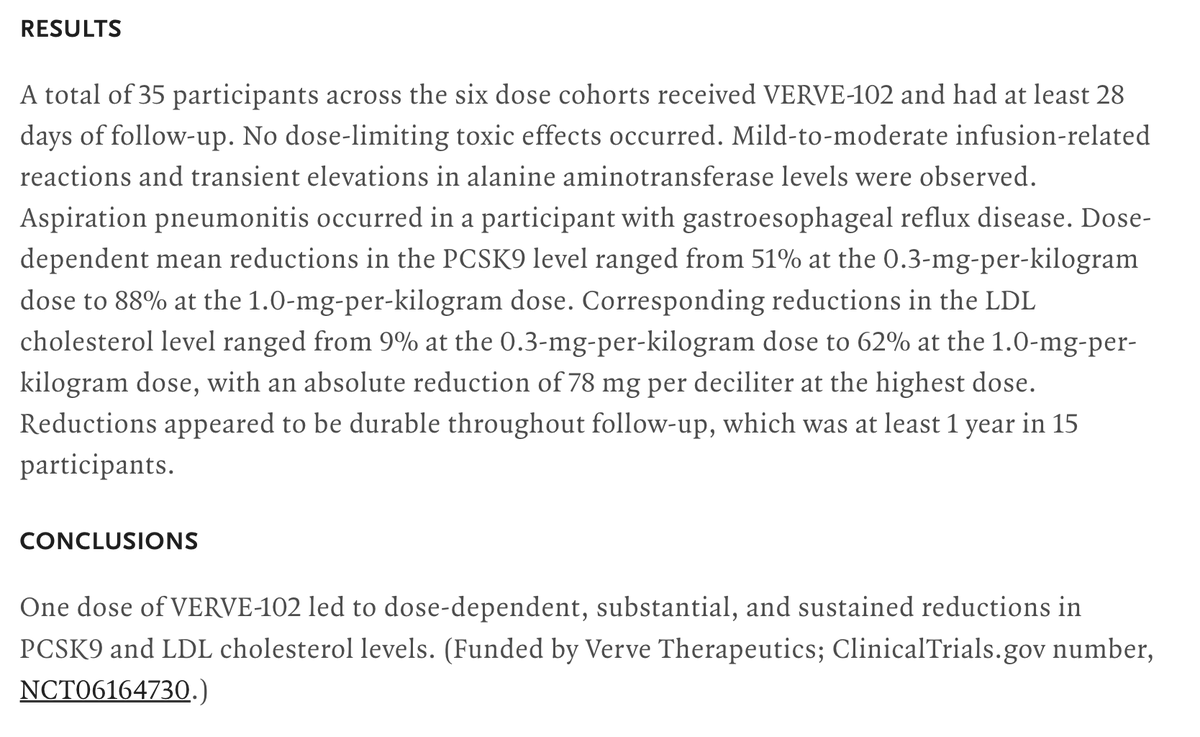
lily made a one-shot gene edit that reduced LDL cholesterol by 62% for an entire year
35 patients with genetic hypercholesterolemia. this condition kills 4.4M/year worldwide
watch my gene editing lesson with 150k+ views for free
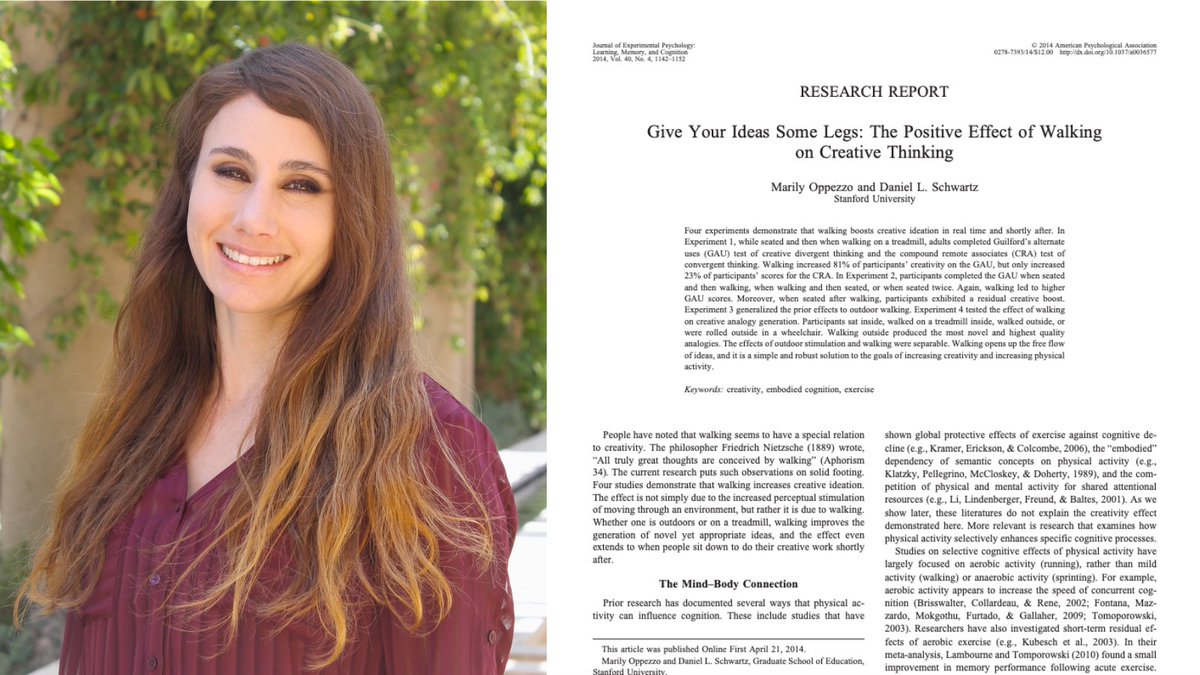
A Stanford psychologist spent 4 years proving that the simple act of walking generates 60% more creative ideas than sitting, and the experiment she designed to kill every alternative explanation is one of the most decisive findings in modern psychology.
Her name is Marily Oppezzo.
She got the idea for the study while walking with her advisor at Stanford to discuss her thesis topic, and the paper she eventually published in the Journal of Experimental Psychology in 2014 is sharp enough that it should have ended the seated meeting on the day it came out.
She ran 4 experiments on 176 people. Same person tested twice. Once sitting, once walking. The creativity tasks were the standard ones psychologists have used for decades to measure how good a brain is at generating novel useful ideas.
The result was almost too clean to publish.
81% of participants in the first experiment produced more creative ideas while walking than while sitting. In the second experiment, 88%. In the third, 100%. Every single person walked into a more creative version of themselves.
On average, people generated 60% more novel useful ideas the moment their legs started moving.
The skeptical question is the obvious one. Maybe it was the fresh air. Maybe it was the scenery passing by. Maybe it was the change of environment doing the work, not the walking itself.
Oppezzo killed every one of those explanations with one experimental decision.
She put people on a treadmill facing a blank wall. No scenery. No fresh air. No environmental change. Just legs moving in place while staring at white drywall. The 60% boost held.
Then she ran the experiment that closed the case completely. She took participants outside in two conditions. Half of them walked through a Stanford courtyard. The other half were pushed through the exact same courtyard in a wheelchair. Same outdoor stimulation. Same scenery passing at the same speed. The only difference was whether the legs were moving.
The walkers produced dramatically more novel high-quality ideas than the wheelchair group. The outdoors did almost nothing on its own. The walking did everything.
This is the part of the study that hit hardest when I read it the first time.
She also tested the opposite kind of thinking. Convergent thinking. The kind where there is one right answer and you have to narrow down to it.
Word puzzles where 3 words share a hidden fourth word that connects them. The seated participants did slightly better on these. Walkers got slightly worse.
Walking is not a general intelligence enhancer. It does one specific thing. It opens up the divergent search inside your brain. The part that generates options. The part that produces unexpected connections. The part that takes a problem and finds five ways into it instead of one.
When you need to converge on the single right answer, sit down. When you need to find the answer in the first place, get up.
The mechanism is now well understood. Walking selectively activates what neuroscientists call the default mode network, the system inside your brain that runs when you are not consciously focused on anything. The DMN is where mind-wandering happens. Where memories cross-reference each other. Where ideas that have been sitting in separate folders inside your head finally bump into each other.
When you sit at a desk and force yourself to concentrate, you suppress the DMN. When you walk at a natural pace, the executive part of your brain gets just busy enough handling the walking that the DMN comes online and starts doing the work that focus was blocking.
The most useful finding in the entire paper is the one almost nobody quotes.
The boost did not turn off the moment people stopped walking. Participants who walked first and then sat back down stayed elevated. Their next round of seated creativity work was still significantly better than people who had been sitting the whole time. The rest lingered for at least several minutes after the legs stopped moving.
You do not need to do creative work while walking. You need to walk before the creative work. The brain holds the state.
The history of this is the part that should haunt anyone who still does meetings in chairs.
Charles Darwin built a gravel loop behind his house in Kent called the Sandwalk and walked it 3 times a day for the rest of his life. The theory of evolution was developed one lap at a time on that path.
Nietzsche walked up to 10 hours a day during the years he wrote his most important books and openly said the work was conceived on his feet.
Beethoven composed for the morning and walked for 5 hours every afternoon with a pencil in his pocket for when something landed.
Kahneman said the best thinking of his Nobel Prize-winning career happened on leisurely walks with Amos Tversky. Steve Jobs refused to take important conversations sitting down. He held them on foot.
Every one of them was using the system Oppezzo would not measure until 2014. They just did not know what to call it.
The question worth sitting with is the one almost nobody asks.
Every meeting you have ever attended sitting around a table was a meeting held at a fraction of the brain power that was actually available to the people in the room. Every brainstorm that got stuck inside a conference room. Every problem you tried to solve at a desk and gave up on. Every idea you could not quite get to.
The intervention is the easiest one in modern science. No supplement. No app. No subscription. No training program. Just a pair of legs and 15 minutes.
The Stanford lab proved it. The philosophers knew it. The neuroscience explains it.
And almost everyone reading this is still trying to think their way out of problems sitting completely still.
One thing you see from this is just how slow economic growth was even within the classic 'industrial revolution' period in Britain (0.2% per capita 1750 - 1820). Even in the 19th century it's only 1.25%, roughly on a par with Britain in the 2010s.
If you earned £1,000,000 a day from when Napoleon was born, you would have less money than HS2's projected cost.
Stuff like this, alongside bat tunnels, is why.
It would be nice to see more pronatal policy from the administration, and this account has often urged exactly what you suggest: favoring the young over the old.
That said, culture matters more than policy here, and the conservative side has developed a pronatal culture - the second family is about to have a baby for the first time in a century!
The cultural piece is having a huge effect - among conservatives - as conservative fertility has remarkably increased in 40 years.
But in spite of the existential and civilizational crisis posed by collapsing birthrates, the left refuses to be culturally pronatal. Arguably, the left is actually driving fertility downward through a variety of positions that amount to antinatalism. Indeed, fertility among liberals has fallen through the floor.
UK tech is back.
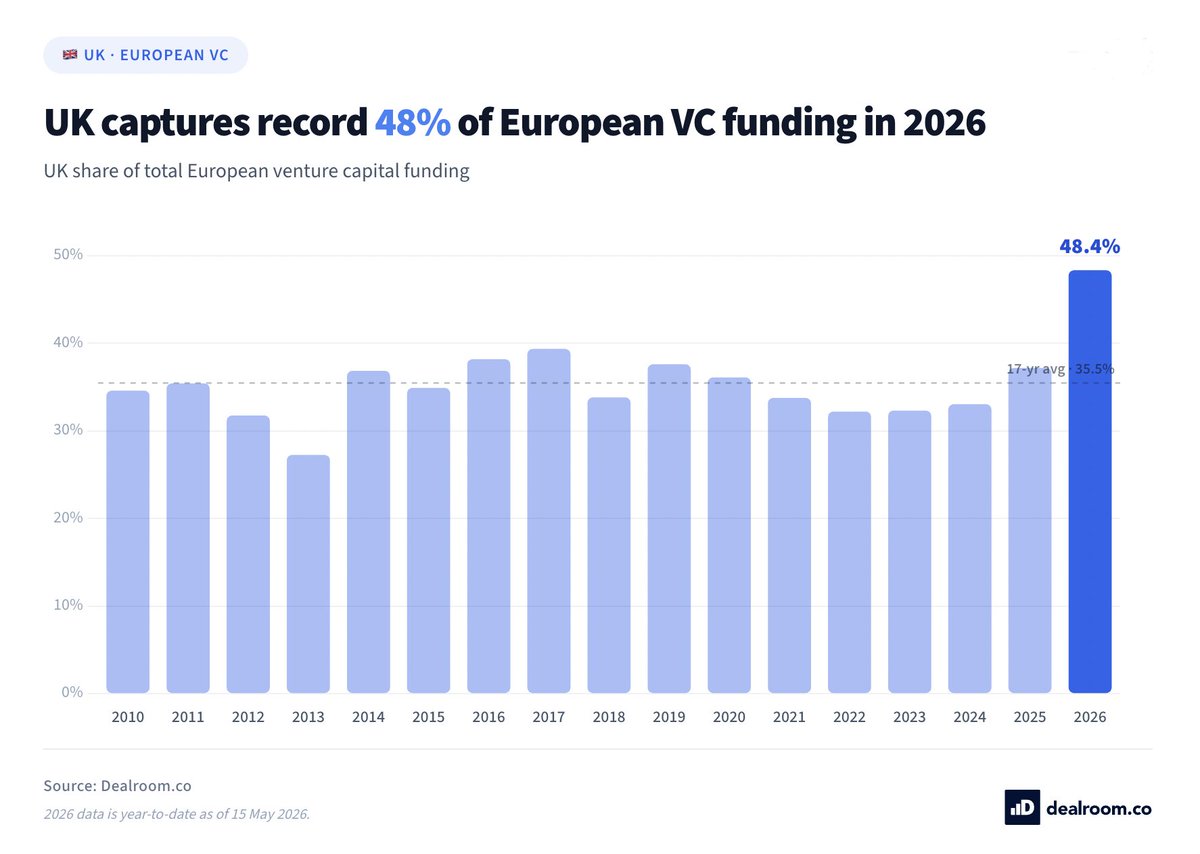
The UK's share of European venture capital is at an all-time high: 48% so far in 2026, compared to long-run average of 35.5%.
The driver is a run of mega-rounds, with AI doing the heavy lifting:
🧬 @IsomorphicLabs — $2.1B Series B
☁️ @nscale — $2B Series C
🚙 @wayve_ai — $1.2B Series D
💡 Ineffable Intelligence — $1.1B Seed
♻️ Recursive Superintelligence — $650M Seed
🎤 @ElevenLabs — $500M Series D
London is once again Europe's standout VC market.
📊: Dealroom