My friend applied to 150 tech jobs in two years. No MIT. No Stanford. No PhD.
Last month SpaceXAI offered him $750,000.
I asked him how he broke in from zero.
He sent me the exact video that got him in. A 1-hour course from SpaceXAI on "Full AI Engineering in 2026".
Lauren Tan aka Poteto (Ex-Cursor) shows you how to architect & build AI agents like Grok Bot from scratch.
I watched it last night.
Halfway through, I realized anyone could break into an AI lab in weeks, not years.
Bookmark this & read the article below.
this is free f*cking gold
Andrej Karpathy joined Anthropic to lead a team pointing Claude at Anthropic's own pretraining research
a model helping design the model that comes after it. that part is confirmed
the line going around - "two Anthropic seniors made his loop 1000x better with graph engineering" - nobody can source it, so I'm not selling it as fact
what is real and public: Anthropic's own Claude cookbook on knowledge graph construction
> extract - pull entities and claims out of raw text
> resolve - decide which mentions point to the same thing
> assemble - connect them with typed edges
> query - ask questions no single document could answer
four steps, free, sitting in the repo while the timeline quotes a rumor
learn them this weekend and you can build the thing the rumor was describing - that skill is what gets handed the AI architecture work this year
read the cookbook first. then decide if the article below earned the click
Google just released the best 1-hour course on Graph Engineering: from single agent to a full 24/7 system
00:00 - What Graphs are
09:16 - Build an agent
21:15 - Graph engineering explained
41:03 - Graph engineering practice
52:21 - Self improving Graphs
Free, the best thing on Graph engineering I've come across
Watch it, then build your first graph with the step-by-step guide below
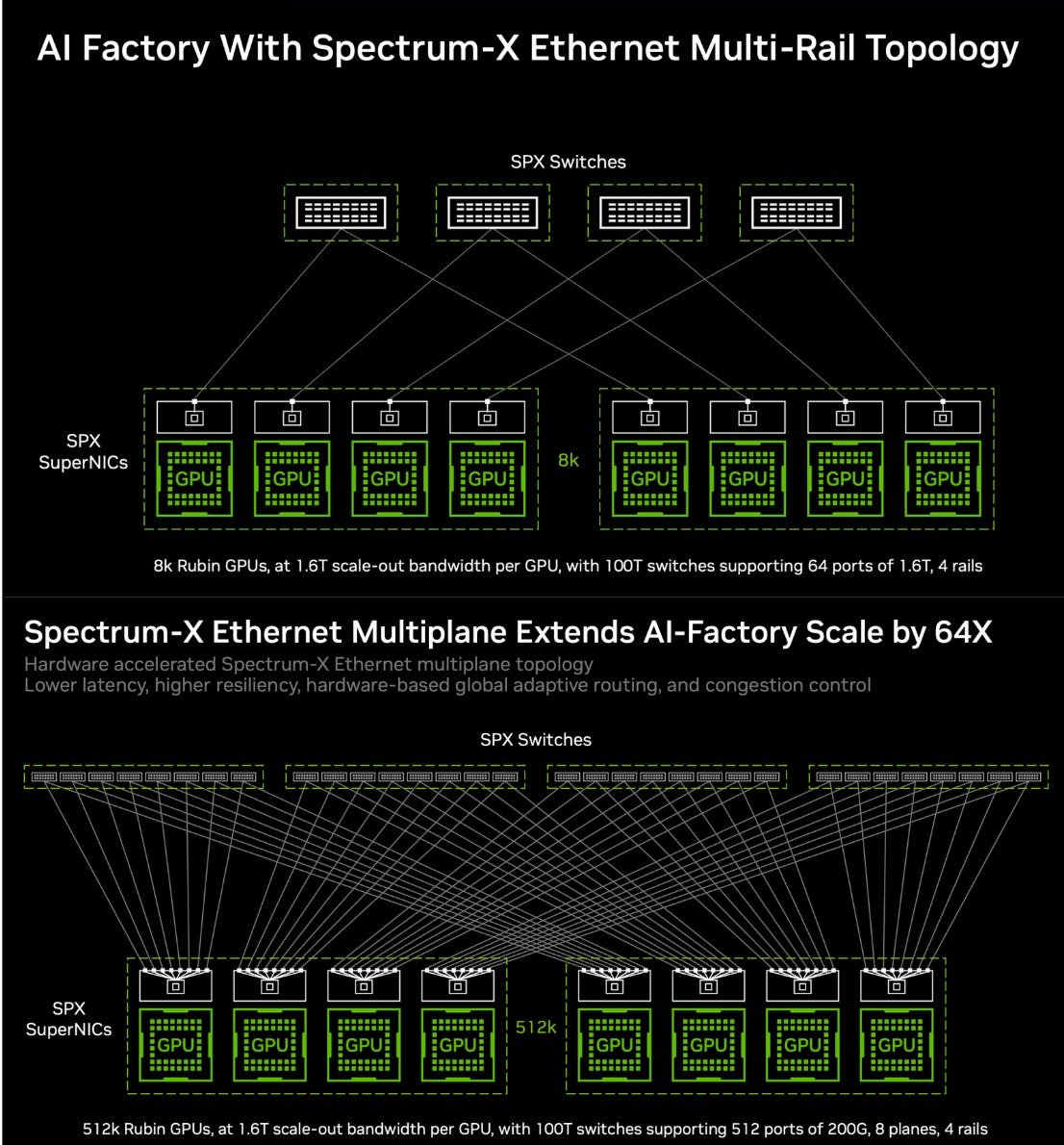
A question I get a lot: we know why you need co-packaged optics for scale-up, but scale-out is already optical, so why CPO there? NVIDIA answered it at Hot Chips, and the answer is power. Co-packaging gets rid of the DSP, the signal-processing chip whose entire job is cleaning up the signal after the long copper trace from the switch ASIC to the faceplate. Their numbers on TSMC's COUPE process, in production: 5x lower power, 4x fewer lasers, 10x better reliability. They also sized optics at about 10% of an AI factory's compute power.
The multiplane topology in the same talk cuts the other way for optics. Instead of giving each GPU 1 fat 1.6T port, you give it 8 thin 200G ports into 8 independent network planes. The GPU keeps the same bandwidth, but the fabric now reaches 512K GPUs, 64x more, because 2-tier network scale goes with the square of the port count. A single link failure costs a GPU 1/8th of its bandwidth instead of all of it. And you need 1.7x fewer switches.
So optics stays a volume story with a per-port content headwind, and the switch and NIC silicon wins either way.
Full Hot Chips 2026 report below.
My full Hot Chips 2026 report is out. 3 days at Stanford, 23 presentations, reorganized by theme instead of by day: memory, CPUs, GPU racks, networking, and the custom silicon from Google, OpenAI, Cerebras and SambaNova.
Memory is now something like 70% of the cost of an AI rack, and every presenter was designing around that number.
8,000+ words. Each talk gets what was argued, the technical content behind it, and the implications at the end of each theme.
SpaceXAI engineer, Lauren Tan:
"99% of people using GrokBot just for 1% of its real power. They run 1 agent without "loop" & "graph"
I'm running a team of 20+ GrokBot agents, fully autonomous. I have a Chief of Staff agent, a PM agent and 20+ workers - that's the new stack of engineer"
In a 1-hour session, a SpaceXAI engineer showed how to build a team of effective AI agents from scratch
this is worth more than a $500 agentic engineering course
watch this workshop today, then read how to build a fleet of GrokBot agents in the article below
CPU vs GPU vs TPU vs NPU vs LPU, explained visually:
(bookmark this)
5 hardware architectures power AI today.
Each one makes a fundamentally different tradeoff between flexibility, parallelism, and memory access.
> CPU
It is built for general-purpose computing. A few powerful cores handle complex logic, branching, and system-level tasks.
It has deep cache hierarchies and off-chip main memory (DRAM). It's great for operating systems, databases, and decision-heavy code, but not that great for repetitive math like matrix multiplications.
> GPU
Instead of a few powerful cores, GPUs spread work across thousands of smaller cores that all execute the same instruction on different data.
This is why GPUs dominate AI training. The parallelism maps directly to the kind of math neural networks need.
> TPU
They go one step further with specialization.
The core compute unit is a grid of multiply-accumulate (MAC) units where data flows through in a wave pattern.
Weights enter from one side, activations from the other, and partial results propagate without going back to memory each time.
The entire execution is compiler-controlled, not hardware-scheduled. Google designed TPUs specifically for neural network workloads.
> NPU
This is an edge-optimized variant.
The architecture is built around a Neural Compute Engine packed with MAC arrays and on-chip SRAM, but instead of high-bandwidth memory (HBM), NPUs use low-power system memory.
The design goal is to run inference at single-digit watt power budgets, like smartphones, wearables, and IoT devices.
Apple Neural Engine and Intel's NPU follow this pattern.
> LPU (Language Processing Unit)
This is the newest entrant, by Groq.
The architecture removes off-chip memory from the critical path entirely. All weight storage lives in on-chip SRAM.
Execution is fully deterministic and compiler-scheduled, which means zero cache misses and zero runtime scheduling overhead.
The tradeoff is that it provides limited memory per chip, which means you need hundreds of chips linked together to serve a single large model. But the latency advantage is real.
AI compute has evolved from general-purpose flexibility (CPU) to extreme specialization (LPU). Each step trades some level of generality for efficiency.
The visual below maps the internal architecture of all five side by side.
To dive deeper into GPU specifically, Akshay wrote a detailed article on it.
It builds up from first principles why memory and compute compete, why that gap exists in the hardware, and what makes a workload memory-bound in the first place.
Read it below.
Pershing Square $PS announced earnings this evening in advance of our call tomorrow at 9am ET and our Spaces on @X which will follow the call.
Please read our letter in advance of the call which explains the quarter and provides updates on the portfolio and six new positions in $NFLX, $V, $MA, $ICE, $ALC, and $SPGI
https://t.co/Bcb1FgjjgE
I'm a former Citadel quant who covered power & gas.
There's constant talk about chips & memory, but power is the central bottleneck for AI.
Very few people understand it, so I'm posting a canonical primer on power pricing & data centers: https://t.co/LO5ovj2imA
$HIMS $LLY $NVO
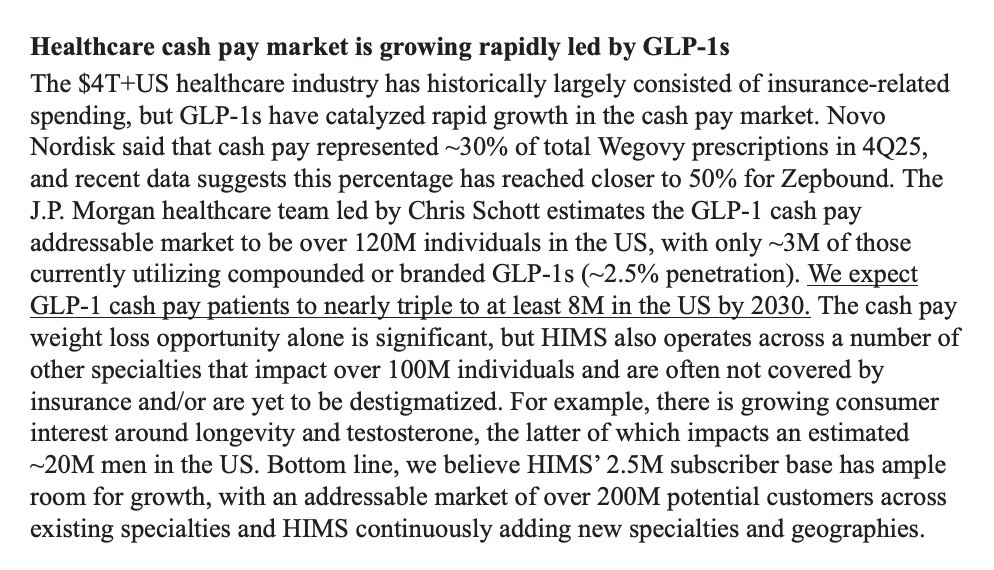
🚨 J.P. MORGAN ESTIMATES THE U.S. GLP-1 CASH PAY ADDRESSABLE MARKET IS >120 MILLION PEOPLE -- WITH ONLY 2.5% PENETRATION RIGHT NOW (~3M PEOPLE)
"The J.P. Morgan healthcare team led by Chris Schott estimates the GLP-1 cash pay addressable market to be over 120M individuals in the US, with only ~3M of those currently utilizing compounded or branded GLP-1s (~2.5% penetration). We expect GLP-1 cash pay patients to nearly triple to at least 8M in the US by 2030."
"HIMS also operates across a number of other specialties that impact over 100M individuals and are often not covered by insurance and/or are yet to be destigmatized. For example, there is growing consumer interest around longevity and testosterone, the latter of which impacts an estimated ~20M men in the US."
"Bottom line, we believe HIMS' 2.5M subscriber base has ample room for growth, with an addressable market of over 200M potential customers across existing specialties and HIMS continuously adding new specialties and geographies."
Source: J.P. Morgan's $HIMS initiation report (Apr 24, 2026)
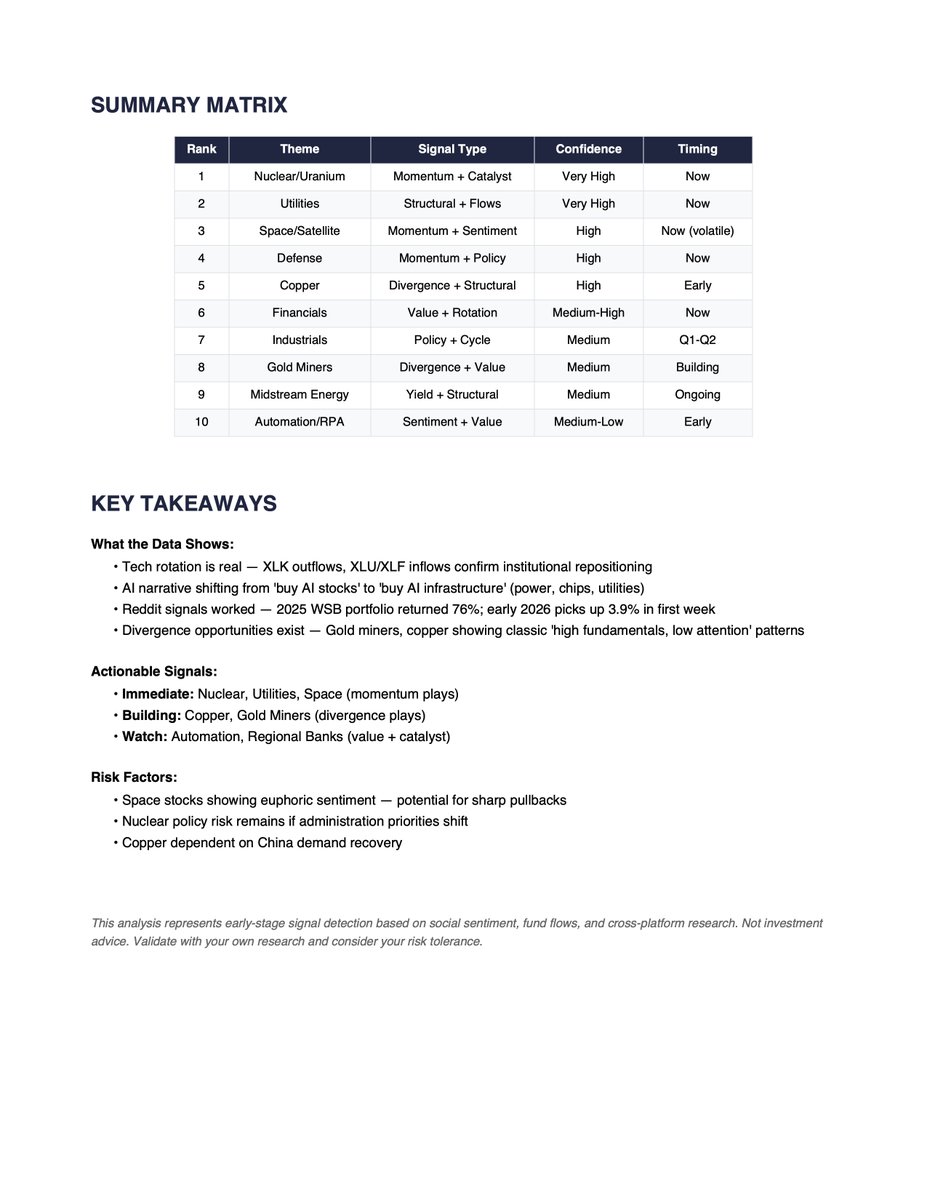
Claude, create a strategy that monitors subreddits to identify capital rotation signals derived from social media chatter before Wall Street and mainstream media fully embrace. Then run the strategy and show me the top ten themes, along with high potential tickers.