@ourcryptotalk When a CA like BTCX or fUSD leaves Zano across Bridgeless or ZEL, some details become visible on the other chain. How do you explain that tradeoff to a user who cares about privacy but also wants liquidity?
@ourcryptotalk ZEL public testnet was aimed at Q3, mainnet at Q4. What part of that stack are you most excited to show first once the public testnet is open?
@ourcryptotalk If I can only stake enough $TASTY for Tier 1, am I structurally late to every good launch? What's the path for a small holder besides farming points?
How Bad Is L1 Altcoin ATH Damage?
• $SUPRA: -99.7%
• $BERA: -98.9%
• $APT: -97.1%
• $QUBIC: -96.3%
• $KTA: -93.9%
• $INJ: -90.5%
• $SUI: -87%
• $MON: -56.2%
Are we cooked… Or can any of them still make a recovery?
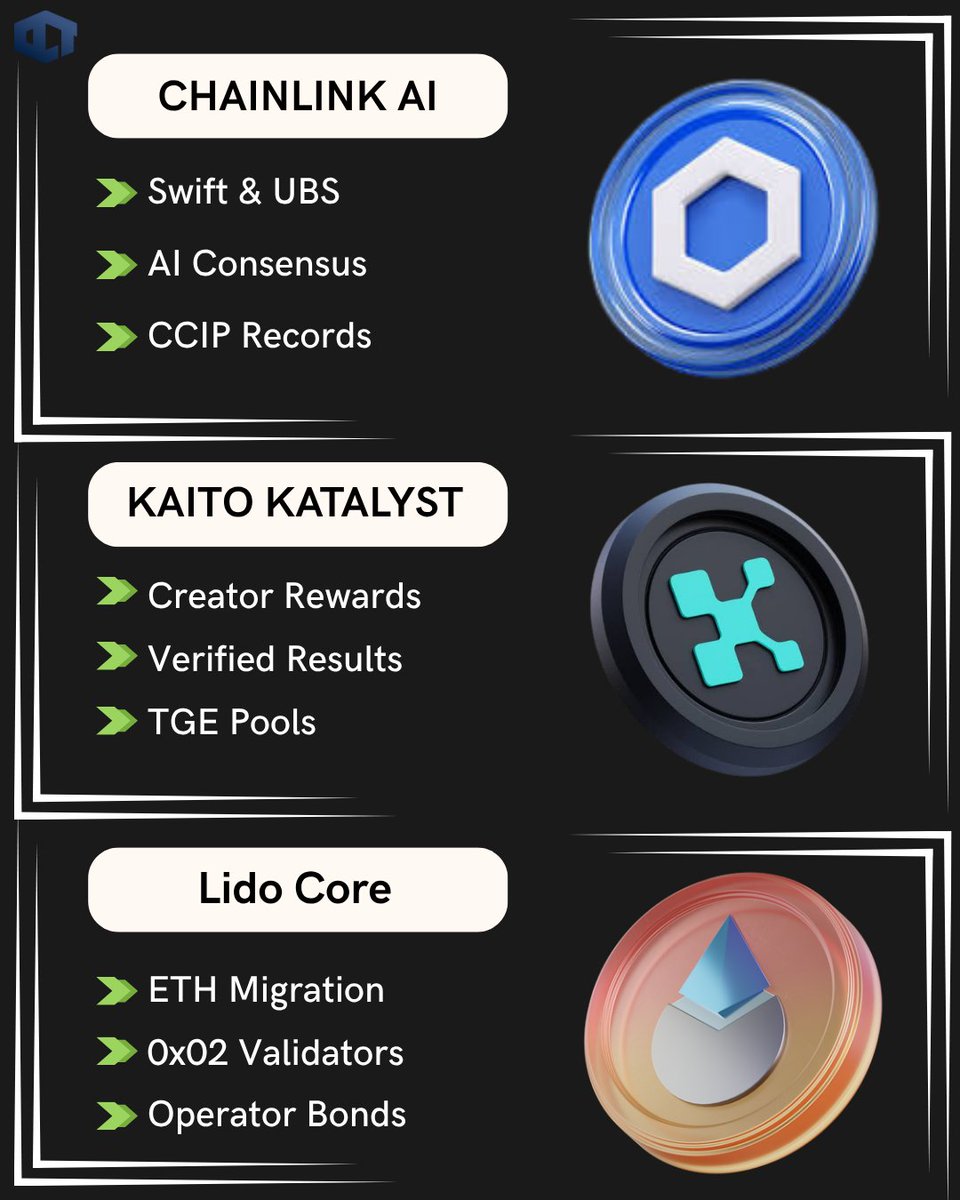
From Wall Street infrastructure upgrades to creator monetization and Ethereum staking changes, this week was all about long-term ecosystem building.
This time it's:
$LINK ( @chainlink )
$KAITO ( @KaitoAI )
$LDO ( @LidoFinance )
Here are 3 stories you shouldn't miss 👇
1️⃣ Chainlink Revives $58B Corporate Actions Push ( $LINK )
Chainlink highlighted how major financial institutions are using its infrastructure to modernize corporate actions processing with AI and CCIP.
🔹 Swift & UBS involved
🔹 24 institutions participating
🔹 AI consensus validation
🔹 Targets $58B industry problem
The initiative is still a showcase rather than a full production rollout, but it signals where tokenized finance is heading.
2️⃣ Kaito Launches Katalyst Creator Rewards ( $KAITO )
Kaito introduced Katalyst, rewarding creators for verified outcomes instead of simply posting content.
🔹 Pays for real results
🔹 Verified attribution
🔹 Transparent TGE pools
🔹 80/20 reward split
The goal is to move crypto creator incentives away from engagement farming and toward measurable impact.
3️⃣ Lido Begins $16B Ethereum Validator Upgrade ( $LDO )
Lido started migrating more than 8 million ETH to Ethereum's new 0x02 validator model following Pectra.
🔹 8M+ ETH migration
🔹 0x02 validators
🔹 Operator bonding
🔹 Leaner validator set
The upgrade could reduce Ethereum's validator count by roughly one-third while introducing stronger economic accountability for node operators.
Most AI training data is scraped, unprovable, and legally messy.
@datafdn is building the onchain rails for rights-cleared human data.
138M+ permanent receipts.
340K+ contributors.
230TB of data audited.
This is our next "Projects We Are Watching in 2026" entry. 🧵👇
@ourcryptotalk How does Crynux’s edge-focused, permissionless model (consumer GPUs + tokenized models/DeFi) compare to larger players like https://t.co/69upF54NPD, Render, or Akash?
@ourcryptotalk Question for team: Can you walk through the key upgrades in Lithium, including the vssML consensus protocol and model fine-tuning. As well as new features.
@ourcryptotalk For Propbase- How close are you to delivering the 7th asset offering and lending features, and what does this mean for making high-quality real estate accessible to retail and institutional investors?
@ourcryptotalk Question for Mike: What strategies will Geodnet use to maintain accurate corrections in areas with poor satellite coverage or during major solar events that disrupt GNSS signals?
@ourcryptotalk As Physical AI moves toward multiple robots working together in shared spaces, what new coordination and safety challenges will emerge, and how can decentralized infrastructure address them at the protocol level?
Why are people even defending $LAB?
It is clear that there is something very shady about this coin.
The market rewards information.
And insiders are the only ones who have information.
They can do whatever they want and manipulate the token.
Why would you risk your hard-earned money for some returns when the risk is huge?
$LAB is down ~40% in 24H.
Now ask yourself:
Was retail trading the same market as insiders?
99% holder concentration alone doesn't prove a scam.
But it is a major red flag and raises serious questions:
• 226M LAB moved to Bitget-linked deposit wallets between March-April
• ~100M LAB withdrawn in 12 hours to 10 fresh wallets during peak hype
• Retail locked in vesting while OTC buyers reportedly got 60-80% discounts
• Vesting terms allegedly changed after launch
• No clear public float despite billions in FDV
That's not the same as early $BTC.
BTC didn't have private discounted allocations, opaque OTC deals, or supply redistribution around exchange pumps.
In @zachxbt's latest investigation:
Insider-linked entities allegedly offered loans at 7.5% monthly interest, repayable in LAB.
Co-founders reportedly pitched OTC deals with steep discounts and special terms.
The same wallet patterns and exchange behavior resemble projects previously flagged by Zach.
For anyone wanting the full timeline and wallet breakdown:
https://t.co/aYmVOx5ZNI
High concentration ≠ scam.
High concentration + hidden deals + supply movements + unclear float + silence?
Retail should pay attention.
Early insiders made multiples.
Late buyers chased a multi-billion valuation without knowing who controlled the supply.
Same token. Different access.
The market rewards information first, conviction second.
Read the wallets before reading the narratives.
$ION wanted to put the entire Internet on-chain.
40M+ users claimed.
Full Web3 ecosystem.
Mass adoption narrative.
$18M spent later, the CEO is considering shutting it down.
What went wrong? 🧵👇
Covenant AI just walked away from $TAO.
Took 3 major subnets with them:
• Templar
• Basilica
• Grail
$TAO dropped hard.
But the real question is:
what happens to these projects now? 🧵👇
The Neobank Landscape: Who’s Actually Serving Which Crypto Users?
Every crypto neobank claims to be:
“the seamless fiat-crypto bridge,”
“the yield-maximizing everyday bank,”
→ $MNT
→ $ETHFI
→ $TEL
→ $XPL
→ $AVICI
→ $TITN
→ $EMONEY
Here’s how the real picture looks 👇
🔵Mantle: The Full-Stack Banking Blockchain
Focus / Use Case: On-chain banking for TradFi-DeFi migration, with everyday spending via debit cards and multi-currency accounts.
Architecture:
• Ethereum Layer 2 with EVM compatibility
• Modular design powering tokenized settlements
• Integrated neobank app (UR) for fiat-crypto conversions
• Swiss-backed multi-currency accounts + Mastercard debit card
Network / Liquidity:
• Powered by $MNT for gas and staking
• Supports USD, EUR, CHF, RMB and more (1:1 backed deposits)
• Deep integrations with DeFi protocols for liquidity and yield
• Global Mastercard access with Apple Pay/Google Pay
My take:
Mantle is turning Layer 2 tech into a proper banking hub. UR feels like a real neobank spend crypto via Apple Pay without selling it first.
No more clunky bridges; it’s built for users who want crypto in their daily wallet but with TradFi polish.
If you’re bridging fiat to on-chain, this is the entry point that doesn’t feel experimental.
🟢https://t.co/9UK63jcf5y: The Liquid Staking Neobank
Focus / Use Case: Non-custodial staking with integrated spending, yields, and a crypto card for everyday use.
Architecture:
• Built on Ethereum with restaking via EigenLayer
• Automated DeFi vaults for yield optimization
• https://t.co/9UK63jcf5y Cash for fiat-crypto accounts and Visa credit card
• Open-source, decentralized node operators
Network / Liquidity:
• Multi-billion TVL in staking and vaults
• 400+ DeFi integrations across chains
• Supports ETH, BTC, stables with auto-compounding
• Non-custodial credit card spending while assets keep earning
My take:
https://t.co/9UK63jcf5y started as restaking but nailed the neobank pivot with Cash earn yields while spending via card. It’s like having a bank account that passively grows your balance.
The decentralization shines: no custody risks, just seamless yields meeting real-world spending.
Perfect for stakers who want their crypto working 24/7 without locking it away.
🟠Telcoin: The Telecom-Backed Digital Bank
Focus / Use Case: Regulated stablecoin banking for remittances, deposits, and global transfers.
Architecture:
• Digital Asset Depository Institution (Nebraska charter)
• eUSD stablecoin issuance with 1:1 backing
• Integrates telecom networks for mobile access
• Blockchain-agnostic (Ethereum, Polygon live)
Network / Liquidity:
• Backed by U.S. Treasuries and reserves
• Targets retail markets with low-fee remittances
• $25M funding for bank capitalization
• Cross-chain deployments for broader reach
My take:
Telcoin is the regulated powerhouse first U.S. digital asset bank with a charter.
eUSD feels like a true bridge to mainstream finance, blending crypto speed with banking oversight.
It’s not just hype; it’s built for underserved markets like remittances, where telecom ties make it accessible.
If compliance is your jam, this is the neobank that won’t get rugged by regulators.
⚫Plasma: The Stablecoin-Native Super App
Focus / Use Case: Permissionless dollar access with spending, earning, and global coverage via cards.
Architecture:
• Purpose-built L1 for USDT payments
• High TPS (1000+) with EVM compatibility
• Plasma One app for neobanking features
• Instant transfers and yield vaults
Network / Liquidity:
• USDT-native with ecosystem yields (up to 10%+ on balances)
• 4% cashback on cards in 150+ countries
• Fee-free in-app USDT transfers
• Built for stablecoin focus at global scale
My take: Plasma One is the neobank for stablecoin maximalists spend while earning yields without touching fiat rails.
It’s simple yet powerful: hold USDT, get a card, earn passively.
No more choosing between custody and convenience; this abstracts it all. In a world of volatile crypto, Plasma makes stables feel like a full bank account.
🔵AVICI: The Self-Custodial Spending Layer
Focus / Use Case: Distributed banking with crypto debit/credit cards and smart wallets for everyday spending.
Architecture:
• Solana-based with self-custodial smart contracts
• Unified app for cards, wallets, and payments
• Direct off-ramps to Visa networks
Network / Liquidity:
• Native $AVICI token for ecosystem perks
• Multi-card support (virtual/physical/tap-to-pay)
• Integrates with Solana DeFi for liquidity
• Low fees via high-speed chain
My take:
AVICI nails self-custody without the hassle spend crypto like cash via Visa, all on-chain.
It’s like a neobank for Solana users who hate centralized exchanges.
The wallet-card combo is the real win: control your keys, shop anywhere. If privacy and speed matter more than yields, this is your daily driver.
🟡Thorwallet: The Cross-Chain DeFi Bank
Focus / Use Case: Multi-chain wallet with banking perks like cards, accounts, and swaps.
Architecture:
• Non-custodial multisig across chains
• Integrated Mastercard for spending
• Swiss-regulated multi-currency accounts
• Gamified features with $TITN utility
Network / Liquidity:
• Supports BTC, ETH, SOL, and more
• $1B+ swap volume with low fees
• USDC cashback and staking rewards
• IBANs for fiat integration
My take:
Thorwallet is the all-in-one for chain-agnostic users swap, stake, spend via card, all self-custodial.
$TITN ties it together with real perks like fee rebates. It’s not just a wallet; it’s a neobank bridging DeFi and TradFi without bridges.
Reliable for everyday crypto folk who want one app ruling them all.
🟤EMoney: The RWA-Compliant Modular Bank
Focus / Use Case: Tokenizing real-world assets with secure wallets and compliant transactions.
Architecture:
• Modular L1 with Cosmos SDK and EVM
• PoS consensus via Tendermint BFT
• Built-in KYC/AML for RWAs
• E Money Wallet for multi-chain ops
Network / Liquidity:
• Focus on RWA tokenization and interoperability
• MiCA-compliant for EU readiness
• Supports DeFi 2.0 integrations
• Bridges Web2 liquidity to on-chain
My take:
EMoney is for RWA neobanking tokenize assets, hold in a compliant wallet, transact seamlessly.
It’s less flashy but essential for institutions entering crypto. The modular setup means it’s future-proof for regulations.
If you’re in RWAs or need on-chain compliance, this is the quiet giant powering the next wave.
🔚Conclusion: The Neobank Split
🟦 Full-Stack Blockchains (TradFi Bridge)
Mantle, Telcoin
→ Built for users blending fiat and crypto with regulatory muscle.
🟪 Yield-First Apps (Earn While Spend)
https://t.co/9UK63jcf5y, Plasma
→ For passive earners who want neobanking with DeFi yields baked in.
🟧 Self-Custody Spenders
AVICI, Thorwallet
→ Non-custodial focus for everyday spending without compromises.
🟨 RWA Infrastructure
EMoney
→ The compliant foundation for tokenized assets in banking.