Announcing the $APEX Token Buyback Program
To reinforce our long-term commitment to the ApeX Protocol ecosystem and ensure our community directly benefits from the value created, we are excited to introduce the APEX Token Buyback Program. We will be kicking off this initiative with a one-time commitment of $12,000,000 using past revenue.
$STBL is setting up perfectly.
We’ve seen this pattern before — compression, breakout, and a strong leg up. The structure is now mirroring that move once again.
New ATH? Only a matter of time.
@stbl_official
STBL Treasury Update
In Q4 we’re rolling out Multi Factor Staking (MFS) and a buyback-and-burn program, accelerating ecosystem and minting activity, and shipping new product innovations with Web2 + Web3 integrations.
In parallel, we’re executing a disciplined treasury strategy and establishing a contingency fund to support these programs efficiently and sustainably.
Throughout Q4, as these initiatives go live, we’ll publish a public treasury overview detailing balances and capital allocation across:
• Buybacks & burns
• Ecosystem growth
• Product development
• Contingency reserves
On tokenomics: while the tokenomics table shows scheduled vesting for categories such as Ecosystem and Market Making, those tokens will not enter circulation. They will be held in the treasury, locked, and staked. We will provide regular public updates on these balances and their use.
🧵 1/7 Diving into $STBL a very promissing stable coin protocol:
- The RWA-backed stablecoin protocol flipping DeFi yields. Launched by Tether co-founder Reeve Collins and Avtar Sehra sits live and non-custodial with full transparency. Avtar Sehra’s update today teases Q4 buybacks, let’s break it down.
2/7 Core Architecture:
- Runs on EVM-compatible chains (Ethereum, BSC, etc.) with optimized smart contracts.
- Users deposit tokenized RWAs e.g. Ondo USDY or BlackRock BUIDL to mint USST, a 1:1 USD-pegged stablecoin.
- No lockups, instant liquidity. Overcollateralized at 105%+ for peg stability.
3/7 Minting Mechanics:
- Deposit RWA (e.g. $1k USDY) → Mint $1k USST at par.
- Redeem anytime by burning USST for underlying RWA.
- Atomic swaps in smart contracts ensure no slippage.
- Yield from RWAs (4-5% APY on treasuries) is stripped, more on that soon.
- Chainlink oracles price assets securely.
4/7 Yield Stripping Magic:
- $STBL 's killer feature, minting spits out a non-transferable YLD NFT per position. It accrues all yield (e.g. treasury interest) without staking or IL. Claim periodically or compound. USST stays liquid for spending/trading.
5/7 $STBL Token:
- 10B total supply, 500M circulating, pure governance.
DAO votes on collateral types, risk params (LTV, oracles), upgrades. 100% of minting fees now route to buybacks, logged on-chain. A slice of fees may burn $STBL for deflation, reducing supply long-term.
6/7 Q4 Buyback Plan:
- Avtar just shared that $STBL buybacks will kick off in Q4 2025 (next week!) All minting fees to buyback $STBL, starting the flywheel effect.
- Roadmap:
Multi-Factor Staking, USST minting expansion, 100% fees → buybacks + logs.
- Vision: Protocol-based treasury buybacks as a public utility.
7/7 Why it matters:
- In a sea of old fashion stablecoins, STBL offers yield separation + RWA composability.
And with only around $180M MC, Kraken/Binance alpha listings, and Avtar's buyback tease, it’s primed for the RWA meta.
Dont fade the next multi billion dollar project.
⚡️ INSIGHT: @stbl_official is launching a decentralized stablecoin protocol that lets users mint stablecoins without giving up yield on their collateral, all under the STBL framework.
Founded by Tether co-founder Reeve Collins and Avtar Sehra of Libre Finance.
[Brought to you by @stbl_official]
We’re building with the @stbl_official community - thanks for the feedback.
We begin buybacks in Q4. This is another step toward making STBL a public utility for programmatic capital. Moving closer to our vision of protocol-based treasury buybacks - where 100% of minting fees route to buybacks, driving value accrual to $STBL.
As we launch STBL, here’s what’s shipping next:
1.Multi-Factor Staking
2.Buyback kickoff
3.USST minting kickoff
4.100% fees → buybacks + on-chain logs
Watch this space.
🚨 WORLD RECORD ACHIEVED 🚨
$QUBIC just hit 15,527,637 TPS ⚡️
Validated by Certik, the global leader in blockchain security. 🔒
To put this in perspective:
•Most blockchains struggle at 100k TPS.
•QUBIC is on another planet 🌍🚀.
📊 Over 1.5 BILLION transactions processed — unstoppable.
This is not hype. This is real, audited performance.
The age of $QUBIC has begun. ⚡️
Qubic has partnered with OKX @okx to offer up to $1,200,000 rewards for our spot listing campaign🚀
You can also win extra $QUBIC rewards by participating in the upcoming Qubic x OKX Discord campaign.
Find more info and join below⏬
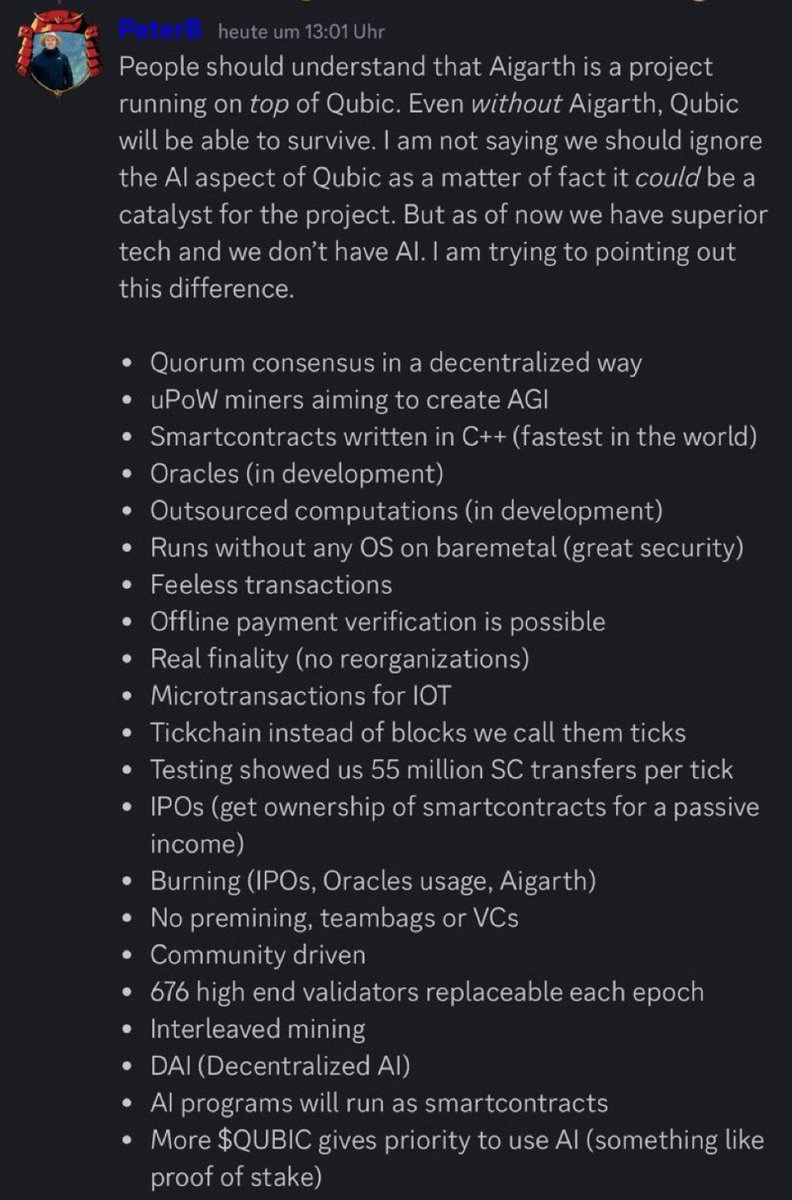
Forget what you know about AI.
Qubic is developing a new paradigm: AGI based on Artificial Neural Networks that are fully on-chain, decentralized, and self-learning.
Look beyond the now. The future of AI is being built on Qubic.
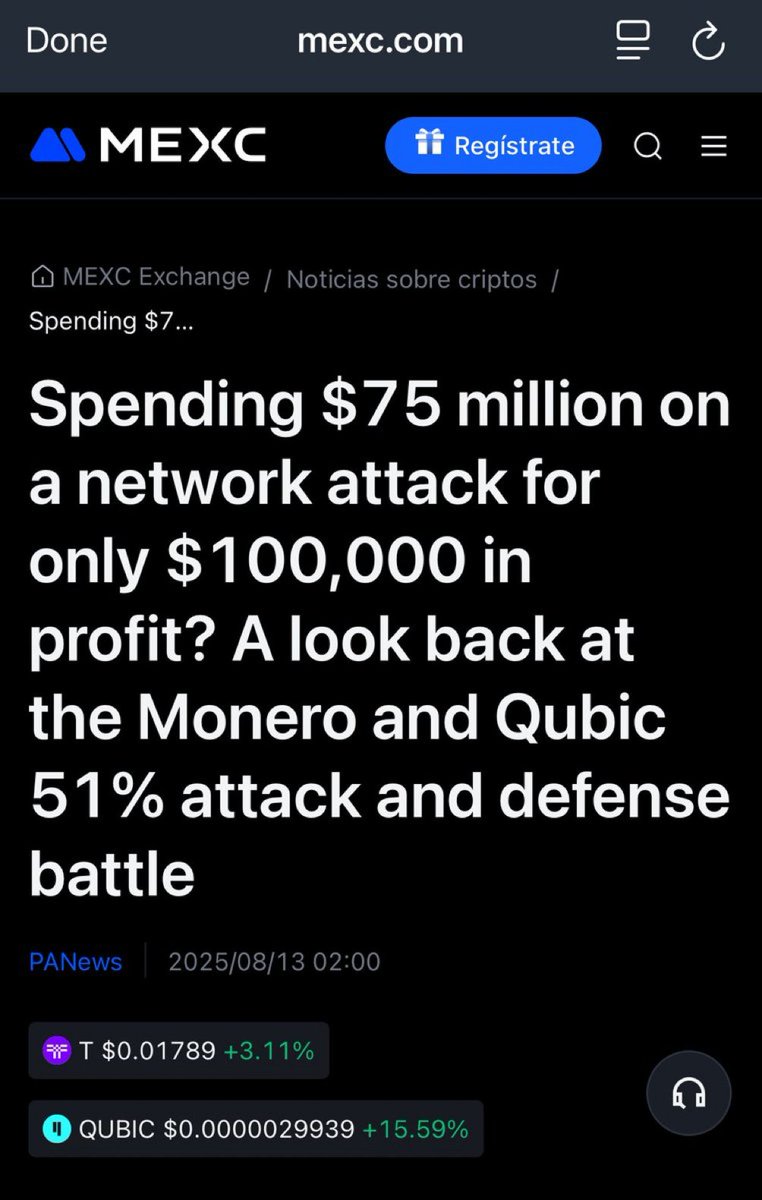
🚨 Debunking the $75M/Day Myth: Qubic's Monero Mining Cost Exposed! 🚨
You've heard the wild claims: $Qubic spent $75 million PER DAY to dominate 51% of Monero's hash rate?
Total nonsense! This amount stems from the cloud rental estimate.
Let's break it down with facts from the source 👇
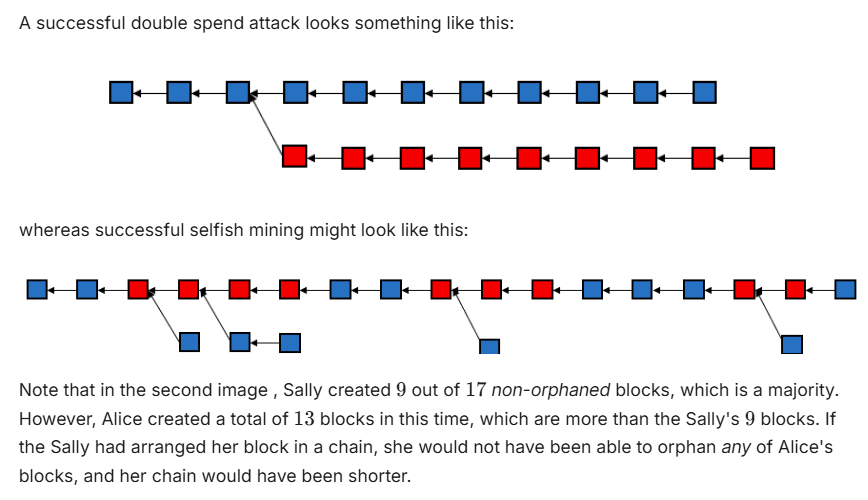
What I personally enjoyed most about Qubic's raid on Monero is that it is by far the most extensive application of Eyal-Sirer (h/t @ittayeyal) to date.
The screenshots people posted from block explorers look like they were lifted from the literature.
Mesmerising.
🚨 MISSION ACCOMPLISHED 🚨
The legendary 50% mark against Monero is no longer a dream…
➡️ 55.45% live
🔥 ATH: 58.45% just minutes ago
From epoch 161 to 174, Qubic’s rise has been relentless.
Every block, every GH/s, every miner pushed us past this forbidden line…
Qubic now holds the power over Monero’s network.
We’re no longer on the move.
We’re in control.
And the crypto world is starting to realize it.
Qubic vs. Monero, preliminary results:
(For those who do not know me, I am not affiliated with Qubic, I do not hold any Qubic, and I am plausibly the most vocal and obnoxious Qubic critic to date. That's exactly why they hired me).
I was provided a wallet seed by @c___f___b from which I generated the public view key:
7804f957c13215e6c98d54c443d16d36e603ca8a4c81ced9e46449bcbd7c6696
In this post, I will inaccurately refer to blocks whose coinbase transaction can be associated back to this wallet as "blocks created by qubic", and refer to the ratio between such blocks and other on-chain blocks as the amount of blocks "created by qubic". This is not the full picture, but it is accurate enough for now.
In the full report (which will hopefully be posted tonight or tomorrow), I explain the limitations of the method, and make more careful inferences of the data. (I will also provide the full list of blocks created by the wallet, as well as tx_proofs that can be cross-checked against any Monero node to verify the results.)
That being said, the preliminary view is honestly a bit astounding.
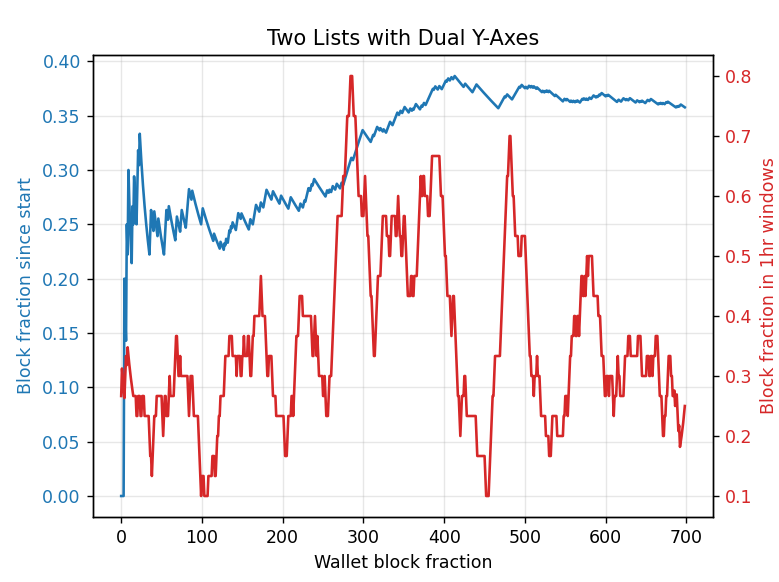
In the graph below, the blue line shows the fraction of blocks created by CFB's wallet out of all blocks created up to that time. The red line shows the fraction in a sliding (centered) window of 30 blocks (about one hour).
As we can see, while not quite being able to maintain superiority for the entire range, there are quite a few one-hour-long windows where Qubic created almost as many as 80% of the blocks in the window.
This does not mean that Qubic managed to hit 80% of the typical XMR hashrate. In these magnitudes of fluctuation, there are forces pulling in all directions, from switch mining to selfish mining. But it defnitely means that Qubic genuinely disrupted Monero by hash power alone.
In the full report, I will discuss in greater length what can be inferred and to what degree of confidence. And will also use the stage to remind that I warned against these kinds of scenarios more than three years ago, against ASIC "resistance" in general, and RandomX in particular. The same threat lingers over other bloated hashes such as Ethash and Scrypt.
The only defense against this kind of raiding is to make sure ASICs are many orders of magnitude more efficient than any existing generic hardware, and (to the best of my knowledge) that can only be achieved by ASIC friendliness. Anything else might be appealing to miners and easier to justify, but it will always face these kinds of threats.
Funny how many people say that there was no the 51% attack because there are no signs of one. Of course no signs, we told you we wouldn't harm anybody -- and we didn't.
Yep, not malicious at all. Though I definitely would not say anything about it was easy. It was thought to be impossible. And from what I understand, even government agencies failed at taking down Monero.
It took several months of work from CFB himself.
He specifically chose $XMR for how complex, difficult, and impossible it seemed.
And the man has a penchant for proving the impossible as possible, and as such improving the technology of the world.
Especially in #crypto.
And especially with $QUBIC.
In this case, this experiment has greatly improved the security of Monero against future adversaries with actual malicious intentions.
For many years, every time @c___f___b says he will do something that the public majority shouts him down as being ‘impossible’ and that he is ‘crazy’ for saying so, if he decides to, he proves them all wrong and makes the impossible into reality.
Constantly turning the detractors into fans.
It is absolutely awe inspiring to witness.
I don’t believe there’s anyone else on this planet that could have done what he did here with Monero. And many have tried.




![Cointelegraph's tweet photo. ⚡️ INSIGHT: @stbl_official is launching a decentralized stablecoin protocol that lets users mint stablecoins without giving up yield on their collateral, all under the STBL framework.
Founded by Tether co-founder Reeve Collins and Avtar Sehra of Libre Finance.
[Brought to you by @stbl_official]](https://pbs.twimg.com/media/G1iHB4DWMAA1pxb.png)