Gnarly looking shakeout took place at midday today. It's been several weeks that we haven't seen one of these so I guess we were overdue.
Notable observation:
Look at where the $Nasdaq bottomed after selling off in an "algorithmic" manner(these moves are meant to trigger physical stops: aka 'shakeouts') after initially gapping up open. Followed by the typical V-shaped recovery that erases the majority of losses.
At mid-day today, the $Nasdaq had pulled back a good 8% off highs in five days.
Look for a red open in the indices tomorrow followed by a reversal higher.
$SMCI — So Supermicro just got $39,000,000,000 in new revenue within a matter of weeks (not yet priced into the stock)…
… and they are raising 1/6th of that amount to make a +600% gain and the stock is down?
NDX intraday today: 5.4% drop high to low, 3.1% recovery low to close.
141 days since 1985. 116 in crisis clusters (2000-02, 2008, 2020). 24 isolated.
ISOLATED cohort forward returns:
T+5: +1.29% mean, 71% green
T+10: +1.25% mean, 58% green
T+20: +2.78% mean, 58% green
Follow-up on the $6752.T Panasonic thesis:
The real power of their rack-level distributed architecture isn’t just backup, it’s how cleanly it solves the two biggest near-term constraints in the AI buildout:
Grid interconnection queues and power quality at 100kW+ densities.
Hyperscalers can now add protected kWh incrementally per rack instead of overbuilding massive centralized UPS upstream. Panasonic’s systems also bring built-in peak shaving, which directly helps flatten the spiky loads that are triggering utility pushback on new capacity.
The supercapacitor CBUs (targeted for FY27 production) are the missing piece for the 800VDC transition. They handle the fast transients and high-power pulses that pure Li-ion can’t efficiently cover without oversizing, while sharing the same rack form factor and cell supply chain.
Hybrid BBU + CBU at scale, 80%+ of FY29 already locked in design wins, and capital-light capacity conversion from underutilized EV lines. It’s one of the cleaner setups that actually benefits from, instead of getting disrupted by, rising rack power density.
I believe this is one of the more asymmetric ways to play the “power is the new bottleneck” theme in AI infrastructure.
$VRT $ETN $FLNC $EOSE $TSLA $ENS
$CIEN just reported a quarter that says everything you need to know about the state of the optical networking industry.
> $COHR and $LITE is the supply chain bottleneck currently. Ciena called out pump lasers and CDMs as active constraints.
> $SIVE is a bet on the next bottleneck. Today it’s pump lasers and CDMs. Tomorrow, as AI clusters scale past 1.6T toward co-packaged optics, the constraint shifts to external light sources, multi-wavelength laser arrays that sit outside the GPU package.
> $AAOI rides the 800G transceiver wave. Ciena is more than doubling its own pluggable revenu, AAOI is one of the few qualified suppliers on the other side of that link, with $124M in 800G orders from a single hyperscaler since mid-March and a second customer already shipping.
> $GLW wins on volume. When Ciena says hyperscalers are building multi-rail systems running multiple fiber pairs in parallel over hundreds of kilometers, that’s a fiber density multiplier.
> $NOK is the competitive read. Nokia acquired Infinera to compete in this space. Ciena’s hyperscaler wins and margin expansion put direct pressure on Nokia’s optical unit, a Ciena share gain here is often a Nokia share loss there.
The bottom line: Ciena’s quarter confirms that AI infrastructure spending is cascading from GPUs → networking → optical components → fiber. The entire optical supply chain is supply-constrained, not demand-constrained. That reprices the margin and growth outlook for every company in the chain.
$CIEN $COHR $LITE $GLW $FN $AAOI $SIVE $ANET $NOK $NVDA
$EWY -10% with everyone in Korea and their mother and grandmother all in on margin and sold their life insurance policies to buy memory stocks.
Only means one thing … time to use moar margin.
Wow, so now $SPCX is getting:
$1.25B/mo from Anthropic
$0.92B/mo from Google
These 2 new revenue streams amount to $26B+ in ARR through 2029.
Add that to expected 2026 revenues of roughly $30B… Figure $60B+ is definitely within reach.
Valuation’s starting to make more sense.
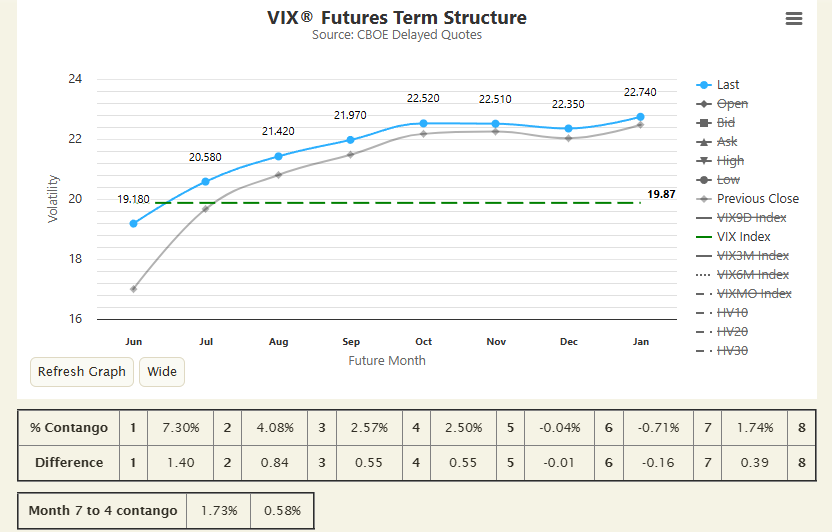
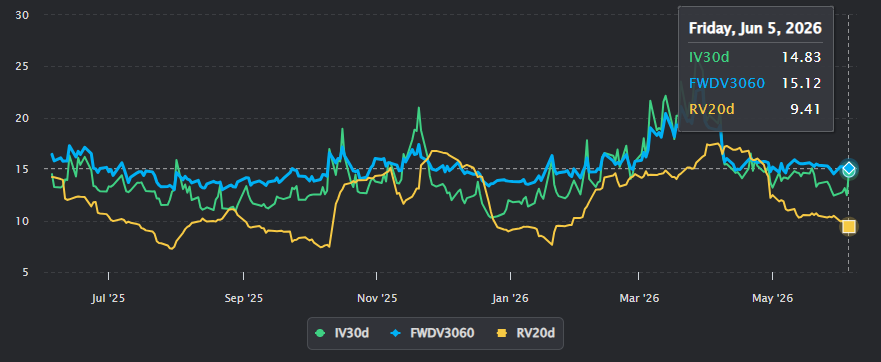
$SPX is down 190pts and fixed strike vol is hardly up 1pt and VX 2pts. This is what you get when we see skew at extremes and historical spot/vol correlations.
The winner of the humanoid race won't have the best AI.
They will have the best actuators. That is where $ALGM and $VPG role in Humanoids come in.
A humanoid has ~43 actuators. Each needs two distinct sensing functions:
> Force sensing: direct physical measurement of load, grip, or joint torque (VPG’s world).
$VPG excels at high-precision strain-gauge load cells and torque sensors. Their technology is excellent for the demanding accuracy and stability humanoids require. Because true precision at this level is hard to replicate, Vishay Precision Group could enjoy real pricing power in the early ramp as robot makers have limited qualified options.
> Current sensing: real-time measurement of current through the BLDC motor, which the control loop uses for precise torque regulation (ALGM’s world).
$ALGM dominates magnetic current sensor ICs. These sit in the motor driver and deliver the fast, accurate current feedback needed for closed-loop torque control. ALGM is the clear leader in this category (especially the isolated magnetic solutions best suited for high-performance actuators), with deep automotive-grade credentials that transfer directly to robotics.
> The critical difference is manufacturing DNA and scalability:
$VPG precision instrumentation model (specialized bonding, calibration, tight tolerances) creates a moat today, and potentially pricing power while volumes are still modest. But that same model becomes a constraint at scale. High-volume robot OEMs will apply heavy pricing pressure, and ramping consistent precision output profitably is notoriously difficult.
$ALGM operates with semiconductor economics: standardized ICs on scalable fabs, falling unit costs at volume, and high incremental margins. At 1M humanoids/year, we’re talking 43M+ current sensor ICs annually on existing infrastructure.
> Valuation and risk asymmetry remains striking:
$VPG offers the “purest” force-sensing exposure and possible early pricing power, but trades at very high multiples on modest revenue with thin margins, and carries meaningful scaling/execution risk.
$ALGM has the strongest positioning in a must-have function per actuator, with far better scalability and more reasonable market pricing relative to its advantages.
> Thesis
The actuator layer is where the humanoid thesis becomes real. ALGM is the best way to own the critical sensing technology that makes high-performance, scalable actuation possible.
I am long Allegro MicroSystems, Inc. ($ALGM).
Panasonic Holdings Corporation ($6752.T) might be the cleanest under-the-radar name in AI data center power infrastructure right now.
Most people still see Panasonic as a legacy consumer/auto name. The real story is in the Energy division’s datacenter BBU business.
They already hold ~80% share in datacenter battery backup units. 600M+ lithium-ion cells shipped with zero critical safety incidents. That’s not a moat you can buy, it takes years of qualification.
The real angle is how they’re positioned for the next phase of the buildout:
• BBU shelves scaling 33kW → 72kW → 102kW target, cells heading to 200W+
• Converting underutilized EV lines to triple Japan capacity with basically double-digit billion yen incremental capex
• >80% of FY29 revenue already locked via design wins
• FY29 target: ~4x revenue to ¥800B at 20%+ ROIC
Now layering in two new products tied directly to the 800VDC transition: proprietary supercapacitor CBUs that fit existing BBU racks (challenging the current monopoly) and purpose-built high-voltage BBUs.
As rack power scales to 8–12kW+, every MW deployed needs more backup kWh. Panasonic is the rare dominant incumbent that actually benefits from this architectural shift instead of getting disrupted.
Other names in the broader datacenter power / backup stack include $VRT, $ETN, $FLNC, $EOSE, $TSLA, $ENS, and supercapacitor-focused names like 7220.T (Musashi Seimitsu). Most are either narrower in scope or don’t have Panasonic’s combination of ~80% BBU share, locked design wins, and capital-light capacity conversion.
The capital-light expansion + 800VDC product optionality makes this feel like one of the cleaner ways to play rising power density in AI infrastructure. Anyone else tracking it?
$SIVE Q1 earnings are good example of why you have to look past headline numbers.
Revenue was down 22% and EBITDA took a hit. Ignore it. The losses are strictly from scaling up the sales team and prepping for a U.S. dual listing.
Here is the only metric that matters right now: Opportunity pipeline just grew 77% to $799M in a single quarter.
They basically took their entire historical pipeline and nearly doubled it in three months. That is the clearest signal yet of the CPO supercycle inflection.
$SIVE sit right alongside $LITE, $COHR, and $MTSI as critical laser suppliers for hyperscalers. The $JBL partnership for 1.6T transceivers is pure validation of the tech, and supply chain mapping points straight to $AAPL and $MRVL.
Be like smart money and looking at the 2027 volume ramp.