Private Capital | 30+ yrs experience
High-probability market setups
Macro Strategist | Capital Operator
I position before the market reacts
Discipline over nois
The WhatsApp group is now live! Comprehensive analyses are posted in the group daily in advance.
Click to join: https://t.co/Ui8E5erQJ3
By joining, you’ll get: the latest and most comprehensive news + precise stock codes and take-profit/stop-loss levels Follow me and send a private message or leave a comment, and I’ll invite you right away.
#QQQ #STOCK
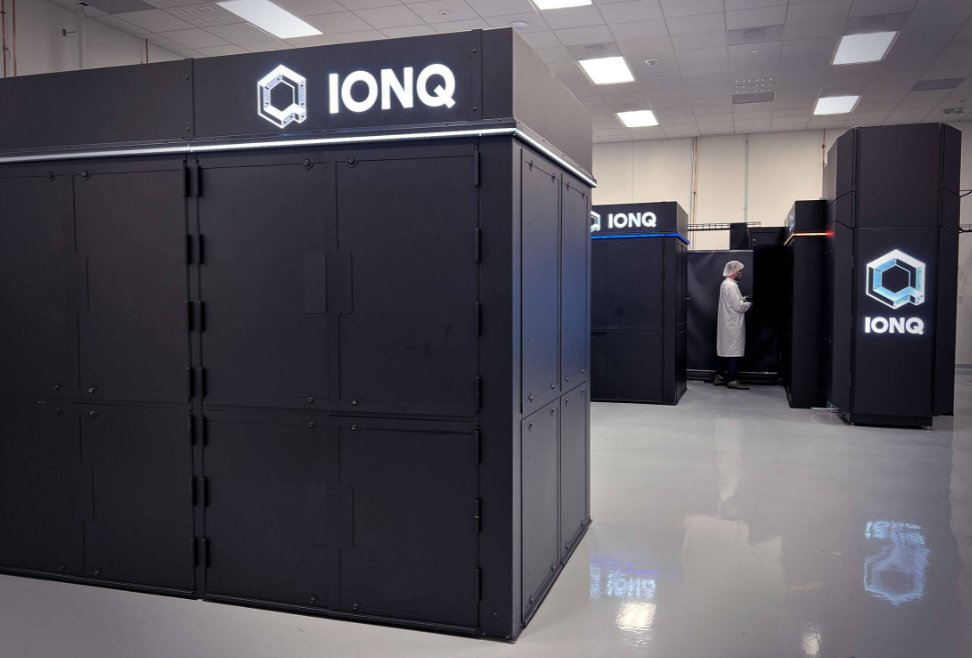
$IONQ
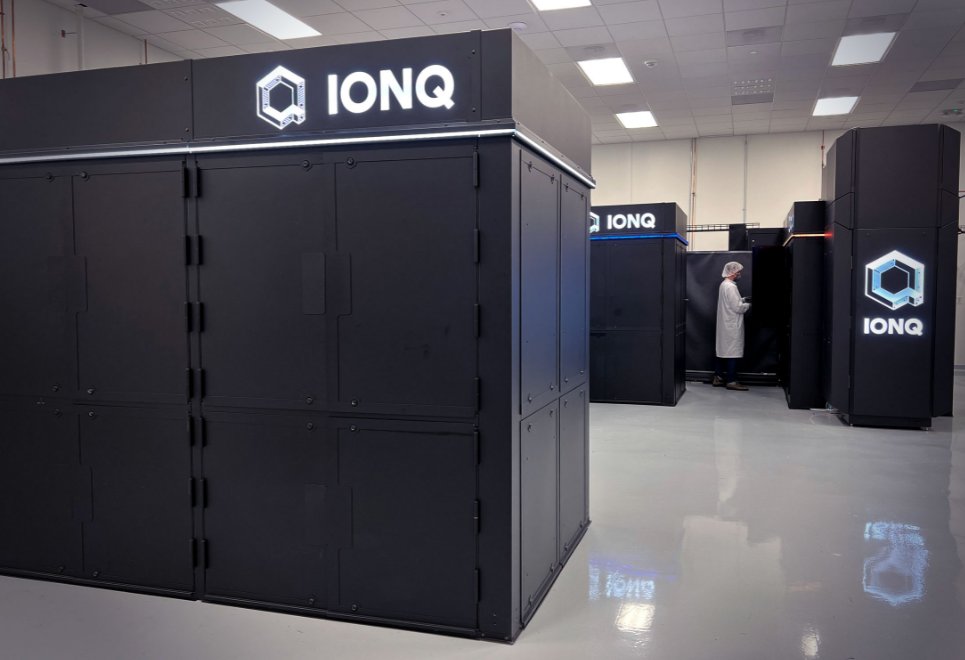
Two rooms—don’t go into the wrong one.
The headline pushed the opening price up to 46, but the closing price returned to the level shown in the server room chart. It closed around 42.5, up about 4%. It opened at 45.9, with a high of 46.05 and a low of 41.63.
Pre-market 42–48: Opened above 47, pulled back to 43–45, failed to hold 45, and tested 48. Momentum didn’t fade back to 40 like it did earlier in the day, but it also didn’t lock in the high. The first company is a lab. Their error-correcting decoder runs on a standard CPU, simulating 408 logical bits and 31.5 million operations, with latency reduced to 0.02%.
This proves that the classical side can keep up, but it does not prove that Forte already has 408 logical bits. The decoder and the quantum chip are still two separate matters. The second room is the server room. The Israeli natural gas pipeline network and Classiq handed a scaled-down pressure optimization problem to Forte-1, using only two layers of circuitry compared to the simulator’s 30 layers.
The solution is close to the classical optimum and effective, but it applies to small networks and shallow circuits. Solving the gas pipeline problem does not mean power grid dispatch has been quantized. The money is in the third table: shipments, cloud usage, and backlog. Cash burn is also in the same table. After-hours trading follows the headlines. The third-quarter results will show whether shipments are still happening. Four scenarios: third-quarter backlog turns into revenue → 44–55; only papers, no shipments → 34–40.
Previous high was 85; it wasn’t reached this week. Error correction on CPUs is just scaffolding. The pipeline network on Forte is a proof of concept. The stock price follows the next machine, not the next arXiv paper. There’s a contact number on the homepage; add it to get the full report.
This is not investment advice.
#IONQ #QQQ #STOCK
$IONQ raised its guidance from 280 million to 450 million. First, let’s distinguish between the quantum computer segment and the acquired wafer fab.
Q2 revenue was $80.1 million (+287%), with RPO at 485 million. Organic full-year revenue remains at 280–290 million; In September, SkyWater was consolidated effective July 31, bringing the consolidated guidance to 450–460 million.
Cash on hand decreased from 3 billion to approximately 2 billion after consolidation. Adjusted EBITDA remains at a loss of 120 million, while the GAAP net loss of 1.9 billion is primarily due to the fair value of warrants.
The product pipeline is expanding: Superion 256 has been officially announced, with delivery scheduled for 2027; FIU secured Florida’s first on-site unit; South Korea’s SDT is seeking a unit with a quantum memory; and NVIDIA’s Quantum Acceleration Center will deploy Superion and connect to NVQLink in 2027. On the security front, Congruity360 has secured an 8.18 million quantum security network contract, and the DARPA atomic clock contract could reach 58 million.
Closed at 45.48 on Friday, with an intraday high of 46.55. Analyst consensus ranges from approximately 64–67, with high estimates at 75–100; BofA just initiated coverage today with a target price of 60. The next earnings report is scheduled for around November 4.
Short-term: The price has already rebounded from 36 to 45; 46.55 is the immediate resistance level. Today looks more like a range-bound trade between 44 and 47.5; only after holding above 47 can we talk about 50–52, while a drop back to 43 would retest 40. Don’t mistake consolidated revenue for a doubling of quantum orders.
The real variables are Superion’s 2027 delivery schedule and whether Tempo can continue to secure on-site contracts.
#QQQ #STOCK #IONQ
Chinese stocks on the Nasdaq saw widespread gains today!
$NTES, $BZ, $BILI, $HTHT, and others all posted strong gains.
Main reasons: Market rumors suggest China plans to issue approximately 2 trillion in special government bonds to stimulate consumption and provide subsidies for families with multiple children.
Policy expectations have boosted risk appetite for Chinese assets.
$NTES’s pipeline is viewed favorably by institutions, providing an additional catalyst for the stock.
Policy expectations are the core driver; we’ll keep an eye on actual implementation moving forward.
#ChineseADRs #Nasdaq #NetEase #Bilibili
EPS $6.75. Sales $93.87B. Stock ~$923 Friday. Memory inflation is in laptops and phones on the warehouse floor. That’s $MU pricing power showing up in retail, not a consumer collapse. #COST
Force majeure talk on a data-center build. Don’t let one project rewrite capex. The AI bid is still in $META and the SOX, not in every contractor. #ORCL
$RELY
It’s not a crypto vault. It’s a mobile cross-border money transfer service. Volume and user growth are still in the double digits, and profit margins are rising. GAAP net income needs to be analyzed separately. It’s expected to come in at around 20.67–20.76, up about 3%. Opened at 20.12, high of 20.78, low of 20.11.
After falling from the 27 range, the market has already priced out the one-time tax reform accounting entry. Stripping away that deferred tax asset release, operating profit isn’t as strong as GAAP figures suggest. The remaining questions are simple: Can customer acquisition costs be kept in check, and will new users continue to send money in their second year?
The next table focuses on just two things: whether active users are growing again, and whether the EBITDA margin can approach the full-year guidance of approximately 21%. Volume is real. One-time accounting adjustments are not. Remittance volume is the business. Tax shields are just accounting. The stock price can only hold up if it follows volume.
This is not investment advice.
#RELY #QQQ #STOCK
$RELY This isn’t a crypto vault. It’s a mobile cross-border money transfer service. User numbers and remittance volumes are still growing in the double digits, and profit margins are also rising.
What really needs to be broken down is net income: if you strip out that tax reform-related accounting entry, operating profit is nowhere near as impressive as it appears under GAAP. The market has already priced out that one-time gain through the stock price decline.
The remaining questions are simple: Can customer acquisition costs be kept in check, and will new users continue to make transfers into the second year?
The next table focuses on just two things: whether active users are growing again, and whether the EBITDA margin can approach the full-year guidance of approximately 21%. Volume is there; one-time accounting adjustments are not.
Remittance volume is the business. Tax shields are accounting. The stock price is only sustainable if it tracks the volume.
#RELY #QQQ #STOCK
$RELY This isn’t a crypto vault. It’s a mobile cross-border money transfer service. User numbers and remittance volumes are still growing in the double digits, and profit margins are also rising.
What really needs to be broken down is net income: if you strip out that tax reform-related accounting entry, operating profit is nowhere near as impressive as it appears under GAAP. The market has already priced out that one-time gain through the stock price decline.
The remaining questions are simple: Can customer acquisition costs be kept in check, and will new users continue to make transfers into the second year?
The next table focuses on just two things: whether active users are growing again, and whether the EBITDA margin can approach the full-year guidance of approximately 21%. Volume is there; one-time accounting adjustments are not.
Remittance volume is the business. Tax shields are accounting. The stock price is only sustainable if it tracks the volume.
#RELY #QQQ #STOCK
Bessent: pause now runs to Jan. 10. Shanghai −1.2%. That’s sell-the-extension, not a new deal. Rare earths, chip licenses, Iran stay on the table. #China
$IONQ
Two rooms—don’t go into the wrong one.
The headline pushed the opening price up to 46, but the closing price returned to the level shown in the server room chart. It closed around 42.5, up about 4%. It opened at 45.9, with a high of 46.05 and a low of 41.63.
Pre-market 42–48: Opened above 47, pulled back to 43–45, failed to hold 45, and tested 48. Momentum didn’t fade back to 40 like it did earlier in the day, but it also didn’t lock in the high. The first company is a lab. Their error-correcting decoder runs on a standard CPU, simulating 408 logical bits and 31.5 million operations, with latency reduced to 0.02%.
This proves that the classical side can keep up, but it does not prove that Forte already has 408 logical bits. The decoder and the quantum chip are still two separate matters. The second room is the server room. The Israeli natural gas pipeline network and Classiq handed a scaled-down pressure optimization problem to Forte-1, using only two layers of circuitry compared to the simulator’s 30 layers.
The solution is close to the classical optimum and effective, but it applies to small networks and shallow circuits. Solving the gas pipeline problem does not mean power grid dispatch has been quantized. The money is in the third table: shipments, cloud usage, and backlog. Cash burn is also in the same table. After-hours trading follows the headlines. The third-quarter results will show whether shipments are still happening. Four scenarios: third-quarter backlog turns into revenue → 44–55; only papers, no shipments → 34–40.
Previous high was 85; it wasn’t reached this week. Error correction on CPUs is just scaffolding. The pipeline network on Forte is a proof of concept. The stock price follows the next machine, not the next arXiv paper. There’s a contact number on the homepage; add it to get the full report.
This is not investment advice.
#IONQ #QQQ #STOCK
$IONQ: There are two rooms—make sure you don’t go into the wrong one. (The number is on the homepage; add it to get the full report.)
The first room is the lab. The error-correction decoder runs on a standard CPU, simulating up to 408 logical bits and 31.5 million operations, with latency reduced to 0.02%. This proves that the classical side can keep up—it does not prove that Forte already has 408 logical bits. The decoder and the quantum chip are still two different things.
The second room is the server room. Israel’s natural gas pipeline network and Classiq applied scaled-down pressure optimization to Forte-1, using only two layers of circuitry—compared to the simulator’s 30 layers. The solution falls close to the classical optimum and is effective, but it’s a small network with shallow circuits. Solving the pipeline problem doesn’t mean power grid scheduling has been quantized.
The money is in the third table: machine shipments, cloud usage, and backlog. Cash burn is also on the same sheet. The after-hours session is driven by headlines; Q3 will depend on whether hardware shipments continue.
Today: $42–$48. If the opening price hits above $47, it will first pull back to $43–$45; if it holds steady at $45, it could test $48.
1–3 days: $39–$50. Once the hype fades, it will likely return to around $40.
4 weeks: If Q3 revenue shows backlogs converting to revenue → $44–$55. If only papers and no shipments → $34–$40. $85 is the previous high; that’s not on the cards this week.
The error correction on the CPU is just scaffolding. The pipeline on Forte is a proof-of-concept. The stock price is driven by the next machine, not the next arXiv paper.
#IONQ is not investment advice.
I’ve just finished reviewing today’s strong performers—several have clear investment logic. Ticker:
$C***
Follow me, comment, or send a DM, and I’ll send you the full version right away.
$IONQ: There are two rooms—make sure you don’t go into the wrong one. (The number is on the homepage; add it to get the full report.)
The first room is the lab. The error-correction decoder runs on a standard CPU, simulating up to 408 logical bits and 31.5 million operations, with latency reduced to 0.02%. This proves that the classical side can keep up—it does not prove that Forte already has 408 logical bits. The decoder and the quantum chip are still two different things.
The second room is the server room. Israel’s natural gas pipeline network and Classiq applied scaled-down pressure optimization to Forte-1, using only two layers of circuitry—compared to the simulator’s 30 layers. The solution falls close to the classical optimum and is effective, but it’s a small network with shallow circuits. Solving the pipeline problem doesn’t mean power grid scheduling has been quantized.
The money is in the third table: machine shipments, cloud usage, and backlog. Cash burn is also on the same sheet. The after-hours session is driven by headlines; Q3 will depend on whether hardware shipments continue.
Today: $42–$48. If the opening price hits above $47, it will first pull back to $43–$45; if it holds steady at $45, it could test $48.
1–3 days: $39–$50. Once the hype fades, it will likely return to around $40.
4 weeks: If Q3 revenue shows backlogs converting to revenue → $44–$55. If only papers and no shipments → $34–$40. $85 is the previous high; that’s not on the cards this week.
The error correction on the CPU is just scaffolding. The pipeline on Forte is a proof-of-concept. The stock price is driven by the next machine, not the next arXiv paper.
#IONQ is not investment advice.
$IONQ: There are two rooms—make sure you don’t go into the wrong one. (The number is on the homepage; add it to get the full report.)
The first room is the lab. The error-correction decoder runs on a standard CPU, simulating up to 408 logical bits and 31.5 million operations, with latency reduced to 0.02%. This proves that the classical side can keep up—it does not prove that Forte already has 408 logical bits. The decoder and the quantum chip are still two different things.
The second room is the server room. Israel’s natural gas pipeline network and Classiq applied scaled-down pressure optimization to Forte-1, using only two layers of circuitry—compared to the simulator’s 30 layers. The solution falls close to the classical optimum and is effective, but it’s a small network with shallow circuits. Solving the pipeline problem doesn’t mean power grid scheduling has been quantized.
The money is in the third table: machine shipments, cloud usage, and backlog. Cash burn is also on the same sheet. The after-hours session is driven by headlines; Q3 will depend on whether hardware shipments continue.
Today: $42–$48. If the opening price hits above $47, it will first pull back to $43–$45; if it holds steady at $45, it could test $48.
1–3 days: $39–$50. Once the hype fades, it will likely return to around $40.
4 weeks: If Q3 revenue shows backlogs converting to revenue → $44–$55. If only papers and no shipments → $34–$40. $85 is the previous high; that’s not on the cards this week.
The error correction on the CPU is just scaffolding. The pipeline on Forte is a proof-of-concept. The stock price is driven by the next machine, not the next arXiv paper.
#IONQ is not investment advice.
$CTAS after the close. Street wants about $1.36. $PAYX and $GIS also print. Tomorrow is $COST. If the consumer holds and Nasdaq doesn’t, the rally stays a five-stock story. #CTAS
$ELVA forklift batteries are on the market. The battery cell manufacturer hasn’t shipped yet. The price is around 6.73, with slight fluctuations. The trading range is approximately 6.62–6.79. Pre-market range: 6.3–7.1—the price held steady near 6.60, but didn’t test 7.1; it also didn’t break below 6.50 to test 6.3.
No new large orders. 7.4 is still a long way off. Current revenue comes from material handling: modules and systems for warehouse vehicles, robots, and specialty vehicles. Infinity emphasizes safety and cycle life, rather than competing on energy density. Quarterly growth has dropped to single digits; existing customers are still placing orders, but new production capacity hasn’t yet boosted revenue. Jamestown is the next milestone. The start of acceptance testing does not mean shipments have begun.
First shipments are projected for Q2 2027. Factory Acceptance Testing (FAT) will be completed by early October, after which the equipment will be shipped to New York. Until the factory goes online in 2027, the valuation will be driven by forklift orders and gross margins. Data centers and defense remain roadshow talk; only cell production will count. Profits are already very thin, and factory capital expenditures will consume cash first.
Four-week outlook: If there’s concrete evidence regarding Jamestown or major clients restocking → 7.2–8.8; if Q3 growth repeats → 5.4–6.4. Previous high: 12. The company is currently surviving on its systems business. Next year hinges on the battery cell factory. Don’t mistake acceptance testing for production capacity. This is not investment advice.
#ELVA #QQQ #STOCK
$ELVA forklift batteries are on the market, but the battery cell factory hasn’t started production yet.
Current revenue comes from material handling: modules and systems for warehouse vehicles, robots, and specialty vehicles. Infinity focuses on safety and cycle life, not the energy density race. Quarterly growth has dropped to single digits, indicating that existing customers are still placing orders, but new production capacity hasn’t yet boosted revenue. Jamestown is the next milestone. The start of acceptance testing does not mean shipments have begun.
Until the factory comes online in 2027, the valuation will be driven by forklift orders and gross margins. Data centers and defense are just roadshow talking points; they won’t count for anything until battery cells roll off the production line. Profits are already very thin, and factory capital expenditures will eat into cash first.
Today: $6.3–$7.1. If it holds at $6.60, it could test $7.1; if it breaks below $6.50, watch for $6.3 first.
1–3 days: $6.0–$7.4. Without new orders, it’ll be hard to break above $7.4.
4 weeks: Concrete confirmation of Jamestown progress or restocking by major customers → $7.2–$8.8. If Q3’s growth rate repeats → $5.4–$6.4. $12 is the previous high.
System business is keeping us afloat today. The battery cell factory will determine our fate next year. Don’t mistake acceptance testing for actual production capacity.
#ELVA #QQQ #STOCK
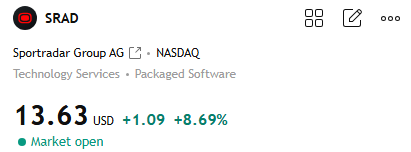
Sportradar Group AG is a technology platform that enables next-generation sports engagement and a B2B solutions provider for the sports betting industry. It generates revenue from two primary sources: subscription-based revenue and revenue sharing. Geographically, it operates in North America, Africa, the Asia-Pacific region, the Middle East, Europe, and Latin America and the Caribbean.
I’ve just finished reviewing today’s strong performers—several have clear investment logic. Ticker:
$S***
Follow me, comment, or send a DM, and I’ll send you the full version right away.
I’ve just finished reviewing today’s strong performers—several have clear investment logic. Ticker:
$S***
Follow me, comment, or send a DM, and I’ll send you the full version right away.
$VICR already printedRaised Q3 growth to >20% q/q on a power-delivery license. +13% after hours. That’s the unsexy plumbing under the GPU story. More real than a summit headline. #VICR#Nasdaq
$ELVA forklift batteries are on the market, but the battery cell factory hasn’t started production yet.
Current revenue comes from material handling: modules and systems for warehouse vehicles, robots, and specialty vehicles. Infinity focuses on safety and cycle life, not the energy density race. Quarterly growth has dropped to single digits, indicating that existing customers are still placing orders, but new production capacity hasn’t yet boosted revenue. Jamestown is the next milestone. The start of acceptance testing does not mean shipments have begun.
Until the factory comes online in 2027, the valuation will be driven by forklift orders and gross margins. Data centers and defense are just roadshow talking points; they won’t count for anything until battery cells roll off the production line. Profits are already very thin, and factory capital expenditures will eat into cash first.
Today: $6.3–$7.1. If it holds at $6.60, it could test $7.1; if it breaks below $6.50, watch for $6.3 first.
1–3 days: $6.0–$7.4. Without new orders, it’ll be hard to break above $7.4.
4 weeks: Concrete confirmation of Jamestown progress or restocking by major customers → $7.2–$8.8. If Q3’s growth rate repeats → $5.4–$6.4. $12 is the previous high.
System business is keeping us afloat today. The battery cell factory will determine our fate next year. Don’t mistake acceptance testing for actual production capacity.
#ELVA #QQQ #STOCK
$VICR already printedRaised Q3 growth to >20% q/q on a power-delivery license. +13% after hours. That’s the unsexy plumbing under the GPU story. More real than a summit headline. #VICR#Nasdaq
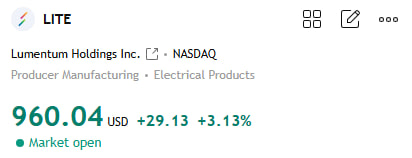
$LITE Laser was the first to hit the trading floor. This quarter’s profits are still coming from modules and pumps. The closing price was around 955–965, up about 3%. It opened at around 950–960, with a high of about 983 and a low of about 946. It opened near 950–953 in premarket trading. It didn’t retest 1027. It didn’t touch 1086. The guidance wasn’t revised ahead of schedule.
Two ECOC announcements: an eight-wavelength DWDM ELSFP, and external light sources for CPO/NPO, with approximately 250 mW per wavelength and about 12 W for the entire module, aligned with the OCI MSA; initial shipments are expected in the first half of 2027. Qualcomm and Corning’s 1060 nm VCSEL chip-to-chip optical interconnect also paves the way for future CPO/NPO applications.
Architecture, not this quarter’s profits. The company’s own stance remains unchanged: pluggable modules aren’t dead; 1.6T is just getting started; 800G is still breaking records; and CPO won’t arrive until after 2028. Pump lasers are set to roughly quadruple over the next five quarters, and multi-year large OCS orders—these are the immediate priorities. First, collect revenue from lasers on each optical path; then wait for lasers to be mounted next to the chips. Only when both are included in the product portfolio can it be called “breadth.”
1.6T and external lasers are on track per guidance, 950–1080; CPO is expected to face overheating and sector pullback, 750–850. 1086 is the previous high.
This is not investment advice.
DM me for the full report.
#LITE #CPO #QQQ #STOCK
$LITE Laser was the first to hit the trading floor. Volume is still concentrated in modules and pumps. Closed at 930.91 on Friday, with an intraday range of 896–951.60. It broke through 916 and touched 945. Pre-market trading is around 950–953.
It didn’t recover to 1,027. Optical Beta didn’t pull ahead, nor did it revise its guidance for the next quarter early. Two ECOC press releases today. The first is an eight-wavelength DWDM ELSFP designed as an external light source for CPO/NPO modules, with approximately 250 mW per wavelength and about 12 W for the entire module. The interface aligns with the OCI MSA, and the initial shipment target is the first half of 2027.
Second, a demonstration with Qualcomm and Corning of chip-to-chip optical interconnects using 1060 nm VCSELs, paving the way for future CPO/NPO solutions. These two items are about architecture, not this quarter’s profits. The company has stated itself: pluggable solutions haven’t disappeared; 1.6T shipments have just begun; 800G records are still being broken; and CPO won’t arrive until after 2028.
Wupen Yuen sold 1,500 shares under Form 10b5-1 at an average price of approximately 903. Pump revenue is expected to roughly quadruple over the next five quarters, and OCS has secured multi-year large orders—these are for existing products. First, collect revenue from lasers on each optical path; then wait for lasers to be integrated next to the chip. Only when both are included in the product portfolio can it be called “breadth.”
The 1.6T and external laser segments are on track according to guidance, with a range of 950–1080; for CPO, we expect overheating and a sector pullback, with a range of 750–850. 1086 is the previous high.
This is not investment advice.
For the full report, send a private message.
#LITE #CPO #QQQ #STOCK
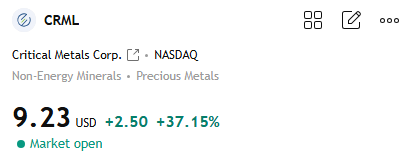
There’s no doubt that today’s star is $CRML (+38%).
Though it’s a relatively small company, it has achieved a decisive technological breakthrough.
“Rare earths”—a strategic resource—are about to break free from China’s stranglehold.
So, what should we keep an eye on next? Without a doubt, it’s “rare earth” magnets. For example, $USAR.
I’ve just finished reviewing today’s strong performers—several have clear investment logic. Ticker:
$C***
Follow me, comment, or send a DM, and I’ll send you the full version right away.