I never thought we would be working on Vitamin E but unbiased CRISPR screens take you into unexpected biology. I am delighted to present our work on how mTORC1 activity suppresses ferroptosis through a SCARB1-dependent HDL-Vitamin E uptake pathway. Congratulations to Tom and all co-authors!
Paper:
https://t.co/FHwFSJlj87
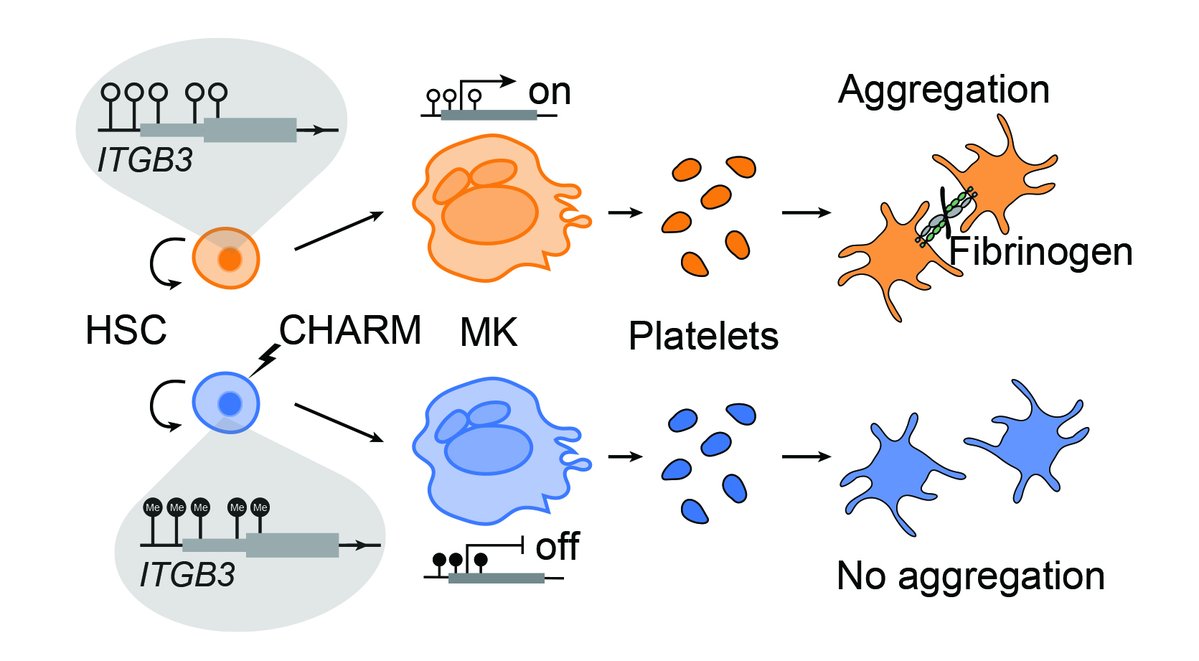
❓A one-time, durable, and even reversible way to prevent thrombosis? In this preprint, led by @lrbzldz, we show that epigenome editing of 🩸 #StemCells can durably reprogram platelet function: https://t.co/bioSZhRFuG
We mapped gene interactions across different environmental conditions (GxGxE) at scale for the first time in human cells. These maps lead to the realization that many genes function in a context dependent manner which provides insight into how humans have relatively few genes but many cell types. Congratulations Ben!
Paper:
https://t.co/w5bYZUUK4n
I am so excited to see epigenetic editing (CRISPRoff) move forward as a new approach in medicine through this clinical trial. We hope to make a difference for folks with HBV. Congratulations on a big step forward to all who made this possible!
https://t.co/3Lkc7m3XL5
Invested in high content CRISPR screening and predictive models? Come to Perturb2026 (March 18/19 2026 in Vienna)! I am co-organizing this conference and am greatly looking forward to what promises to be a fantastic meeting.
https://t.co/FhAY7y1YuR
Too many men die of prostate cancer. We miss you John. We discovered a new way of attacking androgen receptor driven prostate cancers that will lead to new therapeutics. This was a wonderful collaboration with @li_haolong and Felix Feng (rest in peace).
https://t.co/24bBKLdWus
A study out today in @NatureGenet from Core Investigator @LukeGilbertSF, @li_haolong & others identifies PTGES3 as a critical regulator of androgen receptor (AR) protein levels in prostate cancer, revealing a potential new target for tumors that become treatment-resistant.
Published today in @NatureBiotech, @LaineGoudy. @LukeGilbertSF, Alex Marson, and colleagues report a new epigenetic editing platform that safely reprograms multiple genes in human T cells without many of the challenges & risks associated with traditional gene editing approaches.
Epigenetic editing opens new opportunities for programming T cells. CRISPRoff can also be combined with genome editing approaches to enable new cell engineering approaches. Congratulations to @LaineGoudy and everyone involved!
https://t.co/MgkM5Xa3jn
Excited to see the Virtual Cell competition hosted by Arc Institute. We cant "wet lab" our way through the entire matrix of genes x cell types x environments of interest in biology. Cell state models will accelerate progress.
https://t.co/NYflPphVT6
Register today for the Virtual Cell Challenge and use AI to solve one of biology’s most complex problems.
Announced in @CellCellPress, the competition is hosted by Arc Institute and sponsored by @nvidia, @10xGenomics, and @UltimaGenomics.