OECD releases PISA 2022 results - largest assessment of creative thinking in 64 countries:
-Girls outperform boys globally
-Singapore leads in creative thinking
-Positive classrooms boost creativity
-Smaller SES gaps vs. reading/math/science
Report: https://t.co/gEKz5KQyoF
What came first the ‘language chicken’ 🐓 or the ‘thought egg’? 🥚 This paper and thread 🧵 does a lovely job of explaining language as an extrapolation of thought rather than vice versa. An important work that deserves credit to the authors.
Delighted to share our perspective piece “Language is primarily a tool for communication rather than thought” now out in Nature: https://t.co/QZuYPUu4mt
(with long-term collaborators (and friends) @spiantado and @LanguageMIT) 1/n
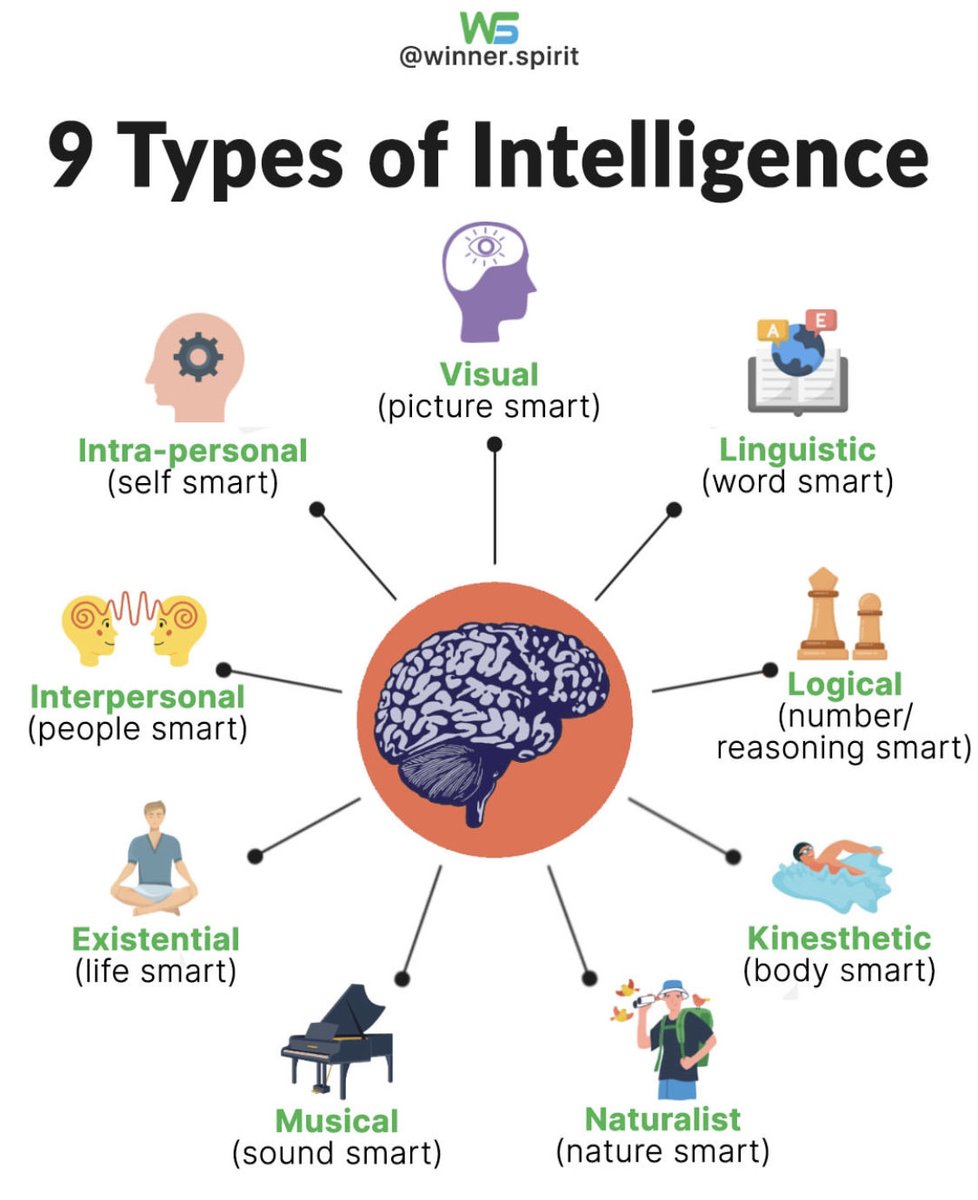
@AndrewWatsonTTB @AndrewRAConway You inspired me to dig up some of my old slides from when I taught about Gardner's theory and I decided to revisit his original works and write a thread on it: https://t.co/7q2NrUR2Em
1/n 🧠 In "Frames of Mind," Gardner proposed multiple intelligences (MI) as independent mental abilities that enable us “to solve problems, or to create products, that are valued within one or more cultural settings” (Gardner, 2011, p. xxviii). #EduChat
Sorry Gardner but my BS detector is going off for this one. No need to differentiate instruction on the basis of Multiple Intelligences if they’re not scientifically valid
14/end 🔔 While Gardner's MI theory offers a compelling narrative, the lack of robust evidence raises serious questions about its practical application. Educators must continue to critically evaluate and demand more solid evidence before revising their teaching methods. #EduChat
1/n 🧠 In "Frames of Mind," Gardner proposed multiple intelligences (MI) as independent mental abilities that enable us “to solve problems, or to create products, that are valued within one or more cultural settings” (Gardner, 2011, p. xxviii). #EduChat
13/n🔍 In Gardner’s own words: “Nor, indeed, have I carried out experiments designed to test the theory… I readily admit that the theory is no longer current. Several fields of knowledge have advanced significantly since the early 1980s.” (p.169, 2016) https://t.co/rRh8uq5vcB