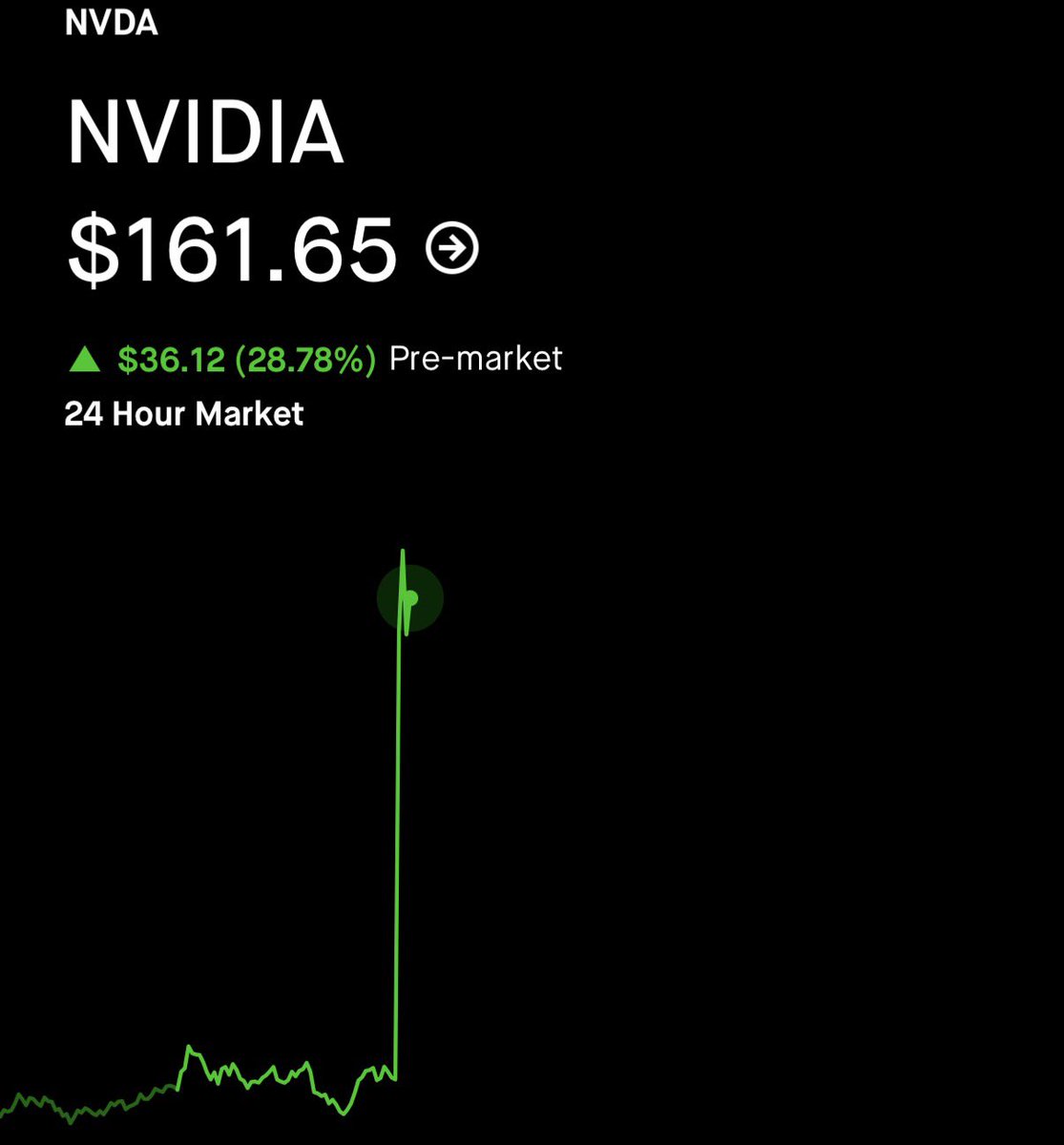
I’m sure it will get hand waved away, but the president’s personal accounts have traded $80mn+ of NVDA in the past 2 years and it’s one of his biggest positions.
When I worked at Goldman Sachs, I couldn’t own single stocks cause I might overhear an irrelevant research analyst talking about it.
Now we have the president using his power over boards to impact his largest personal holdings.
This is INSANE…
Right before Close last Friday someone bought $3,400,000 worth of $NVDA 160 calls which expire today.
This morning Jensen Huang was reinstated as Nvidia CEO.
After a rough (9,000%) gain these contracts will be worth beyond $312,000,000.
Clear levels of insider trading is happening…
TPUs are helping Google $GOOG win the AI race by enabling a model-silicon recursive self-improvement (RSI) loop.
Up until recently, RSI was mostly a concept that applied to AI models helping make better AI models. I believe Google is changing that narrative. It's becoming clear that model-silicon co-design is the future of AI, and RSI has a lot more leverage in the model-chip feedback loop.
Because of scaling laws, the AI race has always been more of a compute acquisition race. Model design is important, but secondary to compute. More compute gets you better results, while better models help you extract more intelligence at lower costs. So the race really comes down to first who can accumulate compute at the cheapest price, and then who can use it most efficiently.
TPUs are arguably the biggest leverage Google has in the AI race. Internally, TPUs are 30-40%+ cheaper than comparable $NVIDIA setups, even after paying Broadcom and TSMC, since Google isn't paying NVIDIA's ~75% gross margins. When frontier AI companies are pouring hundreds of billions into compute, that gap means Google gets way more compute per dollar with much better ROIC, and that compounds every cycle.
Selling TPUs to outside buyers like Anthropic $ANT, Meta, and Oracle also lets Google spread its chip R&D across more volume. Because they can afford thinner margins than NVIDIA, they can undercut on price while still keeping the best economics for themselves.
But I'd argue those substantial cost savings aren't even the biggest edge for Google. As I said in my last post, I believe every frontier lab will eventually become a chip company because otherwise you leave too much efficiency on the table.
Because Google knows Gemini's roadmap in advance, they can strip out the extra features a GPU needs and design chips strictly around Gemini's bottlenecks. For example, TPU 8i triples on-chip memory and redesigns chip-to-chip networking specifically for long-context MoE reasoning, giving them up to 80% better performance per dollar than Ironwood.
On the flip side, the Gemini team designs the next model around the TPU's exact layout before the chip is even made. TPUs are much more rigid than GPUs, so outside models designed for NVIDIA can lose half their utilization in key layers on a TPU, while Gemini is tailored to fit it.
Outside buyers like Anthropic and Meta still buy TPUs because the pricing and supply make it worth adapting their workloads, but they can't match the co-design efficiency Google gets by building Gemini and the chip together.
NVIDIA can't go that far because it doesn't own the models. It can't force thousands of customers to redesign their models around its chip, so it has to keep its chips flexible instead of tuning for one model. In fact, a core part of NVIDIA's success historically has been that they built a general-purpose chip that could be used by gamers, crypto miners, and different AI labs.
Jensen used to argue custom chips move too slowly for fast-changing models, and that's clearly not holding up anymore. Google went from 2-3 year TPU cycles, to yearly releases, to shipping 4 different 8th-gen systems just this year (8t, 8i, 8tx, and 8i Max), each tuned for a different job.
Having both the chips and the models is what gives Google a real shot at RSI:
• Before leaving Google, Jeff Dean said AlphaEvolve came up with a circuit going straight into next-gen TPUs, calling it "TPU brains helping design next-generation TPU bodies."
• AlphaChip cuts chip layouts from weeks to hours, and AlphaEvolve sped up part of Gemini's training code by 23% (taking 1% off total training time).
• Amin Vahdat, who runs AI infra, said TPU 8 was co-designed for Gemini, and this week Google showed that building models around TPUs can boost training throughput by up to 57%.
• Sergey said their models are now helping build the next ones, and AI already writes over 75% of DeepMind's production code (with humans still reviewing it).
• Gemini 4 Argon agents also freed up 300+ TB of data center memory on their own and wrote custom TPU kernels running 8x to 15x faster.
• Sundar even told investors on the Q3 call to expect "continued acceleration" over the next 12 months because of RSI.
For most of 2026 Google looked behind and even missed their June Gemini 3.5 Pro target. Then Gemini 4 Argon went live internally, and over the last 7 weeks they've shipped 4 Gemini 4 models (Argon, Carbon, Hydrogen, and Neon).
Neon is only their mid-tier model, yet it beat Opus 5.5 and GPT-6.2 Sol on almost every launch benchmark (only trailing on 3), hit 95% on long context vs 67% and 80%, and cut hallucinations to 14% vs 50%+. On Artificial Analysis it's also about 36% cheaper per task than Opus (Sol is cheaper, though with much higher hallucination rates).
In tech, even a slightly faster rate of improvement compounds into winner-take-most. Right now it looks like Google is improving faster than everyone else.
OpenAI and Anthropic are obviously still serious contenders, especially if eventually scale their own custom chips, though neither has Google's full stack today. NVIDIA was the one company that already had the hardware edge to close this loop from the other side by making huge bets on frontier open-weight models but that is now in question without Jensen there to take those risks. Google here has a real shot at pulling away and in the RSI world if you pull-away, it'll be very difficult for others to catch up as the distance keeps widening.
Allow me to explain the absolutely crooked, retarded financing behind today's Anthropic IPO. While the company is being reported as now being "worth $1.5 trillion" or more, that's all an obvious deception. Out of the 13.2 billion shares that exist in the company (Class A + Class N common stock), only 980 million shares were offered to the public. Thus, over 92.5% of Anthropic's shares have never even been released into the open market, and no one in public markets bought any of those, which means we don't have any legitimate price discovery of the bulk of the Anthropic shares.
Instead, the price that the public paid for the very limited (artificial scarcity) 7.4% of shares offered for sale was CARRIED OVER and artificially applied to 100% of the company's shares even though about 12.2 billion shares have never been priced in any public market.
If Anthropic released all 100% of its common stock shares to public markets, the stock price would plummet much closer to perhaps $5 / share (that's my guess), not the $83 / share that was announced at the public offering (which is now $97 at end of day).
Because if you are selling something and you create a lot of buzz combined with artificial scarcity, the price of that thing will be bid up to an artificial high. Think Cabbage Patch Dolls. But with the perma-smirk of Dario Amodei.
To then claim that ALL SHARES of Anthropic are therefore worth the same price as the 7.4% of shares offered to the public is nothing but sleight-of-hand hucksterism and deception.
Think of it this way: If Anthropic offered just one million shares to the public, at $1,000 per share, but still kept all its other shares off the market, does that automatically mean Anthropic is suddenly a $13.2 TRILLION dollar company?
Of course not. That would be stupid. But that's exactly how the current offering is being rolled out, just with more shares.
The whored-out financial press, which has pushed Anthropic FOMO with the frenzy of a public masturbator, wants you to think Anthropic is now worth over $1.5 trillion. In reality, if all the shares were offered at real supply/demand pricing, the company is probably worth something closer to $67 billion, by my math. And if you count the fact that the company's revenues can't even begin to cover its massive expenditures that have now reached nearly $900 billion in spending commitments through 2032, the real return on investing in Anthropic could be zero.
Virtually none of the people buying Anthropic right now have any clue whatsoever about anything I've explained in this post, because they are financially illiterate sheeple being fleeced by the founders.