23 years ago, we set out to prove that electric cars could be great – not just great electric cars, but the best cars overall.
We’ve gone from one electric sports car to
– Over 9 million vehicles on the road
– Model Y becoming the world’s best-selling car of any kind only 3 years after first deliveries
– 5 Gigafactories & other manufacturing sites across 3 continents
– The largest & most reliable fast charging network w/ over 80,000 Superchargers globally
– Energy generation & storage systems helping power homes & grids (over 1 million Powerwalls installed, 70+ GWh of industrial energy storage operating globally across 2,200+ projects)
Today, we’re bringing AI into the real world with autonomy @Tesla_AI and robotics @Tesla_Optimus.
Tesla is only getting started – a world of amazing abundance awaits
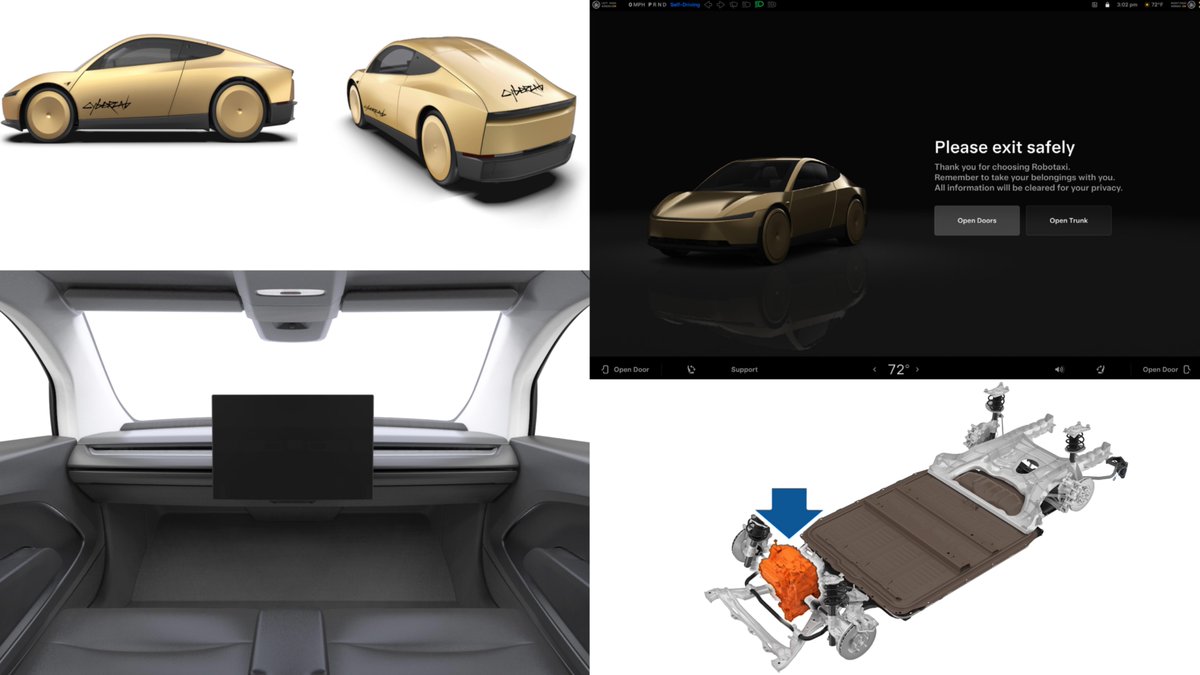
Some additional @Tesla Cybercab info from the official documents:
• Cybercab includes an Active Hood that raises during certain pedestrian impacts to reduce injuries.
• Cybercab has pressurized air canisters and cameras washers.
• If a Cybercab is in the roadway or in a dangerous position, first responders can manually move the vehicle using on-board vehicle controls.
• At least 10 airbags: Front airbags, Knee airbags, Inner seat-mounted side airbags, Outer seat-mounted side airbags and Curtain airbags.
• The interior door handles of Cybercab have two detents, with the second detent acting as the emergency mechanical release.
• Cybercab window switches are situated underneath the touchscreen.
• Cybercab uses both a 400V high-voltage battery and a 48V low-voltage battery.
• Cybercab Robotaxi is equipped with Tesla’s SAE Level 4 automated driving system: "When in Autonomous Mode, the vehicle is designed to be capable of performing the entire dynamic driving task without any input from a human driver."
• Opening a door or unbuckling a passenger's seat belt automatically causes the Robotaxi to disengage and park.
• The battery pack coolant is orange in color.
• There are two First Responder Loops for redundancy - one under the hood and one behind the passenger-side B-pillar.
• The charge port is centered below the trunk instead of on the rear fender (we knew this already)
• Cybercab has a manual emergency charge cable release hidden behind the rear wheel liner.
• The vehicle has exterior microphones and speakers for two-way communication with Tesla Robotaxi Support.
• While waiting for a new ride booking, Cybercab Robotaxi roams its area of operation or proceeds to a charging station or parking lot.
• If the Battery charge level is too low to conduct another ride, Cybercab Robotaxi proceeds to a charging station before accepting new ride bookings.
• If Cybercab Robotaxi experiences connectivity or hardware issues, the hazard lights flash rapidly and the vehicle attempts to pull over at the nearest safe stopping location.
• Cybercab Robotaxi is also designed to respond to clearly visible hand signals from first responders and can follow pathways designated by cones.
Tesla: "The Cybercab Robotaxi operational design domain includes all public roadways, such as freeways, highways, city streets, and rural roads, as well as private roadways and service stations, such as parking lots, charging stations, car washes, and parking garages. Cybercab Robotaxi is also capable of navigating pick- up and drop-off zones to initiate or complete trips.
Cybercab Robotaxi can operate autonomously at all times of day and night, and under light and moderate precipitation such as rain, fog, and snow.
Cybercab Robotaxi does not accept new rides when extreme weather conditions are expected. If unexpectedly caught by extreme weather conditions, Cybercab Robotaxi is designed to pull over at the nearestsafe stopping location and park. Tesla Robotaxi Support is then notified and can recover the vehicle and/or passengers."
🚨TESLA JUST FOUND A WAY TO BUILD THE WORLD'S BIGGEST AI SUPERCOMPUTER WITHOUT BUILDING A SINGLE DATA CENTER
The answer was sitting in millions of driveways the whole time… your parked car.
The entire AI industry has hit a wall.. And it's not chips.. It's power..
Building AI data centers now means waiting years for grid connections.. The Stargate project from OpenAI and Oracle is spending up to $500 billion to build 7 gigawatts of capacity.. And it'll take years to come online..
Tesla just realized it already has 7 gigawatts.. Sitting in its Supercharger network.. Already built.. Already connected to the grid.. Already permitted..
So on June 18, 2026, Tesla quietly filed a trademark for something called MEGAPOD.. Modular AI data center hardware designed to drop straight into existing Supercharger sites..
No land to buy.. No years-long grid queue.. No new power plants.. They just bolt compute onto infrastructure they already own..
But that's the small idea..
Here's the radical one..
The average car sits parked and unused about 95% of its life.. And every modern Tesla already has a powerful AI chip inside it.. Built for self-driving..
So Tesla wants to link millions of parked cars into one massive distributed supercomputer..
The math is staggering.. If Tesla hits 100 million vehicles, and each contributes about 1 kilowatt of compute.. That's 100 gigawatts of AI processing power..
That dwarfs every data center on earth combined.. And the real estate, the power, and the cooling were all already paid for.. By the people who bought the cars..
Your Tesla is liquid-cooled.. Plugged in overnight.. Doing nothing.. It's basically a sleeping computer in your garage..
And Tesla's plan is to let you rent it out..
Owners could earn passive income, free Supercharging, or discounts on Full Self-Driving in exchange for leasing their car's idle computing power while they sleep..
Your car stops being a depreciating asset.. And starts earning money while parked..
This is the part competitors can't copy..
OpenAI has to spend half a trillion dollars and wait years for power.. Tesla already has the grid connections, the batteries to stabilize them, the chips, and millions of cooled computers sitting idle in driveways worldwide..
Everyone else is trying to build a giant brain in one place..
Tesla is turning the entire planet into one.
Elon Musk holds the key to America's success in AI.....even if you're only looking at the short term (long term we already know)
He is the direct answer to the single biggest bottleneck in AI today: The Cost
Over time, frontier models will become harder to differentiate. The AI race is rapidly moving away from "who has the best model?" to "who can produce intelligence at the lowest cost?" The real edge belongs to whoever wins on inference cost, energy efficiency, speed of deployment, and pure infrastructure scale.
Right now, several Chinese models are seeing very high usage globally, partly because they can run at significantly lower cost thanks to cheaper electricity and fewer regulatory hurdles
Meanwhile, many companies are already capping AI spending and putting strict limits on usage because their bills are exploding
Building ground-based data centers in the US has become an existential risk. Projections show a GW-level facility can cost up to $100B. Between weaponized bureaucratic red tape, the "not in my backyard" (NIMBY) mentality, and endless environmental lawsuits, ground projects can get completely halted in court for years.
Meanwhile, China doesn't face these constraints. Their government treats AI infrastructure as a matter of core national security, sweeping away bottlenecks while leveraging incredibly cheap electricity. The US is losing its edge on both cost and regulatory speed.
Elon is the only force moving fast enough to break this bottleneck
Look at the reality: if Elon hadn’t built the Colossus supercomputer cluster at record speed, Anthropic wouldn't have been able to secure the massive compute necessary to scale their models to users, driving massive traffic straight to Chinese alternatives.
By taking data centers off the grid and placing solar-powered compute satellites into orbit, they bypass ground-based land, power, and environmental constraints entirely. But this entire paradigm shift depends heavily on Starship to drive launch costs down.
In a recent interview, SpaceX President Gwynne Shotwell stated that getting Starship fully operational in orbit and flying commercial missions now "largely depends on the FAA."
If America wants to compete on cost and speed with a country that removes friction for its AI projects and maintain AI edge, Starship needs to fly without being stuck in regulatory delays
SpaceX is becoming a central pillar of America’s military space infrastructure
This is no longer just about launching payloads for the Pentagon
Through Starshield and new Space Force contracts, SpaceX is now building part of the actual data layer the military will rely on in orbit: secure satellite links, high-speed data transport, low-latency communications, and resilient connectivity between sensors, shooters, and command systems.
The Space Force recently awarded SpaceX a $2.29B contract for the Space Data Network Backbone....a proliferated low-Earth-orbit communications architecture designed to move military data globally, securely, and fast
The U.S. military is not just buying commercial satellite internet as a backup anymore. It is moving toward SpaceX-built infrastructure as a core layer for future operations
Starlink changed civilian connectivity
Starshield is turning SpaceX into a national security backbone
The last time $META traded at 11x P/OCF, the cash flows were in a decline
Now it is the complete opposite with cash flows accelerating
Year over year growth:
2025: +26%
2026: +29%
New here? Read the $LMND founder's letter from Daniel and Shai. It's a brilliant letter and their entire strategy has stayed true to this from day one. Here is one excerpt.
https://t.co/lNVIijPkzQ
⚡️Satya is describing the new balance sheet of the firm.
The old firm owned people, processes, software, customer relationships, brand, data, and IP.
The new firm will own a compounding cognition loop.
Every workflow becomes a training surface. Every decision becomes a trace. Every expert judgment becomes reusable signal. Every internal correction becomes model improvement. Every model run becomes a chance to turn human judgment into institutional intelligence.
That is what “token capital” really means.
It is accumulated machine-operable cognition. A company’s expertise becomes executable, queryable, evaluable, improvable, and portable across models.
That is a massive shift.
The most important line is the one about switching out the generalist model without losing the company veteran expertise. That is the entire enterprise AI war. Model providers want the firm’s knowledge to flow into the model layer.
Enterprises need that knowledge to stay inside their own loop.
Whoever owns the loop owns the future economic rent.
Satya is laying out Microsoft’s answer to the frontier-model monopoly problem.
If all company knowledge flows upward into a few foundation models, the foundation model labs become landlords of the entire economy. They absorb everyone’s expertise, commoditize every workflow, and capture the value created by every firm’s learning process. That equilibrium will trigger political backlash, customer resistance, regulatory pressure, and corporate revolt.
So Microsoft’s doctrine is: every company should build its own AI learning system on top of frontier models, while Microsoft owns the infrastructure where that happens.
That is elegant and self-serving.
Microsoft does not need to own the single best frontier model forever. It needs to own the enterprise control plane: identity, security, permissions, data, workflow, evals, agents, memory, developer tools, cloud, compliance, and model routing. If the model becomes swappable, the platform underneath the firm’s learning loop becomes the durable asset.
Satya is quietly saying the frontier model alone is unstable. A world of a few models eating every company’s expertise breaks the political economy. A world where every company builds firm-specific AI capital on top of models is more stable, more defensible, and much better for Microsoft.
The “human capital gets more valuable” line is partly true and partly corporate diplomacy.
High-agency humans become more valuable. People with taste, judgment, relationships, domain intuition, ambition, and the ability to direct agentic systems become much more valuable.
Routine cognitive labor loses bargaining power.
The future firm does not need every human equally. It needs humans who can generate high-quality signal for the loop. The human becomes a trainer, judge, strategist, relationship node, taste layer, and goal-setter. The work that cannot feed the loop or direct the loop gets compressed.
This also connects directly to the Anthropic crisis.
If frontier model access can be restricted, pulled, nationality-gated, or subordinated to state power, then enterprises cannot allow their intelligence layer to live entirely inside one external model. They need portability. They need private evals. They need internal memory. They need their own traces. They need model-agnostic learning systems.
The model can change.
The firm’s cognition loop has to survive.
That is the new sovereignty test.
A company that only buys AI access is a renter.
A company that turns its workflows, judgments, corrections, and outcomes into a private learning loop is building capital.
The deeper implication: the future economy splits between firms that compound cognition and firms that leak cognition.
Firms that compound cognition will get stronger every time they operate.
$LMND 🍋
Daniel Schreiber at Piper Sandler Global Conference 3.6.26.
The pet insurance comments were worth noting.
Schreiber said the industry raised prices by roughly 27% over the last year.
Lemonade raised prices by about 12%.
Despite taking less rate, he said Lemonade grew roughly 3x faster than the industry and delivered better loss ratios.
Anyone can improve a loss ratio by pushing through blunt price increases. The better test is whether a company can price more selectively, grow faster, and avoid degrading underwriting quality.
That is the underwriting edge Lemonade is trying to prove.
$LMND 🍋
Seeing a lot of people in the timeline battling with the price action
The team is executing and the fundamentals are good. The stock is cheap.
No one can tell you when the market will realise Lemonade’s full value, and re-rate the stock, but I can assure you this feels no different than:
Buying
$RKLB $4-7 range for 2 years
$PLTR $8-15 range for 2 years
$IREN $5-14 range for 1 year
$MSTR $17-30 range for 2 years
All of these stocks went 10x from my entry, 3 of them went 20-30x
Now everyone thinks those companies are a sure thing. I can assure you they didn’t when I was buying
It’s always obvious in hindsight, but never easy to hold at the time
Be relentlessly focussed on your thesis, the risks, the valuation, the longterm
The key to 10x stocks is being contrarian, rational, right, value mad, and having the patience and fortitude to stick to your thesis
I’m not saying Lemonade is a sure thing. I’m saying the thesis is currently intact from my perspective and I’m very very bullish
~Tune
$LMND
One of the most important Q1 details was bundled IFP.
Only about 5% of customers are multiline, but 18% of total IFP is already bundled.
Insurance is not just about acquiring customers. It is about expanding premium per customer and improving retention without paying full CAC again.
Management said cross-sold business is largely acquired with little to no CAC. Pet is the clearest example: $85M of Pet IFP came from existing Lemonade customers.
Premium per customer rose 7% YoY to $424. ADR was flat at 85%, but management said homeowners non-renewals weighed on the metric. Excluding homeowners, ADR improved more than 300 bps YoY.
Cross selling is a big opportunity, particularly into car (TAM = ~$350 billion).
A 3.14M (+23% YoY) customer base is even more valuable as each customer becomes a platform, not a single policy.
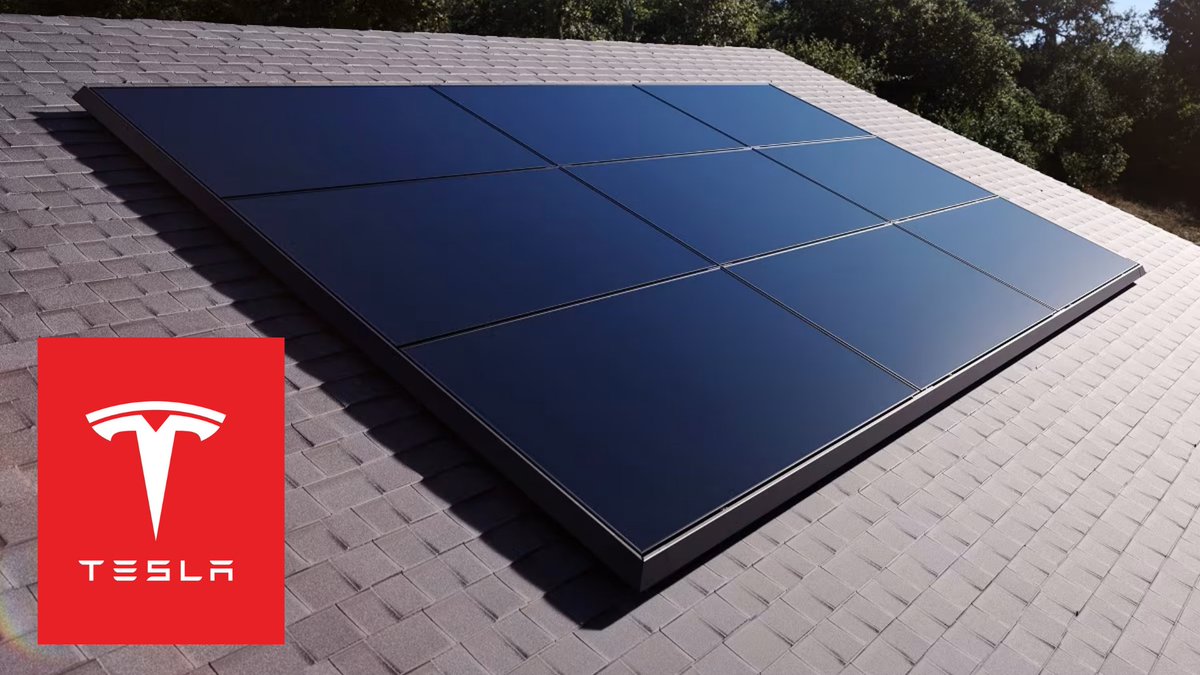
Tesla just went nuclear on solar
Tesla is building a 100 GW solar panel factory in Brookshire, Texas - full vertical integration from ingot to finished panel, all under one roof
• 1.65 million square feet
• Co-located with its new $200M Megapack Megafactory
That’s roughly 10% of the world’s current solar manufacturing capacity in a single facility outside Houston
And the deals are already rolling in:
• Meta tapped Tesla for a massive Wyoming project: 365 MW solar + 200 MW / 1,600 MWh of Tesla batteries, with the battery portion alone reportedly around $200M
• Giga Berlin just got another $250M investment, with battery cell capacity doubling from 8 GWh to 18 GWh
• Model Y became the first EV in history to surpass 100,000 new registrations in Norway
Tesla Energy is no longer some side business hiding behind the car company
It’s becoming one of the foundations of the global energy stack
• Solar generation
• Battery storage
• Grid-scale Megapacks
• Home energy products
• EV charging
• Software to control it all
Tesla is not just building EVs
It’s building the deep infrastructure layer for the sustainable future
The future that really matters....
See how Prufrock continuously mines - pushing and building at the same time.
The machines, from Las Vegas to Dubai, are remotely controlled from our Bastrop Operations Center.
These advances help TBC deliver more miles each year in the battle against soul-destroying traffic.
Elon Musk on the impact of Robotaxi to $TSLA 🔥
"Eventually, a vehicle must be designed as a clean Robotaxi. We’re going to take that risk. No mirrors, no pedals, no steering wheel.
This will be a historically megarevolutionary product. It will transform everything.
This is the product that makes Tesla a ten-trillion-dollar company. People will be talking about this moment in a hundred years."
$LMND 🍋
Six years ago, Lemonade did not insure pets. Today, Pet is their largest line of business by IFP. It crossed $500 million of in-force premium early in Q2 2026. It is the number one most-searched pet insurance brand in the United States. It is the fourth largest carrier by written premium in the country, competing against companies with decades of history in the category.
The IFP growth rate for Pet in 2025: 55%. The industry average: 17%.
The loss ratio for LMND Pet in Q1 2026: 69%. Comparable with peers. Taken while raising rates less than the industry, at 12% versus an industry average of 27%.
The pet business is performing on every axis that matters - growth, underwriting, cost efficiency. It is a proof of concept.
What Lemonade has built in Pet is a structural cost advantage rooted in automation. Pet insurance is high-frequency, low-severity. Most claims are $300 vet bills and medication reimbursements, not catastrophic losses. That profile makes claims highly amenable to AI-powered adjudication. Their LAE ratio in Pet is approximately 4%. That is the cost to handle a claim as a percentage of premium. Peers are paying meaningfully more.
Lower cost to service means more room to compete on price, more room to grow, and more margin to reinvest.
They also benefit from a distribution channel that most pure-play pet insurers cannot match: 3.1 million existing customers to cross-sell into. Approximately $85 million of Pet IFP was sourced from their existing base, acquired at no customer acquisition cost. A pet insurer without a multi-product platform has to buy every one of those customers.
The playbook is clear. Build a product on an AI-native infrastructure, acquire customers efficiently, reduce the cost to serve below the industry, and grow faster as a result.
Pet is evidence that the playbook works. Car is where the same playbook is now being applied at scale.
A year ago (Q1 2025): Car IFP was growing at ~9% YoY. Q1 2026: Car IFP grew 60% YoY, and car TAM is roughly 70x that of pet !
🍋
$LMND
@PaperBagInvest has been in the trenches making YouTube videos on $LMND for 5 years. Almost 200 videos
From interviewing management and asking better questions than financial analysts, to providing more accurate guidance than management at times
High quality 1st principles thinking, backed by rigorous financial models, combined with relentless focus, despite the stock not being the easiest to own over that time
It’s a rare thing on the internet these days when most “finance YouTubers” just gradually degrade into engagement farming the “new thing” in order to gain followers / clicks
But anyone who actually understands longterm investing and how real money is made can identify that his unique approach is correct
Unfortunately, there is a reason most people don’t make real money or sustain above average returns
They lack the focus, and the mathematical / psychological fortitude required to be early, contrarian and right. They merely chase the herd
That’s why markets work. There has to be a seller and a buyer in every trade, and only one side can really win
When Wall Street arrives, and this stock turns hot, and it all seems so obvious in hindsight, we shall remember his name
Remember, it’s in the bag !
https://t.co/ETsWCN5nb0