$STRC la acción preferencial de Strategy cotiza 3% bajo la par.
Cuanto mas lejos de $100 más se le va a complicar a Saylor levantar más deuda.
Hay protocolos Cripto donde la gente deja $STRC de colateral para tomar deuda en $USDC más barata y hacer el famoso loop.
Esta feo el tema…
Buen momento para recordar como abrir cuenta en Interactive Brokers:
1- Ir al sitio web de Interactive Brokers y seleccionar país/región: https://t.co/RERU1wORWW
Hay que hacer clic en “Abrir cuenta” y seleccionar “América del Sur” > “Argentina”
Hay varios tipos de cuenta: https://t.co/UlhT6WwXOg…
3- Hay que seleccionar “Individual” para una cuenta personal, también hay que elegir la moneda base (ej. u$s) y el tipo de cliente (retail o profesional)
Requisitos generales:
https://t.co/zS4PxQn9Tm…
4- Crea un nombre de usuario y contraseña y confirma el correo electrónico ingresando un código de verificación.
Despu��s de esto hay que completar el formulario con toda la información personal que solicitan.
5- Hay que subir la documentación requerida: - Prueba de identidad.
- Prueba de dirección.
6- Firmar electrónicamente y envíar la solicitud, vas a recibir un email de confirmación. IBKR revisará en 1-3 días.
💸 - Ahora veamos cómo fondear la cuenta.
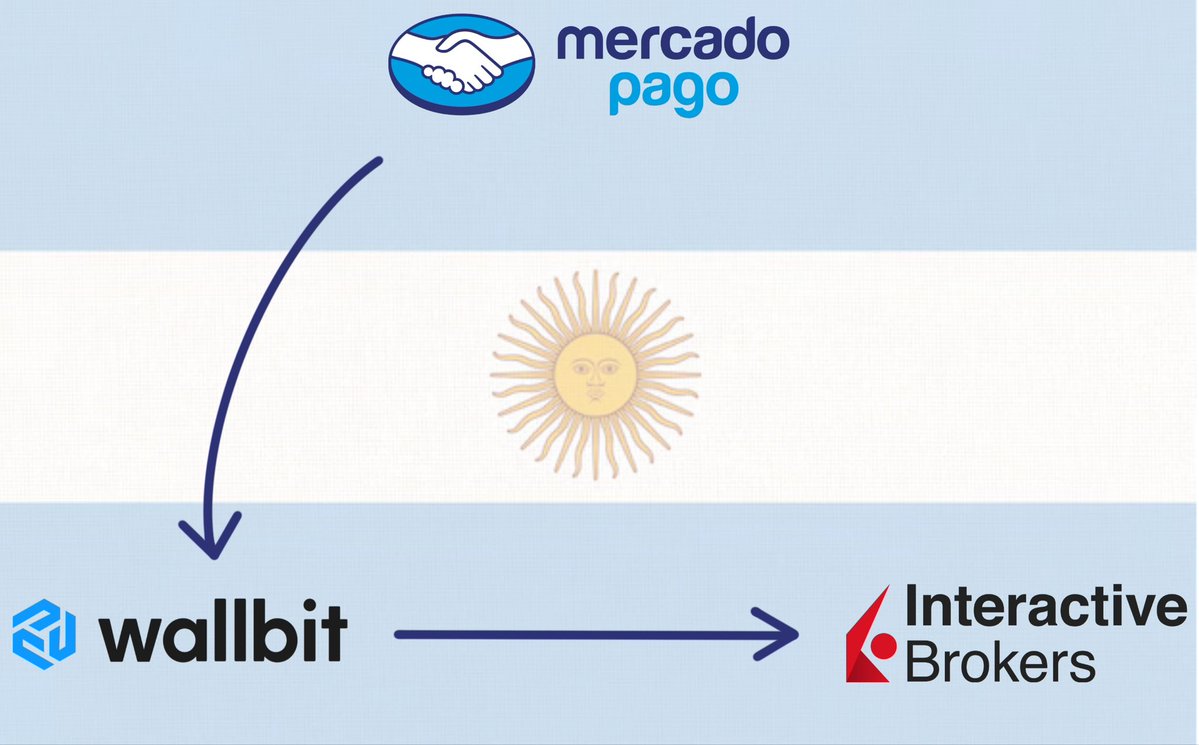
En mi caso use Wallbit, este es el instructivo para dar de alta Interactive Brokers y fonder tu cuenta.
https://t.co/iirEd9LUMI
Muy importante poner en el último paso de la transferencia ACH tu número de cuenta de interactive.
La primer transferencia tarda hasta 3 días, las siguientes en 24 horas hábiles ya figura el saldo disponible.
Espero les sirva.
El año pasado compré plata a $30. Ignoré a mi esposa, a mis amigos y a mis padres. Ahora la plata está en $69 y todos me felicitan.
Lo que no saben es que vendí todo a $32, volví a comprar por FOMO a $123… y ahora está en $69.
"Bill Ackman"
Porque acá ten��s una clase magistral de uno de los inversores más importantes del mundo, con mejores lecciones para invertir que en cualquier MBA:
Vitalik Buterin explains why proof-of-stake is more secure than proof-of-work
“I think proof of stake is very secure because to attack the system, you need to have basically as much stake as the rest of the network. Right now, for example, we have 5 million ETH staking, which means you have to come up with 5 million ETH and then join the network.”
At the time of this writing, more than 37 million ETH are being staked, with 3 million ETH waiting to join via the validator queue. At today’s prices, that’s more than $80 billion of ETH someone would have to acquire to attack the network and revert finalized blocks, which is more than the cost of attacking even the Bitcoin network by some estimates.
The other defense mechanism that proof-of-stake has that proof-of-work doesn’t is slashing, which makes Ethereum antifragile. Vitalik explains:
“Recovering from attacks is much easier in proof-of-stake than proof-of-work. For many kinds of attacks you do against [the Ethereum] network, we have this concept of automatic slashing. In order to revert a finalized block, you basically have to have a big portion of your validators sign two conflicting messages. This is something where once these messages are on the network, you can go and prove ‘these people did it.’ So we have this feature in the protocol where you basically take all these people who provably misbehaved and you burn their coins.”
Vitalik also acknowledges the possibility of censoring attacks, where if 1/3rd of validators refuse to attest, the chain can’t finalize. But, as he explains, Ethereum has a contingency plan for this as well:
“Everyone who got censored would create a minority chain, and the community would have to do a soft fork. The would have to say, ‘this chain is clearly attacking us and this one is not attacking us, so we’re going to join this chain.’ Then what happens is, on that new chain, the attackers also lose a lot of coins. The difference between proof-of-stake and proof-of-work is that in a proof-of-stake system, you can identify specific participants — and this isn’t a human going in and saying ‘I don’t like you’. It’s all automated.”
One last benefit of proof-of-stake is that security scales with the value of the network. As Vitalik put it five years ago, it is really relative security, and not absolute security, that matters:
“The security needs of a thing have to be proportional to the size of that thing, because as a thing gets bigger, its enemies become bigger and more well-motivated. If BTC were 100x as big as it is today, the value from destroying it would be 100x higher, and the kinds of actors that would want to care about destroying it would be much bigger and scarier. This is also why countries of all sizes have roughly similarly sized militaries as a percentage of GDP. Hence, cost of attack divided by market cap really is the correct statistic to measure, and in the long run issuance-free PoW really does look not that good."
Source: @lexfridman (Jun 2021)
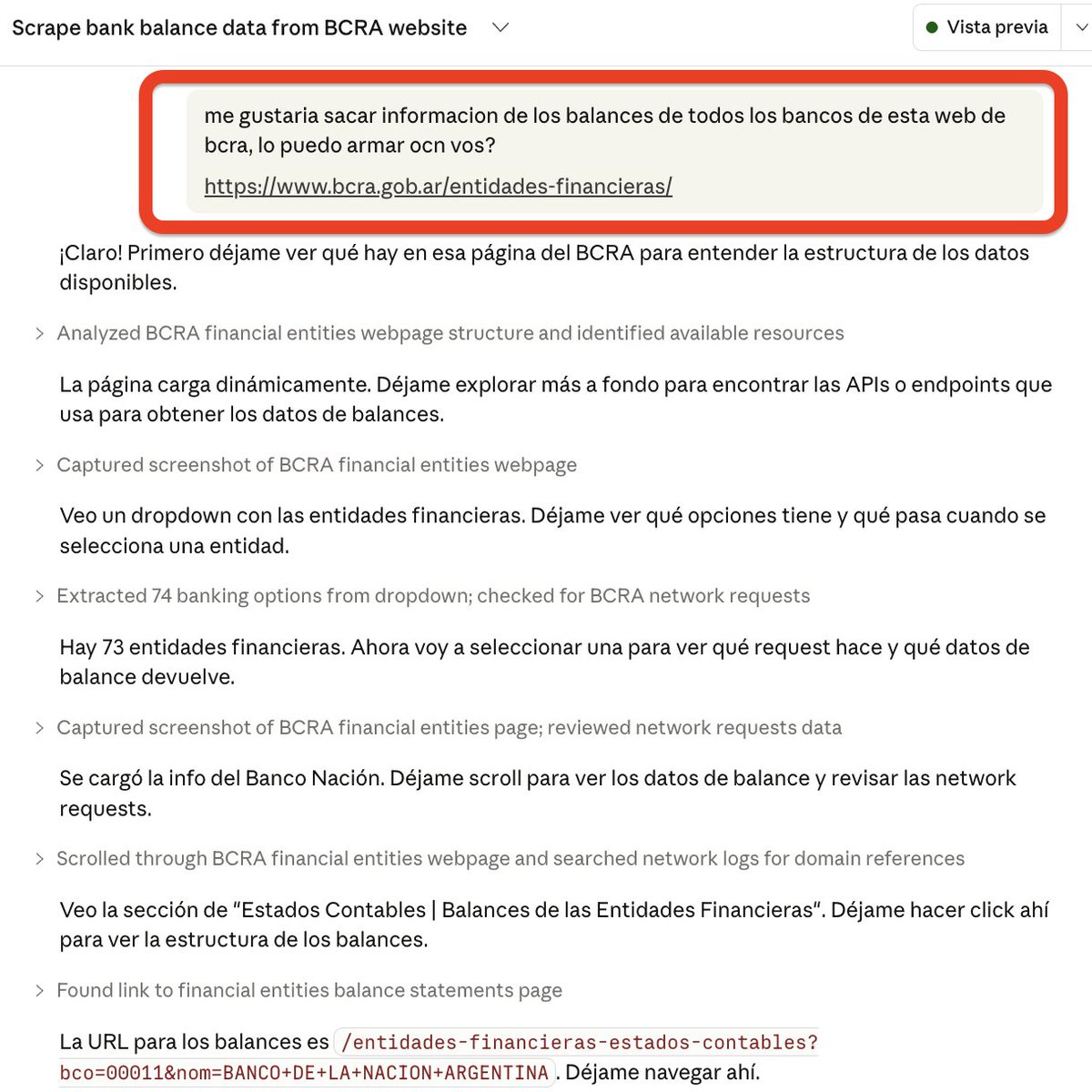
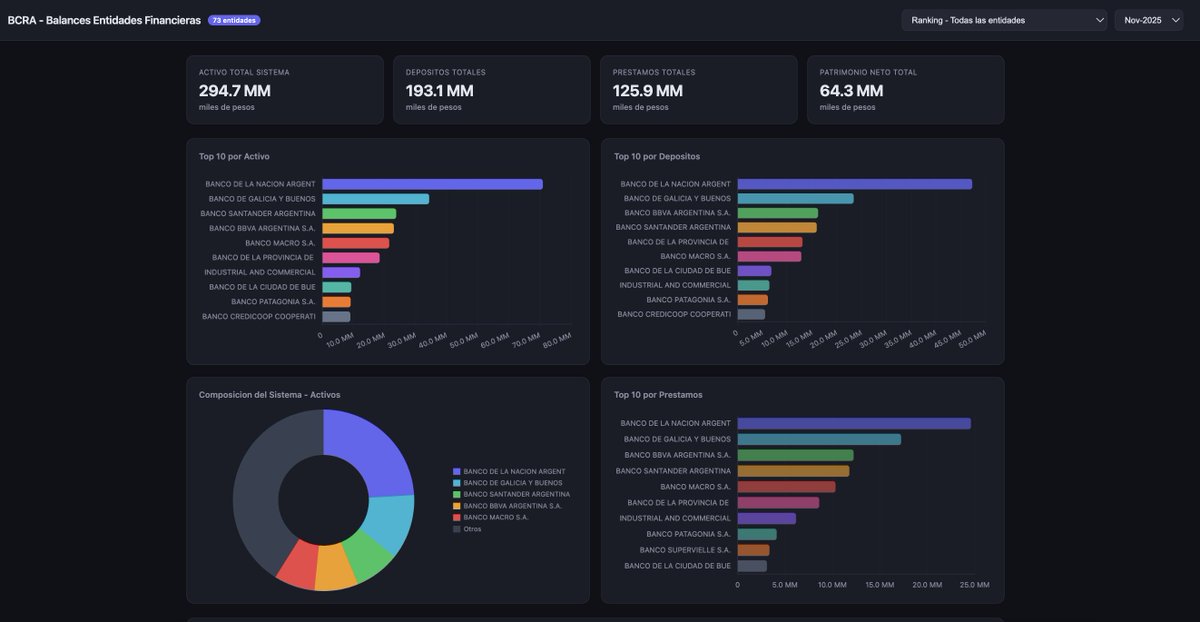
Quería tener la info de los balances de bancos en un solo dashboard así que le pedí a Claude que me scrappee BCRA. En 20 min el tipo me lo puso en una web hermosa.
https://t.co/YCeCY35Vpu
Hace mucho tiempo no me daba tanto miedo una tecnología. El que no se adapte está jodido.
Recently I have been starting to worry about the state of prediction markets, in their current form. They have achieved a certain level of success: market volume is high enough to make meaningful bets and have a full-time job as a trader, and they often prove useful as a supplement to other forms of news media. But also, they seem to be over-converging to an unhealthy product market fit: embracing short-term cryptocurrency price bets, sports betting, and other similar things that have dopamine value but not any kind of long-term fulfillment or societal information value. My guess is that teams feel motivated to capitulate to these things because they bring in large revenue during a bear market where people are desperate - an understandable motive, but one that leads to corposlop.
I have been thinking about how we can help get prediction markets out of this rut. My current view is that we should try harder to push them into a totally different use case: hedging, in a very generalized sense (TLDR: we're gonna replace fiat currency)
Prediction markets have two types of actors: (i) "smart traders" who provide information to the market, and earn money, and necessarily (ii) some kind of actor who loses money.
But who would be willing to lose money and keep coming back? There are basically three answers to this question:
1. "Naive traders": people with dumb opinions who bet on totally wrong things
2. "Info buyers": people who set up money-losing automated market makers, to motivate people to trade on markets to help the info buyer learn information they do not know.
3. "Hedgers": people who are -EV in a linear sense, but who use the market as insurance, reducing their risk.
(1) is where we are today. IMO there is nothing fundamentally morally wrong with taking money from people with dumb opinions. But there still is something fundamentally "cursed" about relying on this too much. It gives the platform the incentive to seek out traders with dumb opinions, and create a public brand and community that encourages dumb opinions to get more people to come in. This is the slide to corposlop.
(2) has always been the idealistic hope of people like Robin Hanson. However, info buying has a public goods problem: you pay for the info, but everyone in the world gets it, including those who don't pay. There are limited cases where it makes sense for one org to pay (esp. decision markets), but even there, it seems likely that the market volumes achieved with that strategy will not be too high.
This gets us to (3). Suppose that you have shares in a biotech company. It's public knowledge that the Purple Party is better for biotech than the Yellow Party. So if you buy a prediction market share betting that the Yellow Party will win the next election, on average, you are reducing your risk.
Mathematical example: suppose that if Purple wins, the share price will be a dice roll between [80...120], and if Yellow wins, it's between [60...100]. If you make a size $10 bet that Yellow will win, your earnings become equivalent to a dice roll between [70...110] in both cases. Taking a logarithmic model of utility, this risk reduction is worth $0.58.
Now, let's get to a more fascinating example. What do people who want stablecoins ultimately want? They want price stability. They have some future expenses in mind, and they want a guarantee that will be able to pay those expenses. But if crypto grows on top of USD-backed stablecoins, crypto is ultimately not truly decentralized. Furthermore, different people have different types of expenses. There has been lots of thinking about making an "ideal stablecoin" that is based on some decentralized global price index, but what if the real solution is to go a step further, and get rid of the concept of currency altogether?
Here's the idea. You have price indices on all major categories of goods and services that people buy (treating physical goods/services in different regions as different categories), and prediction markets on each category. Each user (individual or business) has a local LLM that understands that user's expenses, and offers the user a personalized basket of prediction market shares, representing "N days of that user's expected future expenses".
Now, we do not need fiat currency at all! People can hold stocks, ETH, or whatever else to grow wealth, and personalized prediction market shares when they want stability.
Both of these examples require prediction markets denominated in an asset people want to hold, whether interest-bearing fiat, wrapped stocks, or ETH. Non-interest-bearing fiat has too-high opportunity cost, that overwhelms the hedging value. But if we can make it work, it's much more sustainable than the status quo, because both sides of the equation are likely to be long-term happy with the product that they are buying, and very large volumes of sophisticated capital will be willing to participate.
Build the next generation of finance, not corposlop.