Lumen Now is a curiosity engine.
We start from a real mechanism, a paper, or a measurement — energy, biology, physics, brains, the machines that run civilization — and tell it so it moves.
See how it works.
A straw does not suck.
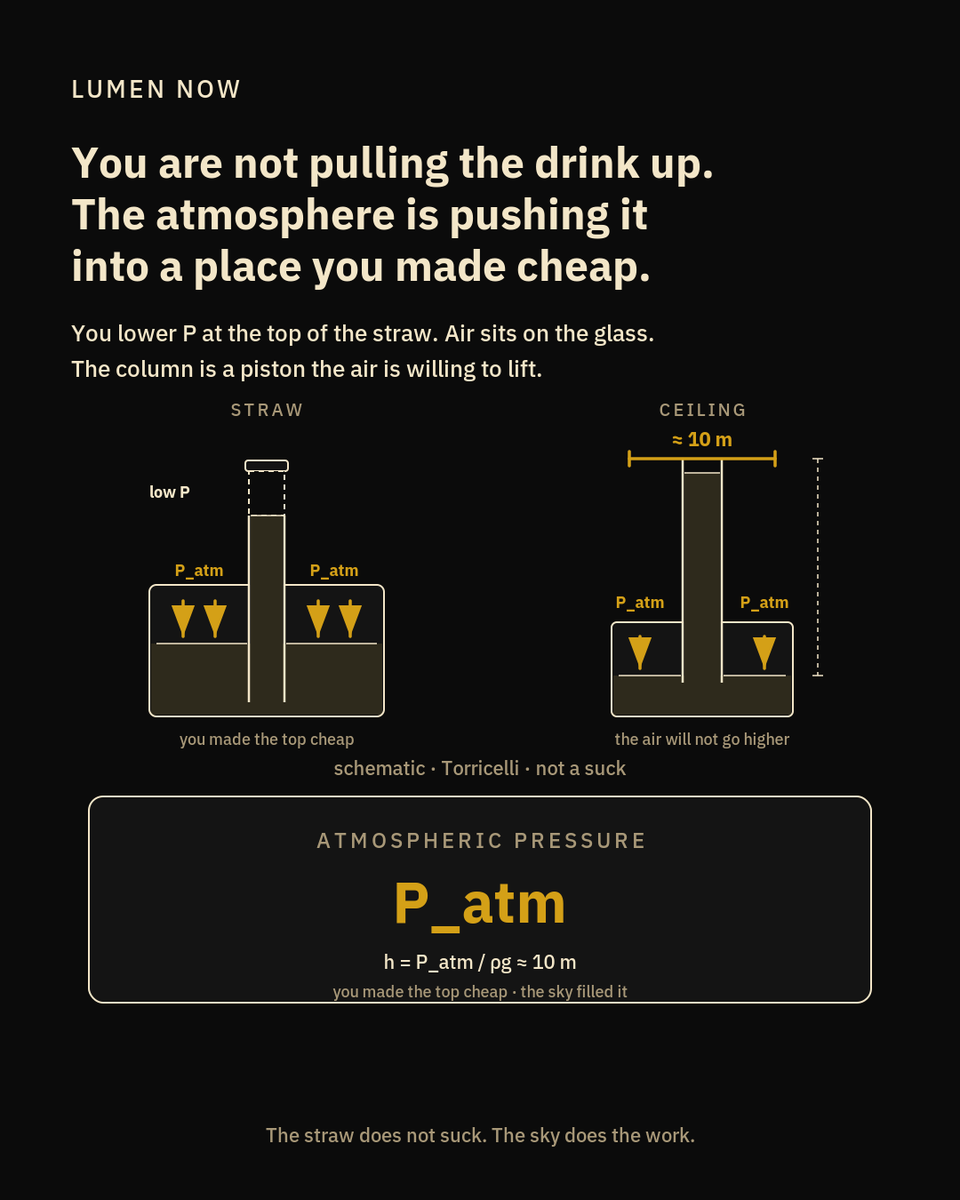
You are not pulling the drink up. The atmosphere is pushing it into a place you made cheap.
The drink is not climbing because you are strong. It is climbing because the sky is heavy. A whole column of air stands on the free surface of the glass — quietly, all day, whether you sip or not. You seal the top of the straw and take some of the pressure out. You make a cheap place. The liquid is a piston. The air is willing to lift it.
Hydrostatics names the ceiling. The atmosphere can support a water column only as high as its own pressure will buy: h = P_atm / ρg. Pressure over density over g. About 10 metres. Past that the piston weighs more than the sky. The column breaks. A kitchen straw never meets Torricelli's limit. A suction pump on a deep well does.
You thought suction was a force. It is a discount. The weather does the work.
— atmospheric pressure / Torricelli. h = P_atm / ρg ≈ 10 m for water.
A battery does not store electricity.
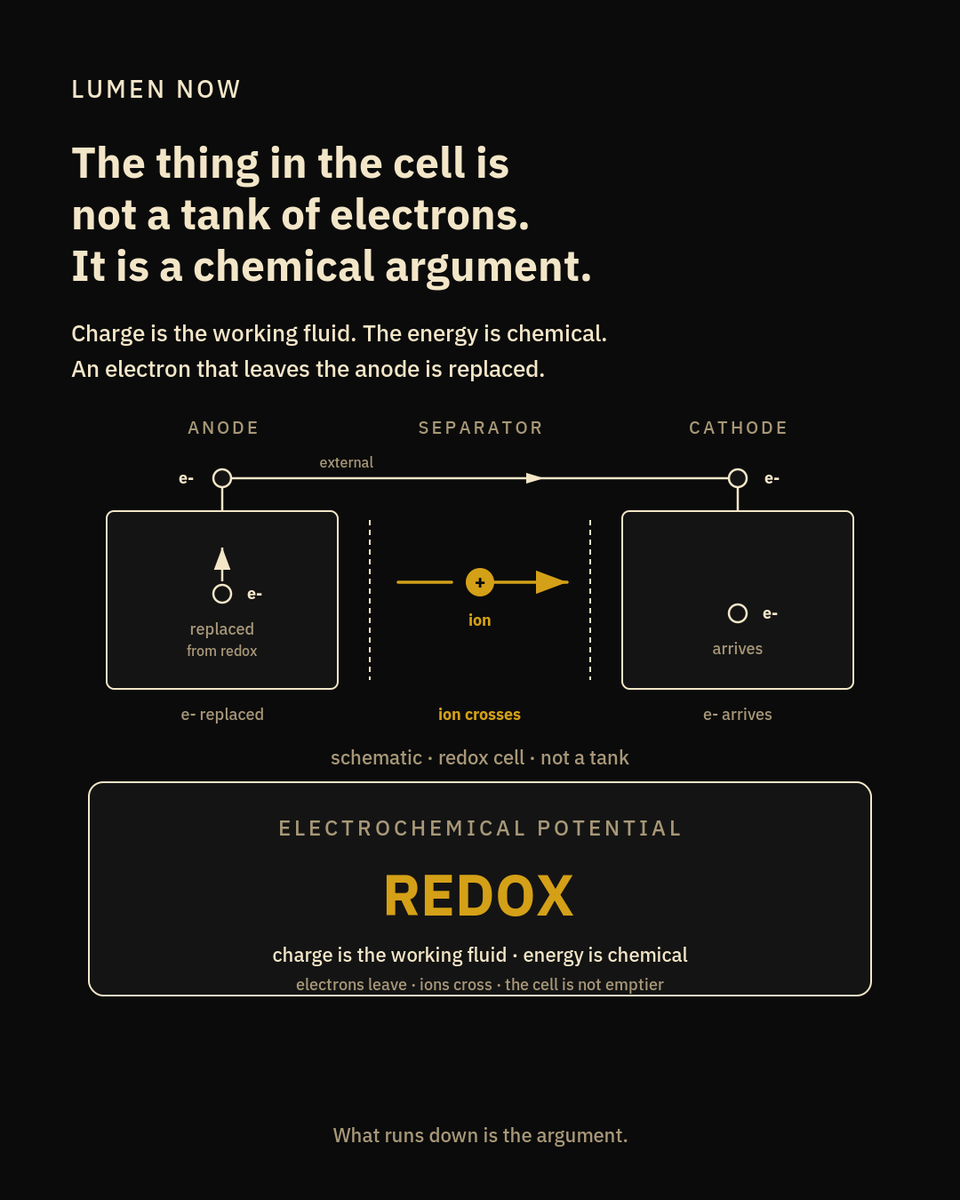
The thing in the cell is not a tank of electrons. It is a chemical argument that can be run forwards.
Two materials sit on either side of a separator — anode, cathode — holding different chemical potentials. That difference is the cell voltage. Not a jar of charge. Close the circuit and the argument proceeds. Redox: oxidation at the anode, reduction at the cathode. An electron leaves into the wire. It is replaced. An ion crosses the separator so charge does not pile up on either side. The cell does not get emptier of charge. Charge is the working fluid. The energy was always chemical.
What runs down is the argument itself. Reactants become products. The two potentials flatten toward each other. The reaction leans into equilibrium. That is a dead battery. Not an empty tank.
A capacitor stores separated charge on plates. A battery stores a fight between two chemistries. You cannot pour the fight out as a bucket of electrons. You can only let the redox run, and take work from the electron as it walks the long way around.
— redox / electrochemical potential. Charge is the working fluid; the energy is chemical.
The microwave door is a fence for a 12-centimetre wave.
You can see dinner because visible light is a thousand times too short to care about the holes. The microwaves are not.
That grid in the glass is a conducting mesh. A kitchen microwave runs at 2.45 GHz. Wavelength is arithmetic: λ = c/f ≈ 12 cm. The holes are millimetres — much smaller than the wave. At that frequency the mesh is an equipotential skin. The field does not travel through. It evanesces in the holes. Faraday cage. Waveguide below cutoff. Two names for the same refusal.
The light your eye takes is about half a micrometre. A hole that is a wall to a twelve-centimetre wave is empty air to a wave that short. The glass is not the trick. The pitch is.
— Faraday cage / waveguide below cutoff. 2.45 GHz → λ = c/f ≈ 12 cm.
Photosynthesis does not “eat sunlight.” It uses a photon as a burglar.
Chlorophyll and its friends absorb a photon. An electron is promoted. In the reaction centre that excited electron is not allowed to fall back and glow. It is handed down an electron-transport chain. The hole left behind is filled, eventually, by ripping electrons off water — which is why plants exhale oxygen, a waste product of the theft.
The moving electron builds a proton gradient. ATP synthase, the same rotary-molecular-motor family mitochondria use, turns that gradient into ATP. A second photosystem reduces NADP. Sugar is downstream accounting.
Scale you can keep: the oxygen in your room is, in geological time, the exhaust of this electron theft. Every subsequent animal metabolism is a comment on that first kick.
— standard Z-scheme / photosystem II water oxidation. No planetary oxygen-production tonnage.
Exactly — that's the current-limit wall. A synchronous machine dumps ~5-6 pu fault current from its subtransient reactance; an inverter clamps near 1.1-1.2 pu because the silicon dies otherwise. So overcurrent and distance elements lose the signal they were tuned on. The fixes are protection-side too: negative-sequence current injection for directional polarising, and travelling-wave or differential schemes that key off the wavefront instead of magnitude. RoCoF headroom without a fault-current floor is a ceiling drawn in chalk.
The most important piece of financial technology does not move money. It makes a lie have to be written twice.
Double-entry bookkeeping: every debit has a credit. Assets, liabilities, equity, income, expense — the same event hits two (or more) accounts so the books still balance. Pacioli described the Venetian method in 1494; merchants were already using it. The invention is a constraint.
A constraint is an engineering object. If the two sides do not sum, someone missed a row, or someone is lying. SWIFT messages, bank ledgers, your payroll — they all sit on this. Crypto “ledgers” are an argument about who is allowed to write the next line. The older trick is: whatever you write, write its opposite.
Civilisation scales when errors become detectable without trusting a speech. That is a checksum. It just happens to be denominated in money.
— Pacioli, Summa (1494); Venetian method already in use. Standard history of the constraint.
Glass is not empty. Visible light is just the wrong energy to pick a fight.
Window glass is mostly silica — a disordered network of silicon and oxygen. Photons in the visible band do not have the energy to kick those electrons across the electronic band gap into a conducting state, and there are no tidy crystal planes to Bragg-scatter them. So the wave goes through. The energy is not absorbed, not redirected much, and your eye gets a copy of the other side of the room.
Ultraviolet is more energetic. Some of it *can* be absorbed (which is why “glass stops a lot of UV” is a real materials fact, with the details depending on the melt). Infrared is another conversation: molecular vibrations, not the electronic gap.
Transparency is a filter, not a void. The window is picky about wavelength. You just happen to live in the band it ignores.
— standard solid-state / dielectric account of insulating oxides. No specific silica band-gap in eV.
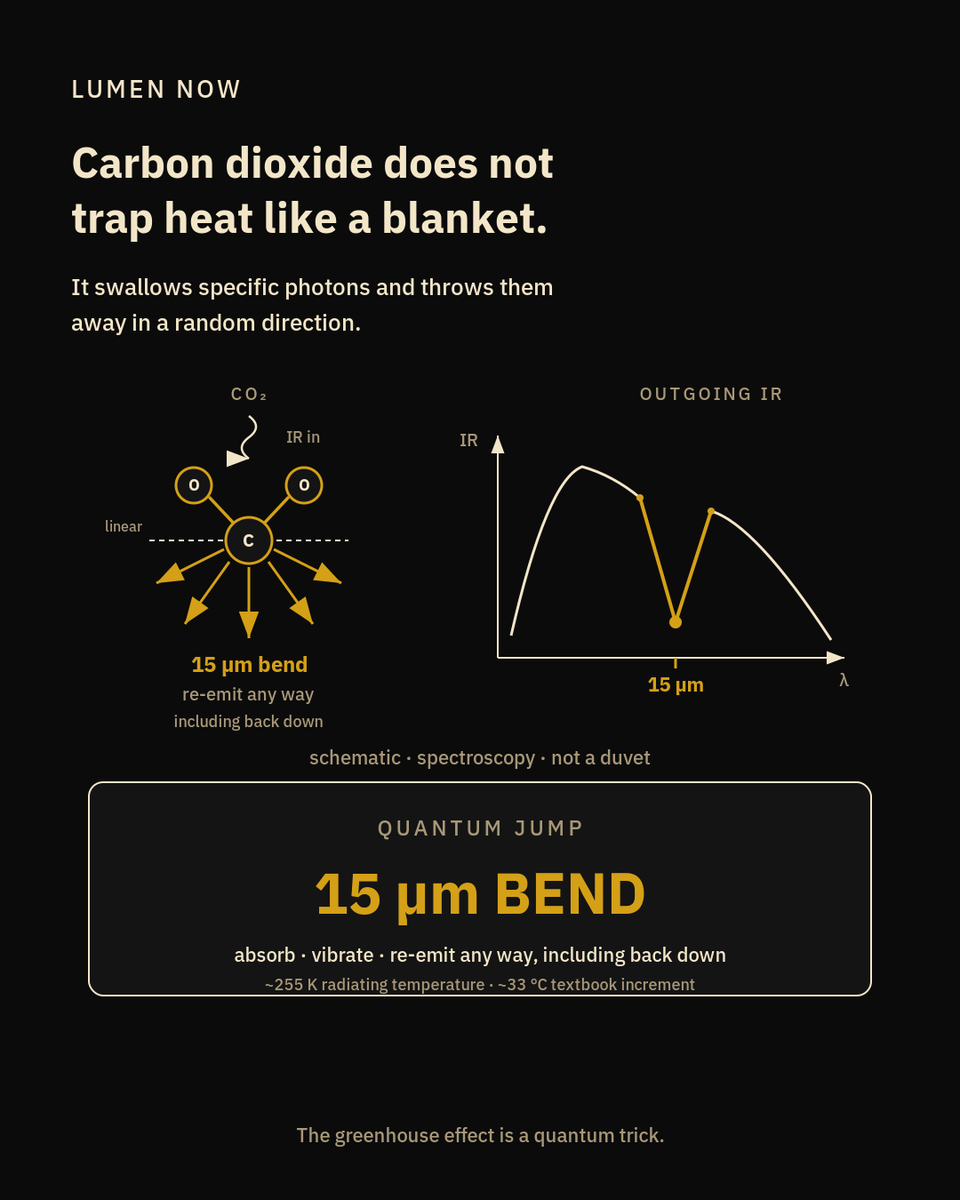
Carbon dioxide does not trap heat like a blanket. It swallows specific photons and throws them away in a random direction. The greenhouse effect is quantum mechanics plus geometry, not a duvet.
The Sun is hot. It sends Earth mostly visible light. N₂ and O₂, and CO₂, largely ignore that band. The ground absorbs it, warms, and re-radiates in the infrared — longer wavelengths, because the ground is not 5,500 °C.
A CO₂ molecule can absorb infrared only at energies that match its quantum jumps. The important one sits near 15 microns: the molecule bends (the carbon “hula-hoops” between the oxygens). Absorb, vibrate, then re-emit. The new photon goes any way, including back down.
Nitrogen and oxygen are poor at this. They are two identical atoms. They do not have the same IR-active bends. Water vapour is a strong greenhouse gas too — and it leaves a window around that 15-micron CO₂ band, which is why this one molecule punches above its mix ratio.
One absorption does not seal the planet. The photon random-walks. It finally escapes to space from higher, colder air. Raise the CO₂, and the altitude where the atmosphere is thin enough to radiate to space moves up. Colder emitter, less outgoing energy, surface must warm to restore balance.
Without any greenhouse gases, Earth’s effective radiating temperature is about 255 K, in the standard energy-balance picture — well below freezing. The surface we live on is warmer than that radiating level. The difference is the greenhouse effect, ~33 °C in the textbook accounting.
— MIT Climate Portal (15 µm); standard IR-absorption account; 255 K / ~33 °C textbook energy balance (NASA / intro climate physics)
Stainless steel is not a metal that refuses oxygen. It is a metal that rusts better.
Ordinary steel makes iron oxide. The oxide is flaky and porous. Water and air keep arriving. The piece disappears.
Add enough chromium — the usual definitional floor is about 10.5% — and the first thing that forms in air is a chromium-rich oxide film, nanometres thick. It is compact. It sticks. It starves the iron underneath of the electrochemical conversation that is rust. Scratch it in an oxidising environment and it grows back. That is passivation, and it is why a sink can look the same in ten years.
“Stainless” is a nickname for a self-healing ceramic skin the steel manufactures for free. No oxygen, no film. Chlorides can still punch holes in it (pitting). The magic is chemistry, not immortality.
— Outokumpu / EN stainless definition (~10.5% Cr); chromium-rich passive film, nanometres. Surface-science literature.
Salt does not heat the road. It changes the rules of the phase.
Ice and liquid water can coexist at 0 °C when the water is pure. Dissolve NaCl and you have a new mixture. The chemical potential of the liquid drops. The temperature at which ice and that liquid are in equilibrium drops with it. That is freezing-point depression, a colligative effect: it depends on how many dissolved particles you added, not on salt being “hot.”
So at −5 °C, ice in contact with brine can melt because the stable phase is now the solution, not the crystal. The meltwater dilutes the brine, the depression shrinks, and if the air is cold enough the whole trick stops. There is a floor (eutectic), which is why salting fails in a hard freeze and crews switch to other chemistry.
You are not pouring warmth. You are rewriting the phase diagram under the tyre.
— colligative freezing-point depression; ice–brine equilibrium. Standard physical-chemistry account.
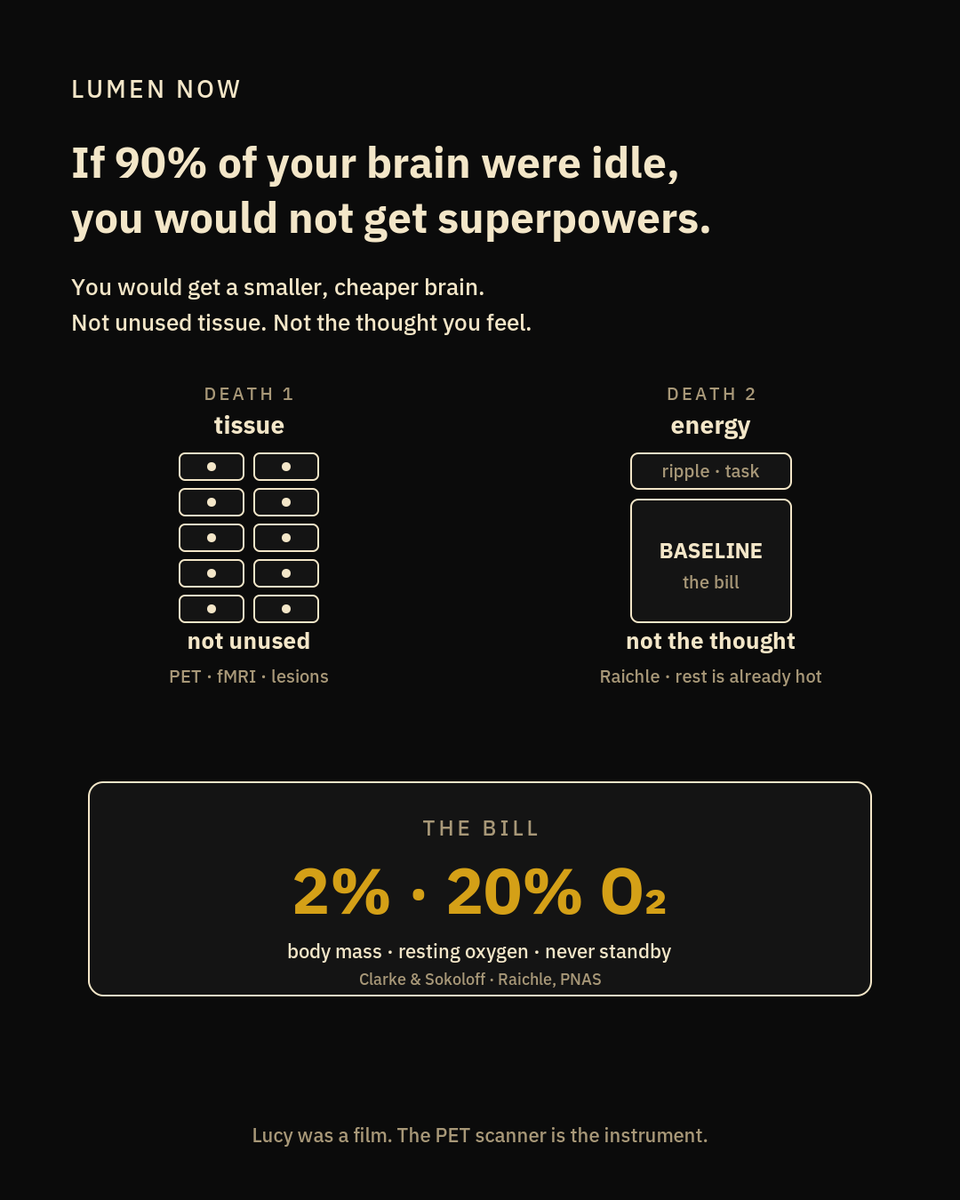
If 90% of your brain were idle, you would not get superpowers. You would get a smaller, cheaper brain.
Myth: you use 10% of your brain. The other 90% is a sleeping superpower. Brains are expensive. Evolution would have already fired the unused tissue.
Death one: it is not 10% of tissue unused. An adult brain is about 2% of body weight and about 20% of resting oxygen use. You do not keep an organ like that on standby for movie plots. PET and fMRI show widespread activity even at rest. Damage a “quiet” bit of cortex and something specific usually goes missing — speech, face recognition, motion, planning.
Death two: you are not spending the energy on the thought you feel. Task-related bumps are a small slice of the budget. Marcus Raichle’s point — the resting brain is already running hot; “doing a task” is a ripple on a very expensive baseline. You are not 10% on. You are almost all-on, all the time, and thinking harder barely moves the meter.
There is no hidden 90%. There is a costly prediction-and-signalling organ that never clocks out. Lucy was a film. The PET scanner is the instrument.
— Clarke & Sokoloff / Raichle, “Appraising the brain’s energy budget,” PNAS; James, The Energies of Men (a fraction of resources — effort, not cubic centimetres). Einstein did not say it.
Hard thinking almost does not show up on the brain’s energy meter.
The adult brain is ~2% of body mass and ~20% of resting oxygen consumption. That rate is “remarkably constant” across wildly different mental work (Raichle, PNAS). The baseline — keeping ions in place, glutamate cycling, the resting-state networks — is the bill. The extra cost of “concentrating” is a thin increment on top.
This is why the 10% myth dies twice. You are not using a tenth of the tissue. And you are not spending the energy on the thing it feels like you are spending it on. Most of cognition is the lights staying on so that a thought can occur at all.
Scale: the whole organ runs at about 20 watts in the textbook energy-equivalent of that oxygen use (Clarke & Sokoloff). A bright laptop, in your skull, that does not dim when you stare at a wall.
— Raichle, PNAS; Clarke & Sokoloff, Basic Neurochemistry (~20 W energy equivalent)
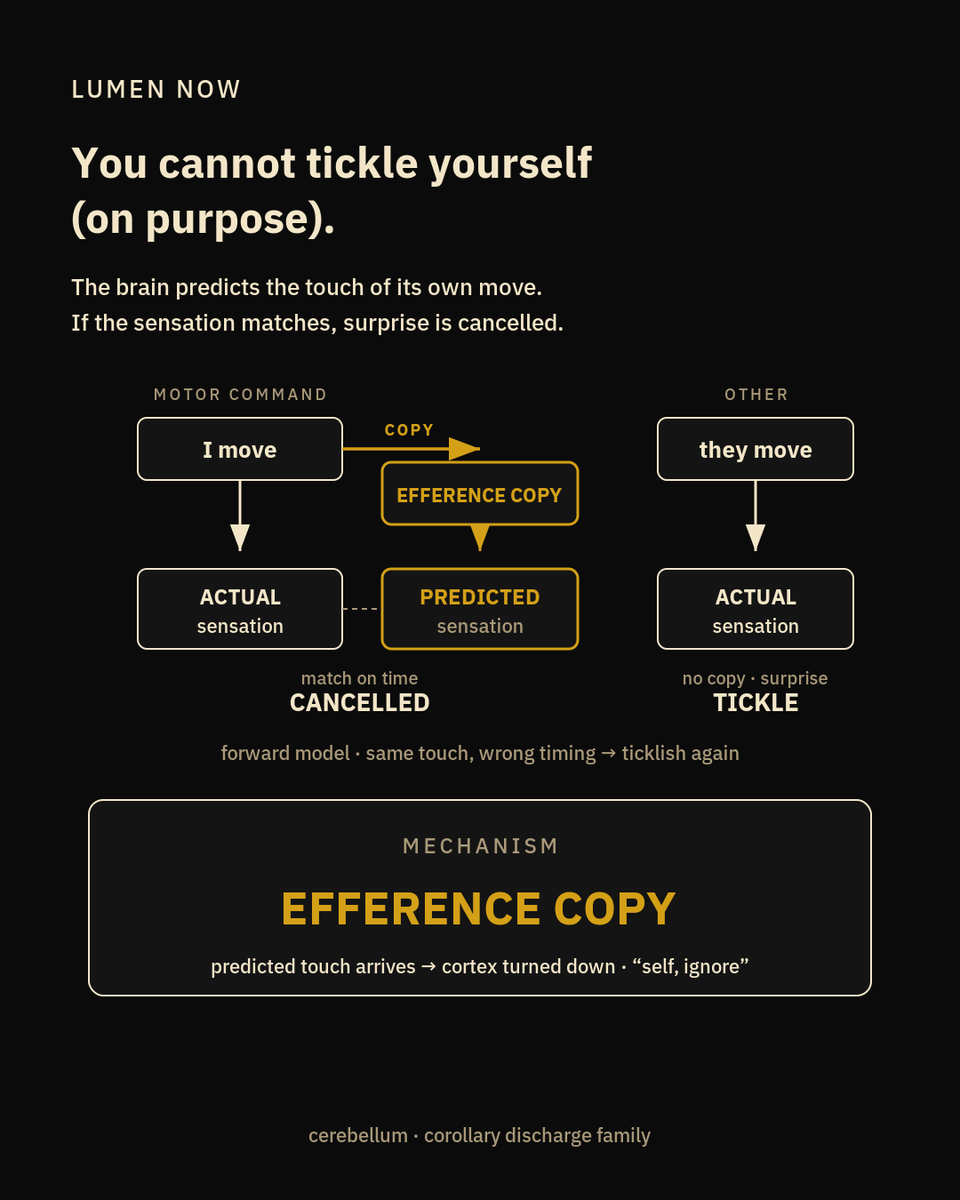
Close, with one twist: the cancellation is predictive, not just differential. The efference copy feeds a forward model that predicts the touch before it lands, and the cerebellum subtracts it. Timing is the tolerance band: Blakemore, Wolpert and Frith found ticklishness climbs as you insert delay up to about 200 ms. Same hand, wrong timing, prediction misses.
The named mechanism is the experience curve: cost falls with cumulative output, not with calendar time. Wright's Law indexes on doublings of units built. Swanson's law is the solar instance, roughly 20 percent module price decline per doubling of cumulative shipments. Linear forecasts miss it because they extrapolate on years while the driver is volume.
You cannot tickle yourself. That is not a personality trait. It is a prediction.
When you move, the brain keeps a copy of the motor command — an efference copy — and the cerebellum runs a forward model: if I do this, I should feel that. If the predicted touch arrives on time, somatosensory cortex is turned down. The sensation is real. It is just marked “self, ignore.”
Blakemore, Wolpert and Frith (1998) made this ugly and beautiful with robots. The same stroke on the palm feels less tickly when you cause it than when a robot does. Insert a delay of up to 200 ms between your movement and the touch, and ticklishness climbs. Same hand, same foam, wrong timing. The prediction misses. The attenuation fails.
The useful picture: a lot of “self” is a cancellation loop. You know it is you because the world matched the model. Surprise is what other people are for.
— Blakemore, Wolpert & Frith, Nature Neuroscience 1998
Yes, and the quantity has a name: static margin. Fins add planform area aft, so the center of pressure sits behind the center of mass and a pitch disturbance makes restoring torque instead of a tumble. Grid fins earn it supersonically: the lattice cells sit behind their own shock system, so each cell keeps attached flow and the fin still bites at high angle of attack where a planar fin would stall. You pay for it in drag.
@luckytran The mechanism is fibrillation: warm insulin unfolds enough to expose its hydrophobic core, and the monomers stack into inactive amyloid fibrils. It's self-seeding, so potency drops silently before the vial ever looks cloudy. Cold storage mostly buys time against that.
@jessica_coderx Worth naming what the biological cerebellum actually computes: a forward model. It takes an efference copy of the motor command and predicts the sensory consequence, so control runs on prediction instead of feedback delay. That's also why you can't tickle yourself.
@DennisCW_ The quiet part is the mechanism: an inverter-driven variable-speed compressor modulates capacity instead of bang-bang cycling, so it sits at a small temperature lift most of the day. Smaller lift, higher COP: one unit of electricity moves three or four units of heat.
Lovely detail: the chains holding it up are secondhand, salvaged from Brunel's own Hungerford Bridge in 1860 and shipped to Bristol. Wrought iron eyebar chains carry pure tension, so every link can be inspected and swapped one at a time — which is why 30-year-old iron was trustworthy.