YOU ARE NOT LOSING MONEY BECAUSE YOU PICK BAD STOCKS.
You are losing money because of when you buy them.
If you’re serious about investing, read this post carefully and save it.
You spend a week on a company, everything checks out, and you get that little rush of finally finding something good. So you buy it that same night, at whatever price it happens to be sitting at.
That’s the whole problem right there.
Research tells you what to own. It tells you nothing about what to pay. 2 completely different skills, and almost nobody works on the second one.
Think about when you actually get excited about a stock. It’s usually after it has already run. The chart looks great, people are posting about it, it’s everywhere. That’s when you’re most likely to buy it, and it’s exactly the worst price to buy it at.
Then it pulls back 12% like every stock does, and suddenly you’re questioning the whole thesis. You sell, then it recovers without you, and the annoying part is your research was fine. You were right about the company, you just paid too much for it.
So here’s what I do instead.
Same research, same excitement, and then I do nothing. It goes on a watchlist and I just watch it for a while. Where did buyers show up last time it dropped? How does it normally pull back, 5% or 15%? What price would make me feel calm putting real money in?
I decide all of that before I own it, because once you own something you stop thinking clearly about it.
If it’s trending up, I wait for the dip that always comes. Price drifts back toward the 50 day or some old high that should hold, volume dries up on the way down, and then I want to see buyers actually step back in before I do anything. A strong green day, volume coming back, something that tells me the selling is done.
If it’s stuck in a range it’s easier. Buy near the bottom of it and stop overthinking.
Honestly the hardest part is just the waiting. You will watch something run without you and it will feel awful lol. That’s going to happen.
But then one day it drops right into your zone, everything lines up, and you buy it feeling completely calm. Size feels right, you have room to breathe, and when it goes red for a day you do not even care because you didn’t overpay for it.
That feeling is the whole point.
Once you get it a few times, buying something the second you like it starts to feel insane.
That’s the exact strategy I use, and it’s how I was able to buy the bottom on PYPL, MELI, ICE, SPGI, and a lot of other great companies.
All of them were shared exclusively inside The Assembly, my private community of 3,600+ investors.
The goal with this was never to hand people signals and leave it at that. It’s to explain the reasoning behind every move I make, so you learn how to do it yourself. That knowledge stays with you for life.
I’m not begging anyone to join, and I mean that. It’s your choice and I don’t need the money. But if you are serious about investing and you want to be part of the number one finance community in the world, it’s in my bio.
THIS SIMPLE STRATEGY WILL MAKE YOU YOUR FIRST $100K
1. Mark the previous day’s High and Low.
2. Wait for a 1-hour candle to break above the High or below the Low.
3. Wait for the retest of that level and enter in the direction of the break.
Read this Before you trade next.
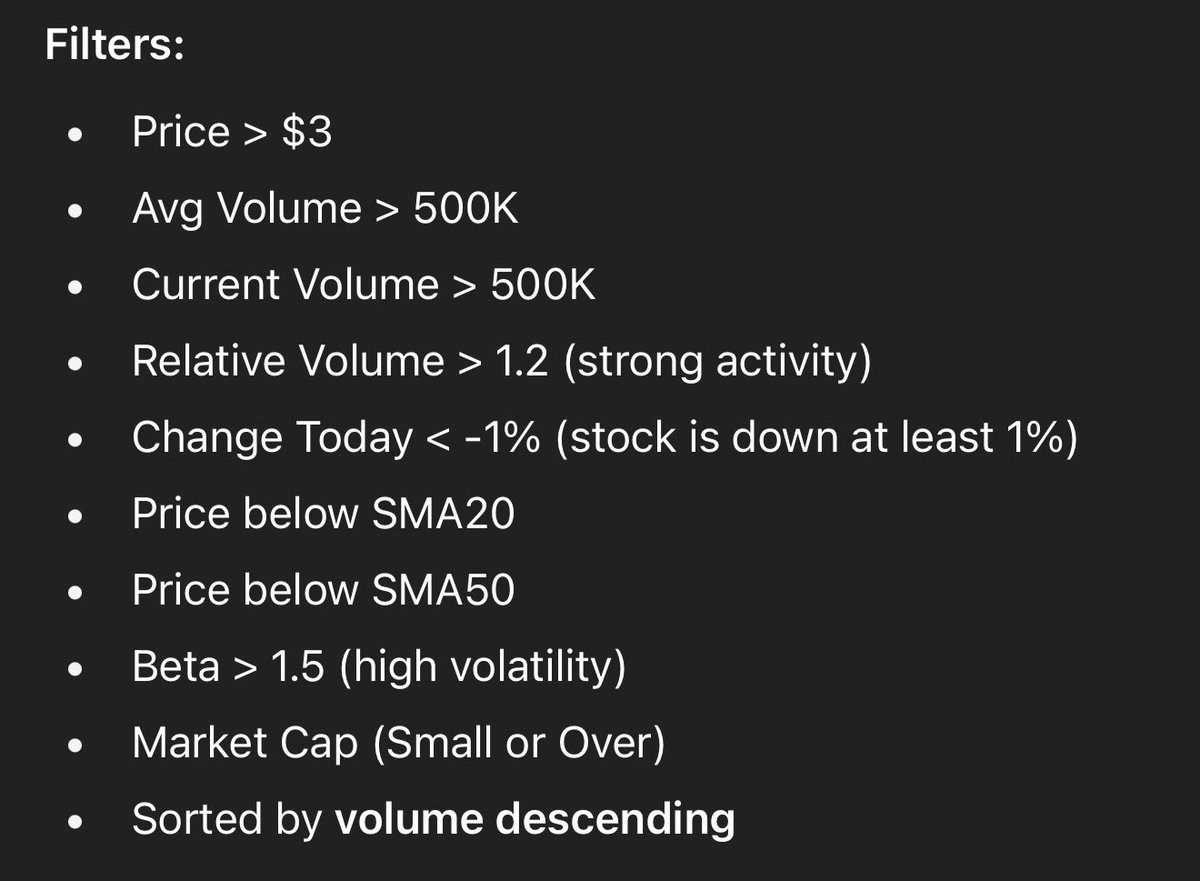
THIS IS THE BEST SCANNER FOR SELLING MARKETS
Save this.
Study these charts this weekend.
Make thousands next week.
This scanner identified the biggest breakdowns across multiple sectors today:
• $TSLA
• $INTC
• $HIMS
• $IREN
• $MU
It find weakness BEFORE the move.
HOW TO STOP LOSING
You keep buying after the trend has already changed
$SMH is a perfect example. This is how we saw leaders like $NVDA and $INTC become weak EARLY
Higher Highs + Higher Lows = Stay long
Lower High + Lower Low = Trend change
Save this. You’ll use it forever.
A few tips on volatile markets:
1. Trade less.
2. Size small.
3. Avoid leverage.
4. Respect the trend.
5. Cash is your friend.
6. Don't fall for FOMO.
7. Always respect risk.
8. Patience is everything.
9. When in doubt, stay out.
10. Only add to your winners.
11. Build positions gradually.
12. Protect your (mental) capital.
13. Never add to losing positions.
14. Small losses are the best losses.
15. Don't try to time the market bottom.
And remember: There will always be another opportunity. You just need to be patient enough.
This Indicator has told you when to BUY and SELL in every market the last 30 years
Listen and Follow this if you want to become Rich from the stock market.
Since 1996, every major $VIX spike above 40 has been followed by a positive 3-year $SPY S&P 500 return.
The VIX is one of the best sentiment indicators I use.
Here’s how I use it:
1) VIX <20 → Overconfidence
• Markets feel calm
• Bull markets often live here
• Stay selective
2) VIX 20–30 → Rising Volatility
• Volatility is increasing
• Expect larger swings
• Focus on quality setups
3) VIX 30–40 → Fear
• Corrections are often underway
• Historically, strong forward returns have often followed
4) VIX >40 → Panic
• Rare occurrence
• Historically one of the best long-term buying zones
• Start buying positions, not panicking
We are currently in “Trim Positions” zone. This means to hold winners and trim positions in them.
This will be your guide moving forward. Keep this with you. Do not lose it.
If only someone told me this sooner-
Don’t listen to analysts.
Don’t listen to Jim Cramer.
Don’t listen to Michael Burry.
Don’t listen to Cathie Wood.
Don’t listen to Michael Saylor.
Don’t follow permabulls.
Don’t follow permabears.
Don’t follow pumper
Don’t follow cheap stocks
Don’t hold bio companies thru a catalyst
Follow price.
Follow technical analysis.
Follow long-term trend.
Follow positive RSI divergences on higher timeframes.
Follow relative strength.
Follow volume.
Follow where institutions are accumulating.
Most importantly…
Follow a President’s buy signals.
This is how you beat the market.
This simple strategy has helped me make Millions trading stocks.
Save this. Bookmark it. You will use it for years.
Most traders focus on individual stocks.
I focus on sector ETFs first.
Sector ETFs tell you where money is flowing, whether a pullback is healthy, and when it’s time to become more defensive.
The weekly 8/21 EMA tells me whether a sector is:
• Still trending higher
• Pulling back to buy
• Breaking down and time to reduce risk
Examples:
• Semis ($SMH) → $NVDA $AMD $INTC are holding their Weekly 8 EMA, showing continued Strength.
• Memory ($DRAM) → $MU $SNDK $STX continue to respect their primary trend and strength holding Weekly 8EMA
• Healthcare ($XLV) → $UNH $LLY $MRK are breaking to new highs, confirming the Best Relative Strength.
• Nuclear ($NLR) → $OKLO $CCJ $CEG lost the weekly trend, signaling Weakness.
The strongest stocks almost always come from the strongest sectors.
This is will tell you before the move to either Buy Sell or Hold.
The stock market changed my life.
This is where I grew up.
Nobody handed me money.
Nobody built this for me.
I failed for 5 years before I saw green.
Today I’m debt free.
I can travel wherever I want
Now this week I made more than I ever imagined
All because I took a risk
This is how you will Save your account and make Millions trading stocks.
Save this. You’ll use it every market cycle.
Fear and Greed index tells you EXACTLY what to do.
Here’s the framework I use:
Extreme Fear (0–25): Start Buying
Fear (25–45): Build Positions
Neutral (45–55): Stay Disciplined
Greed (55–75): Tighten Risk
Extreme Greed (75–100): Protect Capital
Current: 42 Fear -> Look for opportunities to build positions in
A lot of novice “investors” are down 20-30% in the last 2 weeks.
But let me tell you something, if you’re down 20%+ in 2 weeks, you are NOT an investor.
You’re a complete degenerate looking to get rich quick which is an illusion.
In other words, you qualify as a gambler.
REAL investors would almost NEVER be down so much in such a short period of time, because they know how to allocate capital properly and how to hedge and diversify.
Thank you.
I have called every Major move BEFORE each week STARTED.
Not because I can predict the future.
Because I do what most traders refuse to do.
I ZOOM out.
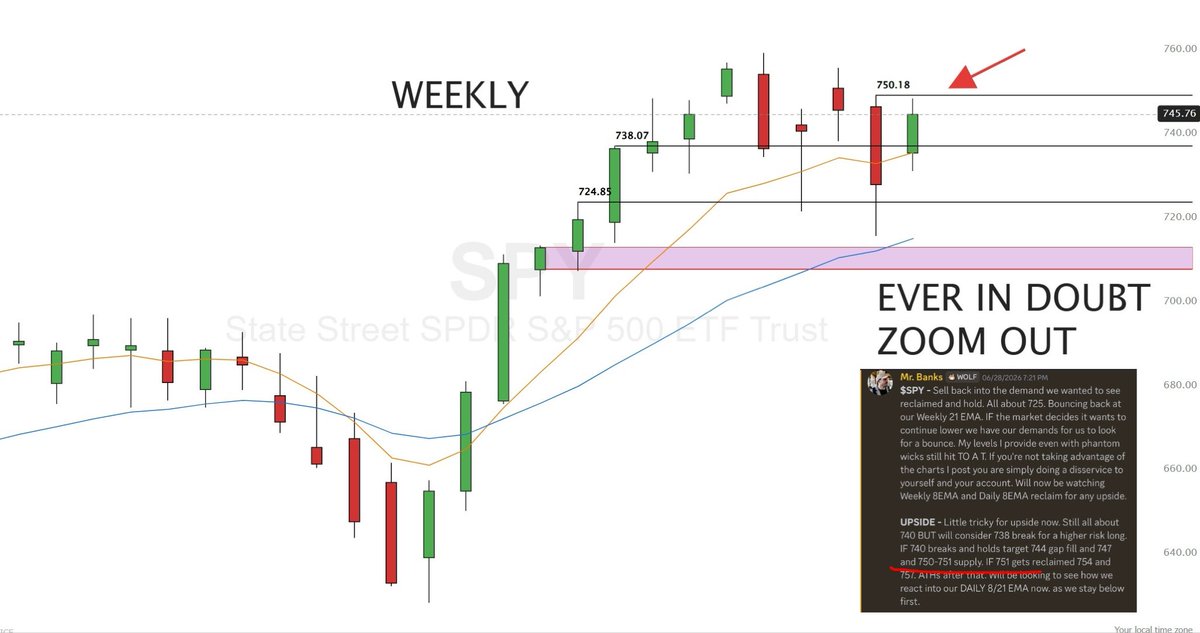
$SPY to 750-751 was called on SUNDAY.
The weekly chart shows me:
• Major support & resistance
• Supply & demand zones
• Trend direction
• Where institutions aka liquidity are active
The lower timeframes create noise.
The higher timeframes create my conviction.
If you’re constantly surprised by the market, you’re probably too zoomed in.
When in doubt, zoom out.
I made over $300,000 in a month.
Here are 8 lessons that took me 13 years to learn:
• The best setups are usually obvious
• Focus on sector leaders, not laggards
• One stock can change your entire year
• The market pays patience, not activity
• You lose because you need to constantly be actively trading
• Your next trade doesn't care about your last trade. Stop focusing on past trades
• Missing a trade is cheaper than forcing one
• The less I trade, the more I make
It took me 13 years to learn this.
You just read it in 15 seconds.
For any retail investors or just anyone who isn’t too experienced that is wondering why your portfolio seems to dump many nights as we have had some pretty crazy drawdowns in the last week or so.
Just a simple breakdown to educate you guys.
Markets trade in a global relay. When the US closes, Asia opens. Japan, Korea, and Taiwan trade all through our overnight hours, and lately those markets have been really volatile.
That matters because so many of the AI and chip names live there. Samsung and SK Hynix which alone make up about half of Korea's entire market and they are central to the whole memory and semiconductor trade.
So when Asia sells off overnight, it sets the tone, and our futures for the same sectors follow. It is not that something new broke in the US. The global chip trade is all connected and it never stops moving just because our market is closed.
It also gets exaggerated because overnight and pre market volume is thin. Less money moving means bigger swings, so a small wave of selling can look scary by morning.
The takeaway. Overnight weakness is usually just global sentiment flowing through, not a real change in the businesses we own. Do not panic. Let the US session open and real volume come in before reacting.
I have MADE over $1,000,000 in the last 2 MONTHS.
The SECRET?
Having a watchlist for every major sector so I can spot rotations EARLY.
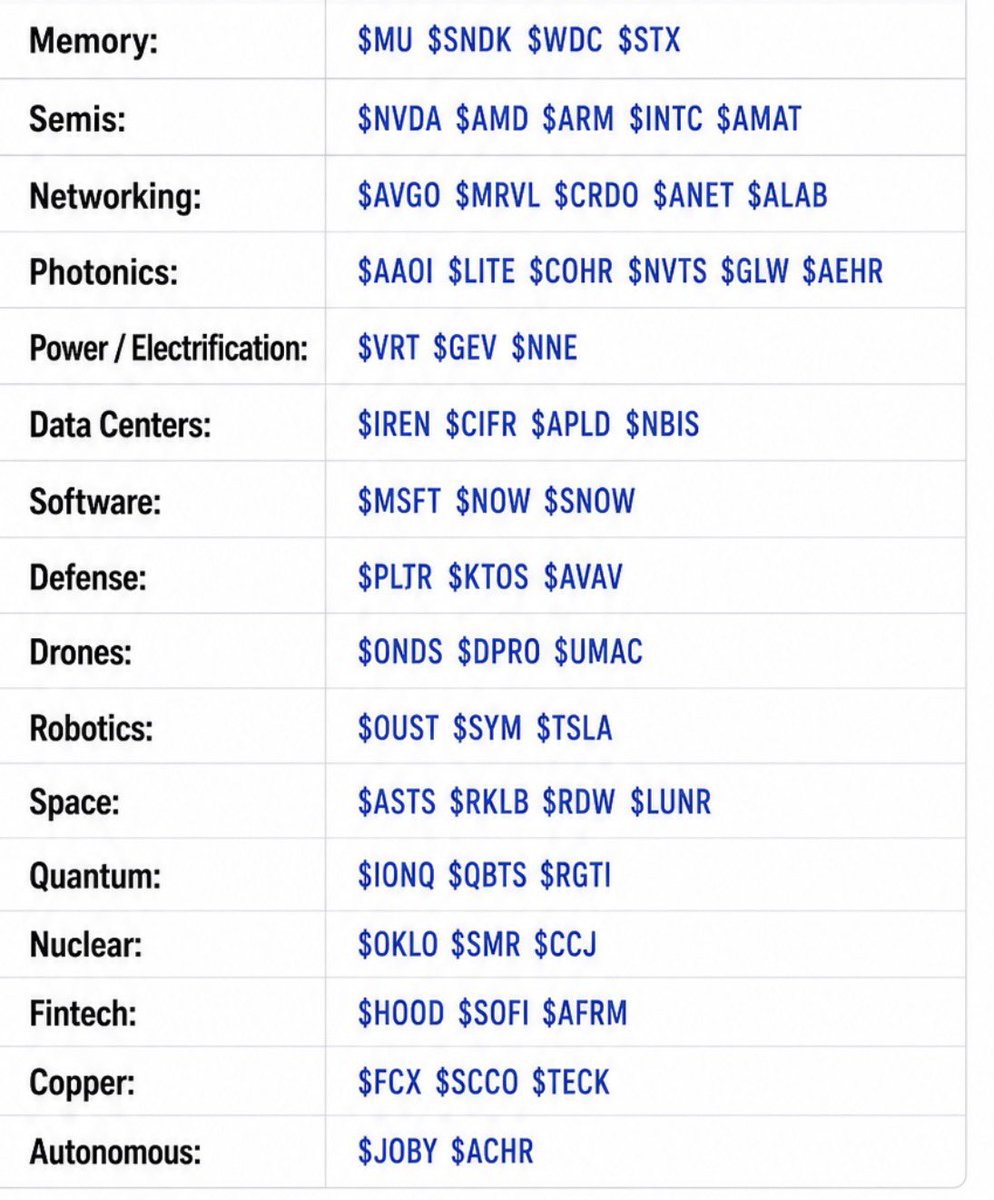
HERE IS MY SECTOR ROTATION WATCHLIST:
Memory: $MU $SNDK $WDC
Semis: $NVDA $AMD $ARM $INTC $AMAT
Networking: $AVGO $MRVL $CRDO $ANET $ALAB
Photonics: $AAOI $LITE $COHR $NVTS $GLW
Power / Electrification: $VRT $GEV $NNE
Data Centers: $IREN $CIFR $APLD $NBIS
Defense: $PLTR $KTOS $AVAV
Drones: $ONDS $DPRO $UMAC
Robotics: $OUST $SYM $TSLA
Space: $ASTS $RKLB $RDW $LUNR
Quantum: $IBM $IONQ $QBTS $RGTI
Nuclear: $OKLO $SMR $CCJ
Fintech: $HOOD $SOFI $AFRM
Autonomous: $JOBY $ACHR
The biggest winners come from finding the next sector rotation before everyone else.
I will HELP you be EARLY to the next rotation.