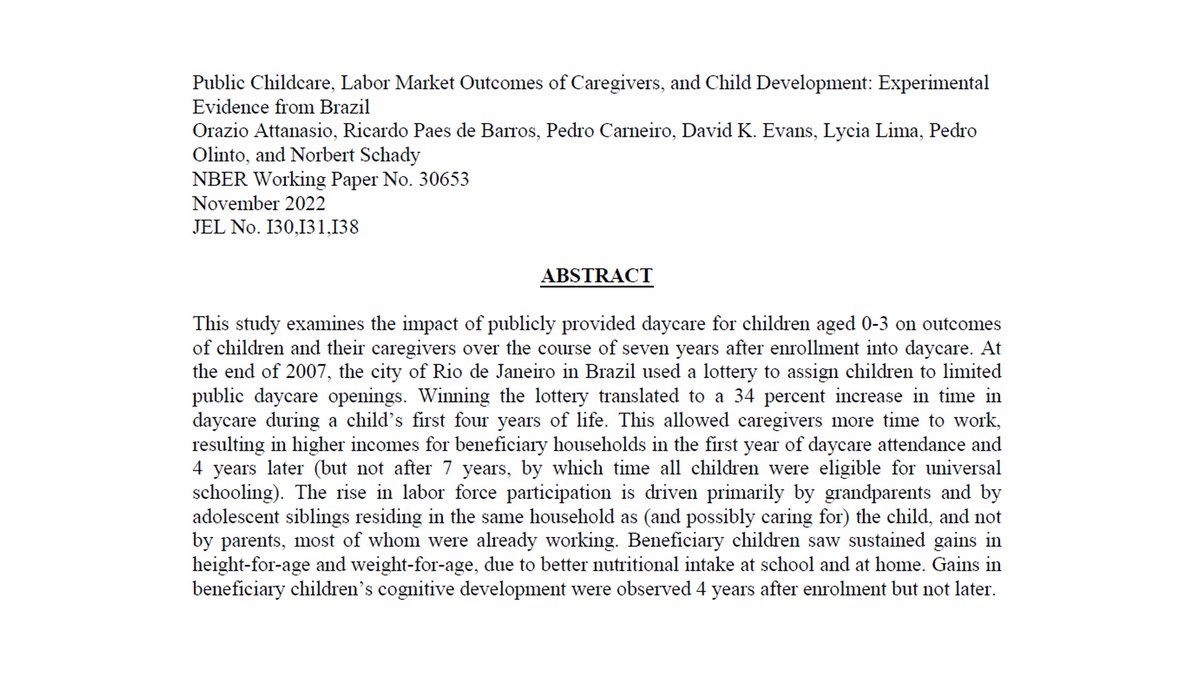
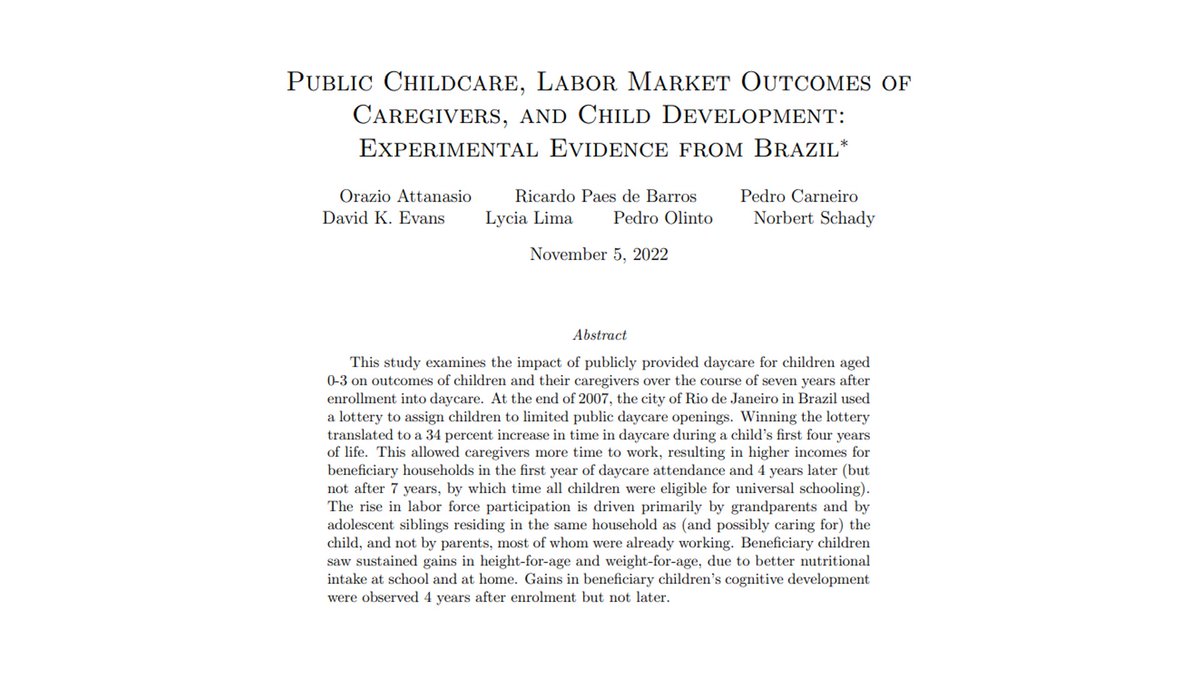
How does providing daycare affect children, their parents, and their grandparents over the course of the next seven years? At-scale evidence from Rio de Janeiro
New paper https://t.co/wJMzn5n4WU
Summary blog https://t.co/qg9d7pKDkg
🧵
Historically, much of the gender gap in earnings could be explained by differences in education and occupational choices. However, this year’s economic sciences laureate Claudia Goldin has shown that the bulk of this earnings difference is now between men and women in the same occupation, and that it largely arises with the birth of the first child.
#NobelPrize
The 2023 Meeting of the Brazilian Econometric Society will be in Rio!
We will have:
- Jeff Wooldridge @jmwooldridge for a mini-course
- Guido Imbens @guido_imbens as Keynote
- Martha Bailey @martha_j_bailey as Keynote
+ more
It'll be awesome!
I hope to see you there!
This is unbelievable!
Kurt Wüthrich, an 84-year-old, Swiss, male scientist, who won the Nobel Prize in 2002 claims that "as a male scientist" he has "a feeling of discrimination."
He said this during the 72nd Lindau Nobel Laureate Meeting on a panel that had four old, male scientists including him and an old, male moderator. (It was literally a susage fest!)
When Science Magazine asked him to elaborate on the kind of discrimnation he faced, "Wüthrich said he did not feel personally discriminated against as an individual at the event but thought that all men attendees faced discrimination while women were tokenized."
Here's an example of the discrimination Kurt Wüthrich, a Nobel Prize winner, gave:
In group photos of laureates, women laureates were asked to stand in front while male scientists like him were told to stand behind them 🤦😂😭
This makes him feel "horrible" because asking women laureates to stand in front is "ridiculous, fully ridiculuous."
A young scholar countered Wüthrich's childish tantrum and the moderator tried to shut her up.
For reference, here's a comparison:
Nobel Prizes won:
By men: 892
By women: 60
Speakers invited to this year's Lindau meeting:
Men: 34
Women: 5
------
A couple of observations:
1. The feeling among men that gender equality is somehow a form of discrimination against them is not limited to incels (involuntary celibates) on the internet.
Male Nobel Prize winners can feel the same way too.
2. Many young scholars and scientists are still playing the "prestige" game: do a PhD in a "prestigious" university, do a postdoc in a "prestigious" lab, go to "prestigious" meetings like Lindau.
Playing the prestige game takes a lot of toll on one's mental health and personal relationships. The worst part is make you feel extremely insecure.
No amount of external validation, not even a Nobel Prize, will help you overcome your insecurities.
How might AI grading systems impact student learning? J-PAL affiliate @bruno_ferman & coauthors @Lycia_Lima@friva_ looked into the adoption of AI systems to score essays in Brazilian public schools. Read here: https://t.co/N0RcrwqWZQ
Um pouco afastado do twitter esses tempos, mas queria agradecer ao espaço cedido por @MichaelFranca para mim e alguns outros novos economistas compartilharmos ideias. Para quem interessar, segue o link do artigo da minha contribuição.
https://t.co/UH4Ssj0zKj
Previously, @DaveEvansPhD@CGDev & @Lycia_Lima@EconomiaGV joined us to discuss new research in #Brazil.
This shows that publicly provided daycare in Rio de Janeiro benefitted both child development and the labour market outcomes of caregivers: https://t.co/iu1YJAvKp5
Recently published paper in the @JPubEcon :
"Affirmative Action and the Choice of Schools"
Vol 219 (Mar 2023)
by Ursula Mello (@ursulammello )
https://t.co/XmYSVqWSCQ
Is daycare good or bad for kids? What about others in the household?
https://t.co/wXKQ0lQo4g
@Lycia_Lima and I discussed the impacts of publicly provided daycare in Rio de Janeiro on children, mothers, and grandmothers with @TimSvengali on the @Vox_Dev podcast. Check it out!
This morning @Lycia_Lima and I talked about the impact of free public daycare in Rio de Janeiro with @timsvengali for the @vox_dev podcast. Coming soon to your earphones!
If you can't wait, read the blog post (https://t.co/qg9d7pKDkg) or the paper (https://t.co/wJMzn5n4WU).
Além de excelente, a turma de mestrado da EESP terá 7 alunas!
Muito legal ver o programa 𝗘𝗘𝗦𝗣 𝗽𝗮𝗿𝗮 𝗘𝗹𝗮𝘀 render frutos.
Ainda queremos mais, mas avançamos muito em relação aos anos anteriores.
There's a terrific paper out today in AER on the effects of inter-racial contact.
Students at the U of Cape Town are randomly assigned roommates, leading to multiracial room assignments. How does this exposure affect attitudes, behavior, & GPA?
https://t.co/1qviIUHs7N
Muito obrigado a todos que apoiaram esse trabalho, principalmente à @ClaudiaCostin, que era Secretária de Educação do município do Rio de Janeiro na época!
Leia mais no estudo e no blog!
[fim do 🧶]
Divulgamos os resultados do nosso artigo de creches em inglês, siga o fio agora em português 🇧🇷
Como é que a oferta de creches afeta as crianças, seus pais e seus avós ao longo dos sete anos subsequentes? Evidências do Rio de Janeiro
Novo estudo: https://t.co/VEnsMQj6L8
🧶
Irmãos adolescentes (com 15 anos ou mais) também eram mais propensos a ter empregos, embora menos que os avós. Esses efeitos se traduziram em rendas familiares mais altas, entre 5% e 10%.