Today @urbaninstitute, we launched a piece: Cracking the Zoning Code! This digital tool is designed to break down all the elements of zoning—with a focus on their contributions to housing affordability & racial equity.
https://t.co/8TLyEOxQyR
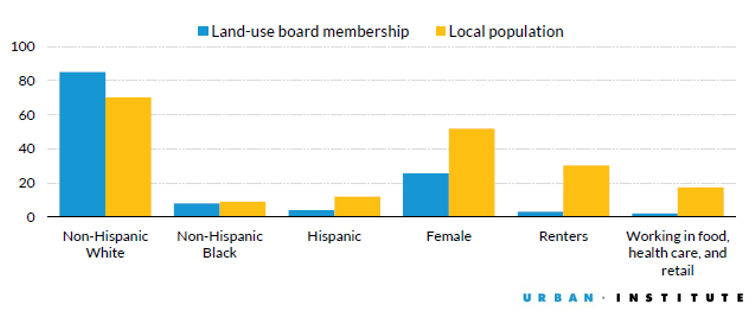
We ran a national survey and found land use planning decision-making boards consistently overrepresent white people, homeowners, males, and white collar workers. It's plausible that decisions of unrepresentative boards do not serve the interests of underrepresented groups. 1/x
We recommend state-level standards—such as requirements for compensation, child care or flexible meeting time options, and elimination of property ownership requirements—to open these roles to underrepresented groups. 8/8
Land-use boards' unrepresentativeness on may stem from inequitable appointment processes or from restrictions related to board membership; many jurisdictions, for instance, require members to be property owners (!) or to hold specific degrees. 7/x
Renters are also underrepresented. Their underrepresentation is so extreme that a 1% higher share of local renters is associated with a nearly equivalent (0.88%) increase homeowner overrepresentation. Renters are underrepresented in 99 percent of all respondent jurisdictions 6/x
In terms of gender, men are overrepresented by more than 20 percentage points on average (though female representation is better in the Western US and in jurisdictions with lower shares of white residents). No respondent reported any transgender or nonbinary board members. 5/x
While Black board representation tracks closely with population levels, Hispanics were consistently underrepresented. Even when Hispanics represented 40-60% of the population, the median jurisdiction’s board was less than 20% Hispanic. 4/x
Non-Hispanic whites represent nearly 100 percent of the board members in almost 50 percent of all the boards we studied. In fact, 45 percent of jurisdictions’ boards were more than 95 percent white, while only 5 percent of jurisdictions’ populations were 95 percent white. 3/x
Most boards don't provide compensation, childcare, transit access, or flexible meetings, and those that do are in lower-income and more diverse cities. Meaning that more economically and racially diverse places appear to have also made board membership more accessible. 2/x
Does allowing for increased housing density lead to greater affordability? See the answer in our new journal article https://t.co/S4XuVCsFxk @yfreemark @DavisChrisW@LydiaLoDC2@GrahamIMac@vzheng0120 @rolfpendall
The community-based development sector has grown steadily in revenues & assets over time, but there are signs of financial stress. Explore the first findings from @urbaninstitute & @NACEDAtweets’ Grounding Values study: https://t.co/pA25QnFAen
@MayorBowser it is unacceptable that the DC govt has relied on volunteers and residents for over 3 months to care for asylum seekers. It is time to stand with residents, asylum seekers, and @councilofdc and create formal support for folks being bused here! #NoSanctuaryinThisCity
Equitable community engagement and development can seed systems change that supports long-term health and well-being within communities. Listen to @UrbanInstitute’s podcast exploring how one initiative put equity into practice. https://t.co/ZGr1qFOPSJ
Short brief out with @CorianneScally@laudyaron & @kpettitdc on how philanthropic funders can explore mutual accountability with their grantees to advance equity and change community development systems. Hint: it takes innovative commitments by both.
https://t.co/pt9Hzh9acj
Overcrowding from a lack of affordability (not density) is the killer.
"By not allowing safe forms of density-think apartments and townhouses-we forced millions of [residents] into living conditions perfectly calibrated to spread the coronavirus."
https://t.co/kP4e7blM0p
In looking at ADU reforms in DC and Portland, we found four lessons for planners who want to change land-use laws to deliver more equitable housing: https://t.co/tWNJoag8i7
My team's new report is out today investigating the process for passing and implementing land use reforms that enable more housing production. Check it out: https://t.co/yqoP80tB1d
As if promoting SF zoning wasn't bad enough, Trump's taxes on Canadian lumber are further driving up home prices. Calling import taxes 'tariffs' hides that we consumers end up paying for them. #weneedmorehousing#buildbabybuild#conservativehypocrisy https://t.co/7MA8REhIV1
Racism in philanthropic giving isn't restricted to US grantmaking. It's embedded in our imperialistic international development funding practices that prioritize white leadership. #trustlocalexperience#shiftpower#endimperialism https://t.co/FIWyjxAzfd