No hard feelings from @IAGovernor even though state officials weren't looped in until days before Army's planned detonation, leaving little time for preparation, soil samples, blood tests, etc.
Many of the mitigation measures were added after initial scheduled explosion date.
@RapidResponse47@JeffAngeloRadio 1. It is Sand.
2. Be original instead of reading other posts that spell his name wrong.
3. Glad things went well but Iowa’s governor, a Republican, didn’t know about the plans until the Friday after the first proposed detonation date. This could have been planned better.
The thing about Donald Trump was that he tied public safety in Iowa to forcing the incoming governor to take blame for any screwups. The gov-elect did not bite. https://t.co/uAHvLY5HpA
From @phoebesaid — “Families that have lived through the Flint water crisis highly recommend that Iowans get a blood test before the detonation event, and test for lead, just to have a recorded baseline.”
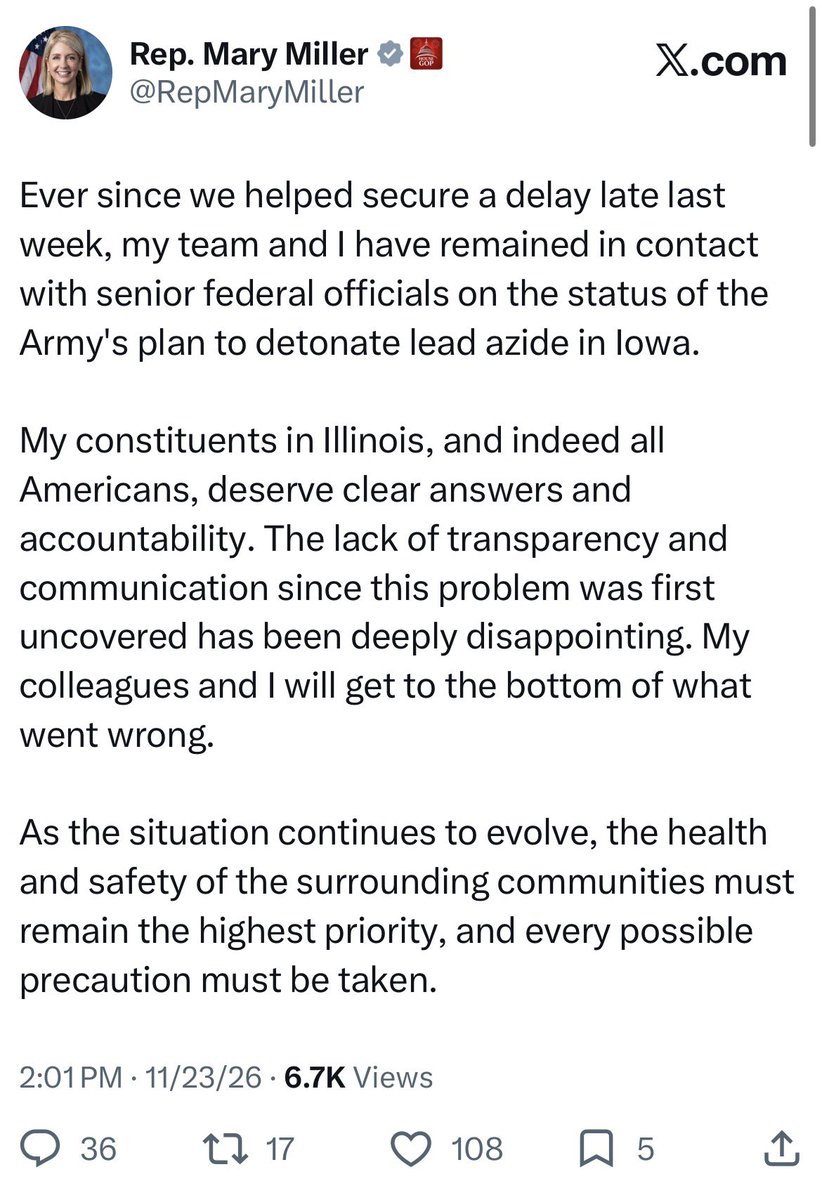
Illinois Rep. Mary Miller, a close ally of Trump and member of the House Freedom Caucus, appears to have put out a statement more critical of the Trump administration than Rob Sand
A LITTLE HISTORY LESSON ON LEAD AZIDE: Questioning the “Imminent threat/only option is to detonate/only time is now now” narrative.
1984, Savanna Army Depot in Illinois. Safety officer presented a paper to the Defense Department’s explosives safety board called, “Complexities of Lead Azide.” After Vietnam, surplus build lead azide sat in “deteriorating 55 gallon drums.” Savanna couldn’t sell it so they tried destroying it with electricity. During that work, azide that had been hosed out, reacted with brass and copper debris under a building and exploded. They stopped after destroying about half the lead azide and repacked the rest into new drums. Old drums that nobody wanted.
The Army’s own Iowa environmental assessment says temperature swings make small amounts dissolved in the alcohol and water and then recrystallize as pure “needles and platelets,” which are much more shock and friction sensitive. The 1984 paper says breaking those needle crystals is BELIEVED to set off a detonation. Military lead azide is deliberately made with crystals under a tenth of a millimeter for exactly that reason. Picatinny Arsenal was even running a study on long-term storage of special purpose lead azide and its containers back in 1972.
There is no public record of another stockpile of lead azide crystallizing this badly and ending up blown in place, either spontaneously or deliberately. The Savanna paper describes deteriorating drums, but not visible crystals.
The hard evidence is all from lab experiments, mostly research at Waltham Abby from the 1950’s and ‘60’s. What the labs showed is lead azide sometimes explodes after being touched, usually 6 to 12 hours into crystal growth. Faint ‘clicks’ and tiny flashes could be heard before explosion. It happened when the solution was only slightly over saturated. Fast precipitation from strong solutions never exploded. A temperature RISE of about 18deg F made explosions much more likely. The danger is when new crystals are forming, not when larger ones are removed or with adequate saturation. The reason for this is unknown.
I can’t find a single recorded case of stored lead azide dissolving, recrystallizing and then detonating on its own. Or because of temperature drops.
In Iowa, the Army’s local environmental assessment says temperature swings cause dissolve-and-recrystallize cycles that make the material more sensitive to shock and friction. It gets touchier when bumped, but there’s no proof it goes off by itself. The real-world accidents have involved detonators going off when someone bagged them or, like the Savanna incident, reacting with brass and copper debris.
The spontaneous detonation risk happened in a lab. There is no documentation that a 55 gallon drum has ever done it.
So, they want to blow it up so that it doesn’t blow up while they try to neutralize it. And they can’t use robots to add the neutralizing solution because it might blow up so they’re going to blow it up without even trying something else.
Questions:
What makes them think the forecasted temperature DROP is going to spontaneously detonate those Iowa drums? Has that ever happened?
When has it ever happened that 55 gallon drums of lead azide, outside of being mixed with copper and brass, spontaneously detonated at all? From bumping or jostling? From moving to a controlled detonation center? Ever? Anywhere?
If the Waltham Abby lab situation from the 50’s/60’s was known and of concern, why wait until crystal formation is visible on 58 of the 68 drums before addressing deteriorating drums containing such a volatile substance?
If y’all find something that answers these questions, please let me know. I’m not sure who else to ask at this point. Meanwhile, my sources are linked below. 👇🏼