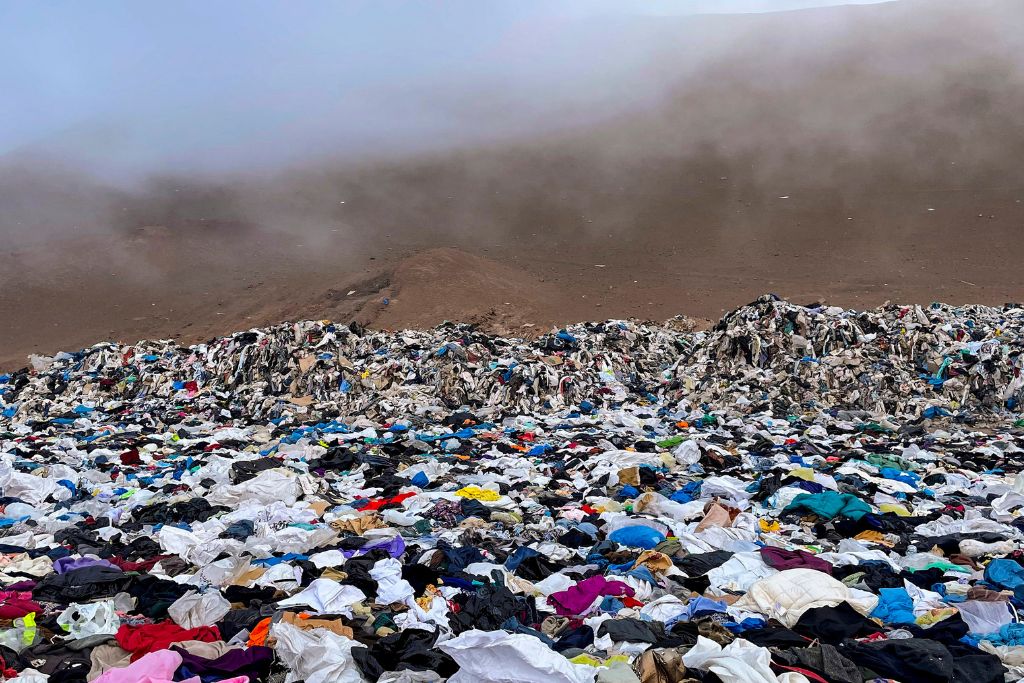
Shein adds about 4,700 new styles to its site every day, and the end of the line for clothes like that is a beach in Ghana where the sand has grown tentacles.
82% of what Shein makes starts life as fossil fuel. Last November Greenpeace sent 56 Shein garments and shoes to a lab. Of those, 18 broke EU chemical limits, three of them children's clothes, and the waterproof jackets carried PFAS at up to 3,300 times the limit.
A dress like that gets worn twice and goes in a charity bag. What the charity can't sell is pressed into bales, and a great many go to Kantamanto in Accra, the biggest second-hand clothes market in the world. About 15 million used garments land in Ghana every week. Traders buy the bales blind, cut the string, and something like 40% is rubbish before it's touched a hanger. Around 100 tonnes a day leaves the market as waste. When Greenpeace tested the clothes on Accra's dumps, 89% had plastic in them.
Some goes on the tip, where old clothes have built up into cliffs with layers like rock. Some goes into Korle Lagoon, and the rains flush the lagoon out to sea. The sea brings it back. On Jamestown beach the tide buries it in the sand and twists it into ropes, tentacles of cloth that start on the beach and carry on under the waves. Last year reporters found M&S, Primark, H&M, Zara and Next clothing dumped in the Densu Delta, where endangered leatherback turtles nest.
And some of it gets burned. In Old Fadama the public washhouses heat their water over fires of old clothes, and the air inside carried benzene at almost 200 times Germany's indoor guideline. People wash in water boiled over somebody else's wardrobe.
Chile has its own version. What won't sell from the free port at Iquique gets dumped in the Atacama, and the pile can be photographed from space. There are Christmas jumpers in it.
Shein knows where all this goes. In 2022 Xu Yangtian's company pledged $50 million over five years to a fund for Kantamanto's waste workers. On the first of September it floated in Hong Kong and raised about $1.7 billion, enough to pay that pledge for 170 years.
Meanwhile a ewe in Powys grows one coat a year. Scientists left wool and polyester in seawater for 90 days, and the sea got stuck into the wool and barely touched the polyester.
Jamestown beach is what the sea does with the stuff it won't eat.
1774: they blew tobacco smoke up drowning victims' backsides to revive them, and the kits hung along the Thames like lifebuoys.
1863: they sold cocaine wine as a daily tonic, and a pope pinned a gold medal on it.
1898: they sold heroin as a cough medicine, and spooned it into coughing children.
1918: they sold radium water as a health drink, and the millionaire who drank 1,400 bottles was buried in a lead-lined coffin with most of his jaw gone.
1921: they put lead in petrol, and Britain kept it in the pumps until 2000.
1930s: they X-rayed children's feet in shoe shops, and kids queued to watch their toes wiggle on the screen.
1940s: they rubbed mercury teething powder into babies' gums, and about 1 in 500 of those babies was poisoned.
1946: they sold cigarettes on the line that more doctors smoked their brand, and put a man in a white coat on the advert.
1949: they gave the lobotomy a Nobel Prize, and doctors went in through the eye socket with an ice pick.
1952: they sold a cigarette filter made of asbestos as the greatest health protection in smoking history, and smokers drew it into their lungs with every puff.
1957: they sold thalidomide to pregnant women for morning sickness, and around 10,000 babies were born with missing or shortened limbs.
1960s: they sold margarine as the heart-healthy fat, and spread trans fat on a generation's toast.
1996: they sold OxyContin as barely addictive, and started an overdose epidemic.
1999: they sold Vioxx for sore joints, and pulled it five years later after tens of thousands of heart attacks.
2026: they're selling seed oil as the heart-healthy fat, and it's in almost every packet in your kitchen.
Every one of these came with an expert's blessing and the same total certainty.
The people telling you which fat to fear today sit in the same chairs as the ones who put radium in the water and a doctor on the cigarette packet, and they're every bit as sure.
"The experts recommend it" has the longest body count in medicine.
This is Camelot Castle, located in Tintagel, Cornwall.
John Mappin, the hotel owner, was offered a staggering sum of money by the Home Office to house illegal migrants. However, he declined the offer. He explained that housing them would necessitate laying off most of his staff and would severely damage Tintagel’s village economy and culture.
If you’re visiting Cornwall on holiday, consider staying there to show your support.
@SamaHoole The Two Fat Ladies were brilliant ! I always watched them. I still have 2 of their books 😋 I regularly used to make their chocolate creme brulee as it was a favourite with our friends. They were proper cooks - none of this poncy stuff cooked by modern chefs !
In June 2014 the future King of England dug a hole in a flowerbed at his London home and buried two jumpers. Four months later he dug them up again.
They looked identical. One was pure merino wool. The other was a synthetic copy. Charles had them laid side by side in the soil at Clarence House in front of an audience, marked the spot, and left them there over the summer.
In October the soil was turned back. The synthetic jumper came out whole. It was clean, white and untouched, as if it had gone in that morning. The wool one was a few threads clinging to the wire frame. The rest had rotted away and fed the roses.
He had done another test the day before the burial. A wool jacket and a synthetic one were each set alight. The wool smouldered and went out. The synthetic went up like a torch.
For 40 years this man was laughed at. He talked to his plants. He worried about soil. He wore the same patched tweed coat for decades. In 2004 he launched a campaign to get the British eating mutton again, on the grounds that an older sheep tastes better and gives the hill farmer something to sell. In 2010 he launched another, for wool, from a medieval barn, because the price of a fleece had fallen below the cost of shearing it.
He was treated as an eccentric with too much land.
Go back over that list. Soil, wool, mutton, old cloth that lasts, small farms, raw milk cheese. Every one of the causes he was mocked for has turned out to be right.
He proved the simplest of them with a spade. One jumper went back to the earth, and the other will still be there when he is not.
“Most of us have small, sad places in our hearts. My father felt deeply but kept his feelings to himself. Or rather, being a writer, he let them escape in his writing. And so such sadnesses as there were put on cap and bells and emerged as Eeyore.”~C.R.Milne #WorldMentalHealthDay
@SamaHoole We had to make our domestic science aprons in needlework and embroider our initials on it. We learnt how to do ironing aswell as cooking. Those were the days!