Reading is not a character trait.
And struggling readers are not broken learners.
LynLight Literacy exists to bring clarity to reading development and dyslexia for educators, families, and schools.
🧵 1/5
Feedback is a key facilitator of learning for both students and teachers.
When feedback is effective, it does more than tell us whether something was right or wrong. It provides information that helps us understand what is working, what needs to change, and what to do next.
For students, that information can help move learning forward.
For teachers, feedback can help translate new knowledge into changes in practice.
My doctoral research gave me the opportunity to explore the role of performance feedback in supporting teacher practice, and it left me thinking even more deeply about what makes feedback truly effective.
The principles of effective feedback extend beyond the classroom and into any profession, as we all seek to learn, grow, and improve our work.
What does the research tell us about the kind of feedback that actually supports learning and change?
Over the next few months, I'll be sharing some of what I've learned through my research, the broader research base, and my years of working alongside teachers in professional learning and coaching, and considering what it means for the feedback we provide to students and educators.
Because ultimately, effective feedback should help answer an important question:
What can I do next to improve?
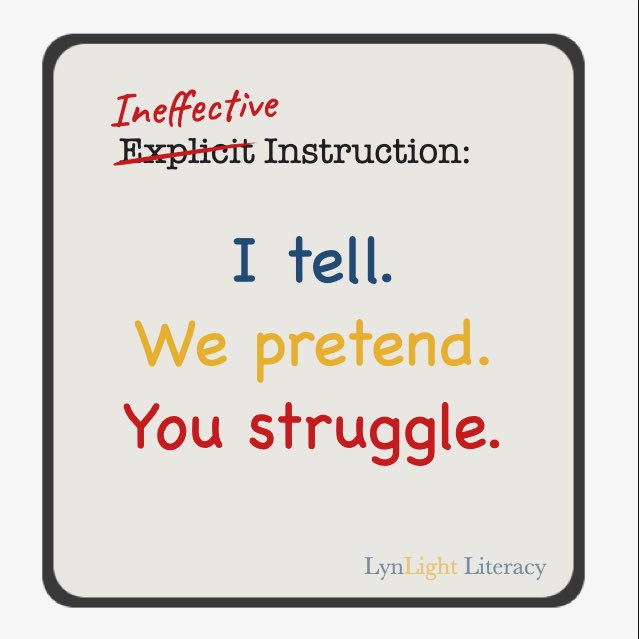
Effective instruction is not “I tell, move on, and hope for the best.”
It includes modeling, guided practice, active monitoring, feedback, and gradual release.
When those pieces are missing, students don’t fail. The system does.
If your child is struggling to read, it does not mean they are behind in intelligence.
Reading is a learned skill.
When the instruction matches how the brain builds word recognition, growth is possible at any age.
@EduConsumersFdn That’s the challenge. When students fall behind, maintaining status quo instruction rarely closes the gap.
Precision, intensity, and coherence become essential.
@larissaphillip Research suggests interest and choice help students begin reading. Success builds confidence, and confidence fuels continued engagement. Start with interest to build buy-in, then intentionally build knowledge through supported reading.
You must read. Read nonfiction. Read fiction. Read history. Read philosophy. Read psychology. Read banned literature. Read poetry. Read about new technology. Read biography. Read memoir. Read on economics. Read on finance. Reread what you have already read. Read. Reflect. Repeat.
@educatedandfree It really is a beautiful process. Hearing complex language spoken clearly gives children a mental model for what reading can sound and feel like. Later, when print becomes easier, that foundation makes a difference.
@SoLInTheWild The “We do it” phase is often underestimated. That’s where clarity, feedback, and active monitoring prevent error patterns from forming. Independence works best when it rests on high-success guided practice.
Archer has also said that it can be more like “We do, we do, we do…”
Many students labeled “unmotivated” are operating at maximum cognitive load. When foundational skills aren’t automatic, every task costs more mental energy than we realize.
@karenvaites Behind every “surge” are years of sequencing, curriculum decisions, teacher training, and classroom implementation. Durable gains rarely happen by accident.