If you have served in public education for 20 years or more, this post is for you.
You are part of the roughly 28% who entered public-school teaching and were still in the profession two decades later.
So for the veteran teachers and staff who have served for 20 years, 25 years, 30 years, and beyond, this is to celebrate you!
You have endured some of the most difficult changes education has ever faced.
You witnessed standardized testing grow into an overwhelming system of high-stakes pressure, excessive data collection, and constant documentation.
You adapted to new standards, new technology, new programs, and an endless cycle of initiatives.
You carried students and families through COVID, even while facing your own fears, losses, and uncertainty.
You have watched respect for educators decline while expectations continued to rise.
You have been asked to do more with less, solve problems you did not create, and meet needs that extend far beyond the classroom.
And yet, you continued to show up.
You taught the lesson again.
You encouraged the struggling student.
You supported the overwhelmed colleague.
You welcomed the nervous parent.
You kept schools functioning during some of the toughest years education has ever experienced.
Most people will never fully understand what it takes to dedicate decades of your life to serving students, families, and communities. They will never know how many evenings, weekends, personal dollars, and pieces of your heart you have invested.
There are adults walking through the world today who are stronger, wiser, and more confident because you once believed in them.
To every teacher and staff member who has served for 20 years or more:
Thank you for your dedication.
Thank you for your sacrifice.
Thank you for your wisdom.
Thank you for caring for our children.
Thank you!
From Helen Lake Rosseau
Today we have witnessed a flipped canoe 🛶 full of kids with no life jackets this afternoon and tonight as the sun was going down we witnessed a flipped seadoo, again with kids in the water and no life jackets. My husband is a lifesaver.
All kids safely rescued but not aware of the risk they put themselves in. Water safety is so important! Cottages can be such fun but things can turn in an instant. Be boating safe! Please 🙏🏼
Fatty liver is now affecting 1 in 3 adults.
It destroys your metabolism, becomes diabetes, and increases your risk of heart disease.
Here’s how to fix it:
1. Eat all the sweet potatoes you can.
I’m sorry, if a kid throws a chair, I don’t care what’s the root cause or what unmet need they’re trying to express
The school cannot tolerate that behavior and the kid has to be expelled
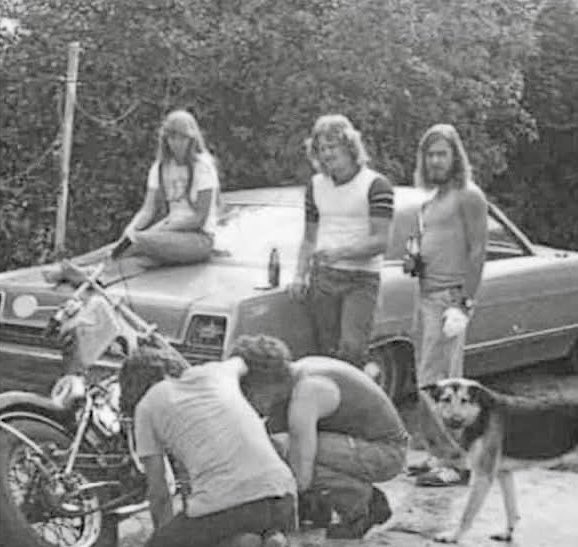
There’s a generation a lot of people forget exists. We were born at the tail end of the Boomers, but we are not culturally the same as people born in the 40s and early 50s. We are Generation Jones.
And honestly, it explains a lot.
We grew up in a world that still felt fundamentally analog, but we were young enough to be dragged headfirst into the digital revolution. We are the bridge generation between rotary phones and smartphones, between slide rules and AI, between Walter Cronkite and algorithm driven media.
We remember when there were only a few television channels and the entire country watched the same thing at the same time. We also adapted to the internet, email, forums, social media, streaming and now artificial intelligence. We lived before and after the technological singularity hit everyday life.
That is not a small thing.
People born in the 40s came of age in a post World War II America that was still industrial, deeply hierarchical and institutionally stable. Their formative years were shaped by the Cold War, Vietnam, the civil rights era and a society where information moved slowly.
Generation Jones came later. We inherited the aftermath of all of that.
We were the kids who watched Watergate destroy blind trust in government. We watched manufacturing begin to collapse. We saw divorce rates explode. We were the first truly latchkey generation in massive numbers. We learned independence early because many of us had to.
We grew up with one foot in old America and one foot in whatever this new thing was becoming.
We played outside until the streetlights came on but we also learned DOS commands. We learned cursive and keyboarding. We had card catalogs and Google searches. We went from vinyl records to cassette tapes to CDs to MP3s to streaming in one lifetime.
We remember maps. We remember memorizing phone numbers. We remember life before GPS and before every human interaction became filtered through a screen.
And because of that, I think Generation Jones developed a very unique perspective. We are adaptable because we had no choice but to adapt. We learned technology as adults instead of being born into it. We remember a slower world but were forced to survive in a rapidly accelerating one.
That creates a very different mindset than either older Boomers or younger Gen X and Millennials.
A lot of us also reject the caricature people now associate with “Boomers.” We were not buying houses for the cost of a sandwich in 1965. The interest rate on my first house was over 14% and that was after buying down a point. Many of us got hit by recessions, outsourcing, pension collapses and economic instability just like younger generations did. We watched promises evaporate in real time.
We understand older generations because we were raised by them. We understand younger generations because we had to evolve alongside them.
That’s why the Jones generation often feels culturally homeless. We are rarely discussed, rarely defined and usually lumped into categories that don’t actually fit us.
But we exist.
We are the human transition point between the industrial age and the digital age.
And frankly, there will probably never be another generation quite like us again.
If there were ever a time for schools and parents to champion book reading, sustained writing, and deep focus, it’s now.
Something has to be done to counter the pull of short-form video and the overreliance on AI.
Much of professional development in education is built on the illusion that teaching is more complicated than it truly is.
Instead of simply asking students to read, write, think, and discuss, we bury ourselves in jargon, acronyms, data charts, and endless protocols.
“But why is the student misbehaving? What’s the root cause?”
Maybe it’s the utter lack of consequences in his school and the implicit message that he can get away with anything, that teachers are worthy of respect, and that following the rules is for chumps
Maybe
Another Auschwitz survivor is gone.
Albrecht Weinberg died yesterday at 101.
He survived Auschwitz, Bergen-Belsen, death marches, forced labor, and the murder of nearly his entire family.
And yet, after everything, he chose not silence, but testimony.
For decades, he stood in classrooms and before crowds across Germany, telling young people exactly where hatred, antisemitism, dehumanization, and indifference can lead. Even at 101 years old, he was still speaking out.
Soon, there will be no Holocaust survivors left to tell these stories firsthand.
What remains will be our willingness to listen. To remember. To teach. To refuse distortion and denial when it appears before us.
May his memory be a blessing… and a responsibility. 🕯️
#Auschwitz #Holocaust
Hear me out:
Whenever I bring up suspensions or expulsions, the response is “but what are we going to do with those kids?” as if it’s the fault of the system
That’s on the parents. They bear final responsibility for that kid, not the school.
And other students shouldn’t have their own learning jeopardized because a few children were poorly parented.