A Norwegian neuroscientist spent 20 years proving that the act of writing by hand changes the human brain in ways typing physically cannot, and almost nobody outside her field has read the paper.
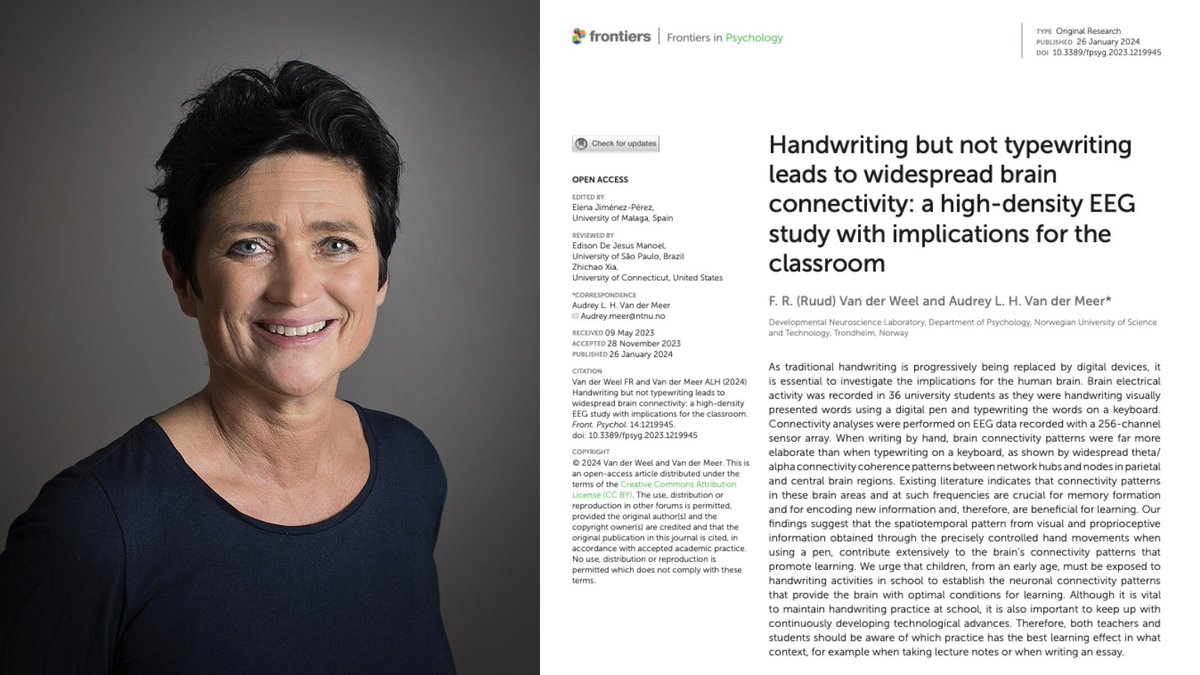
Her name is Audrey van der Meer.
She runs a brain research lab in Trondheim, and the paper that closed the argument was published in 2024 in a journal called Frontiers in Psychology. The finding is brutal enough that it should have changed every classroom on Earth.
The experiment was simple. She recruited 36 university students and put each one in a cap with 256 sensors pressed against their scalp to record brain activity. Words flashed on a screen one at a time.
Sometimes the students wrote the word by hand on a touchscreen using a digital pen, and sometimes they typed the same word on a keyboard. Every neural response was recorded for the full five seconds the word stayed on screen.
Then her team looked at the part of the data most researchers had ignored for years, which is how different parts of the brain were communicating with each other during the task.
When the students wrote by hand, the brain lit up everywhere at once.
The regions responsible for memory, sensory integration, and the encoding of new information were all firing together in a coordinated pattern that spread across the entire cortex. The whole network was awake and connected.
When the same students typed the same word, that pattern collapsed almost completely.
Most of the brain went quiet, and the connections between regions that had been alive seconds earlier were nowhere to be found on the EEG.
Same word, same brain, same person, and two completely different neurological events.
The reason turned out to be something nobody had really paid attention to before her work. Writing by hand is not one motion but a sequence of thousands of tiny micro-movements coordinated with your eyes in real time, where each letter is a different shape that requires the brain to solve a slightly different spatial problem.
Your fingers, wrist, vision, and the parts of your brain that track position in space are all working together to produce one letter, then the next, then the next.
Typing throws all of that away. Every key on a keyboard requires the exact same finger motion regardless of which letter you are pressing, which means the brain has almost nothing to integrate and almost no problem to solve.
Van der Meer said it plainly in her interviews.
Pressing the same key with the same finger over and over does not stimulate the brain in any meaningful way, and she pointed out something that should scare every parent who handed their kid an iPad.
Children who learn to read and write on tablets often cannot tell letters like b and d apart, because they have never physically felt with their bodies what it takes to actually produce those letters on a page.
A decade before her, two researchers at Princeton ran the same fight using a completely different method and ended up at the same answer. Pam Mueller and Daniel Oppenheimer tested 327 students across three experiments, where half took notes on laptops with the internet disabled and half took notes by hand, before testing everyone on what they actually understood from the lectures they had watched.
The handwriting group won by a wide margin on every question that required real understanding rather than surface recall.
The reason was hiding in the transcripts of what the two groups had actually written down.
The laptop students typed almost word for word, capturing more total content but processing almost none of it as they went, while the handwriting students physically could not write fast enough to transcribe a lecture in real time, which forced them to listen carefully, decide what actually mattered, and put it in their own words on the page.
That single act of choosing what to keep was the learning itself, and the keyboard had quietly skipped the choosing and skipped the learning along with it.
Two studies. Two countries. Same answer.
Handwriting makes the brain work. Typing lets it coast.
Every note you have ever typed instead of written went into your brain through a thinner pipe. Every meeting, every book highlight, every idea you captured on your phone instead of on paper was processed at half depth.
You did not forget those things because your memory is bad. You forgot them because typing never woke the part of the brain that would have made them stick.
The fix is the thing your grandmother already knew.
Pick up a pen. Write the thing down. The slower road is the faster one.
Britain has lost around half its hedgerows since the Second World War. The wildlife that depended on them has followed a similar trajectory. 🌿
The old field boundary — a strip of blackthorn, hawthorn, dog rose, and elder two to five metres wide between cultivated ground — was not wasted agricultural space. It was a functioning ecological system that maintained pollinators, pest predators, and farmland birds across centuries of working land.
Each hedgerow is a nesting corridor for grey partridge and skylark, a foraging habitat for brown hares and hedgehogs, a site for solitary bee colonies, and a windbreak for the crops alongside it.
The field cultivated to its very edge gives the maximum return this season. It removes the populations of beneficial insects, farmland birds, and small mammals on which stable long-term production depended.
The field with a hedgerow yields a few percent less per cultivated hectare — but remains productive across decades without compensatory chemical inputs. The documented declines in grey partridge, lapwing, and skylark across the British agricultural landscape since the 1970s are directly linked to field consolidation and hedgerow removal.
Practical equivalents for the garden or smallholding:
- A strip of wildflower meadow at least one metre wide at the plot boundary
- A clump of nettles in a shaded corner as a habitat base for red admiral, small tortoiseshell, and peacock butterflies
- A native mixed hedge of blackthorn and hawthorn in place of post-and-wire fencing
- A section of uncut grass between rows of fruit trees
#HedgerowHabitat #FarmlandWildlife #NativeHedge #GardenWildlife
High-frequency patterns in birdsong can signal safety to the brain, helping the body unwind, ease stress, and restore mental clarity.
At times, nothing soothes the mind more effectively than the quiet rhythms of the natural world.
Nobody could figure out why the abandoned Hendricks apple orchard suddenly bloomed in April 2019. The trees hadn't produced fruit in eleven years. County agriculture office sent two inspectors. They found sixty thousand honeybees working the property - a massive colony that had escaped from Tomás Vega's apiary three miles south. Tomás had reported the swarm missing in March. He expected them dead. Instead they'd colonized the hollow barn on the Hendricks lot and cross-pollinated every surviving tree. That October, the orchard produced twenty-two tons of Cortland apples. The Hendricks family offered Tomás a permanent lease. He moved his entire operation there the following spring.
Right in the middle of a rainy moment, a tiny bird becomes the star of something truly magical—a perfect water droplet lands on its head, forming a crown-like splash that feels almost unreal. The timing is flawless, capturing a split second where nature turns playful.
As Christ carried the cross, a little robin is said to have tried to ease his suffering, plucking barbs from the crown of thorns. A drop of blood fell upon its breast, marking it red to this day—a tale of compassion and kindness. #GoodFriday#Folklore
This paragraph by C.S. Lewis, written in 1948, still hits hard:
“If we are all going to be destroyed by an atomic bomb, let that bomb when it comes find us doing sensible and human things—praying, working, teaching, reading, listening to music, bathing the children, playing tennis, chatting to our friends over a pint and a game of darts—not huddled together like frightened sheep and thinking about bombs. They may break our bodies (a microbe can do that) but they need not dominate our minds.”
MESSAGE
I wholeheartedly endorse the powerful appeal for peace made by the Holy Father, Pope Leo, during his Palm Sunday Mass. His call for the laying down of arms and the renunciation of violence resonated profoundly with me, as it speaks to the very essence of what all major religions teach.
Indeed, whether we look to Christianity, Buddhism, Islam, Hinduism, Judaism or any of the world's great spiritual traditions, the message is fundamentally the same: love, compassion, tolerance, and self-discipline. Violence finds no true home in any of these teachings. History has shown us time and again that violence only begets more violence and is never a lasting foundation for peace.
An enduring resolution to conflict, including the ones we see in the Middle East or between Russia and Ukraine, must be rooted in dialogue, diplomacy and mutual respect — approached with the understanding that, at the deepest level, we are all brothers and sisters.
I urge for and pray that the violence and conflicts may soon come to an end.
DALAI LAMA
31 March 2026
This from @Geoffrey_Cox was titanic - a truly beautiful speech.
He outshone those sat opposite. They could only watch. And nervously laugh.
This should be seen by every new MP to understand what they do, & every new barrister to understand what we do.
Well done to the Team GB Scottish curlers on their silver medal. Thanks for entertaining us over the past 10 days, it's been amazing. So close! Congrats to Canada on their gold 👏
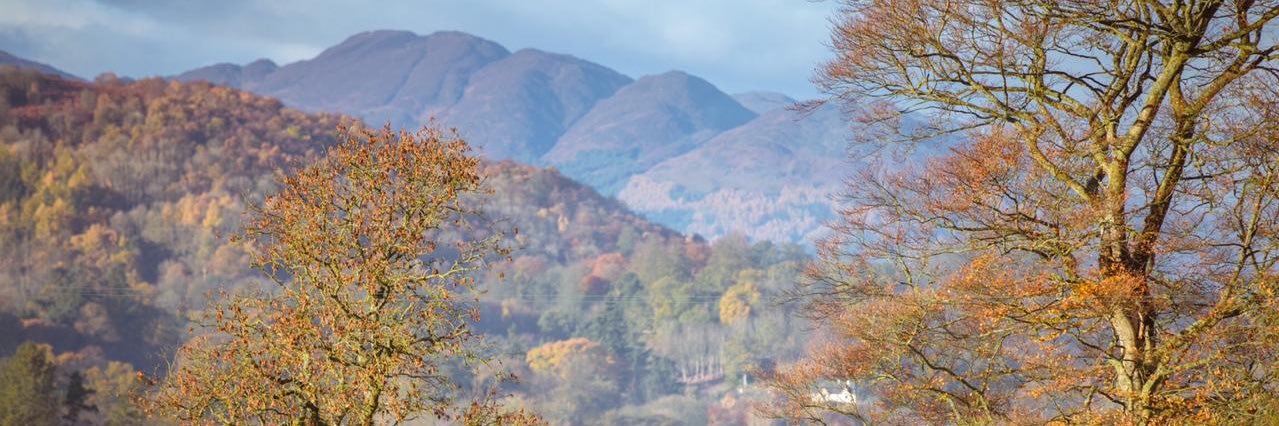
One of my favourite spots. The old family farmlands on a crisp winter afternoon. Britain’s green and pleasant land is one of our glorious national treasures. Maintained by our farmers. Once the farmland is gone, it’s gone forever. We lose it at our peril. No farmers, no food.
"Here's one to think about..."
"Instead of organic carrots having to be called organic carrots, maybe they could just be called carrots, and carrots grown with chemicals could be called chemical carrots?"
"And maybe those that grow with chemicals have to demonstrate and show the chemicals that were used in the production?"
"If that was on the supermarket packs, I wonder how our behaviour would change."
Credit: @greenearthorgan
On this day 100 years ago: John Logie Baird demonstrated the world's first successful instantaneous, moving scenes on his 'televisor' at his laboratory in London. His invention was later renamed 'television'.