With a great commitment to work and a mindset toward achieving exponential results, I humbly accept my appointment as the Special Assistant on Gender Issues and Women Advancement to HE Alhaji Atiku Abubakar, GCON, the presidential candidate of the PDP.
My arms are open wide to..
Igbos never voted for Buhari or Tinubu but they became president— Hon Ben Nwankwo asks if Igbos are really influential as a people.
Hmmm.. He said the right things.
Journalist: You went through a lot of struggles.
H.E. @atiku: Indeed, we did, and on it.
Q: When did you first meet the late Shehu Musa Yar’Adua?
H.E.@atiku: We first met in 1988 in Abuja. One day, the late Shehu Musa Yar’Adua came into my office and said:
"Turaki, I want to join politics. I have consulted elders, business leaders, and other stakeholders in Katsina, and they told me that if I wanted their support, I should first seek the support of Atiku."
He was surprised because I was not from Katsina. That was why he came personally to see me and understand why they had given him such advice.
I told him that perhaps the reason was the good relationships I had built with people, the support I had given them over the years, and the respect with which I treated everyone.
He then said to me:
"In that case, retire from your job and join politics."
I replied:
"Alright, but give me some time."
Afterward, I consulted some of my friends and associates about my plans to enter politics. We discussed the way forward, and once I was satisfied, I submitted my retirement letter, completed all the necessary formalities, and joined him in politics.
From that moment, we continued our political journey together and remained close until his passing.
Throughout his political campaigns, including during the SDP era, I played a key role in coordinating campaign activities. We traveled extensively across Nigeria, visiting virtually every local government area more than once and engaging directly with the people. In those days, traveling across the country was much easier and safer, and one could move freely at any time without fear.
Later, when he was prevented from contesting, he told me:
"Turaki, you should run for President."
It was not my idea initially; he encouraged me to take that step.
When I eventually contested, he continued to support and advise me. At one point, he advised me to step down for Moshood Kashimawo Olawale Abiola, and I accepted his advice and stepped aside.
The Power of the Ultimate Outsider: Why Atiku Abubakar Remains the Unyielding Gravity of Nigerian Politics .PART ONE
By Dare Adelekan
In the theatre of Nigerian politics, power is traditionally believed to flow directly from the control of a state treasury. The common consensus holds that to remain relevant, a political figure must either sit on a government throne or retain a vice-grip over a rich economic hub. Yet, for nearly two decades, one man has fundamentally broken this template. Despite leaving formal office in 2007, Alhaji Atiku Abubakar remains arguably the most visible, influential, and structural political heavyweight outside the active corridors of government power.
To understand the unique weight of Atiku’s influence, one must contrast it with the standard models of political survival in Nigeria. The conventional blueprint is perfectly exemplified by President Bola Ahmed Tinubu, whose continuous relevance since 1999 was heavily anchored on building a formidable empire from the financial nerve center of Lagos State. Tinubu’s dominance was cultivated from the inside out—using the machinery of state resources and a fiercely localized treasury to expand outward into a national vanguard.
Atiku, conversely, has operated from the outside in.
Long before his name appeared on a joint presidential ticket in 1999, Atiku had already amassed a formidable independent financial chest through decades of private enterprise, real estate, and maritime logistics. He did not need a state treasury to fund his political entry; instead, he funded the political system itself. His financial architecture was visible from the inception of the Fourth Republic, when his multi-million naira donations helped breathe life into the early Obasanjo campaigns, and his critical financial backing secured Wadata Plaza as the ultimate nerve center of the People’s Democratic Party (PDP).
However, money alone does not buy longevity in a political landscape as volatile as Nigeria's. What truly separates Atiku from other former vice presidents is his structural blueprint. His network was not built overnight; its foundations stretch back to his alliance with Shehu Musa Yar'Adua and the historic 1992 Social Democratic Party (SDP) Jos Convention. While other politicians construct localized dependencies, Atiku built a truly pan-Nigerian apparatus—an organic grid rooted in all 774 local government areas.
This deep-rooted structure explains why, years after leaving the villa, his political gravity has not decayed. Whether in or out of favor with prevailing administrations, any serious calculation for national leadership across the decades has invariably had to reckon with his silhouette. His supporters argue that it is a relevance sustained not by raw patronage, but by a proven record of economic wizardry and competence during his tenure as the head of the National Economic Council—a period that oversaw some of Nigeria's most significant macroeconomic reforms.
As Nigeria continues to navigate intense economic headwinds, structural deficits, and political uncertainties, the debate over what kind of leadership the nation requires intensifies. For his vast network of loyalists, the solution is clear: Nigeria requires an experienced architect who understands how to build wealth independently of the state, rather than a political class dependent on state coffers. In the grand chronicle of Nigerian democracy, Atiku Abubakar has proved that an individual can step out of the office, but if their roots are deep enough, they never truly step out of power.
Tinubu’s VP was chosen mainly to woo Muslim-Northern votes, their ideologies are dissimilar.
Obi’s running mate was chosen to woo Kano votes, their ideologies are vastly dissimilar.
Atiku will choose a VP that bolsters his ideology and resets the convo from ethnic to national.
Congratulations to Nigerians and Atikulates worldwide.
The journey to rescue and rebuild Nigeria has begun. Together through unity, vision, and strong institutions, we can create a sustainable future and restore hope for millions.
#AA2027
The ADC presidential nomination process is arguably the best in Nigeria’s history.
While the other party shamelessly inflated its figures to the tune of 582,000 votes in Imo State alone, the ADC, on the other hand, followed the path of honesty and transparency.
This shows that the other party will continue to manipulate data if re-elected to office.
I joined other prospective voters of the African Democratic Congress in our party's presidential primaries in casting my vote at the Ajiya Ward Polling Unit in Jimeta Yola, Adamawa State. This is democracy at work. The election taking place simultaneously in 8,809 Wards in Nigeria is a major step in our quest to recover our beloved country and set it on the path of prosperity. -AA
BREAKING:
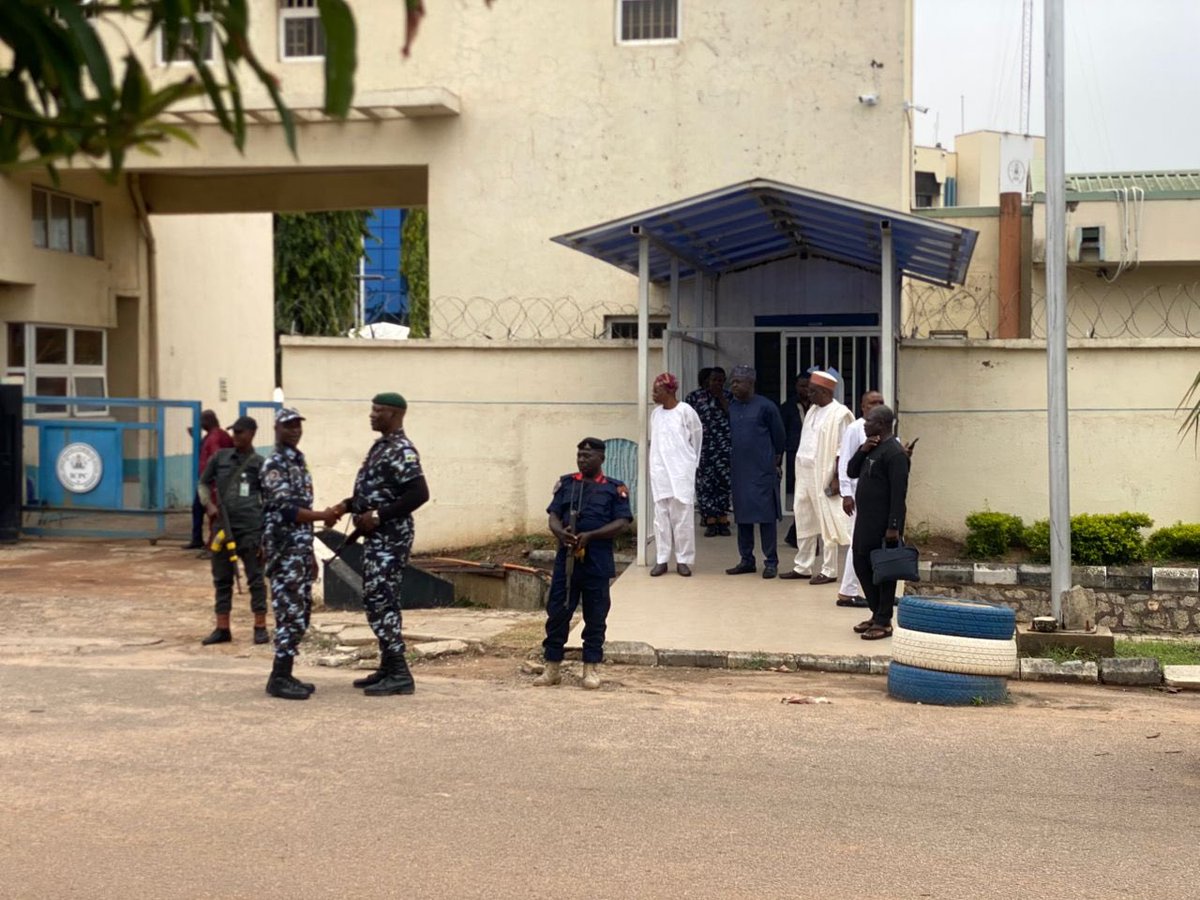
ADC leaders were prevented from seeing Mallam Nasir @ElRufai at the ICPC.
Those denied access include National Secretary @raufaregbesola, National Publicity Secretary @BolajiADC, and Salihu Lukman, Secretary of the party’s Manifesto and Policy Committee.
WATCH: The collation and announcement of the ADC Presidential Primaries. Live from the Congress Hall of Transcorp Hilton, Abuja.
https://t.co/enSgnd3DgA
The ADC Is the Only Party Today That Is Not Controlled By an Individual - Abdullahi
We have three top-class candidates who, in their own right, are eminently qualified and can do better than President Tinubu. Deciding who should withdraw for whom is a challenge.
Bolaji Abdullahi, National Publicity Secretary, ADC
THE COMMON DENOMINATOR: Atiku Abubakar and the Art of Political Longevity in Nigeria
by Dare Adelekan
In the volatile landscape of Nigerian politics, permanence is a rare commodity. Republics collapse, mega-parties dissolve, and once-fearsome powerbrokers vanish into obscurity. Yet, for nearly four decades, one name has remained an unyielding fixture on the national chessboard: Alhaji Atiku Abubakar, the Waziri Adamawa. To understand modern Nigerian political engineering, one must view Atiku not merely as a recurring candidate, but as the closest thing Nigeria has to a living political institution—the ultimate common denominator of our democratic journey.
The Genesis: The Yar’Adua Legacy
Atiku’s unmatched national reach traces back to the late 1980s and early 1990s under the tutelage of Major-General Shehu Musa Yar'Adua. Within the Peoples Front of Nigeria (PFN) and the Social Democratic Party (SDP), Atiku was a principal architect of a new, pan-Nigerian politics that broke away from rigid ethnic regionalism. When he contested the historic 1993 SDP presidential primary, stepping down for Chief M.K.O. Abiola at the landmark Jos convention, he was laying structural roots designed to withstand the test of time.
When the Fourth Republic dawned in 1999, these exact networks formed the bedrock of the Peoples Democratic Party (PDP). As Vice President, Atiku managed the party’s organizational engine, solidifying a national web of loyalty and alliance that remains unmatched in its geographic spread.
Organic Structures vs. Transient Power
The Nigerian political terrain is littered with short-lived alliances that rely strictly on the temporary control of state treasuries or executive appointments. Dozens of powerful governors and regional champions have dominated headlines, only to fade the moment they left public office.
Atiku’s machinery operates on an entirely different plane. His network is generational, deeply rooted, and autonomous. It requires no active public office or federal portfolio to breathe. Built over 35 years of personal relationships, traditional ties, and grassroots alliances, his organization functions like a standing army across all six geopolitical zones. Where others build temporary political camps, Atiku built an enduring ecosystem.
The Continuous Thread
Whether anchoring foundational coalitions or testing alternative ideological platforms, Atiku has consistently dictated the rhythm of the national political conversation since 1992. While critics often view his persistent pursuit of the presidency as a sign of unyielding ambition, an objective editorial gaze reveals a masterclass in political survival.
In an era of rapidly shifting political winds, the Waziri remains the ultimate benchmark for national reach. He stands as a living testament to historical continuity—proving that while players change and rules are rewritten, the common denominator of Nigerian politics remains firmly entrenched in the fabric of our democratic history.
#ATIKU2027: 10 Outstanding Facts You May Not Know About Atiku Abubakar That Makes Him The Very Best Candidate Standing For The 2027 Presidential Election; Number 7. "Not One Person, Both Home And Abroad, Has Ever Accused Atiku Of Any Shady Business Dealings
1. Atiku is the only Vice President of Nigeria that could stand up for the people and Nigeria against his sitting President.
2. Under President Obasanjo, Atiku headed Nigeria’s very booming economy, the best Nigerians have ever experienced.
3. Atiku has been a very successful Businessman for decades, with no single scandal, both home and abroad.
4. Atiku cares so much about Nigerian youths and their future that he had to start a world class University as far back as 2003.
5. Atiku cares so much about young Nigerians that he started a private Primary and Secondary School as far back as 2002.
6. Atiku in 2001, as Vice President, restored peace back to Benue State, by personally leading the Tivs and Fulanis to sign a Peace Accord.
7. Not one person, both home and abroad, has ever accused Atiku of any shady business deal.
8. Atiku at one time was the highest paid Labourer in Adamawa State, due to his hard work, integrity and dedication
9. Atiku is Nigeria’s most investigated Vice President by his President, with absolutely nothing criminal found on him.
10. While working in the now Nigerian Custom Service, Atiku earned a reputation for integrity, refusing bribes in a very corrupt-riddled institution.
#AtikuIsForThePeople
Some APC members are acting shocked that APC primaries are full of manipulation, as if they joined the party yesterday.
This is the funny part of Nigerian politics. A party can build its entire internal culture around imposition, delegate intimidation, result writing, godfather control, and midnight consensus arrangements, then suddenly some members will come online pretending they are surprised when the same system consumes them.
APC rigging its own primaries is not breaking news. It is the party operating according to its political DNA.
The only difference is that this time, the victims are not ordinary Nigerians watching from outside. The victims are APC aspirants who thought the machine would protect them, until the machine looked at them and said, “you too, move aside.”
That is why nobody should pity them too much. Many of them defended the same culture when it favoured their camp. They called it strategy. They called it structure. They called it party supremacy. Now that the structure has landed on their own head, they have suddenly discovered democracy.
Interesting.
This is the bigger lesson for 2027. A party that cannot conduct clean internal primaries has no moral authority to lecture Nigerians about democracy. A party that manipulates its own members will not hesitate to manipulate the will of ordinary voters. A party that cannot respect aspirants inside its own house cannot be trusted to respect citizens outside its gate.
ADC must continue to position itself as the serious alternative, not just by criticizing APC, but by building credibility, fairness, discipline, and internal trust. Nigerians are watching. The collapse of confidence inside APC is an opportunity for ADC to show that politics can be done differently.
APC members are angry today because the same system they enabled has started biting them.
When a house is built on crooked foundations, nobody should act surprised when the walls begin to crack.