In a video clip elsewhere , Preggy describes Gen Khan as his Ex-Son in law. Could this degree of sanguity- if any - be considered so strong that the Gen is unable to testify? I wonder what the next excuse will be: probably they will say that “ Khan was assumed into heaven”.
BREAKING:
MR FEROZ KHAN’S IN-CAMERA TESTIMONY POSTPONED
The Madlanga Commission, confirms that
Mr Feroz Khan appeared before it remotely and in-camera this (Tuesday) morning.
However, due to the death of a family member resulting from a shooting incident on the
R21 in Gauteng last (Monday) night, Mr Khan is not in a position to testify today.
The Commission has therefore postponed the testimony of Mr Khan to a date which has yet to be determined.
@eNCA
Powerful, Ntate. Your intervention changed the trajectory of one young person’s life, but it also exposes a profound systemic failure.
No young South African who has earned the right to graduate should have to beg strangers at a shopping centre to receive their qualification.
We urgently need a sustainable, collective solution to student debt and the so-called “missing middle”.
@tumisole@motsohi_thabang@tebogokhaas@fabacademic1 : this past Sunday, I drove with my wife to Menlyn Shopping Centre for a chill on a lousy Sunday. What an emotional encounter we had: we were approached by a young man who was “begging for donations” from shoppers to help him pay his outstanding fees at UJ- he looked desperate and told us that he was due to graduate today- Tuesday 6th October- but couldn’t because he was owing. He was desperate because it was approaching closing time and he wasn’t reaching the required amount.,When he told us the outstanding amount I just didn’t take pity , I became angry with revulsion. Why should brilliant young SAn’s suffer like this in this country with plenty? A long story short is that we confirmed with the university that it was it was indeed a genuine student and not a scammer. We paid his outstanding fees. I just received the young man’s photos at the graduation ceremony- photos withheld to protect his identity.
My question/ s are: why do SA’n youth have to suffer like this? The problem is well known and why do educational institutions and government seem incapable of a solution? How many other children are denied an opportunity to graduate and get a chance to apply for a good job? There are many other generous SA’ns, is it not possible to work collectively to help more and bigger numbers. This situation I have just described is very very unfair on young SA’ns.
Nca nca! Or rather Nine Nine ! What is this man’s job description or rather KPI’s? I suspect he earns a bonus for every Afrikaner farmer that settles in the US. Rather than maintain diplomatic relations with SA , he seems hellbent on creating fertile ground for Oubaas Trump to authorise a military invasion to steal our natural resources under pretext of protecting the white minority.
@RediTlhabi A man can only be set up and ultimately fall for a trap for which he is known to have a strong penchant or weakness. Someone knows his character very well- if you know a man loves sugar and honey, you send him some bees.
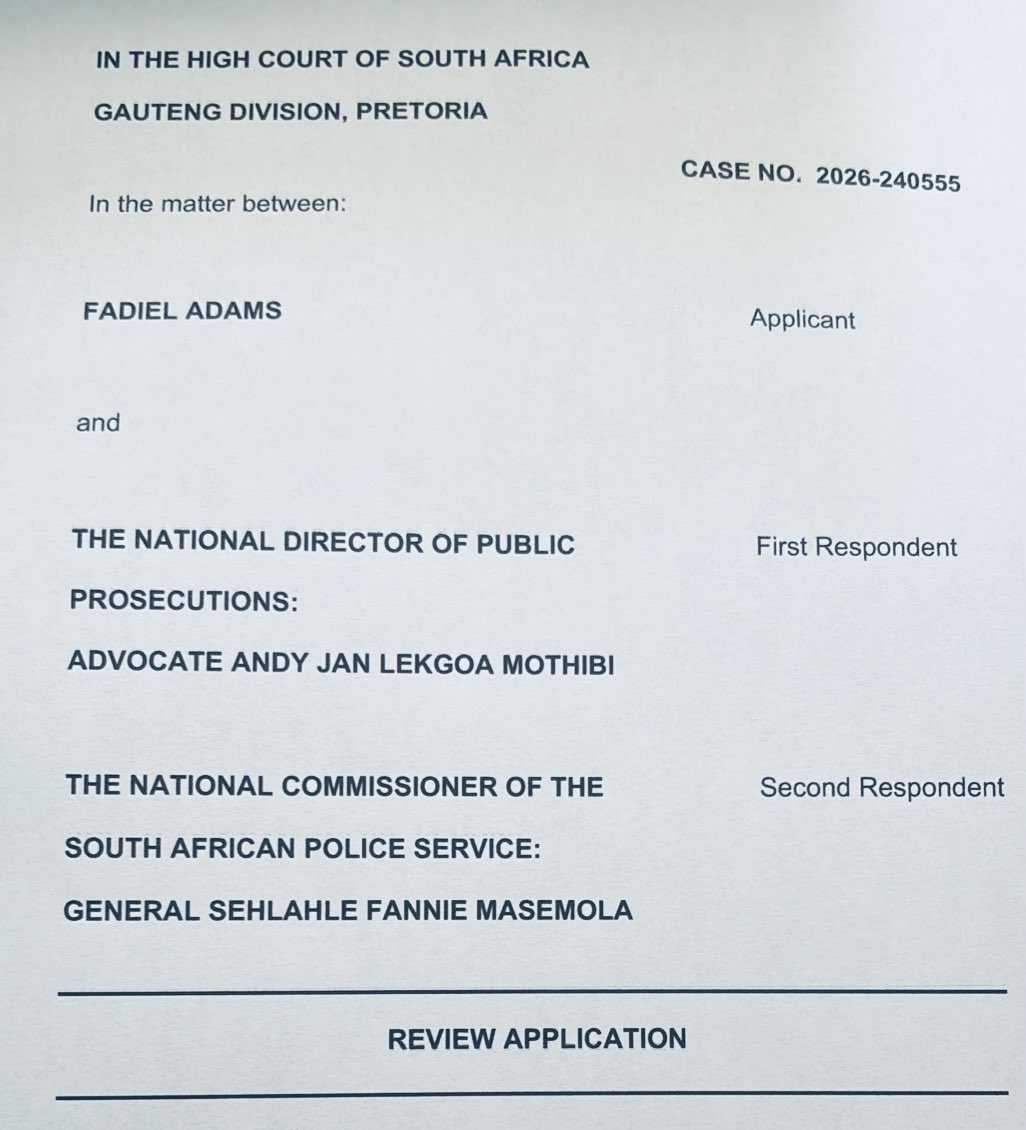
COURT PAPERS SERVED ON SUSPENDED NATIONAL POLICE COMMISSIONER
Court papers have been served on suspended National Police Commissioner Lt Gen Fannie Masemola.
MP Fadiel Adams is bringing an urgent review application challenging the NPA’s decision concerning the criminal charges against Masemola in connection with the multi-million-rand tender awarded to businessman Vusi “Cat” Matlala.
It is understood that the sheriff served the papers on Masemola yesterday. A family member signed for the documents.
The National Prosecuting Authority (NPA) is cited as a respondent in the application.
The urgent application seeks a judicial review of the NPA’s decision.
COURT PAPERS SERVED ON SUSPENDED NATIONAL POLICE COMMISSIONER
Court papers have been served on suspended National Police Commissioner Lt Gen Fannie Masemola.
MP Fadiel Adams is bringing an urgent review application challenging the NPA’s decision concerning the criminal charges against Masemola in connection with the multi-million-rand tender awarded to businessman Vusi “Cat” Matlala.
It is understood that the sheriff served the papers on Masemola yesterday. A family member signed for the documents.
The National Prosecuting Authority (NPA) is cited as a respondent in the application.
The urgent application seeks a judicial review of the NPA’s decision.
I appreciate the pain and depth to which you go to make yourself understood. Based on your response, I can then add that part of the modern SA society arose when activists became government. Suddenly they became deaf and non-responsive to what was initially their perceived problem. When activists enter government, it becomes their turn to eat. Is it possible then to prevent social activists from aspiring to hold political office? I trust you might have an insight into the book by Michaela Wrong about the Kenyan Public Protector: “It’s our turn to eat”.
@MABENGI1, I genuinely appreciate this intervention, particularly because you have pushed the argument beyond diagnosing the pathology towards interrogating the architecture of the solution. I agree with you that the fully coordinated society I describe should not be understood as a finished or perfectly attainable state. Perhaps I should have made that distinction more explicit. I am not advocating for a utopian society in which NGOs, churches, civic movements, communities, academia, business, government and political organisations suddenly cease to have differences. That would indeed be unrealistic. What I am advocating for is a society that develops the institutional capacity to manage those differences without allowing them to become permanent sources of fragmentation.
For me, therefore, the “ideal state” is less a destination than a direction. It is a political, social and institutional horizon towards which we continually organise. We may never arrive at perfect coordination—and perhaps we should not even desire perfect uniformity—but we can certainly build stronger mechanisms for cooperation, collective problem-solving, information-sharing, accountability and coordinated action. The objective is not to make everybody think alike; it is to make different actors capable of working together where their interests and responsibilities intersect.
Interestingly, South Africa itself has historical evidence that this is not merely theoretical. The United Democratic Front demonstrated that hundreds of organisations with different institutional identities could operate under an umbrella around clearly defined common objectives. Research on the UDF shows that its loose, decentralised structure allowed churches, unions, community organisations, youth movements, professional organisations and others to retain their identities while cooperating around broader objectives. At its national launch in 1983, hundreds of civil organisations were represented. The important lesson, therefore, is not that we should recreate the UDF, but that organisational diversity does not necessarily have to produce organisational isolation.
The Treatment Action Campaign provides another important lesson because it operated within constitutional democracy rather than apartheid authoritarianism. Its experience demonstrated that civil society can combine community mobilisation, advocacy, litigation, research, public education and alliances with other organisations to influence public policy. More recent movements such as Equal Education have also demonstrated the value of building networks with allied civil society and labour organisations rather than operating entirely in isolation.
This brings me directly to your proposition of incremental implementation. I agree. We should perhaps stop imagining social transformation as a single grand national project and instead begin constructing what I would call a distributed architecture of social cooperation. It can begin at municipal and community level. Imagine, for example, a local forum in which churches, schools, civic organisations, NGOs, traditional and community leaders, businesses, professional associations, youth organisations and residents periodically sit around the same table—not to establish another bureaucratic organisation, but to identify the five or ten most consequential problems affecting that particular community and determine what each institution can contribute.
The crucial distinction would be that such structures must not become another talking shop. They would require measurable objectives, defined responsibilities, transparent reporting and periodic public evaluation. If unemployment among young people is a problem, for example, the question should not simply be which political party has the best speech about unemployment. The question should become: What can the school contribute? What can local businesses contribute? What can churches contribute? What can NGOs contribute?
@MABENGI1, I genuinely appreciate this intervention, particularly because you have pushed the argument beyond diagnosing the pathology towards interrogating the architecture of the solution. I agree with you that the fully coordinated society I describe should not be understood as a finished or perfectly attainable state. Perhaps I should have made that distinction more explicit. I am not advocating for a utopian society in which NGOs, churches, civic movements, communities, academia, business, government and political organisations suddenly cease to have differences. That would indeed be unrealistic. What I am advocating for is a society that develops the institutional capacity to manage those differences without allowing them to become permanent sources of fragmentation.
For me, therefore, the “ideal state” is less a destination than a direction. It is a political, social and institutional horizon towards which we continually organise. We may never arrive at perfect coordination—and perhaps we should not even desire perfect uniformity—but we can certainly build stronger mechanisms for cooperation, collective problem-solving, information-sharing, accountability and coordinated action. The objective is not to make everybody think alike; it is to make different actors capable of working together where their interests and responsibilities intersect.
Interestingly, South Africa itself has historical evidence that this is not merely theoretical. The United Democratic Front demonstrated that hundreds of organisations with different institutional identities could operate under an umbrella around clearly defined common objectives. Research on the UDF shows that its loose, decentralised structure allowed churches, unions, community organisations, youth movements, professional organisations and others to retain their identities while cooperating around broader objectives. At its national launch in 1983, hundreds of civil organisations were represented. The important lesson, therefore, is not that we should recreate the UDF, but that organisational diversity does not necessarily have to produce organisational isolation.
The Treatment Action Campaign provides another important lesson because it operated within constitutional democracy rather than apartheid authoritarianism. Its experience demonstrated that civil society can combine community mobilisation, advocacy, litigation, research, public education and alliances with other organisations to influence public policy. More recent movements such as Equal Education have also demonstrated the value of building networks with allied civil society and labour organisations rather than operating entirely in isolation.
This brings me directly to your proposition of incremental implementation. I agree. We should perhaps stop imagining social transformation as a single grand national project and instead begin constructing what I would call a distributed architecture of social cooperation. It can begin at municipal and community level. Imagine, for example, a local forum in which churches, schools, civic organisations, NGOs, traditional and community leaders, businesses, professional associations, youth organisations and residents periodically sit around the same table—not to establish another bureaucratic organisation, but to identify the five or ten most consequential problems affecting that particular community and determine what each institution can contribute.
The crucial distinction would be that such structures must not become another talking shop. They would require measurable objectives, defined responsibilities, transparent reporting and periodic public evaluation. If unemployment among young people is a problem, for example, the question should not simply be which political party has the best speech about unemployment. The question should become: What can the school contribute? What can local businesses contribute? What can churches contribute? What can NGOs contribute?
First I must mention that I have read this article twice to make sure I follow your argument. I can find no fault in the analysis of the problem , the argument and its presentation, the research and the value of academic and intellectual capital in it. My real concern is whether such an ideal state of affairs as you propose does exist or if it would ever exist anywhere in this world, A few examples - if any- would be very enlightening for me. The solution is obviously not a single magical wand to transform our society. We need a coherent policy contributed to by the various role players in society as you have identified. The implementation thereof should be gradual and incremental so as to eliminate bottlenecks in the process rather working towards a once-off functional and well coordinated society. My point isn’t to deny your inputs but to add to it. An ideal state as you have defined is in my opinion utopian. However, as a society we can build incrementally towards the ideal- even if the ideal is not achieved in our lifetime- if ever. The points you have raised are instructive and the sooner civil society starts to read and introspect into their own organisation and operations for improved coordination, the better. To borrow from T Motsohi each civil society organisation including political parties and government should reassess whether they are Fit For Purpose. The question for each one therefore should be: What and how does our organisation/ society/ movement contribute towards the building a New SA we would all love to see emerging in the near future.? The next big question though is: whether all of us as SA’ns in various roles and organisations share a common vision about our beloved country.
I would appreciate your views as to how you propose to implement steps towards the ideal state of affairs- as I call it.
Respected ANC struggle hero & parliamentary Chief Whip, Comrade Mdumiseni Ntuli says he, too, concurs with COVID-19 PPE funds looter, Khusela Diko that our National Police Commissioner, General Fanie Masemola is a constitutional delinquent & a thug for implementing Comrade Senzo Mchunu’s unlawful & misguided political instructions in police operational matters— in support of organised crime cartels.
With both of his sticky middle fingers visibly up in the air, he further stresses that Comrade Senzo isn’t guilty of any wrongdoing. Unlike career cop, General Fanie Masemola.
///Ends
Yes. The people shall give you an appropriate and fitting welcome. Make sure that Roets is personally present.
The people really want to meet him and greet him properrly.
Let’s just juxtapose the position of the Ad Hoc Committee led by Soviet Lekganyane and the ANC Statement on this matter. It’s clear that the two positions are at odds with each other. Who is wrong and who is right? It’s clear that each seeks to set up somebody. Ad hoc wants to nail Masemola whilst the ANC statement suggests they want Mchunu. Either statement is premised on a predetermined and desired state of affairs. Either way, someone will remain with an egg on their face.
This is where the constitutional and administrative-law questions become far more interesting than the political headlines suggest.
If the ANC’s argument is that General Masemola had a constitutional duty to resist an unlawful ministerial directive, then we need to interrogate the other side of the equation with equal seriousness: what precisely makes an instruction unlawful, who determines that in real time, and what protection does an accounting officer have when refusing a ministerial instruction could jeopardise his career?
The issue cannot simply become “Masemola should have disobeyed Mchunu.” That risks reducing a profound institutional question to an individual act of courage.
Mchunu’s own parliamentary statement confirms that he directed that the filling of vacant Crime Intelligence posts be halted pending substantive discussions with the National Commissioner. The question, therefore, is not whether the instruction existed. It did. The harder question is whether the Minister possessed the lawful authority to issue it and, if not, what constitutional duty fell upon the National Commissioner once he received it.
And there is a lesson here that extends far beyond Masemola and Mchunu.
We cannot build a professional, constitutionally governed public service if officials are expected to obey political authority unquestioningly—or if they are expected to resist political authority without clear legal protection when they believe an instruction is unlawful.
The law must tell them where the line is.
And institutions must protect those who stand on the lawful side of it.
That, to me, is the real story behind this headline.
This is where the constitutional and administrative-law questions become far more interesting than the political headlines suggest.
If the ANC’s argument is that General Masemola had a constitutional duty to resist an unlawful ministerial directive, then we need to interrogate the other side of the equation with equal seriousness: what precisely makes an instruction unlawful, who determines that in real time, and what protection does an accounting officer have when refusing a ministerial instruction could jeopardise his career?
The issue cannot simply become “Masemola should have disobeyed Mchunu.” That risks reducing a profound institutional question to an individual act of courage.
Mchunu’s own parliamentary statement confirms that he directed that the filling of vacant Crime Intelligence posts be halted pending substantive discussions with the National Commissioner. The question, therefore, is not whether the instruction existed. It did. The harder question is whether the Minister possessed the lawful authority to issue it and, if not, what constitutional duty fell upon the National Commissioner once he received it.
And there is a lesson here that extends far beyond Masemola and Mchunu.
We cannot build a professional, constitutionally governed public service if officials are expected to obey political authority unquestioningly—or if they are expected to resist political authority without clear legal protection when they believe an instruction is unlawful.
The law must tell them where the line is.
And institutions must protect those who stand on the lawful side of it.
That, to me, is the real story behind this headline.
This is just a paradox and 💯 on brand with the ANC lunacy!
Didn't the very same organization's ethics committee clear the very same minister yet the NatCom is the one in the wrong ?
2ndly why act fresh on the commissioner knowing the political climate interference the country operates ?