NSE Certified Market Professional Level 3 | Equity Trader | Founder Northbridge Capital Research |Former Captain in the Indian Army 🇮🇳| USIC 2026 Participant
Mid July Update:
16 July 2026
Total trades: 13, Wins: 2, Losses: 11
Win rate: 15%
R:R= 0.024 (5.5 would be needed to break even)
Expectancy value= -0.6 R
Drawdown= -4.5%
Diagnoses:
July has been a brutal month to trade traditional breakout strategies (more specifically since 24th June).
Even high volume and RVOL confirmation have failed to improve the odds. Squats, T+1 reversals have been the norm.
Even on the days the indices had multi day gains, the broader market didn't participate.
My edge has pretty much acted like Barabara from "Shark Tank" this month ie. My edge looked at my trades and said "Nah..im out" 😆
The first 5 losses were an outcome of hubris and overconfidence on my part due to May and June successes, and i expected follow through days where there were none.
The remaining losses were a slow bleed, as they piled up one after the other. However, the losses were mitigated significantly by reducing size and frequency of trades, and stopping new trades after 11 July, as it became clear that it wasn't an environment for me.
All trades were taken on a T+1 day basis, after my "Breadth Regime Formula" flashed green, but in most occassions the market breadth suffered mean reversion in a day or two following the initial break. Breadth and the indices also closed negative for the day even after a large gap up at the initial open.
This lack of a multi-day follow through and "gap up-lower close combo", led to most trades squatting or reversing, despite volume confirmation. Even the decent, sizeable unrealised winners reversed aggressively and turned into breakevens or much smaller winners.
My preferred entry, position sizing and exit tactics, were clearly not suited for this environment. As stated earlier, my edge was ineffective.
What may have worked (but i don't have enough data to prove it):
1. Entries made on the same day as the market breadth move
2. Entries made as the price moved up from a pullback, closer to the 10/20EMA.
3. Quickly moving to breakeven or selling into strength
A combination of these may have worked. Though i don't have the hard data to prove it yet.
Positives and Negatives:
I am upset that i let hubris get the better of me in the first few days. But i am happy that i reacted well enough to reduce size. Ideally, i may have been able to avoid atleast 4 losses out of 11. The remaining 7 losses are a cost of doing business that could not have been avoided.
The Drawdown could have been reduced to -2.5% had the avoidable trades not been taken.
Drawdown would have increased to -11% had i not reduced size and stopped trading after 11 July. I took several paper trades after 11 July, using my preferred strategy amd tactics, and the outcome of those paper trades was just as ugly.
Advice For New traders:
Avoid trading in low probability environments. You could easily end up in a 10-20% drawdown if u aren't mentally prepared for such a market. You could suffer even bigger losses if u are unable to take losses and start lowering your SL in panic.
Furthermore the emotional trauma will make you incapable of reacting and taking trades when the market environment subsequently improves. ie. You lose capital in bad environments, and fail to recoup it in good environments.
Cheers!
Hell no. The only way the tax base can increase is if there is genuine real economic growth, real GDP, real per capita income and disposable income (not nominal). India needs to increase it's tax base rapidly in the next 15yrs. Our demographic dividend will end by 2040. If we don't get rich as a country by then, we will end up with an aging population on a very low tax base. It will be catastrophic.
Jeff Sun has a method to do this objectively. He uses 3 staggered stops, 33% of the position at each stop. So if all 3 get triggered, u end up with a loss of -0.67R.
But u will have to objectively backtested and foward test this strategy, to figure out if it works better than the traditional stop or not, or what environment it works in best. For eg. My hypothesis is that in choppier markets, it probably works well, and in strong bullish markets it may underperform as it does also punish upside
@realpristinecap Ma maan, i searched for this tweet for a good 30mins cause i remember reading it in May and thinking to myself, yea you're probably gonna be proven right.
Fast forward 3 months, and here we are! Wipeout!! 😂🫡
120 million unrealised loss, which ended up as a 60 million realised loss..on a single trade. He wrote to jack after their interview ended, and told them that he had suffered this new "biggest loss".
Complete failure on his part to close the trade, due to indicisiveness and expecting the short to reverse back to his buy point and reverse his losses. The fact that he let the position fall to -120million, and only managed to recover to -60million because the stock reversed, is very frightening tbh.
What if it had gapped up further, another 20-30%? He'd be down to Zero and gotten liquidated
The best lesson one can take from Russo is, that:
"Hubris and overconfidence can destroy even the best traders. The market can and will discount your life's worth of knowledge in a few seconds. Never assume that u know more than it."
Thats the lesson i chose to take and i have wrttien and stuck it on the wall in front of my trading desk.
Also I'm not sure if it was Russo or someone else in the book that said, that Parabolic shorts worked best during strong bull markets. Because that's when the best over extensions of 300 to 1000%, happen. I'm assuming that u are using this shorting strategy in US stocks, cause it's certainly not applicable to India
At the end of the chapter Jack mentions that Russo reached out to them after the interview, and mentioned that he suffered his largest loss yet from a single trade. An experienced trader with a robust system should ideally not be suffering such massive losses. That indicates that the system is not as robust, and has massive risks of catastrophic failure.
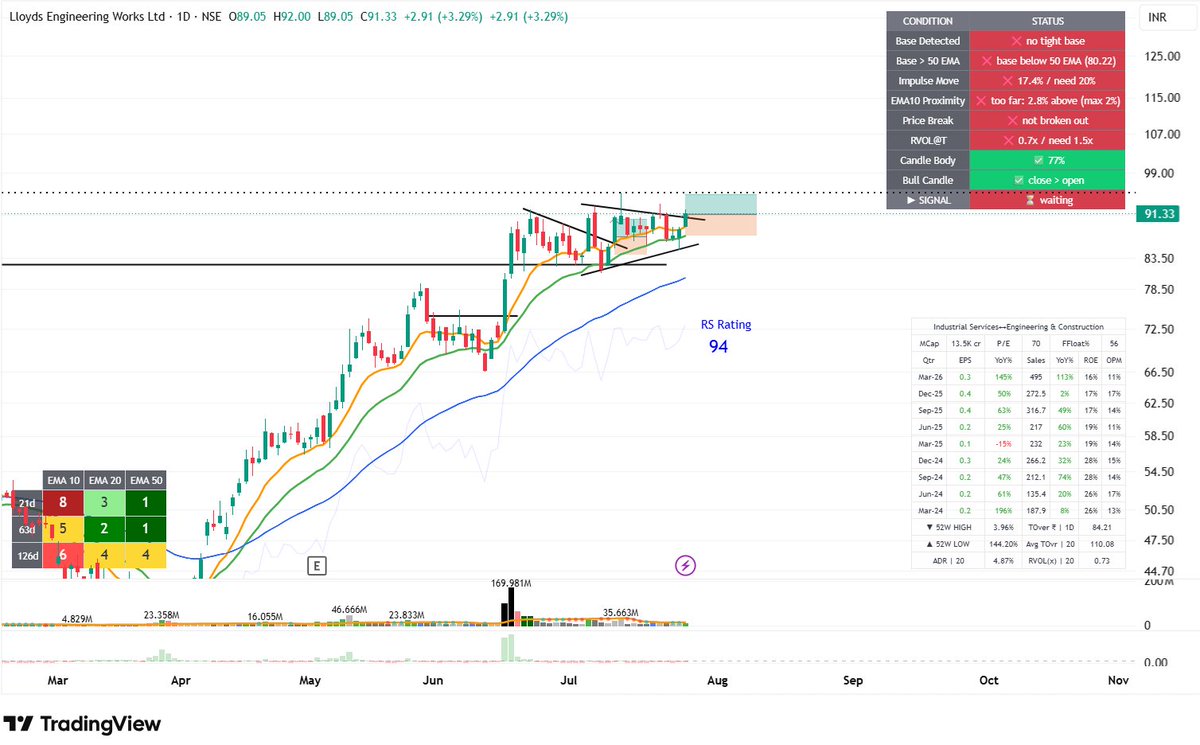
29 July 2026, Wednesday, (yesterday)
Closed all positions due to a complete lack of follow through.
Closed Positions
#LLOYDSENGG= -0.68R, Impact on PF -0.46%,
#SUNFLAG= -0.27R, Impact on PF -0.18%
Presently: Not invested
Realized Loss/Gain: -0.67%
Unrealized Loss/Gain: NA
Net Loss/Gain: -0.67% of PF
Thoughts: A very aggressively mean-reverting market. Momentum based strategies will not work here, or will work in extremely limited cases. If you do not have a strategy that is fine tuned for such a specific market, avoid trading and getting chopped about. Also be extremely cautious about style drift. Any new strategy requires decent forward testing and back testing. Do not jump into anything blindly. Use the opportunity to forward test and back test new idea, for future implementation in similar choppy or mean reverting markets
Cheers
Note: 1R=0.67% of PF
#Swing_Trading
#Momentum_Trading
#Nifty
#USIC_2026
27 July 2026, Monday, After market hours
As of days end, Market Breadth above the 10 MA has seen a +13% improvement over Friday. A reversal after days of drawdown. My first trades since 13 July.
New Positions
#LLOYDSENGG= Avg 91.14, RVOL>2 at entry, SL 4%, Open Risk 0.67% of PF (Position Size 18%)
#SUNFLAG= Avg 359.79, RVOL>2 at entry, SL 4%, Open Risk 0.67% of PF (Position Size 18%)
Presently: 36% invested, 1.34% Open risk
Realized Loss/Gain: NA
Unrealized Loss/Gain: Negligible
Net Loss/Gain: NA
Thoughts: Re-entered the market after a two week long hiatus, that was preceded by a losing streak this July. The market indices showed good momentum and intraday follow through. Breadth peaked by 11AM-12PM and then contracted from the days peak by -7%, but still held at a net +13% from Friday. Further deployment of capital will depend on market follow through and the New Positions doing well. Its still too soon to know if there is a genuine change in nature of the market, given the past 4 weeks or choppiness and narrow market participation.
Cheers
Note: 1R=0.67% of PF
#Swing_Trading
#Momentum_Trading
#Nifty
#USIC_2026