Hello world -
To anyone who reads this, this will be a long thread — apologies in advance.
MAD is still in Alpha and has a long way to go.
The goal is simple - build a serious Asset Intelligence system that can explain what is actually changing inside an asset.
@Natan_benish Strong point!! Good branding helps people notice a stock pair, but it also helps them understand and remember what the pair actually represents.
The best ones will probably be where the brand and the economic design make sense together.
It is one of the experiments at a surface level.
MAD's larger goal is to understand different assets on their own terms -
what changed, why it matters, what supports or contradicts it, and what remains uncertain.
The direction: an Asset Intelligence layer, exposed through APIs for apps and agents.
For now, we keep building and testing.
Hello world -
To anyone who reads this, this will be a long thread — apologies in advance.
MAD is still in Alpha and has a long way to go.
The goal is simple - build a serious Asset Intelligence system that can explain what is actually changing inside an asset.
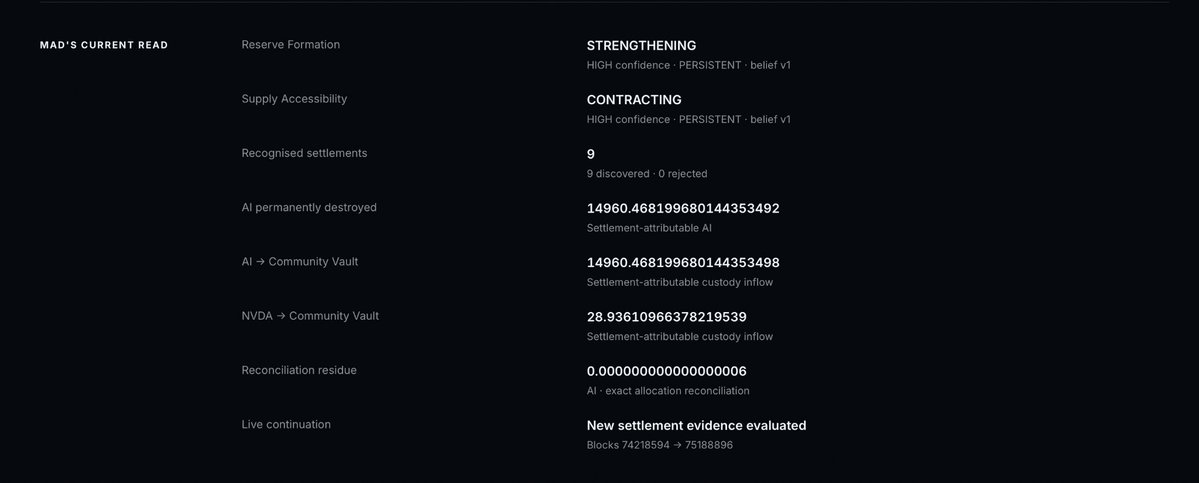
From the evidence observed so far, MAD currently reads -
Reserve Formation — Strengthening
Supply Accessibility — Contracting
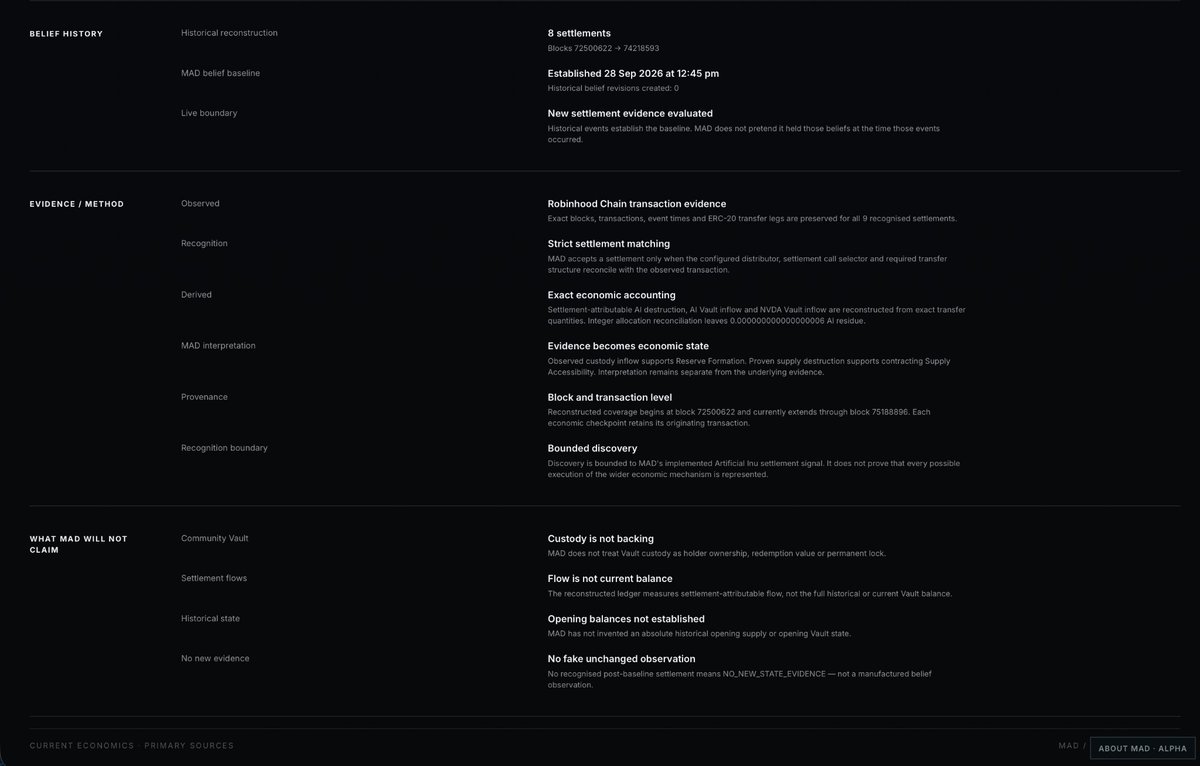
MAD also separates historical events from when it formed its view, and can revise that view when new evidence arrives.
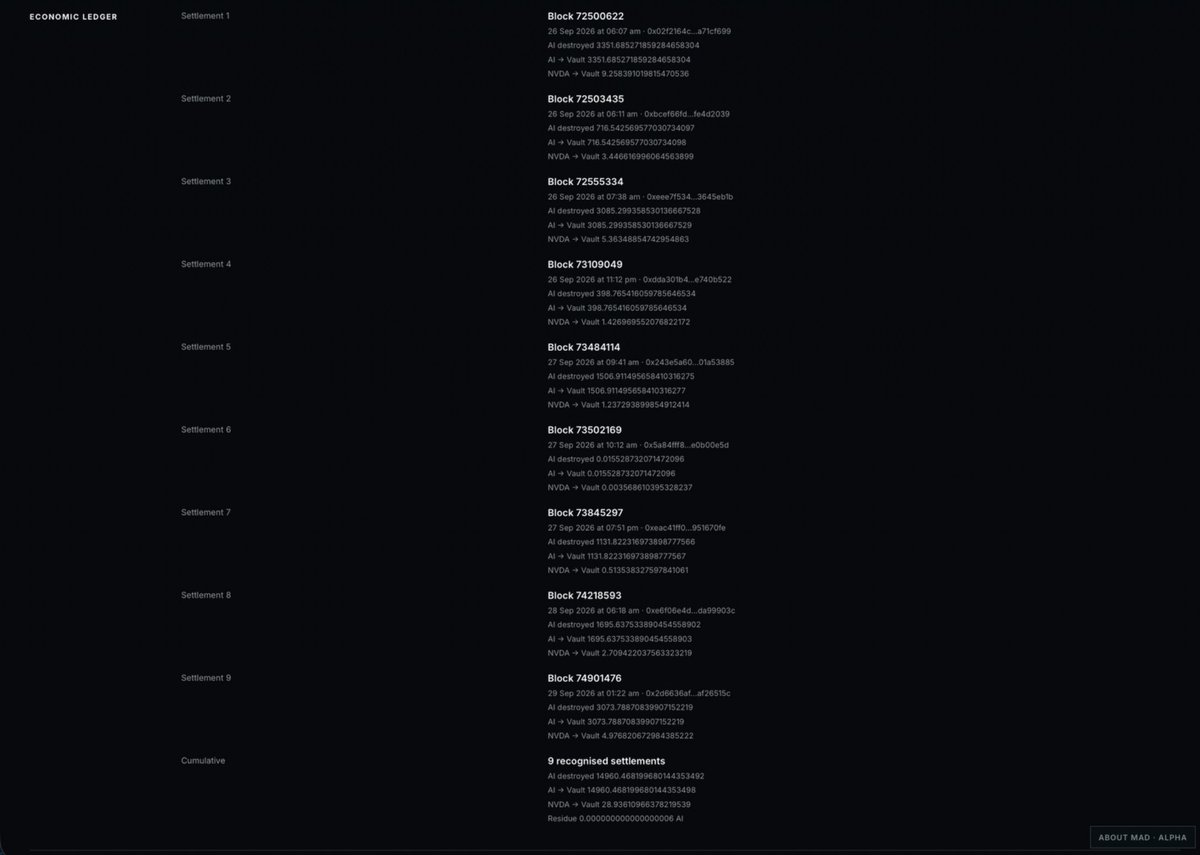
From those settlements, MAD can calculate what actually changed: AI destroyed, AI entering the Community Vault, NVDA entering the Vault, and the cumulative effect over time.
Finding transactions is the easier part. The harder question is what they mean economically.
The goal was not to explain everything about a token but to see how much MAD could independently reconstruct from observable evidence.
MAD rebuilt recognised settlements from Robinhood Chain — block by block, transaction by transaction and transfer by transfer.
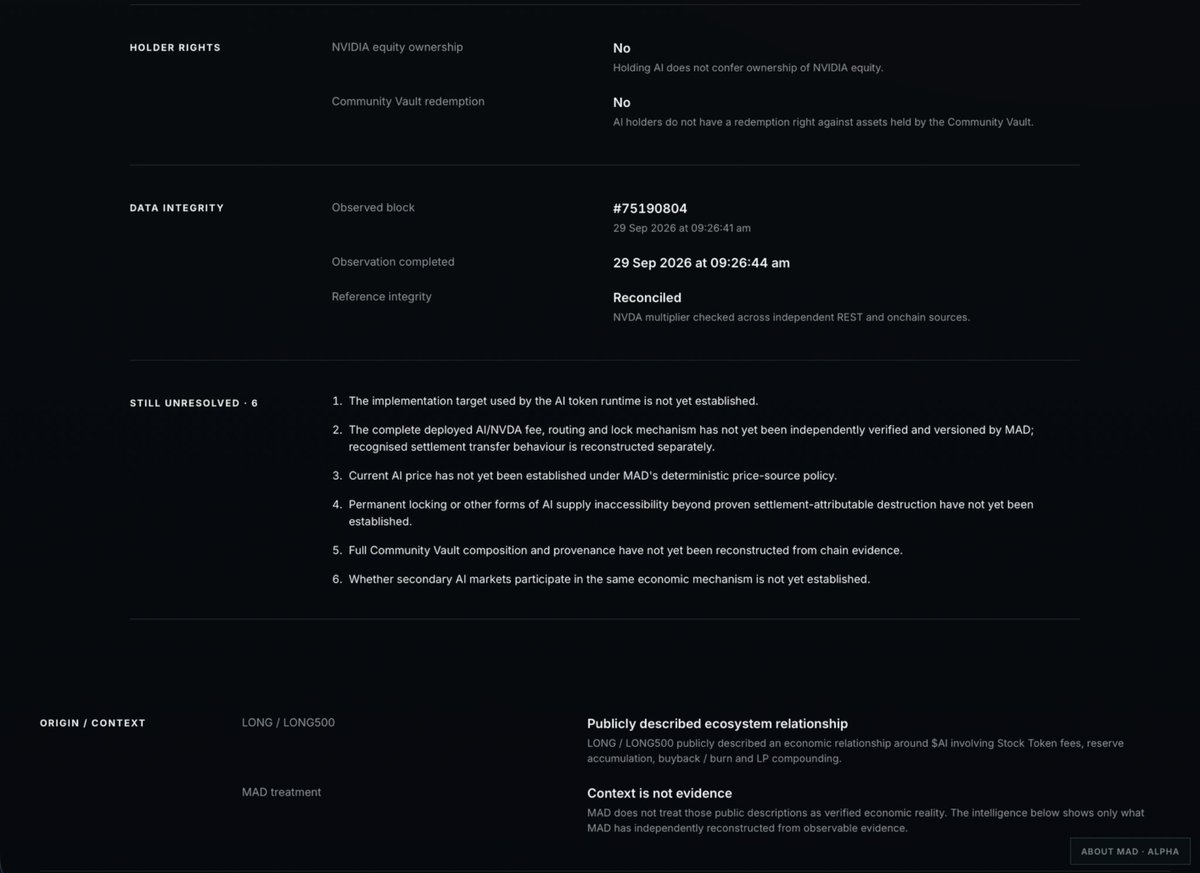
After looking at a few candidates, we chose Artificial Inu ($AI) from the LONG / LONG500 ecosystem.
It gave us a token, NVDA reference asset, Community Vault, settlement flows and supply changes. We kept the investigation bounded.
@ArtificiallyInu@longdotxyz@Natan_benish
One question kept coming up - Can MAD understand an onchain asset beyond price, volume and wallet activity?
To test that properly, we wanted a composable asset with several moving parts, where understanding the asset meant understanding how those parts interact.
We have been building MAD through trial and error — roughly 190 commits in the last few weeks.
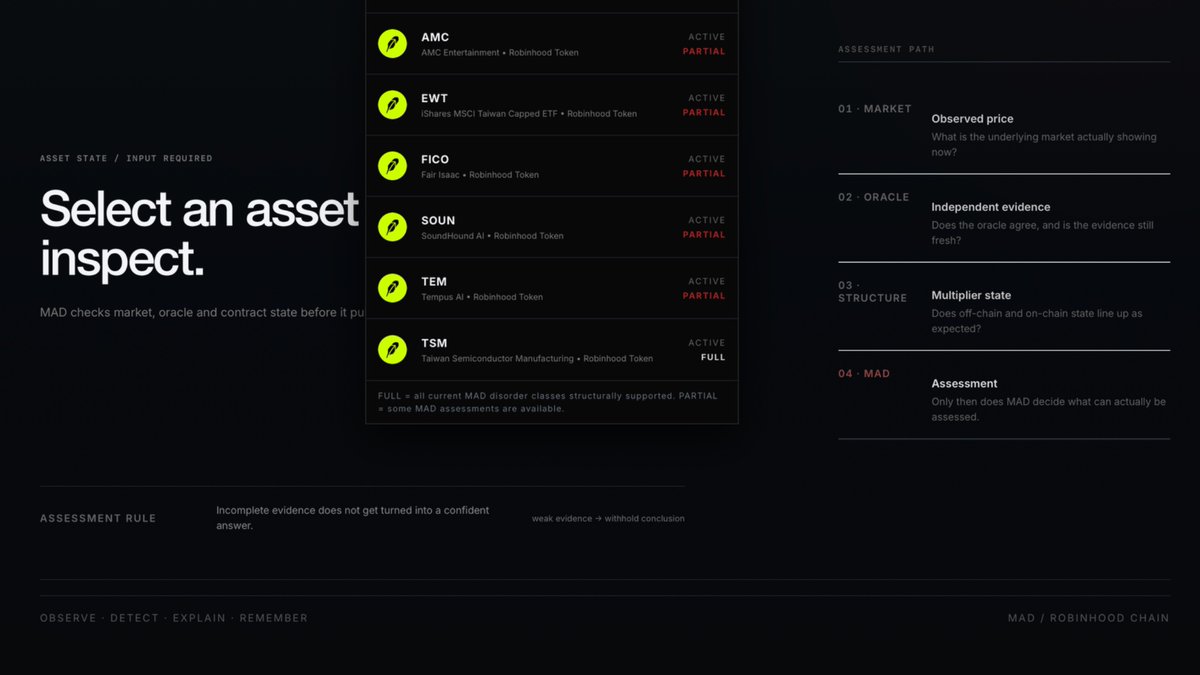
MAD is being built around Robinhood Chain, where market and economic activity can exist onchain and give MAD something real to investigate.
@RobinhoodCrypto@JohannKerbrat
An AI agent shouldn’t just explain what happened. It should know what it believed before, detect what has changed and then revise its view when the evidence earns it, and show exactly why.
That’s what we’re building with MAD!!!
#RobinhoodCrypto#RobinhoodChain#AgenticAI
MAD Alpha is already live and we’re still building it every day.
Now we have another decision to make - Do we launch the MAD contract/token and let the market take over?
Or keep building until the asset intelligence is much harder to ignore?
Right now, we’re leaning toward getting the product right first.
Curious how others would think about it.
As more assets become tokenized, the problem isn’t getting more data. It’s understanding what the data actually means.
Every data source, feature and line of code must earn its place by improving how well the user understands an asset.
MAD is still Alpha and we have a lot more to do.
The Observatory is open to use.
The GitHub repo is private for now, but if you are building, researching, or genuinely interested in looking at the code, reach out and we can arrange access.
Any feedback, bugs and criticism are all welcome.🙏
Thought this was a good time to share what we’ve been working on with MAD.
It’s still in Alpha, but it has reached a point where we’re comfortable showing it properly.
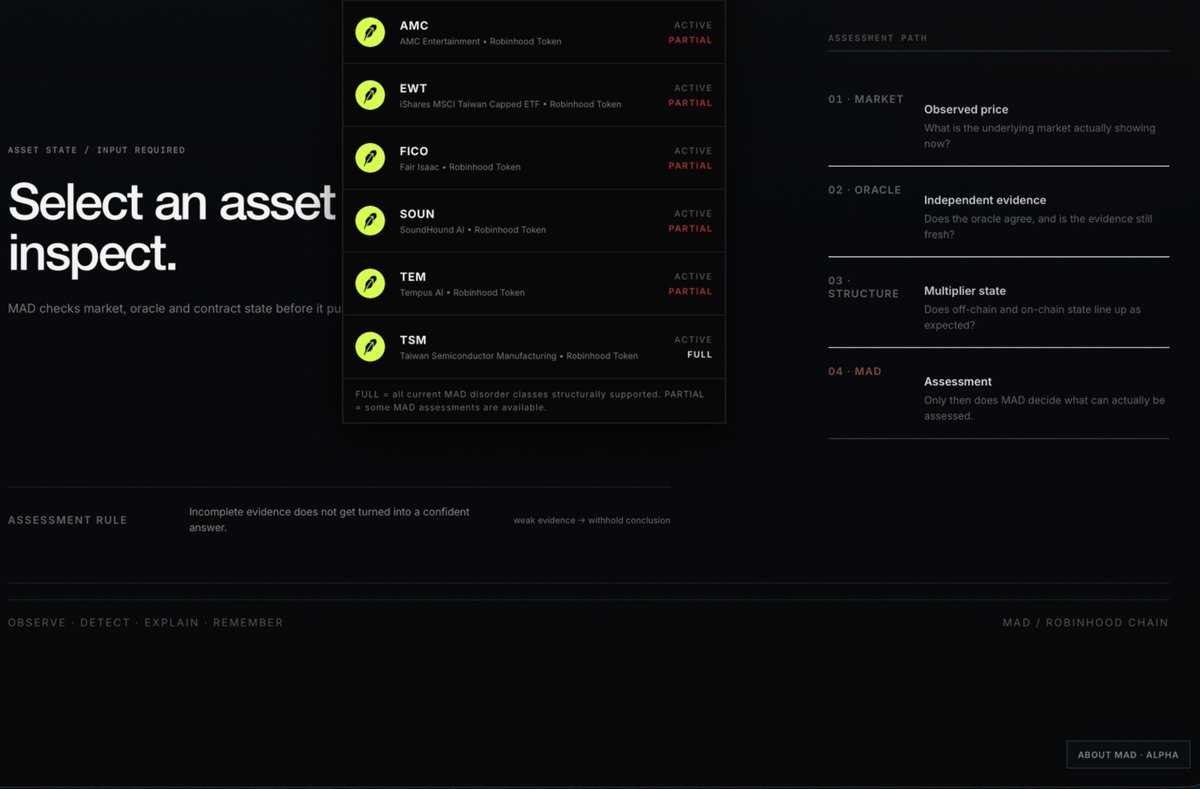
MAD looks at market movement and tries to understand what changed, what might explain it, and what the evidence actually supports.
Built on Robinhood Chain.
#RobinhoodChain
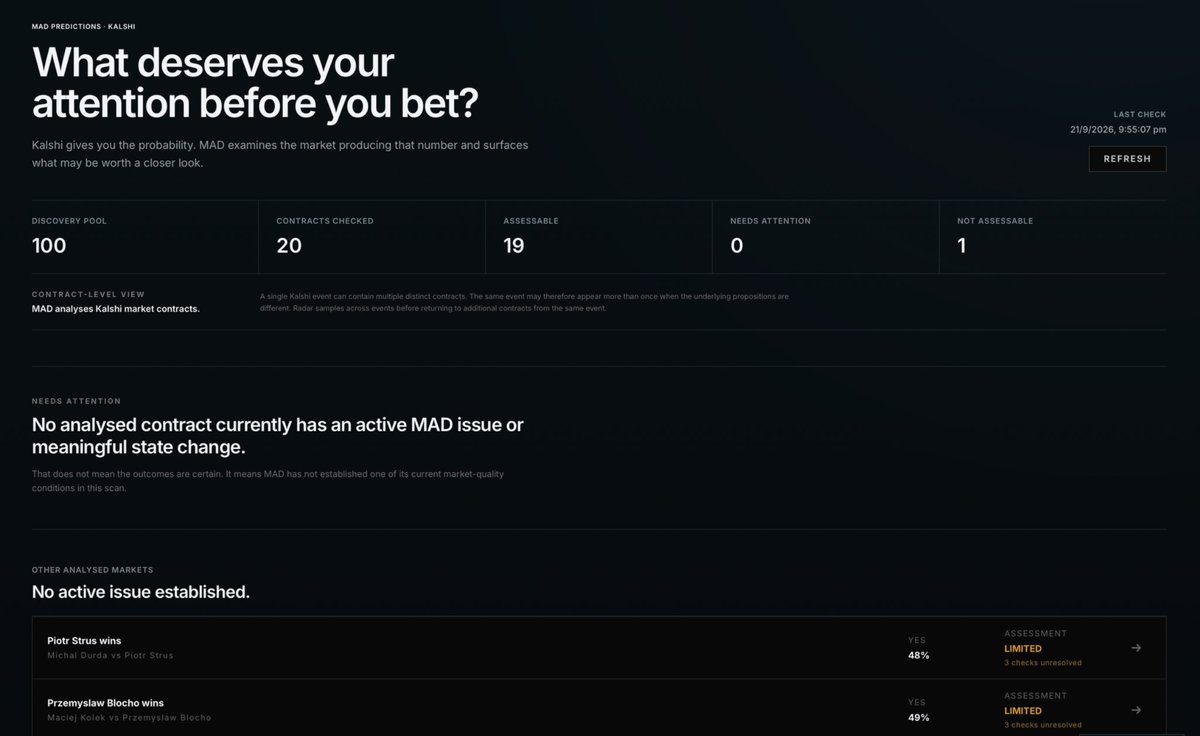
We are also testing the same approach with prediction markets.
MAD is not trying to predict whether YES or NO will win.
It looks at the market behind the number and checks whether there is anything worth paying attention to.
This part is still early.