“The ability to reduce everything to simple fundamental laws does not imply the ability to start from those laws and reconstruct the universe.”
— Philip W. Anderson
Bro, this Goku vs Saitama fight goes harder than any official episode I've seen lately 🔥
The way they just keep breaking their limits is absolutely insane to watch
Huge props to the creators for putting together this epic Fan Made masterpiece
La Casa de la Moneda de Reino Unido ha lanzado una colección especial para celebrar el 25 aniversario de El Señor de los Anillos. El diseño está basado en el Anillo Único y cuando la luz atraviesa la moneda se proyecta el ojo de Sauron.
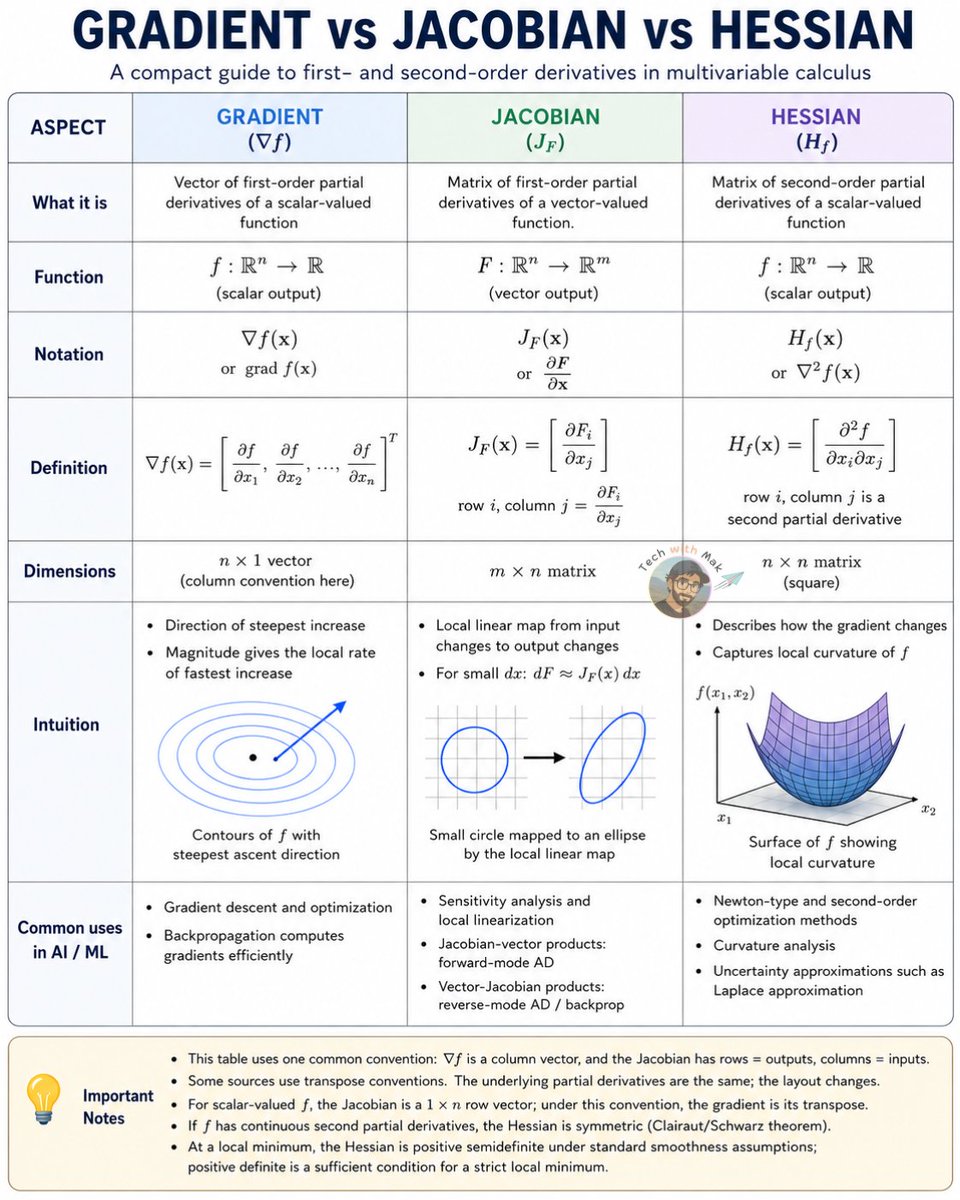
This math sits underneath every AI model being trained right now.
Gradient. Jacobian. Hessian.
Three words that look intimidating at first.
But they are really just three ways of measuring change.
𝟭. 𝗚𝗿𝗮𝗱𝗶𝗲𝗻𝘁 ∇f
Takes a scalar function:
f : ℝⁿ → ℝ
Returns a vector of first-order partial derivatives.
It answers:
"Which direction makes f increase fastest?"
That is why gradients are central to optimization.
Gradient descent moves in the opposite direction because the gradient points uphill.
Backpropagation efficiently computes gradients during training.
𝟮. 𝗝𝗮𝗰𝗼𝗯𝗶𝗮𝗻 J_F
Takes a vector-valued function:
F : ℝⁿ → ℝᵐ
Returns an m × n matrix of first-order partial derivatives.
It answers:
"How does each output change with each input?"
The Jacobian is the local linear map of a vector-valued function.
It shows up in:
→ sensitivity analysis
→ change of variables
→ automatic differentiation
→ forward-mode AD
→ reverse-mode AD / backpropagation
In simple terms:
forward-mode AD uses Jacobian-vector products.
reverse-mode AD uses vector-Jacobian products.
𝟯. 𝗛𝗲𝘀𝘀𝗶𝗮𝗻 H_f
Takes a scalar function:
f : ℝⁿ → ℝ
Returns an n × n matrix of second-order partial derivatives.
It answers:
"How does the gradient itself change?"
That means the Hessian measures curvature.
When the second partial derivatives are continuous, the Hessian is symmetric.
At a critical point:
→ positive definite Hessian → strict local minimum
→ negative definite Hessian → strict local maximum
→ indefinite Hessian → saddle point
The clean mental model
Gradient = first derivatives of one output
→ tells you direction
Jacobian = first derivatives of many outputs
→ tells you sensitivity
Hessian = second derivatives of one output
→ tells you curvature
And the relationship between them is simple:
The Hessian is the Jacobian of the gradient.
For a scalar output, the Jacobian contains the same partial derivatives as the gradient, up to row/column convention.
Same idea:
measure change.
Different object:
direction, sensitivity, curvature.
Once this clicks, optimization stops looking like a pile of formulas.
It starts looking like a map of the problem.
La biología en PDF acaba de morir.
Un tío hizo una app donde exploras estructuras 3D como un videojuego.
UI: GPT Images 2. Código: Gemini 3.1 Pro.
Los libros de texto ya no sirven.
Shannon Entropy: Measuring Uncertainty in Information
H(X) = - ∑ P(xᵢ) log P(xᵢ)
This is the legendary formula by Claude Elwood Shannon (1916–2001); the father of Information Theory.
Entropy quantifies how much uncertainty (or average information) is contained in the outcome of a random variable X. The more unpredictable the outcomes, the higher the entropy.
From data compression and cryptography to AI and communications; this concept powers the digital world.
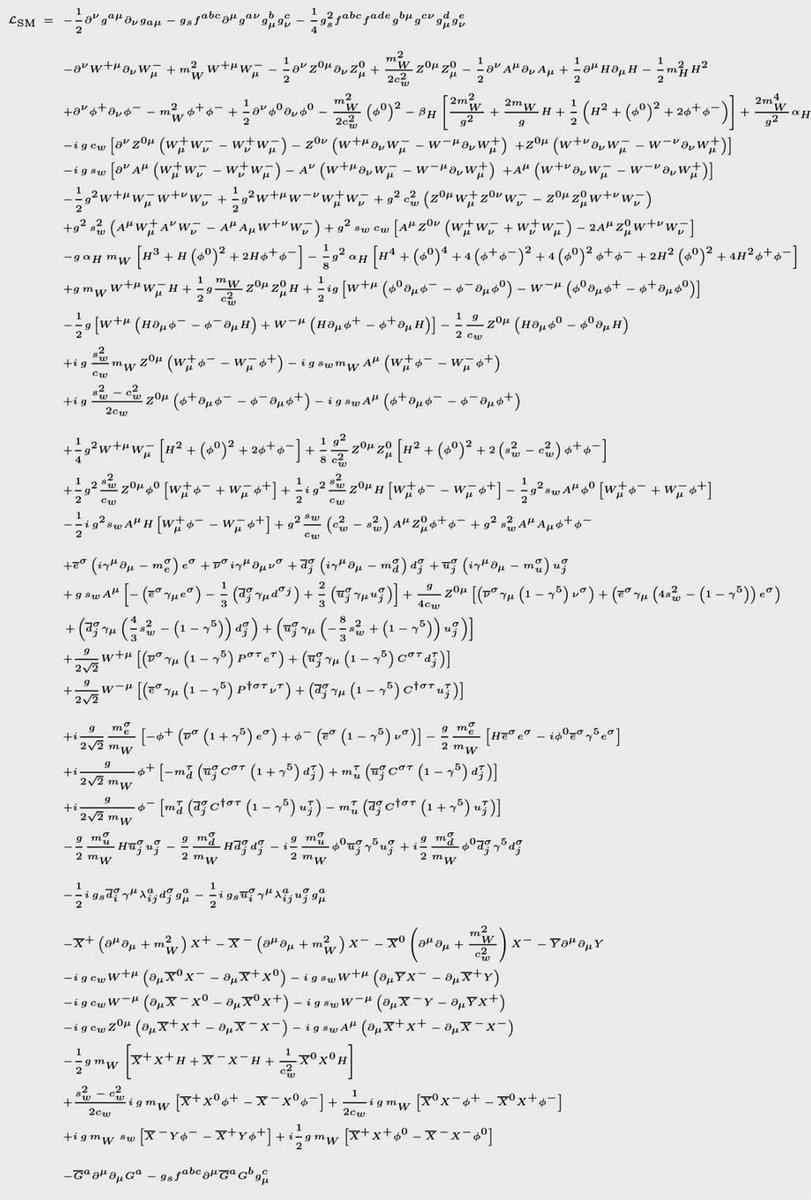
This is the longest equation in physics: the Standard Model Lagrangian.
It is the complete mathematical summary of the Standard Model, our best theory describing how all known elementary particles interact through the electromagnetic, weak, and strong forces.
One curve.
Three projections.f(t) = e^{-γ(t-t₀)²} ⋅ e^{iωt}
From the Re-t plane: damped cosine.
Im-t: damped sine.
Re-Im: perfect inward spiral.Same reality, different slices.