The Next Commercial Landmark in Gulshan-e-Iqbal is Here!
Gulshan-e-Iqbal’s commercial landscape is set for a transformation with Waniya Mobile Mall & Office Tower, currently under construction by Waniya Builders & Tabani Real Estate Pakistan at a prime location of Karachi's main Rashid Minhas Road.
Designed to offer a premium mix of modern retail spaces and corporate offices, this upcoming commercial hub is set to redefine the business landscape of Karachi.
With an investor-friendly payment plan, owning a space has never been easier:
• Booking Starts at: Only 4 Lacs
• Flexible Installments: Spread over 2 Years
• Premium Spaces Starting From: 40 Lacs
Whether you’re seeking strong rental potential, long-term capital growth, or the perfect location for your business, Waniya Mobile Mall & Office Tower offers an opportunity you don’t want to miss.
For Booking & Details: 0320 8300022
Visit: https://t.co/h14bQR1KsW
#TOKAlert #Karachi #Waniyabuilders
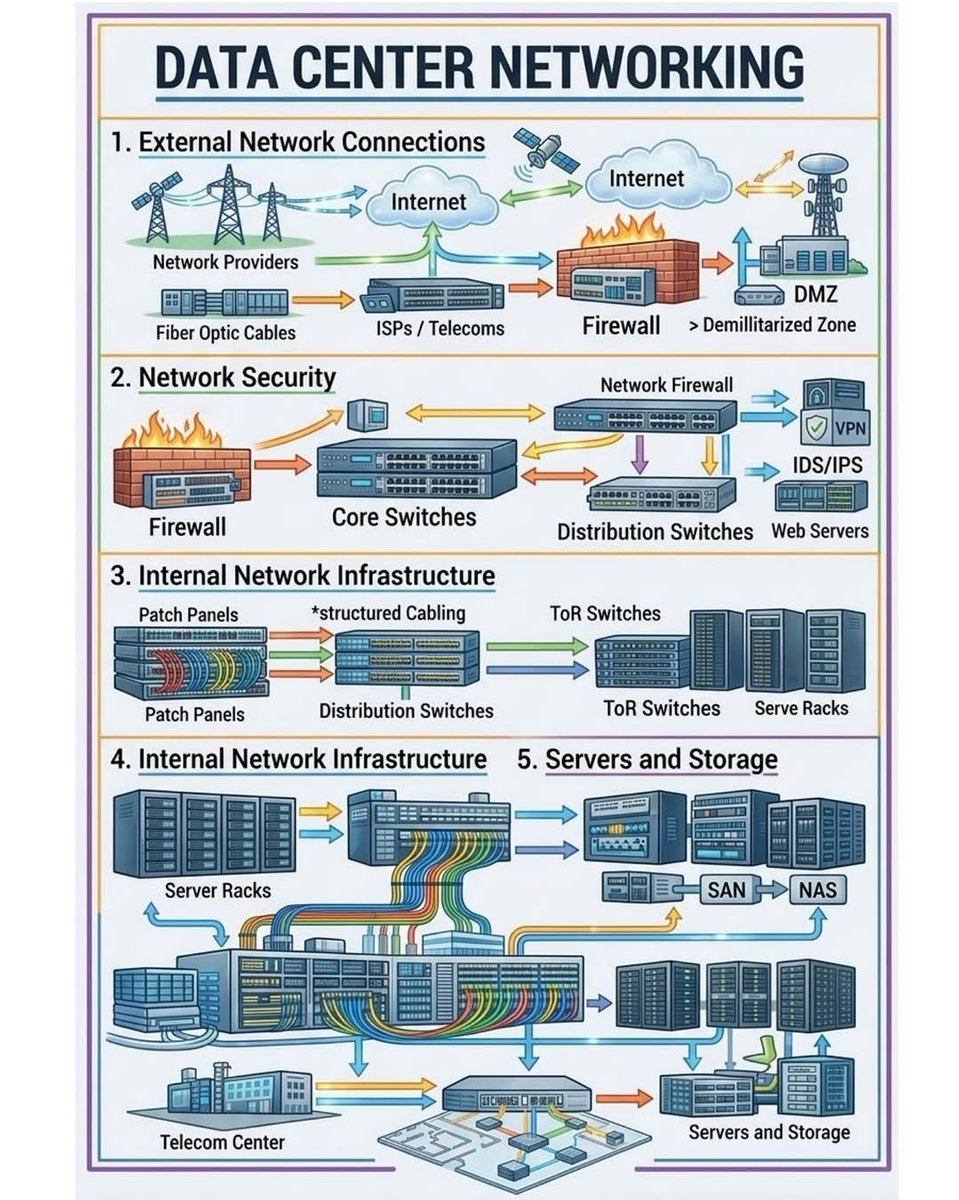
DATA CENTER NETWORKING
Think of a data center like a small city for computers.
Everything starts with internet providers bringing connectivity into the facility through high-speed fiber. Before any traffic reaches the servers, it passes through firewalls, DMZs, and other security layers that filter out unwanted traffic and protect critical systems.
Inside the data center, core switches act as the backbone, distribution switches direct traffic where it needs to go, and Top-of-Rack (ToR) switches connect individual servers inside each rack.
At the end of the chain are the servers and storage systems (SAN/NAS), where websites, apps, databases, and cloud services actually run.
Every packet follows a carefully designed path to keep latency low, performance high, and downtime close to zero.
Switch ports aren't all the same.
Two of the most common types are Access Ports and Trunk Ports, and knowing the difference makes VLANs much easier to understand.
Access Port
• Belongs to a single VLAN.
• Connects end devices like PCs, printers, IP phones, or servers.
• Sends and receives normal Ethernet frames without VLAN tags because the connected device usually doesn't understand VLANs.
Think of it as a dedicated lane for one network.
Trunk Port
• Carries traffic for multiple VLANs over a single cable.
• Used to connect switches together or connect a switch to devices like routers, firewalls, or virtualization hosts.
• Uses VLAN tagging (typically IEEE 802.1Q) so devices know which VLAN each frame belongs to.
Think of it as a highway with multiple lanes, where each lane represents a different VLAN.
Simple rule to remember:
Access Port = One VLAN, one end device.
Trunk Port = Multiple VLANs, network devices.
Most people hear ACCESS PORT VS TRUNK PORT and it sounds more complicated than it actually is.
Here’s the clean mental model:
An access port is like a single-lane road.
It carries traffic for one VLAN only and connects directly to end devices like PCs, printers, or cameras.
So if your laptop plugs into a switch → that’s almost always an access port. No tagging, no complexity, just plain traffic.
A trunk port is more like a multi-lane highway.
It carries traffic for multiple VLANs at the same time using VLAN tagging (802.1Q).
This is what connects:
Switch ↔ Switch
Switch ↔ Router
Switch ↔ Firewall
Basically, anywhere you need VLANs to “travel together” across devices.
Simple way to remember it:
Access = one VLAN, end devices
Trunk = many VLANs, networking devices
If you mix them up, your network won’t “break”… but it definitely won’t behave the way you expect.
Networking is mostly just knowing what should talk to what, and how cleanly you want that conversation structured.
Confused between NPN and PNP transistors outputs?
Here’s the simplest way to understand Sinking vs Sourcing PLC signals.
Save this guide for troubleshooting sensors, PLC inputs, and industrial wiring.