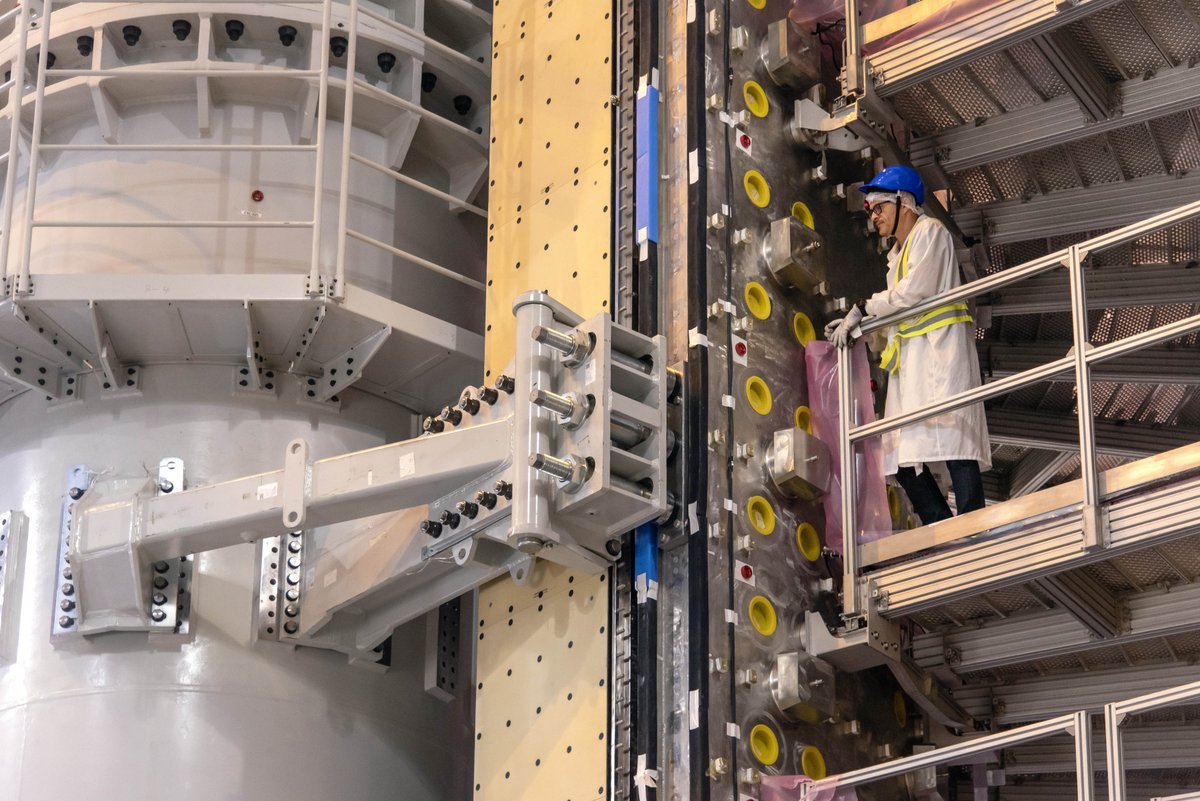
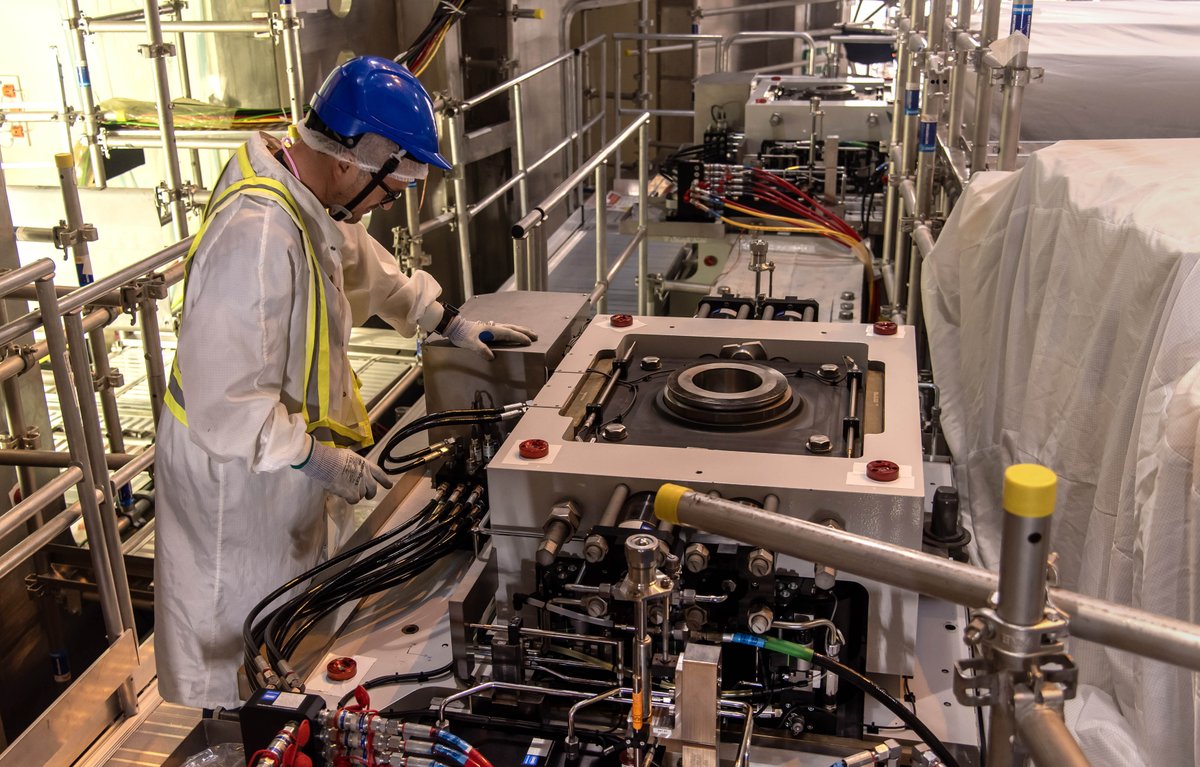
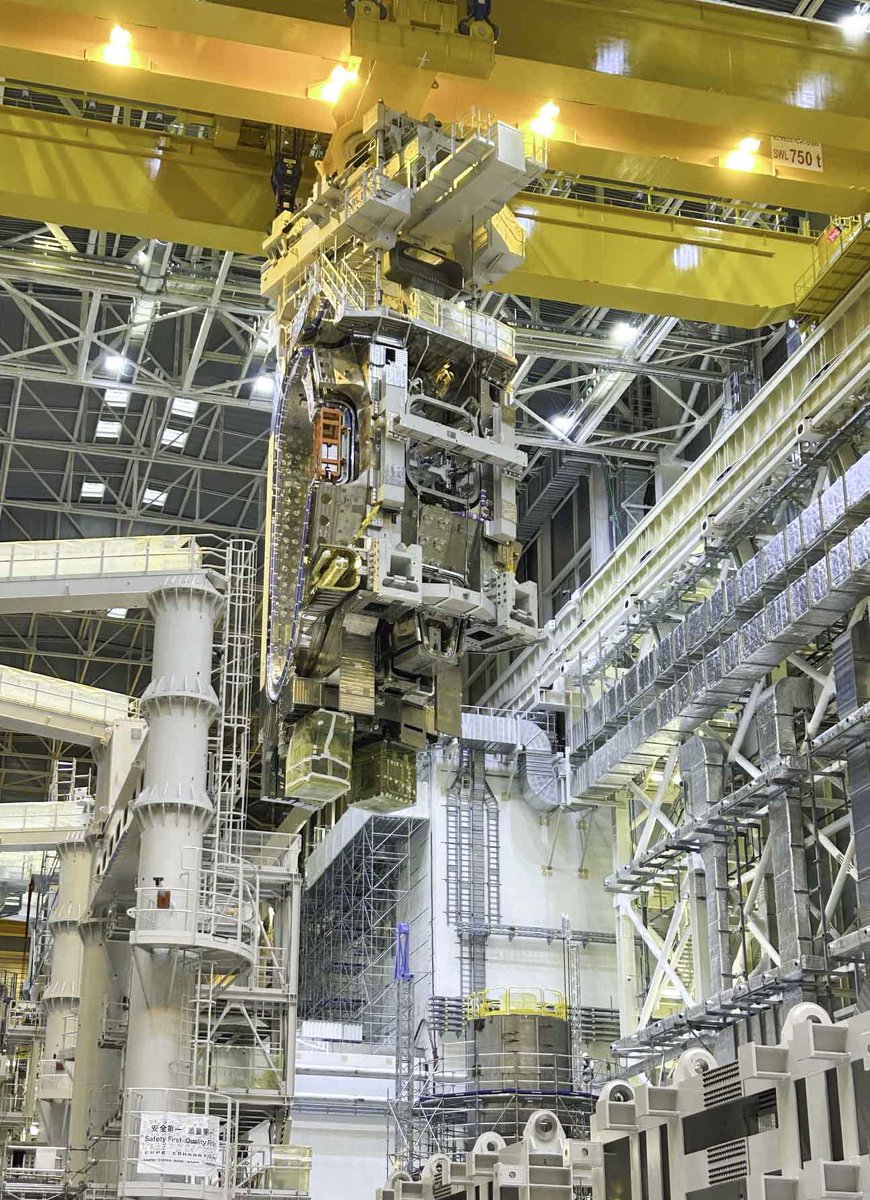
A 1,200-tonne ITER sector module—heavier than two Airbus A380s—has been lowered into the tokamak pit and is now undergoing millimetre-precision alignment. Engineers shift the coils and vacuum vessel in tiny 5 mm steps until everything reaches its exact position.
Good things do come in three at #ITER!
The 3rd #vacuumvessel sector module has ‘landed’ in the #tokamak pit. The lift of the 1100-tonne sector module #5 featured incredible precision as the module was lowered down with only about 10mm margin of space.
Full story in Newsline!
Prof. Chen Ning Yang, a world-renowned physicist, Nobel Laureate in Physics, Academician of the Chinese Academy of Sciences, Professor at Tsinghua University, and Honorary Director of the Institute for Advanced Study at Tsinghua University, passed away in Beijing due to illness at the age of 103. His life stands as a timeless chapter in human history—one that shines not only for China but for the global community of thinkers and innovators. His legacy will live on forever.
The Schwarzschild Metric is a solution to Einstein's field equations in general relativity, which describes the spacetime geometry around a spherically symmetric, non-rotating, and uncharged mass (like a star or a black hole).
Watch the spectacular lift operation of 17/18 June, inserting the 2nd #vacuumvessel module into the #tokamak pit at #ITER.
Two sectors are now sitting side by side. It's seven more to go!
Here's the full Newsline article with more photos: https://t.co/LF2uCxS7Yj
#fusionenergy
ITER has reached a new milestone: the first Japanese gyrotron is now in place and prepared for commissioning. In total, ITER will host 72 gyrotrons:
48 for the initial operation phase (SRO)
another 24 for DT-1
#ITER#FusionEnergy#Gyrotron#Plasma
The video shows a glowing plasma toroid resembling a hollow, dynamic donut. This mirrors the “snowflake” plasma shape in tokamaks, where magnetic fields create a hexagonal pattern that spreads heat, reduces wall wear, and stabilizes fusion plasma. Only 15 views on YT
When you throw a ball at a wall, you can be sure it will bounce back at you.
You would be extremely surprised if the ball suddenly appeared on the other side of the wall. In quantum mechanics this type of phenomenon is called tunnelling and is exactly the type of phenomenon that has given it a reputation for being bizarre and unintuitive.
The 2025 #NobelPrize laureates in physics John Clarke, Michel H. Devoret and John M. Martinis, used a series of experiments to demonstrate that the bizarre properties of the quantum world can be made concrete in a system big enough to be held in the hand. Their superconducting electrical system could tunnel from one state to another, as if it were passing straight through a wall. They also showed that the system absorbed and emitted energy in doses of specific sizes, just as predicted by quantum mechanics.