MBN’s New Design Highlights its Broader Mission
https://t.co/HN7exsmmiu is introducing a fresh new design for our Arabic and English-language websites meant to better present readers with the full range of our offerings as the premier Arabic-first source of news and commentary connecting the Middle East and Washington.
The cleaner user experience, faster load times and improved navigation system highlight a broader palette of digital insights, including a podcast, four new weekly newsletters, informative video news and features, and a magazine rich in feature stories and expert commentary you’ll see nowhere else.
https://t.co/HN7exsmmiu has always brought a distinctly American insight to Middle Eastern audiences. But we’ve found that our Arabic and English websites need to give more nuance and clarity in each language than simply translated versions of the same articles can convey; see for yourself by using the EN and AR buttons to toggle between the two versions. We have also created more interactive features to foster two-way conversations and closer relationships with our readers in the U.S. and the broader region, both on the site and through social media.
Read more and browse the new website: https://t.co/hvsO8c1Pd2
▪️ Syria’s interim parliament, sworn in earlier this week after President Ahmed al-Sharaa appointed its last 70 members, contains no representatives from the organization that led Kurdish efforts in the country’s long civil war.
▪️ Members of the left-wing Democratic Union Party (PYD), long the dominant political force among Syria’s Kurds, are conspicuously missing from those appointed to the 210-seat chamber. Sharaa’s selections underscore his goal to build a unified Syrian state, and creates greater inroads for Turkey’s regional ambitions.
▪️ Sharaa’s picks did include Abdul Hakim Bashar of the more conservative Kurdish National Council (KNC), which favors integration of Syria’s largest ethnic minority into a federal state and has opposed the creation of an autonomous Kurdish region, something the Democratic Union Party supports.
➡️ A political shift is underway among Syria’s Kurds as Damascus favors the Kurdish National Council over the PYD. What does it mean for the region’s future?
https://t.co/6lABkbdlxS
▪️ During this week’s NATO summit in Ankara, U.S. President Donald Trump signaled his intent to resume sales of the advanced F-35 fighter jet to Turkey, which have been blocked by the U.S. for years.
▪️ Israel has been closely watching the possibility that the United States could return Turkey to the F-35 program, viewing the issue as one that extends far beyond defense procurement and into the broader balance of power in the Middle East.
▪️ For Israel, Turkey’s readmission to the F-35, a move would signal a significant shift in Washington’s policy toward Ankara. It would also touch on one of the country’s core security priorities: maintaining Israel’s qualitative military edge in the region.
A possible F-35 deal with Turkey is fueling debate in Israel over regional security, U.S. policy, and the shifting balance of power. Read more ⬇️
https://t.co/wwJghAYPJw
▪️ With a cease-fire that’s all but over, the U.S. and Iran traded strikes this week without sparing regional neighbors. Iran attacked U.S. bases in Kuwait, Bahrain, and Qatar, dragging Gulf Arab nations into the conflict.
▪️ In Iraq, an anti-corruption probe that seized assets of more than $250 million is rattling the political class. In Syria, Washington wants foreign fighters out. In Yemen, the Houthis are reviving threats against Saudi Arabia. Across the Gulf, a proposed Saudi-Turkish railway could redraw trade routes, much to Israel’s alarm. And in Gaza, Hamas announced a retreat from performing government functions–but it may be mostly a face-saving acknowledgement of reality.
Read the full briefing ➡️ https://t.co/weJx2eOxNT
Subscribe to the MBN Weekly Newsletter for more in-depth analysis and updates ➡️ https://t.co/P3nhKXiiJR
▪️ During this week’s NATO summit in Ankara, U.S. President Donald Trump signaled his intent to resume sales of the advanced F-35 fighter jet to Turkey, which have been blocked by the U.S. for years.
▪️ Israel has been closely watching the possibility that the United States could return Turkey to the F-35 program, viewing the issue as one that extends far beyond defense procurement and into the broader balance of power in the Middle East.
▪️ For Israel, Turkey’s readmission to the F-35 deal would signal a significant shift in Washington’s policy toward Ankara. It would also touch on one of the country’s core security priorities: maintaining Israel’s qualitative military edge in the region.
▪️ Prime Minister Benjamin Netanyahu underscored those points in an interview with CNN, warning that selling F-35 fighter jets to Turkey would “destroy the balance of power in the Middle East.” He argued that Turkey “is not a model U.S. ally,” citing Turkish President Recep Tayyip Erdogan’s policies and Ankara’s ties to Hamas and the Muslim Brotherhood.
For more reading, follow the link ➡️ https://t.co/wwJghAYPJw
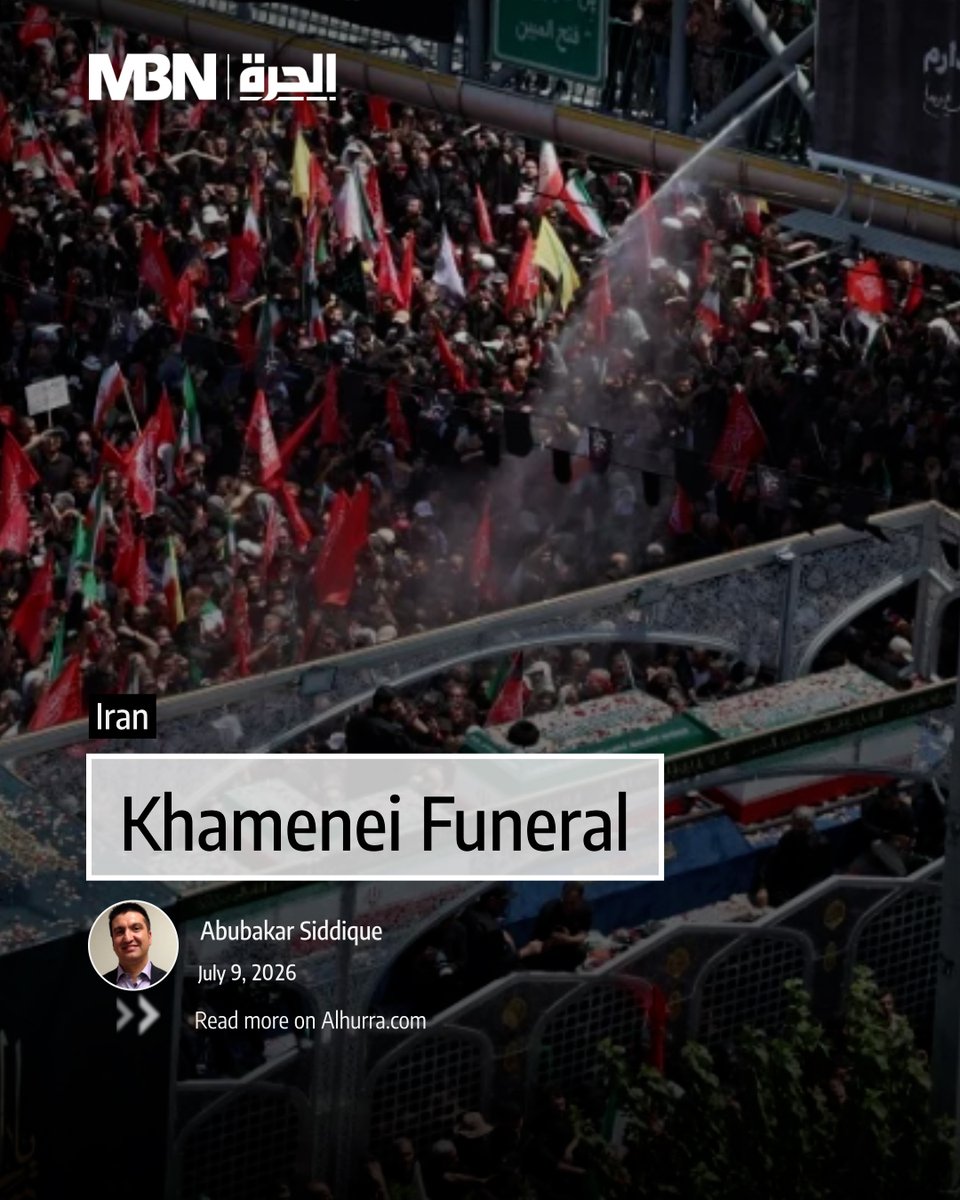
◾ Iran is burying its former supreme leader, Ayatollah Ali Khamenei, more than four months after he was killed by Israeli and U.S. airstrikes at the start of the war. Tehran has turned his funeral into one of the largest in history. Authorities have choreographed it as a momentous political and religious event. The aim is to mobilize domestic support, strengthen regional alliances, and reinforce the leadership of his son and successor, Mojtaba Khamenei.
◾ The funeral began on July 3 with an official ceremony for foreign leaders in Tehran. Over the next two days, crowded public mourning ceremonies were held at the Grand Mosalla Mosque, culminating in a public funeral procession in the capital on July 6. The next day, a similar procession was held in the Iranian city of Qom, a center of Shia religious learning.
For more reading, follow the link ➡️ https://t.co/ZADPgyLI37
📷 Today marks six months since security forces killed thousands of protesters over two days in January. Within Iran, the regime’s account of martyred soldiers and foreign-backed terror cells has hardened into unchallenged official doctrine. Dozens of prisoners tied to the unrest sit under sentence of death.
📷 Also in this edition: how the war that began in February compounded the crackdown, and where international accountability efforts stand six months on.
Read the full Iran Briefing on Alhurra 📷 https://t.co/fDXCor3fp7
Subscribe for the weekly newsletter 📷 https://t.co/P3nhKXiiJR
Political and economic sources in Iraq told Alhurra that Iraqi politicians and businessmen provided billions of dollars in cash support to Iran during the recent conflict
https://t.co/zj14B4jGcI
Can the World Cup do what Nasser failed to do: Bring the Arab world closer together?
Not exactly. When Morocco defeated Canada, some Algerian headlines simply announced Canada’s elimination from the tournament. Great piece on MBN’s @alhurra https://t.co/ZNKP0Fw3ex
▪️ During this week’s NATO summit in Ankara, U.S. President Donald Trump signaled his intent to resume sales of the advanced F-35 fighter jet to Turkey, which have been blocked by the U.S. for years.
▪️ Israel has been closely watching the possibility that the United States could return Turkey to the F-35 program, viewing the issue as one that extends far beyond defense procurement and into the broader balance of power in the Middle East.
▪️ For Israel, Turkey’s readmission to the F-35 deal would signal a significant shift in Washington’s policy toward Ankara. It would also touch on one of the country’s core security priorities: maintaining Israel’s qualitative military edge in the region.
▪️ Prime Minister Benjamin Netanyahu underscored those points in an interview with CNN, warning that selling F-35 fighter jets to Turkey would “destroy the balance of power in the Middle East.” He argued that Turkey “is not a model U.S. ally,” citing Turkish President Recep Tayyip Erdogan’s policies and Ankara’s ties to Hamas and the Muslim Brotherhood.
For more reading, follow the link ➡️ https://t.co/wwJghAYPJw
◾ Iran is burying its former supreme leader, Ayatollah Ali Khamenei, more than four months after he was killed by Israeli and U.S. airstrikes at the start of the war. Tehran has turned his funeral into one of the largest in history. Authorities have choreographed it as a momentous political and religious event. The aim is to mobilize domestic support, strengthen regional alliances, and reinforce the leadership of his son and successor, Mojtaba Khamenei.
◾ The funeral began on July 3 with an official ceremony for foreign leaders in Tehran. Over the next two days, crowded public mourning ceremonies were held at the Grand Mosalla Mosque, culminating in a public funeral procession in the capital on July 6. The next day, a similar procession was held in the Iranian city of Qom, a center of Shia religious learning.
For more reading, follow the link ➡️ https://t.co/ZADPgyLI37
@sid_abu
▪️ Iraqi Prime Minister Ali al-Zaidi held two separate meetings in late June with Iranian Foreign Minister Abbas Araghchi and Quds Force commander Esmail Qaani, both marked by clear tensions over Iran-backed armed factions and their weapons outside state control, two Iraqi sources familiar with the matter told MBN.
▪️ Details of the meetings, verified through two Iraqi sources close to the prime minister and a political source inside the ruling Shiite Coordination Framework, point to a tougher stance by Baghdad toward Iran’s military influence in Iraq. Zaidi’s government is seeking to bring all weapons under state control before the international coalition’s mission ends in September, amid growing U.S. pressure to curb the influence of armed factions.
▪️ According to the sources, Zaidi raised the issue of armed factions directly during his meeting with Araghchi, who visited Baghdad on June 28. The Iraqi leader warned of the impact of weapons outside state institutions on Iraq’s sovereignty, foreign relations and governmental authority.
Read more on Alhurra ➡️ https://t.co/GfsRwfehlD
The funeral of Ali Khamenei has become a political test for Iran’s leadership, as Mojtaba Khamenei remains absent from the public scene despite being viewed as a potential successor to the Supreme Leader.
▪️ With every FIFA World Cup featuring Arab national teams, an old debate returns: Can football unite people who share the Arabic language?
▪️ The tournament often rekindles a sense of pan-Arab identity, along with hopes that football might succeed where politics has failed in forging a common Arab nation. Those aspirations echo a series of unsuccessful attempts at Arab unity, from the union between Egypt and Syria to failed federation projects linking Iraq with Syria and, separately, Iraq with Jordan under the short-lived Arab Federation.
▪️ Egyptian President Gamal Abdel Nasser became the leading champion of Arab nationalism, but his vision ultimately faltered for political and demographic reasons. The union between Egypt and Syria collapsed, the Yemen War exposed deep divisions between Nasser’s Egypt and Saudi Arabia, and the Arab defeat by Isreal in 1967 Six-Day War further weakened the movement. Following Nasser’s death, pan-Arab ambitions gradually faded.
Football revives dreams of Arab unity at every World Cup. But the politics, identities and rivalries that shape the region rarely stay outside the stadium.. Read more on Alhurra website ➡️ https://t.co/WwMToqM8XT
◾ Today marks six months since security forces killed thousands of protesters over two days in January. Within Iran, the regime’s account of martyred soldiers and foreign-backed terror cells has hardened into unchallenged official doctrine. Dozens of prisoners tied to the unrest sit under sentence of death.
◾ Also in this edition: how the war that began in February compounded the crackdown, and where international accountability efforts stand six months on.
Read the full Iran Briefing on Alhurra ➡️ https://t.co/fDXCor2Hzz
Subscribe for the weekly newsletter ➡️ https://t.co/P3nhKXhKUj
The Strait of Hormuz remains open.. but it is no longer as secure as it once was. As OPEC+ boosts production and insurance costs and geopolitical risks continue to rise, Gulf oil shipments are becoming an increasingly powerful source of leverage for Tehran.
▪️ Syria’s interim parliament, sworn in earlier this week after President Ahmed al-Sharaa appointed its last 70 members, contains no representatives from the organization that led Kurdish efforts in the country’s long civil war.
▪️ Members of the left-wing Democratic Union Party (PYD), long the dominant political force among Syria’s Kurds, are conspicuously missing from those appointed to the 210-seat chamber. Sharaa’s selections underscore his goal to build a unified Syrian state, and creates greater inroads for Turkey’s regional ambitions.
▪️ Sharaa’s picks did include Abdul Hakim Bashar of the more conservative Kurdish National Council (KNC), which favors integration of Syria’s largest ethnic minority into a federal state and has opposed the creation of an autonomous Kurdish region, something the Democratic Union Party supports.
Read more on Alhurra website ➡️ https://t.co/6lABkbcNIk
After months of negotiations and a fragile calm, tensions flare again between #SaudiArabia and the #Houthis, with new threats targeting #Riyadh. What is happening behind the scenes?
#ISIS is back in the spotlight in Syria as #Raqqa returns to the headlines. With sleeper cells becoming more active, #Damascus faces new security challenges. Houda Elboukili takes you behind the scenes of what is happening in #Syria now.