Big one for Anduril and Kraken Robotics.
Project Broadsword proved a US torpedo can launch from a robot sub (the UK's Excalibur). The next phase, Project CUTLASS, is about turning that into a real capability: weapons integration, remote command, battle tactics.
The Navy seems to be moving forward with Anduril's Dive-XL as the platform.
Dive-XL is already “competing” in the Navy’s CAMP program to be the go-to autonomous maritime vehicle. Now it's the weapons testbed too. It seems like the Navy is lining up behind Anduril here.
As the battery/sonar/navigation supplier, Kraken Robotic’s $PNG.V / $KRKNF FY27 guide for $550M - $600M of revenue seems increasingly likely.
https://t.co/njfD8F3ogk
😳 Brad Gerstner on the ex-Anthropic researcher who told America AI could end humanity in three years:
"To go on national television in a highly coordinated way and sit in the living room on NBC, on ABC, on CBS, on Fox, and have a single researcher who spent six weeks at Anthropic tell the moms and dads of America that this can kill all of humanity in the next three years without any countervailing conversation is deeply irresponsible.
Jensen Huang yesterday called it deeply untrue. Andrew Feldman, the founder of Cerebras, who spent decades studying this, called it utter horseshit. Elon himself said it was a coordinated psyop."
- @altcap with Scott Wapner @TheJudgeCNBC on CNBC Friday, Sept 11th, 2026
1) AI will not eradicate humanity. Humans survived an ice age, the Black Death, two world wars, and (so far) the advent of nuclear weapons. Anyone who is loudly warning of AI-caused human extinction should not be taken seriously.
2) If you worked in a company where you anticipated a 10% chance that your product would kill ten people, let alone all people, the correct response would be horror, ceasing all operations, and likely contacting the police or other criminal authorities. I am obviously no Coxon booster but at least his behavior is in line with his stated beliefs. Any current AI company employees saying "yes, me too, the thing we are building and about to IPO may kill all humans" should, again, not be taken seriously. Their actions betray their actual beliefs.
3) Antitrust law does not prevent AI companies from coordinating to make sure AI does not hurt people. It does not prevent companies working together to make sure it doesn't hack people; the DOJ and FTC made this clear a decade ago when they issued a policy statement saying that the agencies "do not believe that antitrust is – or should be – a roadblock to legitimate cybersecurity information sharing." The same principles apply here. See: https://t.co/aQsqGn1xjX
4) Antitrust law does absolutely prevent AI companies from organizing to prevent the entry of cheaper, upstart rivals because the bigger companies are burning cash and failing to achieve sufficient profitability. The panic of individual employees may be sincere if misguided, but the moves by their CEOs to achieve some kind of broad "antitrust waiver" or "exemption" should be meet with deep skepticism in light of the economics of the industry and the threat they face from open models.
Kraken Robotics understands that in naval operations, small details revealed through high-resolution subsea imaging can change the interpretation of an entire mission area.
Rope, cables, tyres, ladders, anchors, small debris, and mine-like objects can all present differently on the seabed. At lower resolution, these objects may be harder to distinguish from true threats, increasing the risk of missed contacts or unnecessary follow-up investigations.
Kraken SAS delivers high and ultra-high-resolution seabed imagery that helps operators detect, assess, and determine subsea objects with greater confidence. For mine countermeasures, maritime security, and critical underwater infrastructure surveys, that confidence supports faster decisions and a clearer understanding of what is on the seabed.
Learn more about how Kraken supports naval operations: https://t.co/29MC018GJ6
#KrakenRobotics #SyntheticApertureSonar #SAS #MaritimeSecurity #MineCountermeasures #SubseaTechnology
David Friedberg: Higher Interest Rates Are About to Make America’s $40 Trillion Debt Problem Much Worse
“The federal government has a problem because over the next 12 months they have to refinance $10 trillion of debt.
That debt is coming due. Those bonds are now due. They have to pay the principal back to the bond holders, and they have to go back to the treasury market and sell more treasuries to borrow more money to refinance.
So the borrowing cost now is going to climb up, and when that borrowing cost climbs up, the federal government's burn goes up and the fiscal deficit goes up.
So my theory and my argument on this is: There is no action that Bessent can take that's actually going to have a meaningful effect on the long end of the curve.
We have a fundamental fiscal spending problem with the federal government right now.
It is very expensive now to borrow money if you're the US federal government. And the reason is persistent inflation, I would argue because of excess government spending on social programs and other things.
And the big problem at this point is the federal government is spending so much that if they were to cut spending aggressively, the argument and the concern is it would hit unemployment and it would cause a recession because the federal government is such an intricate part of the economy now.
That's the argument. But it's causing inflation, and it's causing deficit spending.
So this year the deficit will be roughly $2 trillion. And as a result, the market is saying, ‘We're worried about the US fiscal solvency over the long run, or there's a higher risk. As a result, we're going to charge you a higher interest, 5.2% on the 30 year.’
What does this mean for the federal government?
Well, today, the federal government's average cost of debt is 3.4%. That's what we're paying on interest on average on the $40 trillion of debt that the federal government has outstanding.
For every 1% change in the interest rate, the US government has to pay 1.25% of GDP in excess interest each year. 1.25% of GDP in interest each year for that 1% change in the interest rate.”
Kraken Robotics offers a range of subsea survey platforms designed to support advanced sonar and environmental sensors across defence, mine countermeasures, offshore energy, and marine survey applications. From high-speed seabed mapping to hydrographic, oceanographic, and environmental data collection, these platforms support efficient and reliable survey operations in demanding marine environments.
KATFISH
Purpose-built for Kraken SAS, KATFISH is an actively stabilized towed vehicle designed to deliver consistent, ultra-high-resolution seabed imagery over large survey areas. Its stable flight characteristics support reliable target detection, classification, and mapping. Learn more: https://t.co/jiaOE9GyKf
EIVA ScanFish
The flexible EIVA ScanFish range of platforms consists of multiple remotely operated towed vehicle variants, designed for applications such as geophysical, hydrographic, oceanographic, and environmental surveys. Its modular payload configuration allows operators to integrate multiple sensors and acquire complementary datasets in a single deployment. Learn more: https://t.co/lWQbN9mmKu
EIVA ViperFish
ViperFish is a compact remotely operated towed vehicle designed for inspection and mapping applications. Designed for deployment from crewed and uncrewed surface vessels, it provides an intelligent platform for sensor integration and subsea data collection. Learn more: https://t.co/7aiV7DXlJX
#KrakenRobotics #SubseaTechnology #HydrographicSurvey #OceanTechnology #DefenceTechnology #OffshoreEnergy #MarineTechnology #KATFISH #ScanFish #ViperFish
Kraken Robotics Announces $35 Million in New Orders and Business Update.
“Our product portfolio forms the backbone of a wide range of platforms used across both defence and commercial applications and we expect it to represent over 75% of consolidated revenue in 2026. These include crewed platforms such as ships and submarines, as well as uncrewed systems including autonomous underwater vehicles (AUVs), uncrewed surface vessels (USVs) and remotely operated vehicles (ROVs). Beyond vessel-based applications, our dual-use technologies are also deployed in unattended seafloor sensors.” said Greg Reid, CEO of Kraken Robotics.
Read the announcement: https://t.co/u5OtfoKtve
Kraken Robotics' 3D acoustic Sub-Bottom Imager (SBI) can be deployed in shallow water and nearshore environments utilizing our GeoArm and GeoLink platforms.
Designed for stable vessel-mounted survey operations in water depths up to 15m, the GeoArm allows SBI surveys to take place in areas that are difficult to access with traditional towed or ROV-based solutions. The GeoArm was initially designed to ensure cables could be surveyed along the entire cable route - from the intertidal zone to the offshore asset. Since its design, the GeoArm's portfolio has rapidly expanded, surveying around harbour infrastructure and in fluvial environments.
Operating in maximum water depths of 8m, the GeoLink is the ideal solution for shallow port and harbour surveys, due to its maneuverability. The GeoLink has a strong track record, particularly for ferrous and non-ferrous UXO surveys.
Using our SBI technology, operators can locate and image buried cables, pipelines, boulders, and UXO in the shallow-water zone, supporting route clearance, asset integrity, and offshore energy projects.
Learn more about Kraken’s Sub-Bottom Imaging service: https://t.co/gZRLExVdjW
$KRKNF / $PNG.V
Last week, something happened in the defense world that almost nobody noticed, and I think it matters a lot.
Kraken Robotics is a Canadian company that makes the components used in underwater drones. The sonar that sees the seabed, the batteries that survive deep ocean depths, and the navigation that works where GPS cannot reach. Militaries around the world are racing to build underwater drone fleets, and almost all of them need parts like these.
On July 2, Kraken finally closed the biggest deal in its history. It paid C$615 million for Covelya Group, a collection of six underwater technology companies. The crown jewel is Sonardyne, a 50-year-old British firm that generates ~£90 million in revenue and is already part of the supply chain for Anduril's Ghost Shark / Dive-XL.
Four days later, on Monday, July 6, the giants went shopping. $LMT bought an undersea warfare company for $3.5 billion. Italy's biggest shipbuilder spent €600 million on four underwater firms. And Thales, the French defense giant, won a bidding war for Exail, paying $4.5 billion. That price worked out to 8.1x Exail's revenue, after a 44% premium, with two French giants fighting over it.
Here is where it gets interesting. Exail is basically a bigger version of what Kraken just assembled. Same industry, same customers, same type of technology. So apply Monday's price to Kraken's new pieces. At 8.1 times revenue, Sonardyne alone, just one of the six companies Kraken bought, would be worth roughly C$1.2 billion. That is close to Kraken's entire market cap today. The stock trades at ~$4.5 USD with a market cap of ~$1.4 billion.
Read that again. Kraken paid C$615 million for six companies. Days later, the market indicated that one of those six is worth about double what Kraken paid for all six.
Three things can explain a gap like that. Either the giants overpaid on Monday, or Kraken got a steal, or the market simply has not connected the dots yet on a small Canadian stock that closed its deal the same week everyone was distracted. My money is on the last two.
(S/O @Tarbay14 for the coverage around Kraken!)
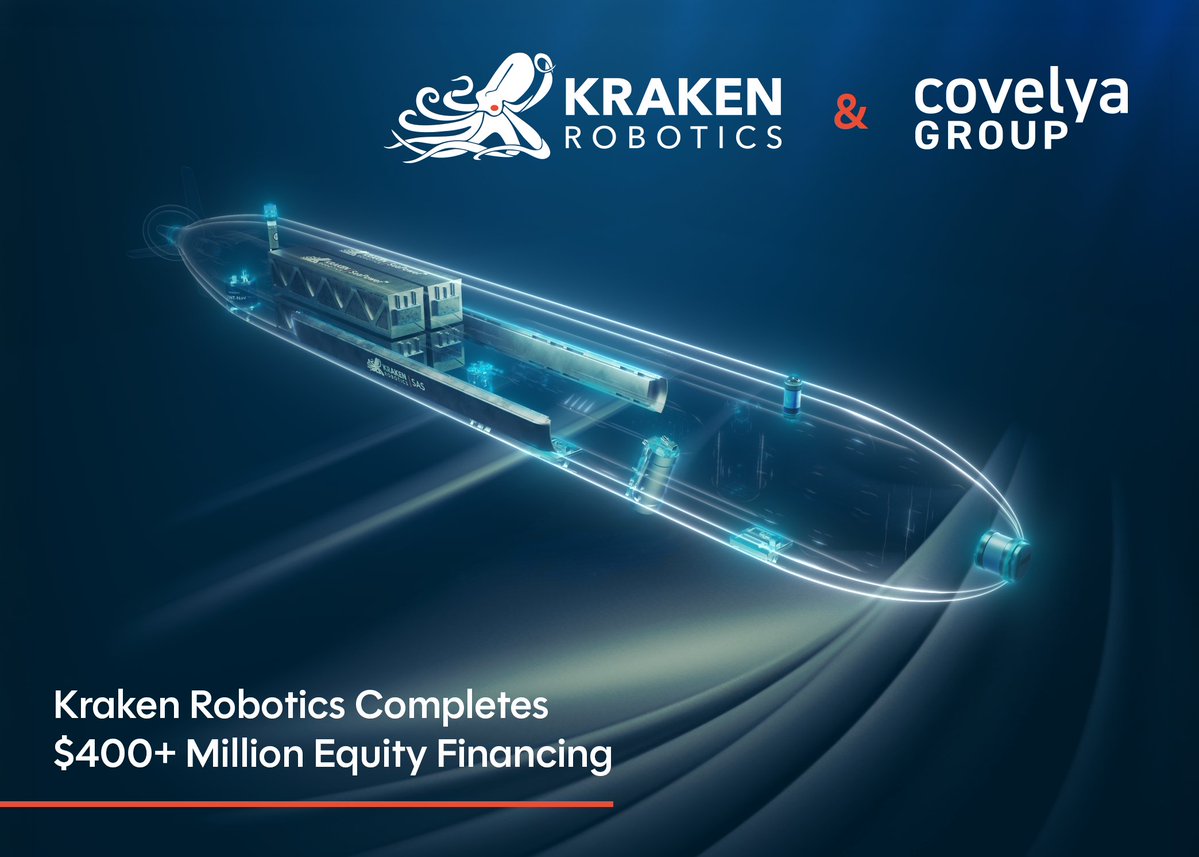
Kraken Robotics is excited to announce the acquisition of Covelya Group. Together, we're creating a world-leading marine technology company focused on transforming subsea intelligence.
"We welcome the new employees to the team and look forward to the many benefits this combination can provide. Together, Kraken and Covelya Group bring complementary products, technological capabilities, and customer relationships that we expect will strengthen Kraken’s growth potential and long-term outlook. This positive long-term outlook is further supported by the expected increase in defence budgets globally, including growing investment in autonomous underwater systems.” said Greg Reid, CEO of Kraken Robotics.
Read the announcement: https://t.co/U7kOwWqEUw
Anduril is partnering with @KrakenTechGroup to deliver a fleet of small unmanned surface vehicles for the @USNavy.
You can't command the sea without scale.
https://t.co/lcdSpHPCF9
Jensen Huang just told Silicon Valley it’s fighting on the wrong floor.
Every boardroom in tech is locked on the same question. Which model wins. OpenAI or xAI. GPT or Claude. Grok or Gemini.
Trillions moving on that bet alone.
Huang zoomed out and showed them the whole building.
Huang: “AI is actually essentially a five-layer cake.”
Energy at the bottom. Chips above it. Cloud above that. Models next. Applications on top.
Five layers. One war. Everyone crowded onto the fourth floor.
Huang: “This is where most people think AI is.”
He was pointing at the model layer. Every pitch deck. Every valuation. Every founder story. All packed onto one floor.
One floor below the finish line. Three above the foundation. The middle of the building.
Huang: “At the bottom is energy.”
Not data. Not parameters. Not talent.
Power.
You cannot out-code the grid. You cannot train a frontier model with a press release. The smartest model on Earth still needs a dumb turbine spinning somewhere.
The smartest engineers alive are building on top of someone else’s silicon, inside someone else’s cloud, powered by someone else’s electricity.
They own nothing beneath them.
Huang: “This layer on top ultimately is where economic benefit will happen.”
Healthcare. Finance. Manufacturing. The only floors where AI actually meets money.
Every dollar of real value lives at the top. Every physical constraint that decides who gets to play lives at the bottom.
The model sits in between. Squeezed from above and below and owning neither end.
Silicon Valley is burning hundreds of billions to build plumbing for somebody else’s economy.
The basement decides if it runs. The penthouse decides if it pays.
The companies building models think they are building the future.
Huang just told them they are the middle layer in someone else’s cake.
Kraken Robotics - Full Year 2025 Earnings
$KRKNF 6.15 [-0.01% PM]
Revenue: $102.2M
Adjusted EBITDA: $25.0M
Additional Metrics:
- $87M product orders booked to date in 2026
FY2026 Guidance:
Revenue: $165–175M
Adjusted EBITDA: $40–50M
Strategic Updates:
- Acquisition of UK-based Covelya Group announced in March 2026
- Continued product innovation including higher energy density batteries, LARS for smaller USVs, and circular SAS
This is insane.
We always talk about $KRKNF's tech in UUVs. But they just proved they can run their KATFISH mine hunter on USVs, fully remotely.
A USV is an unmanned surface vessel aka a robot boat. KATFISH is Kraken's towed sonar that gets dragged behind it, scanning the seafloor for mines at 3cm resolution. That data streams live to operators sitting safely onshore.
This matters because Iran is actively laying mines in the Strait of Hormuz. Clearing those mines traditionally meant putting sailors directly in the minefield aboard a minesweeper ship.
This system puts zero humans at risk and marks two successful USV demos in five months across a Royal Navy and now Turkish vessel.
When is the @Saronic collab coming?
Kraken Robotics has successfully demonstrated its KATFISH towed synthetic aperture sonar and autonomous launch and recovery system (LARS) from SEFINE’s RD-22 unmanned surface vessel (USV) in coordination with SEFINE SISAM.
Read the full announcement: https://t.co/MBScCPmdTf
Sea mines remain a persistent maritime threat - modern systems sit on the seabed, disguised and difficult to detect. Kraken Robotics supports MCM with high-resolution SAS, enabling confident detection and classification at scale.
Read more: https://t.co/FviciZYGkw
Jeff Bezos just delivered the clearest definition of what artificial intelligence actually is.
The market is still debating which department should own the AI budget.
They’re asking the wrong question entirely.
Bezos: “AI, modern AI is a horizontal enabling layer. It can be used to improve everything. It will be in everything. This is most like electricity.”
This isn’t a software product. It’s the new utility grid of the global economy.
Don’t treat it like a feature update. Treat it like the invention of alternating current.
When a horizontal layer hits the board, it doesn’t improve a single vertical. It violently rewrites the baseline physics of every industry it touches.
The companies that survive this decade won’t be the ones that bought a new AI tool.
They’ll be the ones that ripped out their entire infrastructure and rewired the execution engine to run on the new grid.
Bezos: “Because we are literally working on a thousand applications internally. I guarantee you there is not a single application that you can think of that is not going to be made better by AI.”
The standard enterprise strategy is to launch one or two safe, isolated AI pilots and test the waters.
You don’t pilot a horizontal enabling layer. You saturate the board immediately.
Amazon isn’t building a single monolithic chatbot. It’s deploying a thousand specialized execution loops across every friction point in the empire.
If your deployment strategy isn’t total saturation, you’re already bleeding margin to someone whose is.
Interviewer: “What is it that you’re doing at Amazon?”
Bezos: “AI. It’s 95% AI.”
The standard CEO delegates automation strategy to a mid-level committee while focusing on quarterly earnings.
The operator commanding a trillion-dollar supply chain is spending 95 percent of his personal bandwidth on a single vector.
That is the market signal.
If the leader of your organization isn’t driving algorithmic integration from the top down with everything they have, the company is already dead.
It just hasn’t received the memo yet.
5 years old - Dad knows everything!
7 years old - Dad knows.
10 years old - Maybe dad doesn’t know?!
12 years old - Dad doesn’t know.
14 years old - Dads gone crazy!
16 years old - Can’t take dad seriously.
18 years old - What does dad know?!
22 years old - Dads talking rubbish!
24 years old - I know more than dad!
26 years old - Dad seems to know some things after all.
30 years old - Think I should ask dad about this?!
40 years old - It’s amazing how dad went through all this!
45 years old - Dads been right all along.
50 years old - If dad was here, I could have learned a lot from him.
Your father is the only man who's proud to see you doing better than him.




![Sam_Badawi's tweet photo. Kraken Robotics - Full Year 2025 Earnings
$KRKNF 6.15 [-0.01% PM]
Revenue: $102.2M
Adjusted EBITDA: $25.0M
Additional Metrics:
- $87M product orders booked to date in 2026
FY2026 Guidance:
Revenue: $165–175M
Adjusted EBITDA: $40–50M
Strategic Updates:
- Acquisition of UK-based Covelya Group announced in March 2026
- Continued product innovation including higher energy density batteries, LARS for smaller USVs, and circular SAS](https://pbs.twimg.com/media/HGBzF4LaUAA_lk2.jpg)