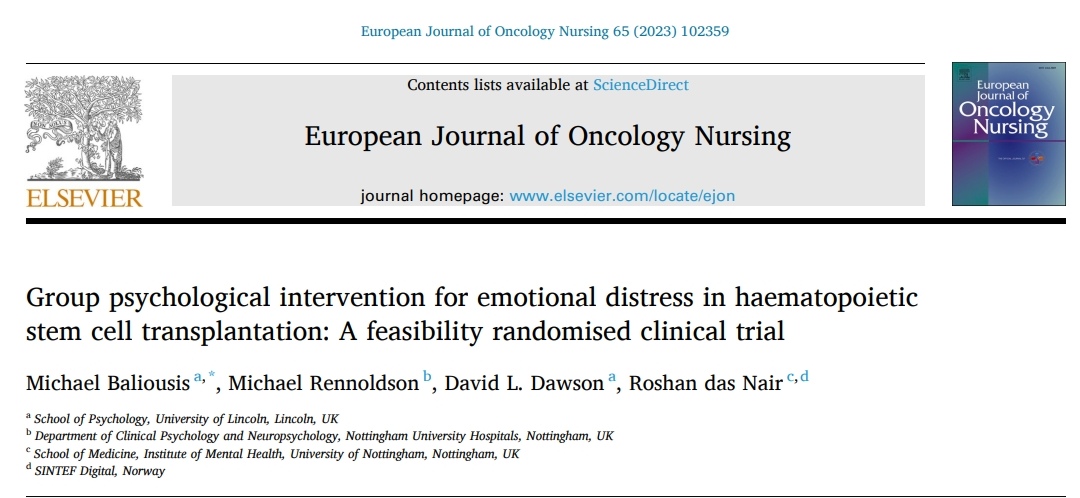
📢 New insights! Psychological preparation (#prehabilitation) is key in #HSCT.🔑
🔍 But what should we pay attention to when designing #RCTs and #groupinterventions to support patients' psychological readiness?
Our findings: https://t.co/jto9HedKAz
@MikeRennoldson #BMT#cancer
🎉 Proud to have helped develop https://t.co/1hCT9t15g7!
This free resource empowers people to manage the psychological challenges of #cancer. Co-created with experts & patients, based on #ACT & self-efficacy theory.
Explore & share! 🌟
#CancerSupport#PsychoOncology
As clinician, I have found power analysis for
#MultilevelModelling a challenge!
The paper and app below are definitely a step in the right direction for us non-statistician folk.
Key Takeaways from “Regression Modeling Strategies” by Frank Harrell (@f2harrell)
A must-read for anyone working with predictive modeling. Here’s what you need to know:
Plan your model with clear goals—whether prediction, effect estimation, or hypothesis testing. Avoid arbitrary categorization of continuous variables, as it leads to information loss and reduced statistical power.
Use flexible techniques like restricted cubic splines to relax linearity assumptions while maintaining interpretability. Avoid stepwise selection, which often results in overfitting. Instead, rely on penalized regression methods such as ridge or elastic net.
Handle missing data effectively through multiple imputation rather than case deletion. Reduce dimensionality using redundancy analysis, variable clustering, or principal component analysis to make models more efficient and interpretable.
Validate models rigorously using bootstrap resampling rather than splitting data into arbitrary training and testing sets. Focus on calibration and discrimination metrics like concordance indices to assess predictive performance.
Communicate results clearly with visualization tools such as diagnostic plots and nomograms. Simplify models thoughtfully through approximations rather than haphazardly dropping predictors.
This book combines theoretical depth, practical advice, and reproducible R code, making it essential for statisticians, data scientists, and researchers in fields like biostatistics and machine learning.
Thoughts?
#Statistics #DataScience #Research #Science #Rstats
There's 1 week left to get your conference abstracts in! We're looking forward to seeing you all in Manchester from the 26th - 28th March next year.
https://t.co/8h3dyHbxGB
Interventions for the management of long covid (post-covid condition): living systematic review | The BMJ. A finding that should come as no surprise and has probably been delayed as a result of activist activity and, shamefully, @NICEComms https://t.co/m1lt2dr2XR
With December on the horizon, don't forget to add your BPOS conference abstract to the to-do list. The deadline is 10am on the 9th December. More details can be found here: https://t.co/8h3dyHaZR3
🚨 We’re hiring a #Postdoc! Test an innovative #digitalhealth 'mindset' intervention for childhood cancer survivors.
📅 1-year role @KingsIoPPN (potential extension onto a 5-year @wellcometrust#interoception research programme).
🔗 https://t.co/PCf4NBEW8p
Some great recommendations for future research on web-based interventions for fear of cancer recurrence in this #PLOSONE article #FCR#PsyOnc
Web-based interventions for fear of cancer recurrence: A scoping review with a focus on suggestions ... https://t.co/HQcCMN8hQr
The number of people who go bankrupt every year because of medical bills.
Norway - 0
UK - 0
France - 0
Spain - 0
Portugal - 0
Denmark - 0
Australia - 0
Iceland - 0
Italy - 0
Finland - 0
Ireland - 0
Germany - 0
Netherlands - 0
Sweden - 0
Japan - 0
Canada - 0
United States - 643k
#PsySoc suffering in pts w cancer remains a🌐unmet need
We highlight the urgent need 4 stigma reduction, routine distress screening & equitable resource allocation @BillyRosaPhD@wwtlam07 & cols
🔹@TheLancetOncol Commission on the Human Crisis of Cancer
https://t.co/TlaBrXFPtX
#PsySoc suffering in pts w cancer remains a🌐unmet need
We highlight the urgent need 4 stigma reduction, routine distress screening & equitable resource allocation @BillyRosaPhD@wwtlam07 & cols
🔹@TheLancetOncol Commission on the Human Crisis of Cancer
https://t.co/TlaBrXFPtX
🚨 Abstract submissions are now OPEN for the 2025 BPOS Annual Conference! Join us at Manchester Holiday Inn-City Centre, 27-28 March, with a pre-conference event on 26 March.
🔗 Details & submissions: https://t.co/DNb0MYaQxm⏰ Deadline: 9 December 2024. #BPOS2025
It was a pleasure joining Jean Campbell on the I'm Fine podcast this week 🎙️ to discuss #chronicpain after #cancer and our @MedResFdn funded research exploring how our body mindsets impact post-cancer recovery. @KingsIoPPN https://t.co/IxZlOuH4z5
Our five-step framework for co-designing clinical tools was discussed on the Simulcast podcast by @SocraticEM and @symon_ben. We asked Matt Woodward, a human factors engineering specialist @THIS_Institute, to share his top tips on using the framework: https://t.co/E2pPzWz3mz
Do you work with patients who experience late effects due to their HN Radiotherapy? Is this an area you have a special interest/ experience or expertise? Have a look at the link below 👇
A website of resources about the STEP UP project on strategies trialists can use to promote equal participation in clinical trials for under-served populations is at:
https://t.co/WnsdUywEfO
..and a paper describing how it was developed is just out:
https://t.co/kZfmfAvAVR