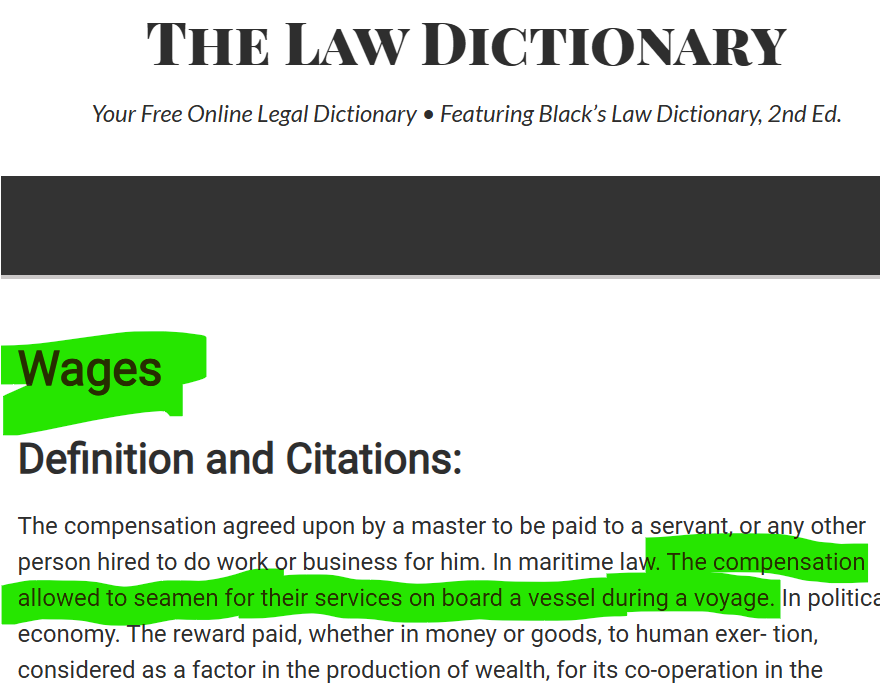
"Wages" is an maritime term & seemingly an economic measure. Maritime terms are suspicious since we're on land. Webster's defines 'wages' (plural) to be something different from 'wage' singular. Point is "wages" is a specialized term. Use with caution. I receive pay, not wages.
Websters -- Wages: plural: the share of the national product attributable to labor as a factor in production. 👀https://t.co/5PSePvZfnZ
From @MistralAI we get:
Maritime Meaning
In maritime law and tradition, "wages" specifically refers to the payment due to seafarers (sailors, crew members) for their work aboard a vessel. Historically, this term was used in contracts and legal documents related to seafaring, and it remains relevant in modern maritime labor law.
Example:
A sailor’s contract might specify their "wages" for a voyage or period of service.
Etymology of "Wages":
"Wages" comes from the Old Northern French word "wage" (also "gages" in Old French), meaning a "pledge" or "security."
This, in turn, derives from the Frankish *"wadi," related to the Old High German "wetti" (pledge, surety).
The idea was that a sailor’s wages were a kind of "pledge" or "guarantee" for their service, often paid in advance or secured by contract before a voyage.
Black's Law 2nd:
The compensation agreed upon by a master to be paid to a servant, or any other person hired to do work or business for him. In maritime law. The compensation allowed to seamen for their services on board a vessel during a voyage. In political economy. The reward paid, whether in money or goods, to human exer- tion, considered as a factor in the production of wealth, for its co-operation in the process
https://t.co/pU90DpMQGB
We're all presumed to be misters/masters/captains on their citizen ships holding the office of citizen. No surprise we're presumed to receive "wages".