"Each team built a knowledge graph in its own field, then connected it to the other knowledge graphs through a shared technical fabric. The result is a single federated network rather than 18 separate projects."
https://t.co/gQ2sFcqGEu
NSF launched the Open Knowledge Network at https://t.co/LIJJIsPHUE, an open-data infrastructure linking 43 knowledge graphs & tens of billions of connected facts on health, environment, justice, manufacturing & national security. It's live and open to all. https://t.co/67SxZWZal8
PurRDF 1.0.0 is live. One RDF 1.2 engine, implemented in Rust and carried into Python, WebAssembly/JavaScript, and C—with the same semantics everywhere. SPARQL, SHACL, ShEx, entailment, codecs, GeoSPARQL, full-text and vector search. https://t.co/qFTIOyCsfq
I don't know how I missed this!
If you work with RDF, be sure to check out:
https://t.co/ijMS1UOWWx
From the repo: sop aims to be a swiss-army knife for processing RDF and Linked Data on the command line.
This has some very nice feature like:
sop parse examples/social.ttl ! query 'PREFIX foaf: <https://t.co/XY0Q1RUkz4> CONSTRUCT { ?p foaf:name ?n } WHERE { ?p foaf:name ?n }' ! serialize -f ttl
To query a local file with SPARQL. It has much much more, you really want to check this out.
Shout out to Pierre-Antoine Champin and @linkedktk and the other developers! Thanks for this!
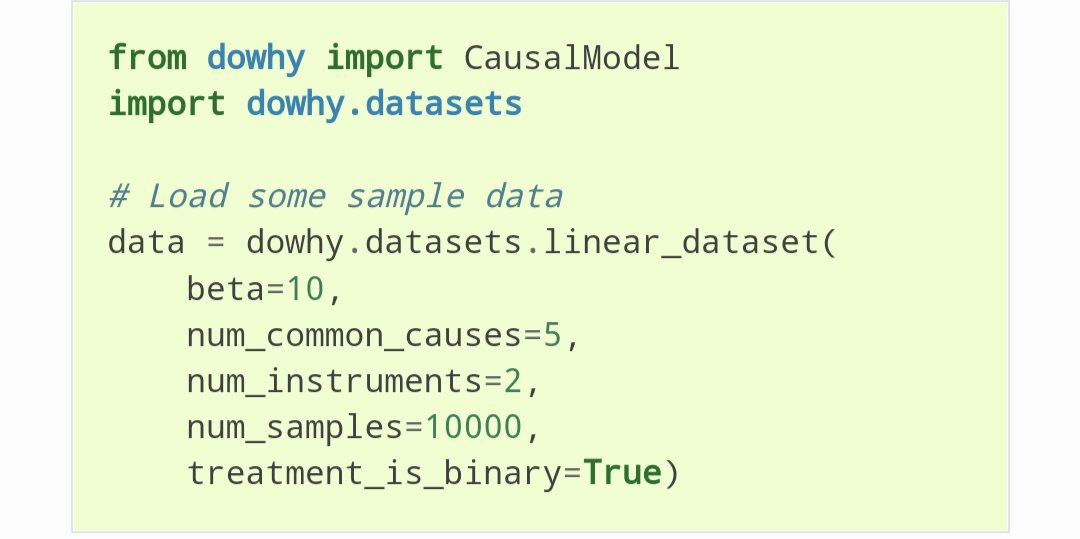
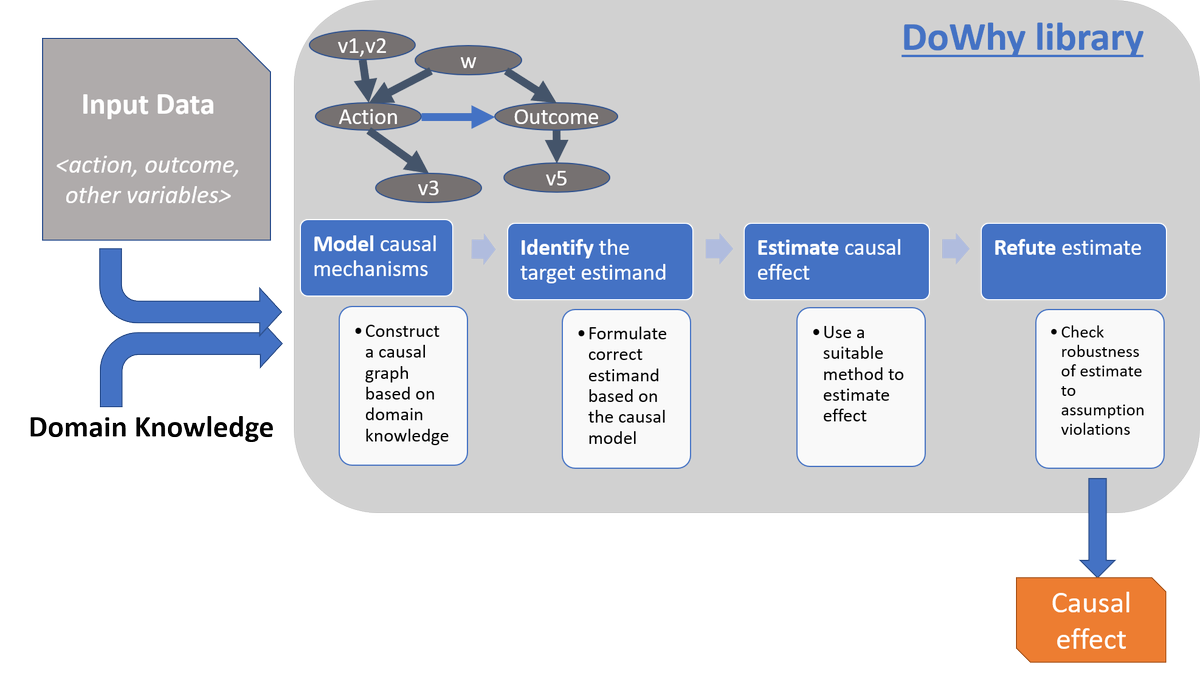
DoWhy - Low Code Causal Inference in Python as a Microsoft and AWS Collaboration
Article:
https://t.co/DHNrQUxJwS
https://t.co/uy9cvW7tMT
Python GitHub:
https://t.co/XRbE4eBBGs
(Example below shows inference in 4 lines of code)
"Introduction to Special Issue on FAIR Principles and Machine Learning, AI Readiness and AI Reproducibility" by Lynne Schreiber, Daniel S. Katz, Yuhan Rao, and Christine R. Kirkpatrick is now available. As artificial intelligence continues to evolve, ensuring that research is FAIR (Findable, Accessible, Interoperable, and Reusable) is crucial. This introduction highlights the growing importance of AI readiness, reproducibility, and responsible data practices in advancing trustworthy AI research. Read the article: https://t.co/T56wKDSFO8
The wait is over. AI Magazine Special Issue: "FAIR Principles and Machine Learning, AI Readiness, and AI Reproducibility" is now online. The special issue addresses the challenges of making research objects (data, software, and ML models) findable, accessible, interoperable, and reusable in the age of generative AI and large language models. https://t.co/7NPIQiaRUU
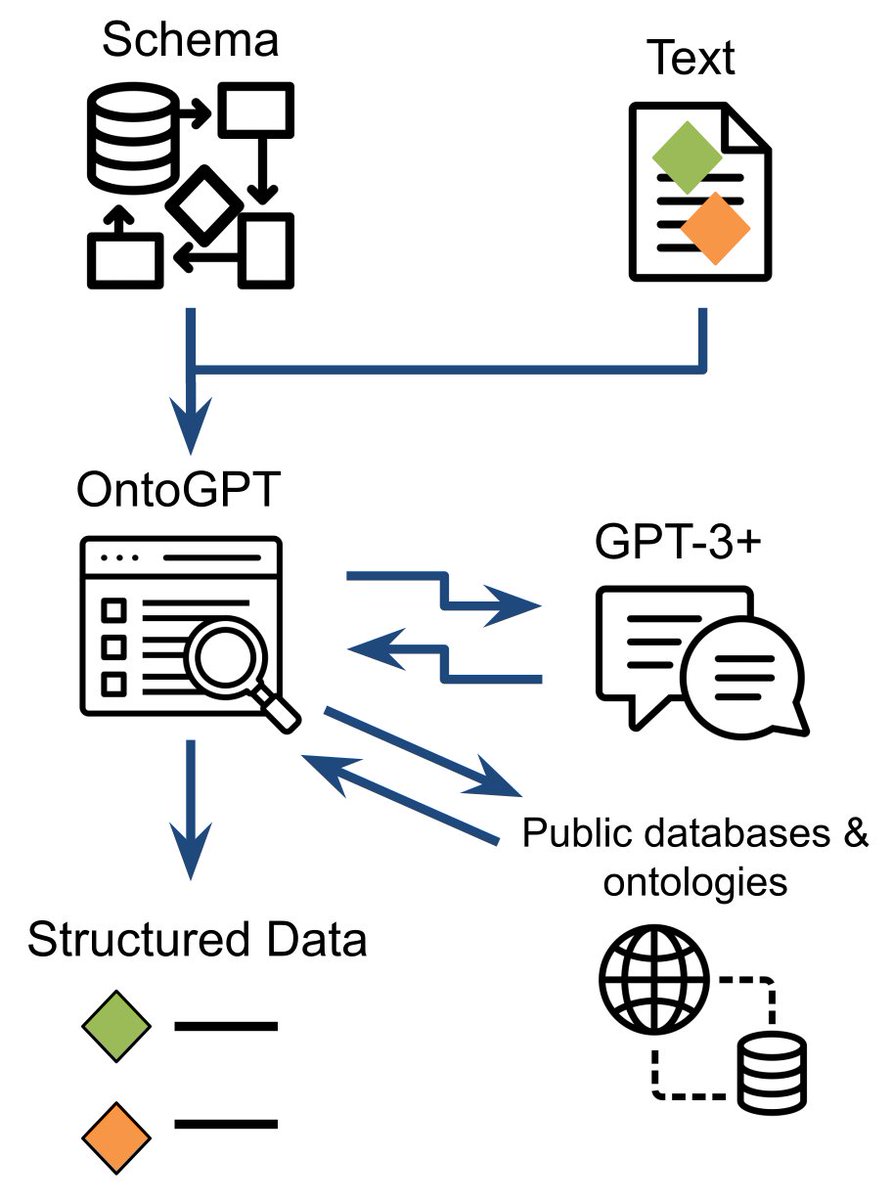
Here's our pre-print describing our GPT-3 based knowledge extraction tool SPIRES: https://t.co/8b57yidudx. Great work from @harry_caufield et al! SPIRES allows you to specify a knowledge schema (in @linkml_data) and then populate instances of that schema from unstructured text
Gartner Says Lack of Semantics Causes Inaccurate AI Agents and Wasted Spending. #AllegroGraph provides the semantic foundation for governed, context-aware, explainable AI with enterprise #KnowledgeGraphs at the core of #AgenticAI.
#AI#SemanticAI https://t.co/LzQXd95v8y
AllegroGraph v9 is here — and it introduces GraphTalker, a major advancement in how people and AI agents interact with enterprise Knowledge Graphs. GraphTalker brings natural-language intelligence directly to the #semanticlayer. https://t.co/gn6Ubu8elT #KnowledgeGraphs#NSAI
Transforming Research Visibility with RAiD at Oak Ridge National Laboratory
Interesting blog post. Also fascinated with the Acorn CLI mentioned in this article: https://t.co/HX3FxvUrLl
https://t.co/aGGQO5Rjhv
The spring 2026 edition of AI Magazine features the special topic article "An actionable framework for AI-ready data" by Neil Majithia, Thomas Carey-Wilson, Elena Simperl, and Nigel Shadbolt. Read more, including further steps that should be taken for the open data ecosystem to be made AI-ready in order to realize its true potential in supporting an innovative future: https://t.co/9lb2hTHQuf.
AI Magazine Spring 2026 Issue is here. The purpose of AI Magazine is to disseminate timely and informative expository articles that represent the current state of the art in AI and to keep its readers posted on AAAI-related matters. View all the articles:
https://t.co/0MJJhcg22A
Even if we only consider AI, there was an official web standard for Web Ontology Language established in 2004, building on ontology work in AI (using that term) going back to the early 1990s.
Proceedings of the Fortieth AAAI Conference on Artificial Intelligence are now available to review online. The proceedings have been published in 48 consecutive issues which are all available here: https://t.co/d5OwIZQGXX
AllegroGraph 8.5: Strengthening the Semantic Foundation for Agentic AI
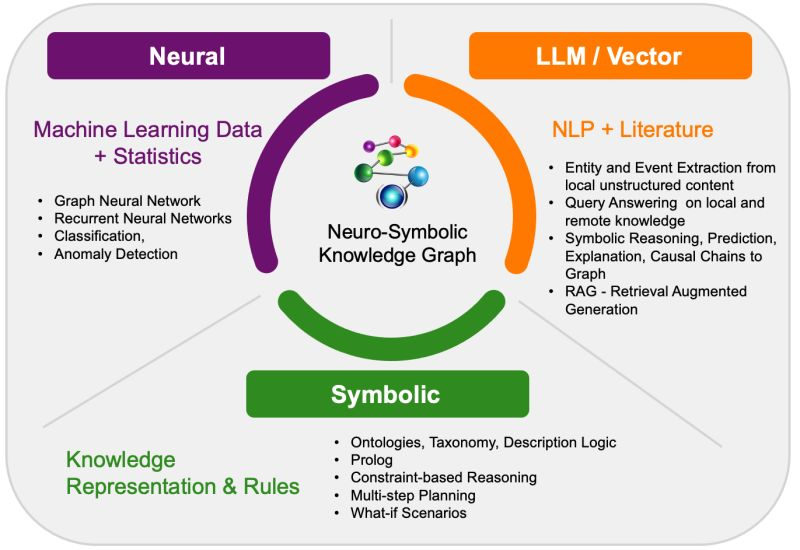
AllegroGraph is a Neuro-Symbolic AI Platform that fuses machine learning (statistical AI) with symbolic AI, enabling it to solve complex problems with fewer data and provide explainable outcomes.
The latest release announced today, AllegroGraph v8.5, aims to help enterprises build Agentic AI solutions by enabling more intuitive, human-like interaction between users and intelligent systems—critical for agents that need to reason, plan, and act autonomously.
AllegroGraph v8.5 combines knowledge graphs, vector embeddings, and neuro-symbolic reasoning to provide the semantic layer needed for AI agents to interpret data meaningfully and deliver more accurate, explainable results.
New capabilities include:
* Optimized Natural Language Query (NLQ): Faster, more token-efficient translation of natural language questions into graph queries, reducing LLM usage while improving response times.
* Expanded MCP Support: Simplifies connecting models, tools, and enterprise knowledge graph workflows into agentic AI systems.
* Faster Vector Processing: Accelerates vector creation and supports configurable vector sizes to optimize performance and cost.
* Enhanced Observability: Enhanced integration with Prometheus and Grafana for improved monitoring and operational visibility.
* Production-ready AI Semantic Graph Infrastructure: Strengthens AllegroGraph’s role as a production-ready platform for AI applications that combine knowledge graphs, vector search, and LLM reasoning.
@Franzinc was recently listed as a Neuro-Symbolic AI vendor in Gartner’s 2025 Hype Cycle for AI in recognition of AllegroGraph’s Neuro-Symbolic AI capabilities.
According to Gartner, “Neurosymbolic AI addresses limitations in current AI systems, such as incorrect outputs, lack of generalization to a variety of tasks and an inability to explain the steps that led to an output. The neurosymbolic approach leads to more powerful, versatile and interpretable AI solutions and allows AI systems to reason through more complex tasks. Generative AI systems are starting to leverage neurosymbolic methods to overcome their reasoning shortcomings.”
Source: Gartner, Hype Cycle for Artificial Intelligence, July 2025.
“AI requires structured knowledge,” said Charles Betz, VP Principal Analyst at Forrester. “GenAI and large language models (LLMs) require structured and contextualized data. Graphs provide a foundational knowledge model that enhances AI-driven automation, reasoning, and prediction. If unstructured data and the LLMs and vector databases that make sense of it are like flesh, graphs are the skeleton, the bones that give it structure. You need both.”
Source: Forrester, The Graphic Future of IT Management, March 2025.
--
The Year of the Graph's Spring 2026 newsletter issue on all things #KnowledgeGraph, #GraphDB, Graph #Analytics / #DataScience / #AI and #SemTech is coming soon.
Subscribe and follow to be in the know. Reach out if you'd like to be featured 👇
https://t.co/7pg6gqWYvw
New Predictions for Data and Analytics in 2026 by @Gartner_inc
"By 2030, universal semantic layers will be treated as critical infrastructure, alongside data platforms and cybersecurity."
https://t.co/bAsTZgLQ33