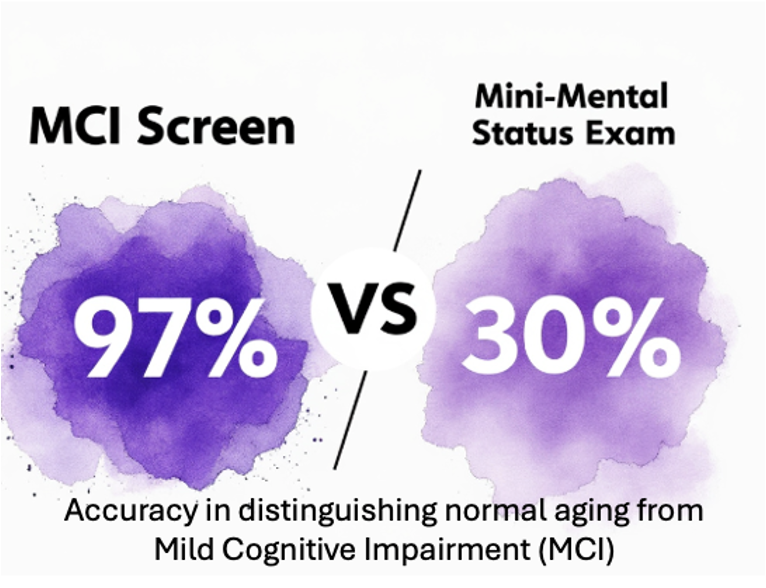
Sleeper diseases like Alzheimer’s, or other illness, can silently progress for years. Early detection protects us from missing the window to intervene while still in good health. Learn more about MCI Screen, 97% accurate online assessment answering the essential question: Is my memory normal for my age, or am I at risk of an underlying medical condition.
#AlzheimersAwareness #EarlyDetection
https://t.co/xVPS6GCg5o
Worried about your memory? MCI Screen: 97.3% accurate AI-powered test to detect cognitive decline and early stage Alzheimer's. Take a short survey & get MCI Screen for free (normally $199). Start now at https://t.co/FlDV47qe2S
AI can help with early detection of Alzheimer's especially for those without obvious symptoms (forgetfulness, brain fog, difficulty completing tasks). From performance-minded executives to people in retirement age, cognitive health should be part of every longevity plan.
Since 2011, CMS has mandated cognitive impairment screening during Medicare wellness visits, yet only 16% of people over 65 receive regular assessments.
Too many are diagnosed with advanced dementia when it’s too late.
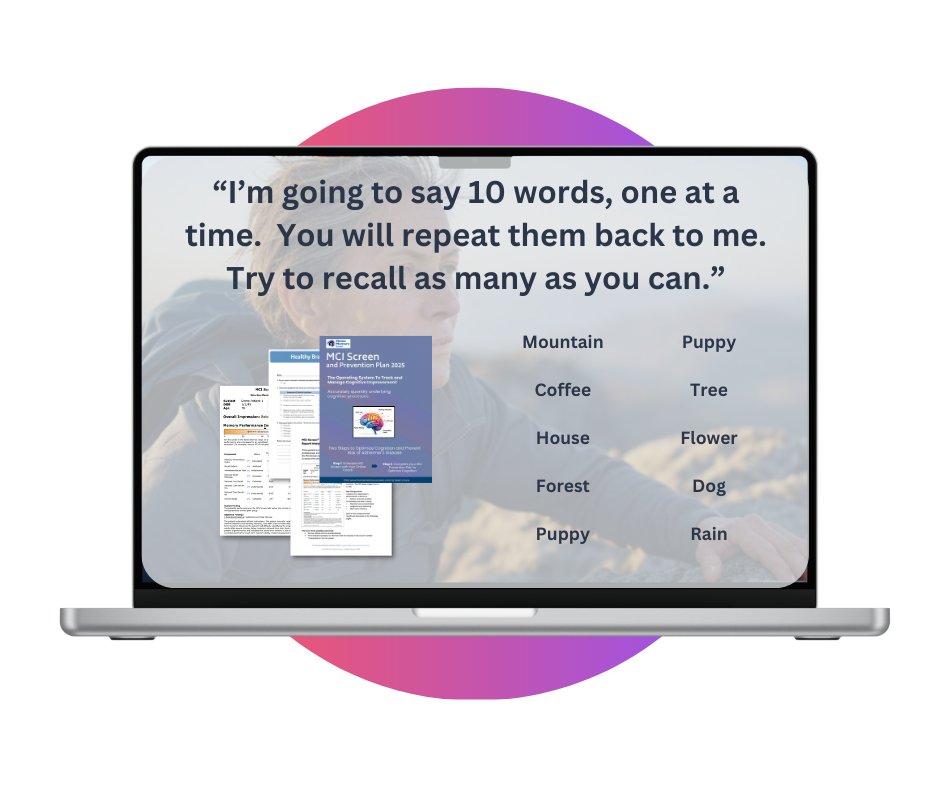
Our solution? The MCI Screen—an AI-powered 10-minute test of memory, judgment, language, and executive function, built on the gold-standard ADA-Cog, a 10-word recall test used in Alzheimer’s clinical research.
Powered by a 2-million-person normative database and a Bayesian cognitive machine learning model, this non-invasive test detects subtle cognitive shifts that subjective methods miss.
Benefits? It reassures those with normal aging memory (about 50% of users feel a profound sense of relief) and identifies mild cognitive impairment (MCI)—the earliest, most treatable stage of Alzheimer’s.
MCI Screen isn’t a diagnosis—it complements clinical practice. Cognitive changes can stem from many causes (e.g., diabetes, poor sleep, concussions), not just Alzheimer’s.
Our goal is to empower people to act early—through lifestyle changes or medical care—to slow, stop, or reverse decline.
Learn more at https://t.co/gbO79umA6y. Questions? please connect with me here on X.
#Alzheimers #CognitiveHealth #EarlyDetection #HealthTech #AI
If traditional cognitive tests like MMSE give you a positive result for early detection of Alzheimer's, there's only a 17% chance it's correct. MCI Screen positive results are 97.3% accurate. That's the difference between worry and certainty. #HealthInnovation#AlzheimersResearch
In a head-to-head study of 254 patients, Embic found that 43% of cognitive impairment cases were Alzheimer's and 36% were cerebrovascular disease. Early detection with accurate tools like MCI Screen is critical. #MedicalResearch#BrainHealth
AI Benchmark Study: Clock Drawing Test accuracy for detecting early cognitive decline:
MOCA: 54%
Mini-Mental State Exam: 62%
MCI Screen: 96%
The numbers speak for themselves. We need better screening tools in primary care. #HealthTech#AlzheimersResearch
Did you know? Up to 20% of seemingly asymptomatic adults over 65 may have mild cognitive impairment (MCI). Most traditional tests miss these cases, but the MCI Screen catches them with 97% specificity. #CognitiveHealth#AlzheimersAwareness
The statistics from one head-to-head study in cognitive testing are eye-opening for both patients and healthcare professionals, specific to positive predictive value:
Clock Drawing Test: Only 16% 'positive predictive value'
Standard MMSE: Just 17% 'positive predictive value' AI-powered
MCI Screen: 86% 'positive predictive value'
With Alzheimer's disease accounting for 43% of diagnosed cases in our study and cerebrovascular disease another 36%, the implications for early intervention are substantial.
AI benchmark study shows AI-powered MCI Screen detects early stage Alzheimer's with 97.3% sensitivity vs 62% for MMSE and 54% for Clock Drawing Test. Early detection means earlier intervention. Learn more at https://t.co/gbO79umA6y #AlzheimersResearch#EarlyDetection #BrainHealth
"There is nothing I can do about it anyway." This is why some avoid testing to know if their memory and cognitive function are normal or not. However, this is not true.
Many underlying causes of mild cognitive impairment are treatable and even reversible. Examples include poor sleep, uncontrolled diabetes, and excessive alcohol consumption. There are many others.
Even diseases such as Alzheimer's Disease have new medications that slow progression.
What matters most is early detection. When you know your cognitive health status you can make informed decisions to improve your health.
At Home Memory Screen we make it as easy as possible to know if your memory is normal for your age or if there is an underlying medical condition that is affecting you.
We can also provide you with a personalized prevention strategy developed by a leading Neurologist and based on evidence-based medicine to mitigate your risk factors for Alzheimer's Disease and maximize your cognitive function.
To learn more, visit https://t.co/OdoccVq6xX
Nearly all PCP's (96%) say it is important to assess patients age 60 and older for cognitive impairment but report that they conduct assessments for just half of their patients age 60 and older. (Source: Special report, Alzheimer's Association, 2022). The more you know, the more you can inform your MCI Prevention Plan.
The vast majority of primary care physicians (86%), according to a special report by the Alzheimer's Association, 2022) say that early intervention can slow progression of cognitive decline when MCI is detected in patients, PCP's most often recommend lifestyle changes (73%), perform laboratory testing for reversible causes of MCI (70%) and or refer patients to a specialist (53%). The more you know, the better you can inform your MCI prevention plan.
Sometimes a diagnosis of mild cognitive impairment (MCI) requires ruling out other health conditions, such as Alzheimer's, cardiovascular disease, or our lifestyle factors like insomnia or smoking. Be sure to talk to your physician about accurate screening to get further insights into your overall health.
Approximately 12% to 18% of people age 60 or older or living with mild cognitive impairment (MCI). MCI is characterized by subtle changes in memory and thinking, and sometimes confused with normal aging. #MildCognitiveImpairment#Alzheimer's #MCIScreen