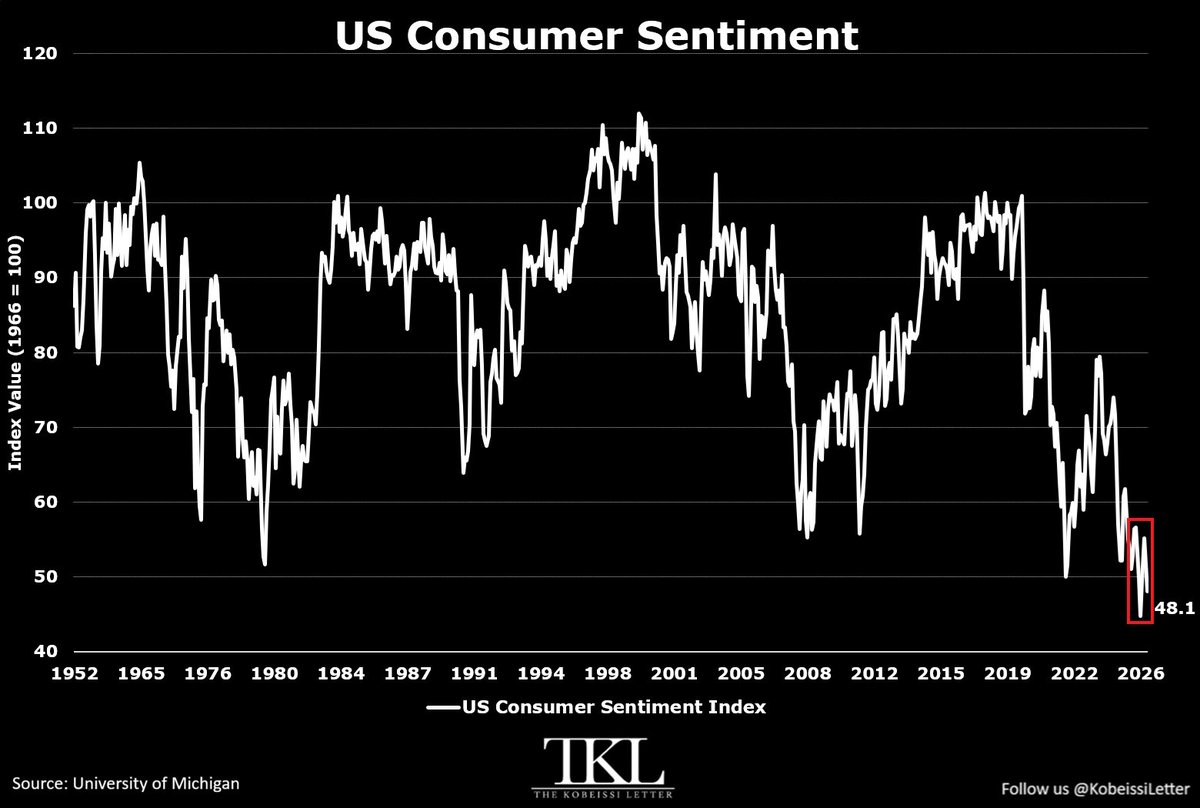
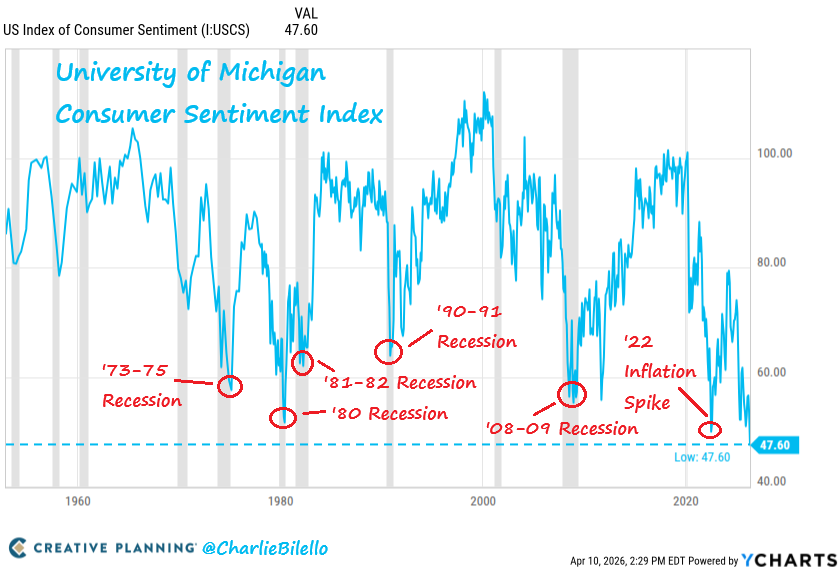
BREAKING: The Consumer Sentiment Index fell -3.6 points in September, to 48.1, its 2nd-lowest level in history.
This marks the 2nd consecutive monthly decline, totaling -7.1 points.
This comes as the Current Conditions Index decreased -1.0 point, to 50.9, its 4th-lowest reading on record.
At the same time, the Consumer Expectations Index dropped -5.2 points, to 46.3, its 2nd-lowest since 1980.
This year, the sentiment has deteriorated for all groups by age, education, geography, political party and income.
The decline has been driven by a higher cost-of-living, as higher fuel prices, persistent inflation, rising mortgage rates, and weaker purchasing power.
Consumer sentiment is at crisis levels.
Is the 🇯🇵 yen carry trade (YCT) about to blow up?
@FoFtyTrader and I have warned about this many times. The YCT provides a tremendous amount of liquidity to the US markets.
When the yen increases in value against the Dollar, institutions suddenly stop borrowing in Japan and investing in the US. Instead the money flows back into Japan, draining liquidity from the US stock and bond markets.
The parabolic on the Japanese 10 year yield has been in play since 2016.
In the next 45 days it's about to go vertical from 2.8% to 4% without a historic intervention by the bank of Japan.
What is historic intervention?
Selling US treasuries to buying their own Japanese treasuries. The only other solution is for the Federal Reserve to offer a massive currency swap line.
Leverage in South Korean chip stocks is out of control:
Single-stock leveraged and inverse ETFs tracking SK Hynix now hold ~$19 billion in total assets, more than 4 times the stock's average daily trading volume this year of ~$4.5 billion.
At the same time, Samsung has ~$12.4 billion in leveraged ETF assets, +176% above its ~$4.5 billion in average daily turnover.
Furthermore, the Hong Kong-listed 2x leveraged long SK Hynix ETF, which holds ~$13 billion in assets, is worth about twice the value of SK Hynix shares traded on an average day, the widest gap of any major stock with a leveraged ETF tracking it.
By comparison, Micron, $MU, has ~$9.9 billion in leveraged ETF assets, well below its ~$27.5 billion in average daily trading volume.
All while Tesla, $TSLA, and Nvidia, $NVDA, have leveraged ETF assets of ~$6.0 billion and ~$5.6 billion, both far smaller than their daily trading volumes of ~$23.6 billion and ~$28.8 billion, respectively.
Leverage concentration in Korean chip stocks is through the roof.
BREAKING: US oil prices fall over -16% on the day and officially drop below $80/barrel.
Geopolitical risk premiums are being rapidly priced-out.
The oil market says the war is ending.
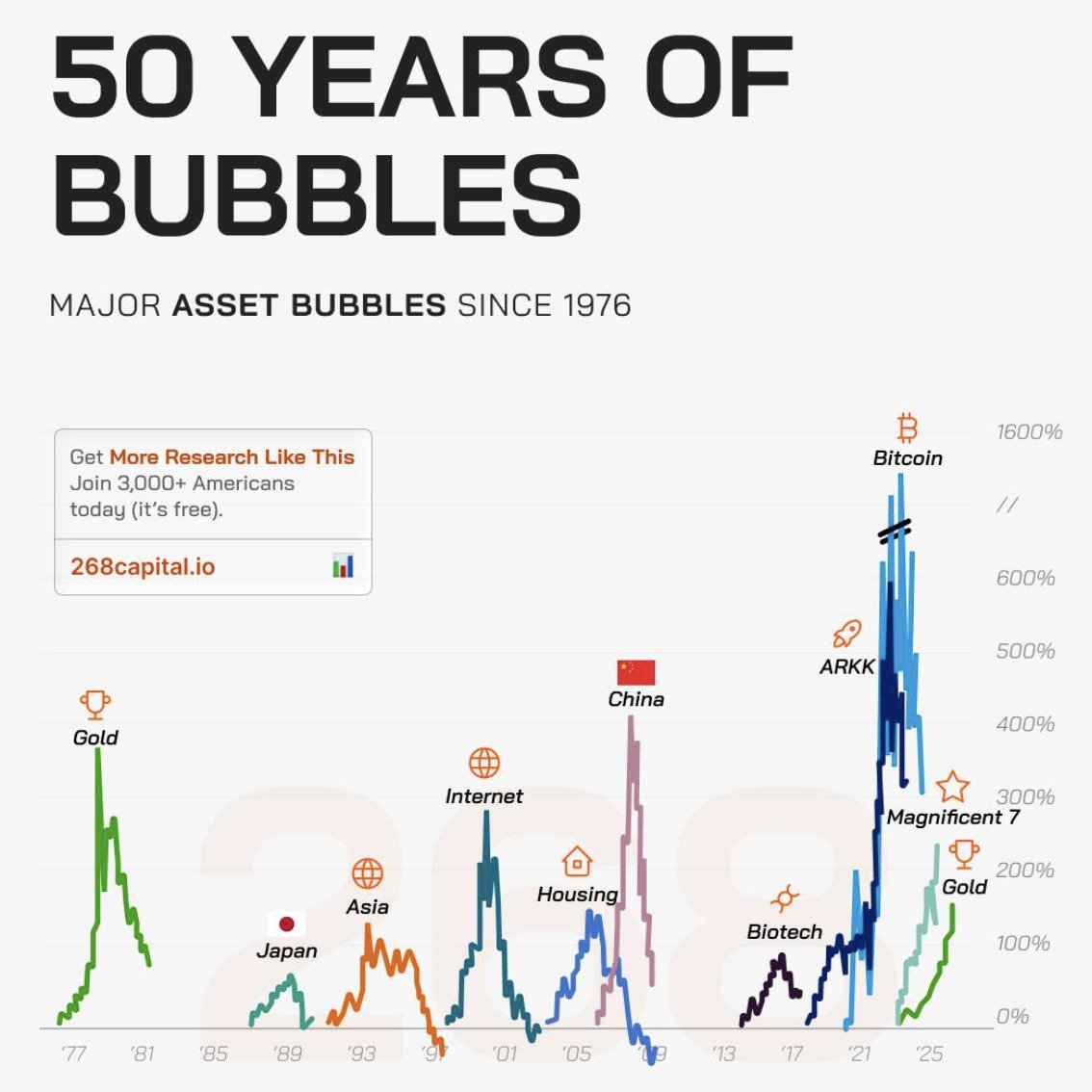
Fifty years. Same movie. Different ticker.
Gold in the late 70s. Japan in the 80s. Asia in the 90s. The Internet in 2000. Housing in 2006. China in 2008. Biotech in 2015. ARKK, Bitcoin, and now the Magnificent 7.
Every cycle has a story that feels different. Revolutionary. Structural. This time is smarter. This time is permanent.
Price goes vertical. Narratives get louder. Risk management gets quieter.
Then gravity shows up.
The takeaway is not that innovation is fake. It is that parabolic moves rarely sustain without resets. Excess always gets wrung out.
Bubbles are not about bad assets. They are about stretched expectations and crowded positioning.
If you trade long enough, you stop asking “Is this different?”
You start asking, “Where are we in the cycle?”
BREAKING: American shoppers spent a RECORD $11.8 billion online on Black Friday, up +9.1% from last year.
Adobe Analytics, which tracks over 1 trillion US retail site visits, expects shoppers to spend $5.5 billion on Saturday and $5.9 billion on Sunday, up 3.8% and 5.4%.