Department of Philosophy at Magdalen College School, Oxford. Re-tweets signify that this could be worth discussing with your sister/brother/parent/neighbour.
From Peter Thiel to Donald Trump, the fantasy of the "sovereign individual" — the genius who bends reality to their will, free from all constraints — is newly dominant. | https://t.co/Br0oQJaJyH
But philosopher James I. Porter argues this vision fatally misunderstands what a self actually is.
Individuality is forged through friction with others; strip that away and the result isn't freedom but self-annihilation.
Excellent piece from David Goodhart, though I would disagree with the thought that liberal democracy needs to be less liberal and more democratic. We certainly need a revitalisation of democracy. But with respect to liberalism, we need less “hyper-liberalism”, both social and economic, which is in reality a morally hollowed-out form of liberalism.
You'd be forgiven for thinking one of the most rewarding aspects of academic life is celebrating the success of graduates, including calling them forward individually by name to accept their degrees. Why would you even contemplate delegating this role to an AI system?
That which is glorious is worthy of being revered, and revered because it is glorious. That's the conservative side of the role of the humanities.
But they also have an inseparable critical and creative side, to foster critical reflection so that, partly through being aware of past and present shortcomings, we can make our own contribution, perhaps even adding to the glories that are worthy of reverence.
Sadly the former function can be perverted into a form of parochialism and idolatry, while the latter can degenerate into a form of relativism and nihilism.
With a title like this, who could resist reading?
Especially as one of the two organisms covered has (my nomination for) the best scientific name ever bestowed:
'Chaos chaos.'
@JTasioulas ....But I'm not sure I buy your analysis of Nietzsche. This might just be a verbal matter: I don't see him as promoting the subordination you describe, nor that doing so would be to interpret the good formalistically. I need to ponder!
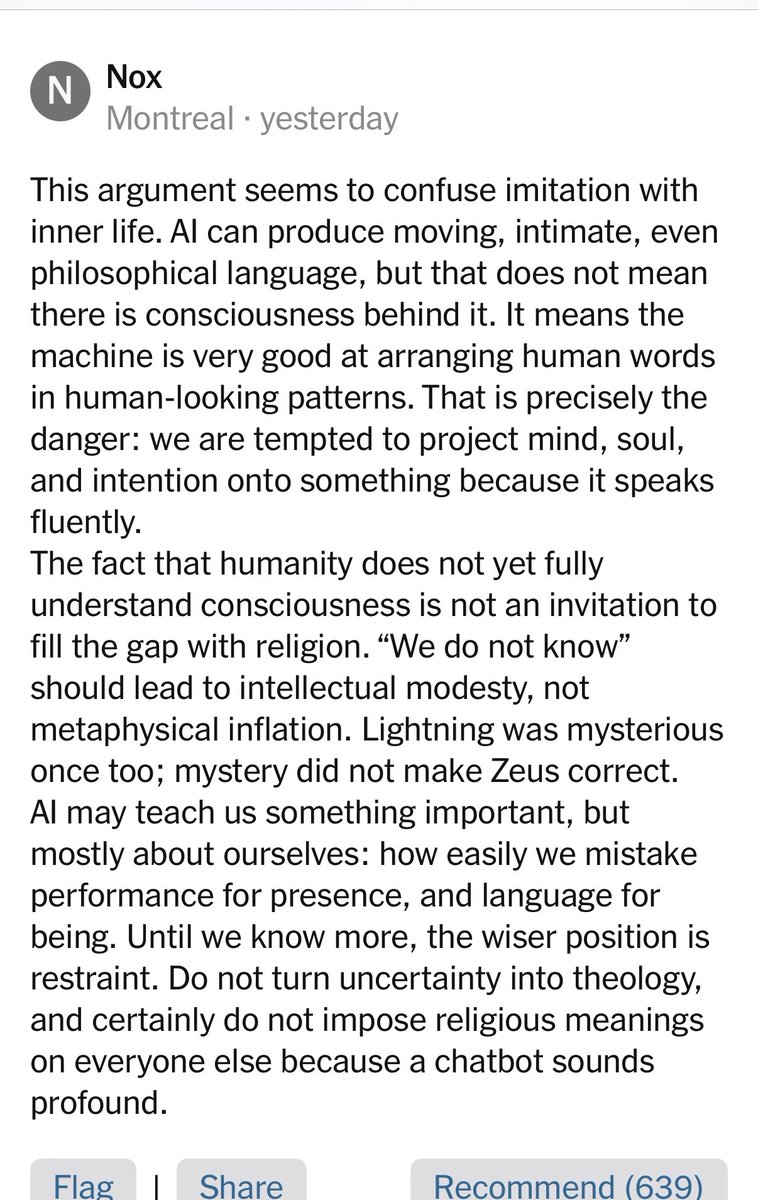
This reader comment on a NY Times column where Ross Douthat ponders that maybe God is speaking to us through A.I. is an absolute fastball on the corner with movement, and deserves a column. "Lightening was once mysterious too; mystery did not make Zeus correct" is perfect.
Yes, it does, but I think typically gets less common as we age. Exhibit A: thoughtful U6th in her utilitarianism essay claims that Bernard Williams' objection about integrity is fatal. Some reading and discussion later, she changes her mind...
Nothing in our experience tells us there should be a smallest possible size. Yet modern physics assumes there is a minimum possible measure for any object.
Now known as the Planck scale, it is central to both cosmology and particle physics. But is this model reflective of nature, or just a mathematical construction?
At HowTheLightGetsIn Festival, theoretical physicist Jonathan Oppenheim, quantum theorist Chiara Marletto, microprocessor pioneer Federico Faggin, and philosopher of physics Tim Maudlin debate the Planck scale.
Tap here to dive into our full programme. https://t.co/vx58uxYGdi
Is the tension between meaning and well-being a deep truth about life, or a sign of institutional failure? In a letter to Philosophy Now, Anders Wallin argues that strong welfare societies reduce the need for people to turn their lives into exhausting projects of achievement just to feel meaningful. A humane society is one where most people can live decent, balanced, “unheroic” lives - think Scandinavian model. Read more: https://t.co/zV43rZziCy
“I tell the rogues to read, read, read, read, read. Those who read own the world; those who immerse themselves in the internet or watch too much television lose it... Our civilization is suffering profound wounds because of the wholesale abandonment of reading by contemporary society.”
— Werner Herzog
"Many experts think that conscious AI is possible. I think they're wrong."
Watch neuroscientist @anilkseth's full TED Talk here: https://t.co/ZyWLaBCb7R