They steal the parts. Then sell it back to the City. Then your lights go out. Then you pay for the “repairs.”
This is the circuit breaker mafia. Watch the full video to see what the DA will do to deal with this issue!⚡️
#BelieveInJoburg#Zille4Mayor
You paid your electricity bill.
Every month, more or less on time, you settled what you owed. Maybe you grumbled about the tariff hike. Maybe you spent 45 minutes on hold querying a billing error that somehow took six months to resolve.
But you paid.
The City of Johannesburg didn’t.
Thanks @MYANC
Saying that goodbye to my friend in South Africa, who has fled to the USA, due to racial discrimination and fear for their lives ... is a sad experience.
It brings out resentment in me ,,, what the fuck has the ANC done to this once beautiful country!
Fuck the anc!
One of the signals that shows South Africa is practically unsalvageable without a drastic mindset shift is the strong rallying cry behind rejecting Starlink from operating in South Africa. None of the arguments offered for why it should be blocked are compelling at all. Just pure resentment, arrogance, and emotion over facts.
South Africa's Immigration laws requires every foreign national to have a minimum of R5million invested in their businesses and to also apply for a Business Visa, which must include registration with CIPC, SARS, UIF etc,
Anyone who operate any business in SA without meeting the above is breaking SA laws. No amount of emotions and rubbish will stop the businesses from being shut down. Thank you.
Balwin Properties plans on being delisted from the JSE 📊
the stock is down 60% over 11 years, leaving shareholders “homeless” with NO dividends
yet somehow, the PIC is STILL paying a fat 40% premium for Balwin ⁉️
“privatize gains & socialise losses” is a broken model 🏡💔
YOUR IDENTITY IS ABOUT TO CHANGE FOREVER — DON'T LET YOUR SILENCE BE MISTAKEN FOR CONSENT!
The Department of Home Affairs has officially opened public comment on a massive overhaul of South Africa’s civic infrastructure: the draft Identification Regulations, 2026 (Government Gazette No. 54610).
Under the new "Home Affairs @ home" strategy, the state is introducing a smartphone-based "Digital Identity Credential" housed inside a new app called MyMzansi. This digital ID will carry the exact same legal weight as your physical Smart ID card.
While phasing out paperwork and cutting down administrative delays sounds like a win for convenience, the actual legal mechanics hidden within the draft text raise major questions about privacy, asset security, and digital exclusion.
If we don't speak out before the 6 June 2026 deadline, these rules will become law as they stand.
Here is what is actually on the table:
👉 Real-Time Corporate Data Loops: The state will record "Verified Relationships" between you and private entities like banks and telcos. If you update your address or phone number at your bank, it will synchronise across the state population register automatically in near real-time—permanently blurring the line between public civic data and private corporate infrastructure.
👉 The Stolen Phone Lockdown: Your digital ID is cryptographically "bound" to a single smartphone. In a country with high rates of mobile theft, losing your phone means your legal identity token is instantly frozen or revoked. The regulations are currently silent on a secure, remote path to restore your access, raising the threat of immediate financial and administrative paralysis.
👉 The 10-Year Physical Queue Trap: Your digital ID expires every 5 years. While remote renewal via a facial scan in the app is permitted, the draft rules state that if you go 10 consecutive years without a physical, in-person touchpoint at a Home Affairs branch or partner bank, your credential completely lapses. You will be forced to line up in person from scratch to re-prove your identity.
👉 Algorithmic Profiling (The 30-Day Rule): You will be legally required to report routine life updates (moving house, changing an email) within 30 days. If you fail to do so, the state will algorithmically drop your internal "Identity Assurance Level." A lowered score could mean sudden, frustrating transaction rejections when you try to use high-security online services.
👉 Foundations for Function Creep: Centralising dynamic biometric registries and cross-entity tracking pipelines creates a technical foundation that critics warn could easily be weaponised into an authoritarian behavioural tracking system, or act as a centralised economic kill-switch over your accounts.
🗣️ YOUR VOICE IS A LEGAL FORCE
Public participation is not a mere tick-box exercise—it is a binding constitutional right under the Promotion of Administrative Justice Act (PAJA). Every choice and comment submitted through the Dear South Africa portal forms a recognised legal submission delivered directly to the Chief Director: Legal Services, Adv A M Malakate.
We’ve cut through the legalese and structured the official questionnaire into clear, direct focal points so you can have your say in less than a minute.
👇 Click the link below to cast your vote and submit your formal comment now!
🔗 https://t.co/ZbAhiZ4WUt
Spread the word! Once you’ve participated, share this post to your local community groups, family chats, and colleagues. Our digital future must be shaped by active citizens, not unchecked bureaucracy.
If you are an unemployed person/youth looking for work in South Africa, I want you to listen to me very carefully, because no politician is going to campaign by telling you the truth.
South Africa's unemployment rate is currently 32.7%
At a sustained 5% annual GDP growth (we've barely achieved 1% for over a decade), reducing it to 20% would likely take 12-18 years.
Read that again.
Read it again.
IF 5% - maybe 12-18 years.
This assumes some translation from growth to jobs, but SA's structural issues create jobless growth. This is why investment doesn't = employment.
Even optimistic models project slow progress.
4% growth barely dents youth unemployment.
Again, Cyril and their policies can't achieve 1%.
The majority of you will NOT SEE employment in your lifetime. I'm sorry to tell you that.
The ANC has stolen your life.
Every dream you ever had.
Wrap your mind around that.
Have a blessed day.
@Space_Station Due to unfavorable weather, now targeting tomorrow, May 13, for Falcon 9’s launch of the CRS-34 mission to the @Space_Station → https://t.co/c8cVFXwJY0
We should be outraged by what Gayton McKenzie is doing at Sports, Art and Culture. We cannot be told there's no money for the National Arts Council, but there's a budget set aside for the 2010 Bafana Bafana World Cup squad to travel to the US?
#CapeTownTaxesRatesCrisis The 40% of Cape Town’s residents who are expected to subsidise the other 60% in terms of the DA’s plans have started to push back. Well done. It is about time. https://t.co/fTOtlQdtYj
The big change (like a switch in the economy) was in 2007, when the NPA dropped the charges against Zuma for political expediency. From that point, politicians (in the ANC connected inner circle) have been given impunity. Corruption shifted from skimming in the shadows to wholesale plunder in the open. What followed was the destruction of the police (especially investigative capacity), destruction of the NPA, breakdown of the judicial system (especially the magistrate courts) and oversight in general. The effect on the economy by the 2007 NPA decision was hidden by the 2008 global financial crisis but the SA economic underperformance from that time has been catastrophic. Especially in unemployment and poverty levels.
People really saying “just connect to the internet not a big deal” my brother in Christ that’s not the point. God forbid a natural disaster happens or you can’t pay your WiFi bill one month and just can’t play games you PAID for until you reconnect.
It doesn’t matter if you have internet, it’s a matter of principle. You shouldn’t be okay with PS arbitrarily taking away access to games you spent your hard earned money on. The more comfortable you get with this the worse it will get.
We’re frogs in the pot and they’re slowly raising the heat and some of yall aren’t noticing.
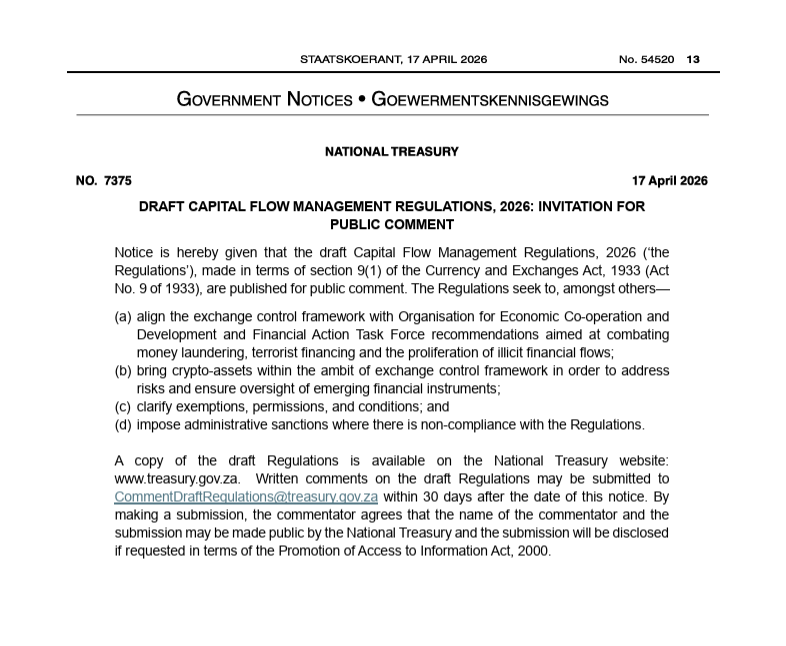
I am frankly dumbstruck by the news out of South Africa 🇿🇦 that newly proposed regulations would upend self custody in that country.
South Africa's National Treasury has published draft Capital Flow Management Regulations (https://t.co/72NEvhnM1f) to replace its 1961 exchange-control regime, and the proposal extends sixty-five-year-old capital controls designed for gold bullion and foreign banknotes directly onto self-custodied crypto.
The result is one of the most invasive treatments of non-custodial wallets proposed anywhere in the world.
The mechanics are clear and severe. Any purchase, sale, loan, or transfer of crypto above a Treasury-set threshold must run through a licensed "authorised crypto asset service provider." Cross-border movement of crypto requires permission. Holdings above the threshold must be declared within thirty days, and Treasury can compel their sale at market price. Crypto can be attached by administrative order, without prior judicial process, on reasonable suspicion of contravention. Penalties run to R1 million, five years in prison, or the full value of the crypto involved.
The provision that is the real showstopper is Regulation 25(5). Where crypto has been forfeited to the state, the owner must "furnish full particulars in writing of all and any passwords, personal identification numbers or codes" necessary to give Treasury access.
That seems to be a statutory compelled disclosure of seed phrases and private keys.
There is no carve-out, no judicial check inside the regulation itself, no recognition that the keys are not separable from the user's right against self-incrimination or right to privacy under the South African Constitution.
The reason that provision appears to exist is Treasury understands that, without it, the rest of the framework cannot reach a self-custody user. Exchange-control logic depends on gatekeepers — banks, dealers, intermediaries that the state can appoint and command. Self-custody removes the gatekeeper by design. So the regulation reaches the only places it still can: the on-ramp, the holder's declaration, and ultimately the holder's body and devices at the border. Regulations 4 and 5 give enforcement officers the power to search travelers entering or leaving the country, demand they "produce" any crypto in their possession or control, and seize it on suspicion alone.
As you well know, this is not how most of the rest of the world is approaching self-custody. The EU's Markets in Crypto-Assets framework regulates issuers and crypto-asset service providers and explicitly leaves self-custody alone. The UK's financial services regime regulates exchanges and custodians and treats unhosted wallet software as out of scope. The US has spent the last two years walking back its most aggressive theories — the SAB 121 reversal, the broker-dealer rule rollback, the IRS DeFi broker rule rescission — precisely because policymakers across both parties recognized that you cannot regulate non-custodial software the way you regulate a bank. FATF's own guidance distinguishes wallet software publishers from custodial intermediaries.
South Africa's draft does the opposite. It very much intends to reach through the software to the user.
The technical reality the draft ignores is that a non-custodial wallet is a key-management tool, not a financial intermediary. @MetaMask does not hold user funds. It does not see private keys. It cannot freeze, seize, or surrender anything to a regulator. Compelling its users to declare, surrender, or hand over keys does not make Treasury more effective at managing capital flows. It makes ordinary South Africans criminally liable for using software the rest of the world treats as legitimate self-custody infrastructure.
Treasury has opened a public comment period, and anyone with a dog in the fight should ask that the compelled-key provision be struck. The cross-border search-and-seizure regime should not extend to self-custodied wallets. And the framework should distinguish — as nearly every other major jurisdiction now does — between intermediated services and the user's own software.