Thrilled to serve as Co-Director of the next @scaielm cohort with @jaygirimd!
See you all next week in Miami at @SCAI Fellows, and then Montreal this Spring (structural tract will be sweet, led by @mszerlip) Not a member yet? Time to join! @SrihariNaiduMD@JDawnAbbott1
Beautiful night in Boston complete with boat ride, dancing, cornhole and a campfire. Grateful for these incredible friends. @SCAI remains a steady, loyal and dependable professional society for interventional cardiologists. This is where so much of my volunteer time goes...
How will you counsel your patient who is taking a NOAC lifelong- but has a strong preference not to- when they ask you about the choice of LAAC vs. NOAC? On behalf of my co-investigators, I will present late-breaking science #ESCCongress 2026 in Munich to further answer this question.
This meta-analysis by @DFCapodanno@LaudaniClaudio and others includes the landscape of #LAAC trials from the past two decades. A similar one was published in #JACC Clin EP this year.
Current @ACCinTouch@escardio guidelines encourage NOAC over warfarin, making PROTECT and PREVAIL- using warfarin as a comparator, with a prior device iteration- less relevant.
Other, more recent trials included in the meta-analyses focus on higher risk patients with great medical complexity. Contemporary devices and techniques have led to improved safety, with National Cardiovascular Data Registry (NCDR) SURPASS Registry supporting real-world complications lower than 1%. https://t.co/wIUH0Rnw6B
For patients with #AF who are indicated for lifelong #OAC (i.e. higher CHADS2VASC, lower bleeding risk), with today's contemporary devices and medications: what is the relevant data to inform patient-centered #shareddecisionmaking? Join me Monday August 31 at 1:00 pm for what is sure to be a passionate discussion.
No free lunch. In our meta-analysis, now published in JAMA Cardiology, transcatheter left atrial appendage closure (LAAC) was associated with similar long-term risks of any stroke and major bleeding compared with oral anticoagulation in patients with atrial fibrillation, while increasing the risk of ischemic stroke and reducing the risk of nonprocedure-related major bleeding.
Article: https://t.co/3Sy1RGpCze
Editorial: https://t.co/4w8xc31xZ2
When it comes to severe AS, I’ve heard firsthand how a “wait & see” approach can be a mental
burden for pts. I'm collaborating with @EdwardsLifesci to highlight the importance of talking to pts about earlier treatment options & helping make the right choice with them.
Sponsored by @EdwardsLifesci | I've had this happen. You see a severe aortic stenosis patient and they're asymptomatic. Next time you see them, they've unexpectedly landed in the hospital. The question is, how common is this? Has this happened in your practice?
Haytham Allaham, MD; Megan Coylewright, MD (@MCoylewright); and Mukta Srivastava, MD (@smuktas), explore how automation and AI have the potential to reshape the TAVR landscape by improving disease detection.
https://t.co/l3XEhoOEv9
🆕���JSCAI’s latest special issue “Strategies to Promote Health Equity in #IC” is now live. #HealthEquity isn’t optional — it’s essential.
Guest edited by @MCoylewright, @MayraGuerreroMD & @_WayneBatchelor, the issue highlights actionable strategies to advance #equity across #InterventionalCardiology
📚https://t.co/0CCyog3ogc
#ACC26 This was an incredibly impactful session- while I love geeking out on all the technical details in my field #IC- I recognize that often the most challenging task- and requiring more preparation and skill- are the conversations we have with our patients as we guide them down complex #shareddecisionmaking paths. True experts deliver here on those needed skills. @jae_patton@KadijahPorterMD@SammyElmariahMD@VietHeartPA
This is a critical time for #IC@SCAI and confident in the care and commitment Dr Dawn Abbott has always shared with her interventional community. @scaielm
You’re all in great hands. Dr Abbott truly merges education and academics and being 💯 in the trenches as a very busy operator.
Plus first @scaielm to take the helm @SCAI
We’re all behind you Dawn.
I’m here … call any of us past presidents if needed!
AI is an important part of our #structuralheart future, but cannot replace what we get back from close collaboration and friendship with colleagues. Great to work with you again @smuktas !
In this dual-center cohort of TEE-guided LAAC, the overcompression group was independently associated to a higher rate of LAA occlusion at TEE follow-up.
Get the details in #JACCCEP: https://t.co/d1WB1a908j
🚀 The Pulse is live — and women in cardiology are showing up.
Hundreds are already using @WomenAs1’s new platform to connect, find opportunities, and stay at the forefront of science. 💫
No surprise that Career Opportunities is leading the way 👀
How are you using The Pulse? 👇
🔗 https://t.co/WOwOxSezBc
#ThePulse #WomenInCardiology #WomenInMedicine #Leadership 💜
When all cardiologists are equitably and visibly valued for what they bring to the table, it can impact an entire field. Without it, we fail to attract top talent.
Study finds workplace cultures with aggressive competition & male norms signal that women are less valued, even w/o overt discrimination. Women cope by distancing themselves from other women in order to fit in or be taken seriously.
https://t.co/2yt5u5BS6I
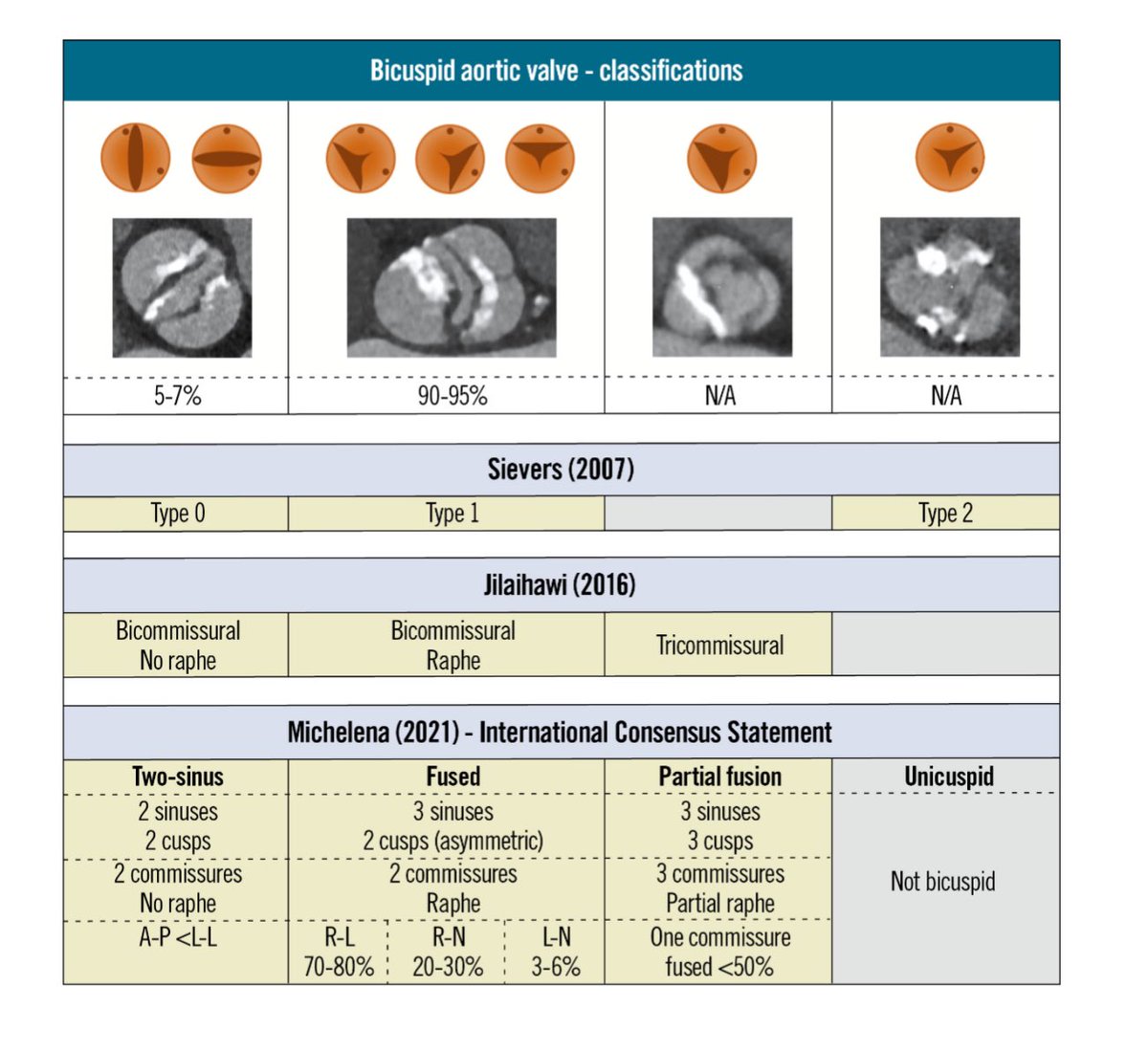
Cardiac Imaging Pearls in Bicuspid AS
From EuroIntervention:
https://t.co/JmCy7u9jbn
1️⃣ CT is King for BAV TAVR
•Essential for defining raphe, leaflet morphology, calcium burden, annular shape, and ascending aorta size.
•Identify heavy/rigid raphe → predicts expansion issues + PVL risk.
2️⃣ Measure More Than the Annulus
•BAV = elliptical, asymmetric.
•Consider supra-annular sizing or “virtual raphe ring” when annulus doesn’t tell the whole story.
3️⃣ Calcium Mapping Matter
•High calcium → higher risk of malexpansion, rupture, stroke.
4️⃣ Delineate the Aorta
•BAV often comes with root & ascending aorta dilation.
•CT aortography crucial for deciding TAVR vs SAVR when aortopathy present.
5️⃣ Coronary Heights in BAV Are Tricky
•Asymmetric cusp fusion can distort coronary takeoff. High/ eccentric take off
•Carefully assess coronary height + sinus size.
6️⃣ Echo Complements CT
•TTE: Hemodynamics, gradient confirmation, LV function, AR degree.
•TEE: Intra-procedural alignment & PVL detection especially in challenging anatomy.
7️⃣ Post-TAVR Imaging is Not Optional
•BAV valves may expand asymmetrically → follow-up echo ± CT for durability and PVL assessment.
#Echofirst #YesCCT #CVimaging