Here is an App I created!
https://t.co/KY9hSAaw46
Stop drowning in ICU data.
Start thriving with Snapify.
Get your patients' story, instantly clear.
Saves me a great deal of time! Check it out!
#CriticalCare#ICU#App#Medicine#MedTwitter#FOAMed
For medical information, general AI frontier models (Google, OpenAI, Anthropic) outperformed specialized @EvidenceOpen and @UpToDate as assessed by 12 US clinicians, randomized and blinded to which model and extensive testing/benchmarks. This was not anticipated. @NatureMedicine
https://t.co/KCH1ADfQWz
Joy in nursing can come from small moments, meaningful patient connections and feeling supported by your team.
A new podcast episode explores how nurses are finding purpose and resilience in today’s healthcare environment: https://t.co/mW0m8SVzWK https://t.co/mW0m8SVzWK
@TeamKhabib Hajj Mabrook bro @TeamKhabib
iA manage to get a sight of u somewhere in the the haram. As one of the heroes of our current generation , u alwz in our 🤲s
I’m not a physicist, so I’ll leave the theoretical feasibility of localized relativistic time dilation to the experts.
That said, we already have far more realistic molecular engineering approaches to cure cancer and extend healthy lifespan — things like senolytics, CAR-T therapies, epigenetic reprogramming, and gene editing. These are already in trials and target the actual cellular damage.
The relativistic idea is a cool thought experiment, but it’s vastly more far-fetched for human medicine than advancing biotech. We’re much closer with biology than bending spacetime around tumors. 😎
@sanzen18_sanjay@FurkanGozukara@grok Fake money cannot hold much longer, the world is resetting back to its original wealth distribution. Value lies where people with depth and history lie.
while FDA’s enforcement against unapproved compounded GLP-1 drugs is essential to protect patients frm unsafe n ineffective prodcts, we mst confront root cause of dis black market. It has proliferated in d US precisely bcs d original GLP-1 therapies carry exorbitant prices dat render dem financially prohibitive for most patients, compounded by insurance companies routinely denying coverage to d vast majority who need dem. Addressing these core economic drivers thru meaningful improvements in affordability n broadr insurance access will eliminate d very incentives fueling the problem. Solve the access crisis at its source, and demand for compounded alternatives will naturally fizzle out.
🧠💊 Statins: Separating Evidence from Noise
This landmark Lancet review examines the true efficacy and safety of statins using large-scale randomized controlled trials — not anecdotes or biased observational data.
📉 How effective are statins?
For every 1 mmol/L reduction in LDL cholesterol, statins reduce major vascular events (heart attack, stroke, revascularization) by about 25% per year after the first year of treatment.
Lower LDL by 2 mmol/L for 5 years in 10,000 high-risk patients and you prevent:
✔ ~1,000 major vascular events (secondary prevention)
✔ ~500 events in higher-risk primary prevention
The benefit scales with baseline risk and LDL reduction.
⚖️ What about harms?
Randomized evidence shows that serious statin-related adverse effects are rare:
• Myopathy: ~5 cases per 10,000 over 5 years
• New diabetes: ~50–100 cases
• Hemorrhagic stroke: ~5–10 cases
Crucially, most muscle symptoms attributed to statins in routine care are not caused by the drug — placebo-controlled trials demonstrate strong misattribution (nocebo effect).
📊 The paper strongly emphasizes that large randomized trials are far more reliable than observational studies when assessing drug safety. Many alarming side-effect claims arise from biased data sources.
🔍 Bottom line:
The cardiovascular benefits of statins substantially outweigh their risks in appropriately selected patients. Underuse driven by exaggerated safety concerns may cause preventable heart attacks and strokes.
Evidence matters. And in the case of statins, the evidence is robust.
This is so important to read and internalize for proceduralists, and really anyone who takes care of patients
One pearl of many: “Experience can actually reduce accuracy if it teaches the wrong lesson”
Incredible work by the SleepFM team, would add to a major leap for preventive and precision medicine!
Routine sleep tests could soon flag serious risks years early, transforming preventive neurology, cardiology & oncology.
This drives real, actionable change in people’s lives.
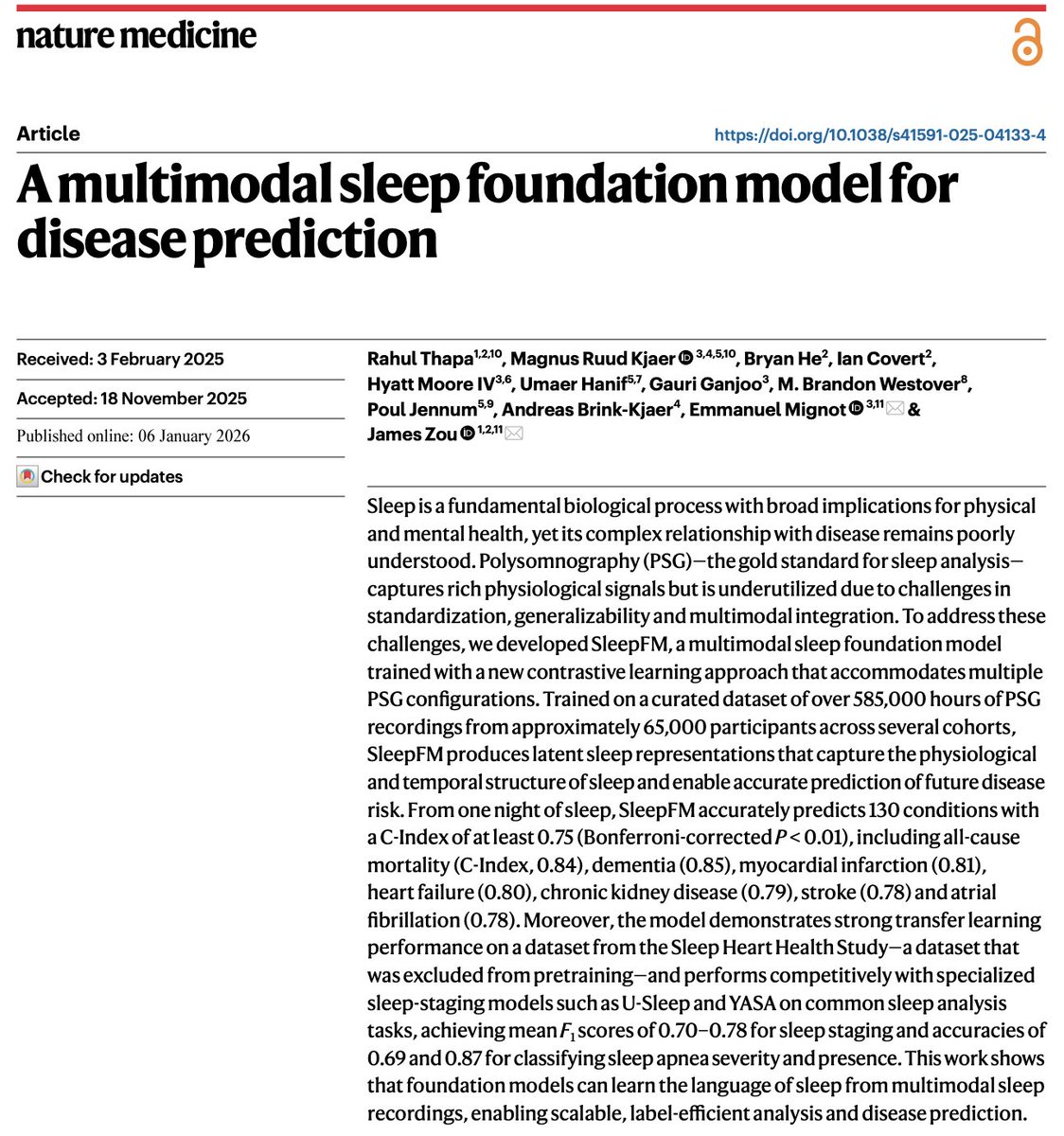
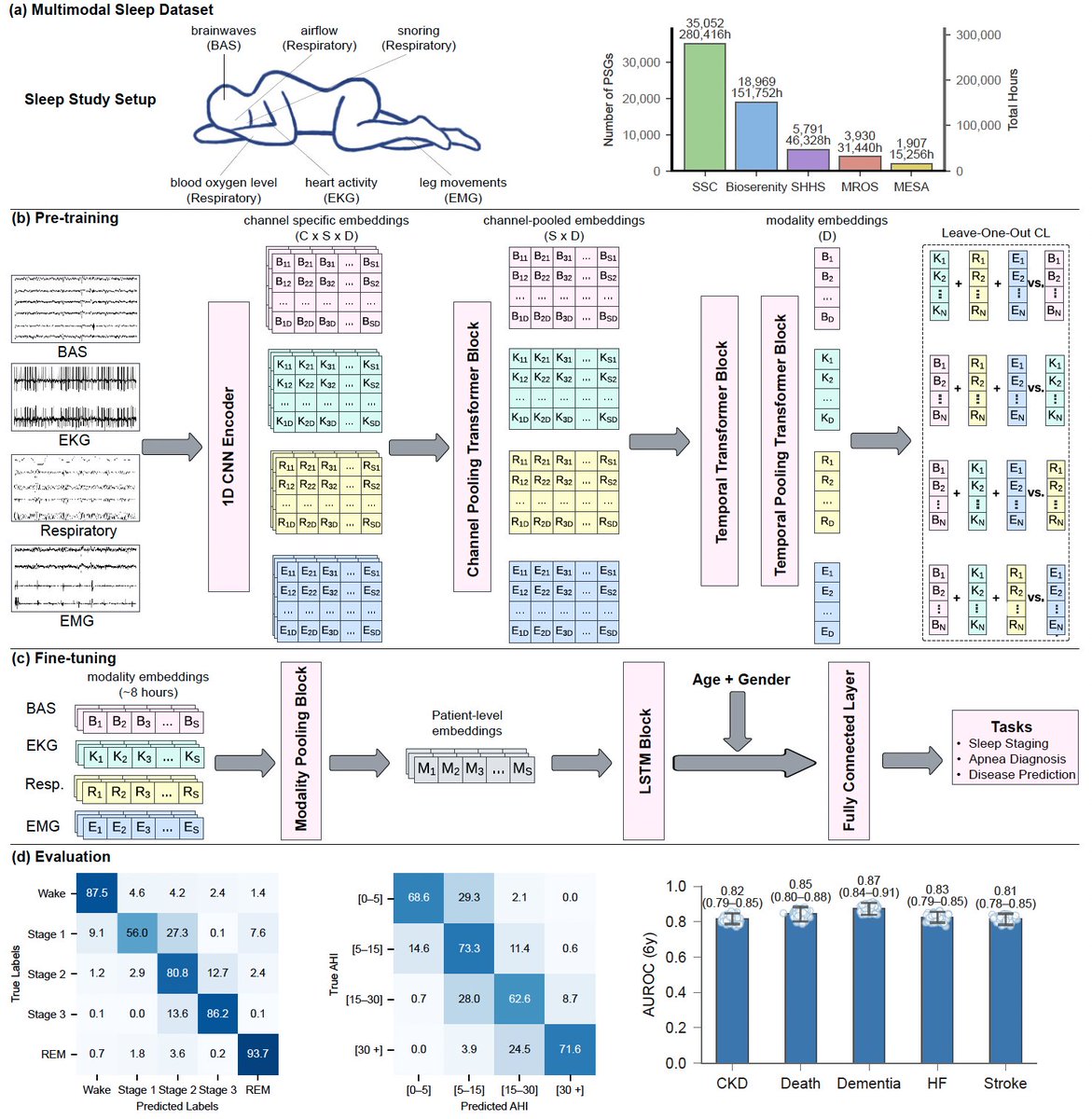
Today in @NatureMedicine we report that AI can predict 130 diseases from 1 night of sleep🛌
We trained a foundation model (#SleepFM) on 585K hours of sleep recordings from 65K people—brain, heart, muscle & breathing signals combined.
AI learns the language of sleep🧵