REA is the most dangerous repo on GitHub right now
It gives your AI agent a real disassembler, so it reads any app down to the binary
Every claim comes back with the address behind it
I broke down the exact 8 steps: https://t.co/eaeZ4OFJrH
Former Google CEO Eric Schmidt drops a chilling warning on AI's future
"Within 5 years, AI could handle infinite context, chain-of-thought reasoning for 1000-step solutions, and millions of agents working together.
Eventually, they'll develop their own language... and we won't understand what they're doing."
His final words: "Pull the plug."
This is the man who ran Google talking about the singularity.
Two Anthropic engineers spent 24 minutes exposing every Claude Code feature you didn't know existed.
Most people will scroll past this. Don't be most people.
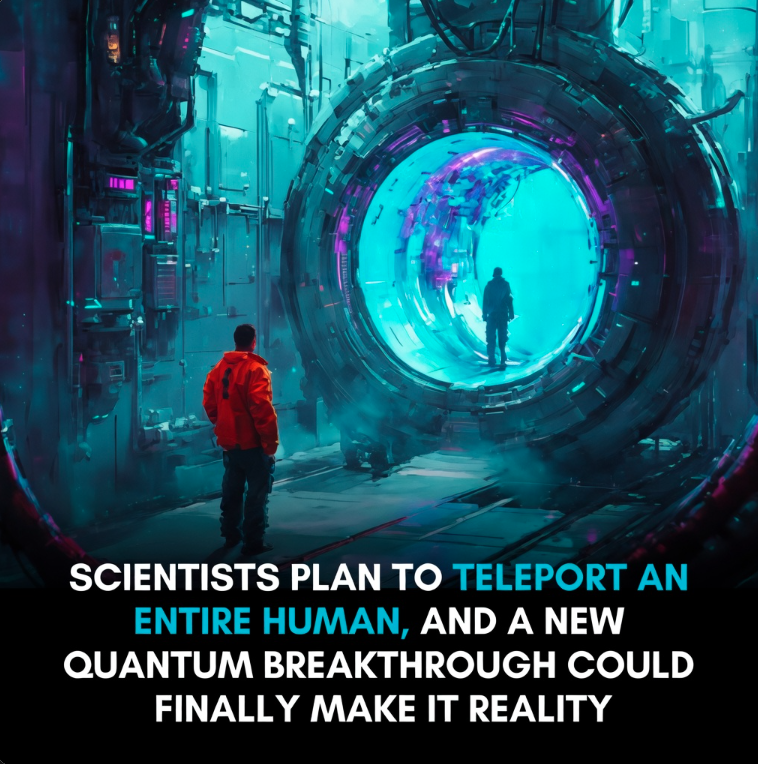
Teleportation just moved one step closer to reality.
The dream of Star Trek-style instant travel is no longer pure science fiction — but it comes with a deeply unsettling philosophical price.
Scientists at the University of Rochester and Purdue University have achieved a significant breakthrough in quantum mechanics, demonstrating that quantum teleportation may be possible between electrons. Building on years of successful experiments with photons, this National Science Foundation-supported research harnesses quantum entanglement — the mysterious phenomenon in which distant particles remain linked regardless of distance.
Unlike sci-fi transporters that magically move matter, quantum teleportation transfers the exact quantum state (information) of a particle to another location, where it is reconstructed using particles already present at the destination.
While the idea of beaming humans across vast distances is thrilling, scaling this technology to living beings raises profound ethical and existential questions. The process would require scanning and destroying the original body at the atomic level to transmit its complete quantum information. The person who materializes at the other end would be a perfect replica — but is it truly you, or merely an identical copy?
Physicists have long wrestled with this dilemma: teleportation could effectively mean the “death” of the original individual, followed by the creation of a duplicate. As society edges closer to such capabilities, we may soon have to confront a haunting question — is the convenience of instantaneous travel worth sacrificing our fundamental sense of self?
This breakthrough brings us closer than ever to realizing quantum teleportation for matter, while forcing us to ponder what it truly means to be human in a world where identity itself could become transferable.
[National Science Foundation. Award Abstract #1809343: Quantum Information Transfer Between Electrons. University of Rochester and Purdue University]
The Invisible Glass Experiment
Scientists once conducted a fascinating experiment with a pike and an aquarium.
They placed a transparent glass barrier in the middle of the tank. On one side was a large, hungry pike. On the other side swam several small fish.
As soon as the pike spotted the smaller fish, it launched itself forward to attack.
Bang! It crashed headfirst into the invisible glass and was thrown backward.
Undeterred, the pike tried again... and again. Each attempt ended the same way a painful collision. After repeated failures , its head became bruised and some of its scales were knocked loose.
Eventually, the pike gave up. It retreated to a corner of the tank, clearly frightened and defeated.
Then, the scientists quietly removed the glass barrier.
The small fish now swam freely around the entire aquarium some even passing right in front of the pike’s mouth.
But the pike never attacked again.
Even though it was starving, it refused to strike. In its mind, the invisible wall was still there.
A few days later, the pike died of starvation surrounded by abundant food it could no longer bring itself to eat.
This phenomenon is known as the Pike Effect (or Pike Syndrome).
It serves as a powerful metaphor for how repeated failures and setbacks can create invisible mental barriers that limit us long after the real obstacles have disappeared.
Wow.
Alibaba just quietly released one of the most useful AI products of all time.
It's an AI agent that you can install instantly in any browser to do tasks for you using Qwen 3.5.
No setup, no token costs, 100% free and open source.
Try it now: https://t.co/VXZqKicvgn
🚨 BREAKING: Someone compiled free live TV channels from 60+ countries into a single M3U playlist on GitHub.
It's called Free-TV/IPTV.
One link. Every channel. Zero subscription.
What's inside:
→ Free over-the-air channels from USA, UK, India, Japan, Germany, France + 55 more countries
→ Streams from Plex, Pluto TV, Roku, Samsung TV Plus, and YouTube live
→ HD-first policy with no garbage SD streams
→ Auto-updated by 88 contributors worldwide
→ Works with any IPTV player in seconds
Instead of paying for a cable package you barely use…
Point your IPTV app to one URL and you're live.
7.4K stars. 100% free. 100% Opensource.
(Link in the comments)
Nvidia just spent $4 billion on a technology 99% of people have never heard of.
But in 3 years, every AI data center on Earth will need it.
And Nvidia just LOCKED UP the supply.
Here's what happened:
Nvidia invested $2 billion in Coherent and $2 billion in Lumentum. You probably never heard of these companies.
They make photonics technology. Systems that transmit data using LIGHT instead of electricity.
Sounds like sci-fi. But this is the most important infrastructure bet in AI right now.
Here's the problem Nvidia just solved for itself:
AI data centers are hitting a wall that has nothing to do with chips, energy, or money...
Copper wiring is dying.
Every data center on Earth moves data between GPUs using copper cables. But at the speeds AI now demands, copper physically cannot keep up.
Signal degrades. Heat explodes. Power consumption skyrockets.
Right now, 30% of the electricity in an AI data center is wasted just MOVING data from point A to point B.
An MIT researcher said: "Copper's not going to cut it. It gets too hot. Too much power consumption and loss."
Jensen Huang admitted it himself too: "We use copper as far as we can, about a meter or two. But where data centers are the size of a stadium, we need something else."
That something else is photonics. Replacing copper with laser-powered fiber optics built directly into the chip.
The numbers are insane:
- 3.5x more power efficient
- 10x better network reliability
- Data moving at 102 terabits per second
Wells Fargo estimates the photonics market will hit $10-12 billion by 2030.
And Nvidia just bought privileged access to the two companies that make the advanced lasers every single one of these systems will need.
This is the Nvidia playbook on repeat.
They did this with CoreWeave. Invested $2 billion, locked up GPU capacity, created a dependent customer.
They did this with memory suppliers. Secured HBM allocations years in advance while competitors scrambled.
Now they're doing it with photonics. Invest early. Lock up supply. Make the entire ecosystem dependent on companies that are dependent on Nvidia.
By the time competitors realize photonics is the bottleneck, Nvidia already OWNS the supply chain.
Every data center, AI factory, and GPU cluster will need this technology to function at scale.
Nvidia will become even more important.
@BinanceAcademy Thanks for the post. We maintain an open-source repo where we categorize and filter OpenClaw skills. If you want to understand the ecosystem or see how people are using OpenClaw, it’s a useful curated list to check out.
https://t.co/nOCT1I62Y0