Trench life, made easy
$MEMEDEX pays holders the top tokens on Robinhood Chain - we use trade fees to buy $CASHCAT $PONS $INDEX & more before distributing straight to our holders every ~15 min.
live on @flapdotsh 👇
CA: 0x925c9da0a4dd25b41ab15cc766b436e63b9d7777
> Be Memedex dev
> Spend 17 days on the @flapdotsh bonding curve
> Launch a custom-built memecoin distribution protocol
> Distribute over $3,000 worth of the top tokens on Robinhood Chain to $MEMEDEX holders
> Manage X account, graphics creation & Telegram
> Build fully onchain prediction markets
> Build RH-native DCA & limit order engine
> Keep building out the rest of the Memedex product suite
> Keep building out the rest of the Memedex product suiteyour holders. Ignore the noise, keep going.
Update Time!
You may have seen the exploit that hit @TheIndexFi's old distributor on Robinhood Chain. Respect to them for disclosing it openly & pushing a patch out promptly.
Here's what happened, as I see it, and exactly how I'm making sure it can't happen to $MEMEDEX holders 👇
WHAT HAPPENED TO $INDEX
Their distributor paid holders from a "snapshot" - a saved list detailing who held how much at a moment in time.
The flaw: it never re-checked whether those balances were still real when it actually paid out.
So, an attacker took a flash loan (a huge amount borrowed and repaid inside a single transaction, essentially free), used it to look like a massive holder in the snapshot across a few helper wallets & collected oversized payouts cycle after cycle, skimming roughly 8%-11% of holder rewards before repaying the loan. The tokens were never really theirs. The snapshot just didn't know that.
WHY MEMEDEX WAS NEVER BUILT THAT WAY
Memedex has never used a snapshot. Our payouts are live & pro-rata:
- Your rewards are always based on your real, current balance, never a saved number.
- Splitting your bag across 10 wallets earns the exact same as holding it in one. There is no "count me multiple times" trick to abuse.
- Only our keeper can trigger a distribution, so no attacker can force a payout inside their own flash-loan transaction.
The exact $INDEX attack simply has no surface here.
WHAT I JUST SHIPPED: SEASONING
I went further. I upgraded the distribution engine to V2 with an on-chain defense I call 'seasoning' - built to kill the entire class of flash-loan reward attacks before we graduate to a DEX (the moment a cheap flash-loan surface would first exist).
Simply put: when your $MEMEDEX balance increases, those new tokens do not earn instantly. They season for about 10 minutes first. Only balance you have genuinely held through that window earns rewards.
This is airtight against flash loans. A flash loan lives for one transaction, a few seconds. It can never survive a 10-minute window. By the time borrowed tokens could earn, they are already repaid and gone, and the contract re-checks your live balance and gives them zero weight. The same logic shuts down "buy right before a payout, dump right after" farming.
The result: to earn $MEMEDEX rewards, you have to actually hold $MEMEDEX... which was always the point.
THE HONEST PART
I will not tell you that any contract is "unhackable" - nobody honest does. What I will tell you, and what you can verify on-chain yourself:
- Memedex never had the snapshot flaw that hit $INDEX.
- I proactively closed the broader flash-loan attack class at the contract level, ahead of graduation, not after an incident.
- It is live right now, holders are being paid, and every contract is on-chain for anyone to read.
Hold and get paid... That's the ultimate goal & Memedex is just making sure that "hold" actually means hold.
Update Time!
You may have seen the exploit that hit @TheIndexFi's old distributor on Robinhood Chain. Respect to them for disclosing it openly & pushing a patch out promptly.
Here's what happened, as I see it, and exactly how I'm making sure it can't happen to $MEMEDEX holders 👇
WHAT HAPPENED TO $INDEX
Their distributor paid holders from a "snapshot" - a saved list detailing who held how much at a moment in time.
The flaw: it never re-checked whether those balances were still real when it actually paid out.
So, an attacker took a flash loan (a huge amount borrowed and repaid inside a single transaction, essentially free), used it to look like a massive holder in the snapshot across a few helper wallets & collected oversized payouts cycle after cycle, skimming roughly 8%-11% of holder rewards before repaying the loan. The tokens were never really theirs. The snapshot just didn't know that.
WHY MEMEDEX WAS NEVER BUILT THAT WAY
Memedex has never used a snapshot. Our payouts are live & pro-rata:
- Your rewards are always based on your real, current balance, never a saved number.
- Splitting your bag across 10 wallets earns the exact same as holding it in one. There is no "count me multiple times" trick to abuse.
- Only our keeper can trigger a distribution, so no attacker can force a payout inside their own flash-loan transaction.
The exact $INDEX attack simply has no surface here.
WHAT I JUST SHIPPED: SEASONING
I went further. I upgraded the distribution engine to V2 with an on-chain defense I call 'seasoning' - built to kill the entire class of flash-loan reward attacks before we graduate to a DEX (the moment a cheap flash-loan surface would first exist).
Simply put: when your $MEMEDEX balance increases, those new tokens do not earn instantly. They season for about 10 minutes first. Only balance you have genuinely held through that window earns rewards.
This is airtight against flash loans. A flash loan lives for one transaction, a few seconds. It can never survive a 10-minute window. By the time borrowed tokens could earn, they are already repaid and gone, and the contract re-checks your live balance and gives them zero weight. The same logic shuts down "buy right before a payout, dump right after" farming.
The result: to earn $MEMEDEX rewards, you have to actually hold $MEMEDEX... which was always the point.
THE HONEST PART
I will not tell you that any contract is "unhackable" - nobody honest does. What I will tell you, and what you can verify on-chain yourself:
- Memedex never had the snapshot flaw that hit $INDEX.
- I proactively closed the broader flash-loan attack class at the contract level, ahead of graduation, not after an incident.
- It is live right now, holders are being paid, and every contract is on-chain for anyone to read.
Hold and get paid... That's the ultimate goal & Memedex is just making sure that "hold" actually means hold.
For distribution tokens, your dividends are inextricably tied to trading volume.
When volume falls through the floorboards, how do you keep the people around who originally came for those distributions? What happens when the next dog / cat / frog token comes along and sucks up all the liquidity from memecoin traders?
That's where your product suite comes into play.
I started building this ecosystem for Memedex before the token even launched - that's why my fully custom onchain prediction markets are already so far along in the build process. And guess what? That's only the first product I planned on launching. The more revenue streams I create - the more my holders will win.
And that's the ultimate goal for Memedex - create an ecosystem that benefits $MEMEDEX holders to absolute maximum. In order to do that, we can't rely on a single revenue stream in the world's most volatile casino.
Creators & builders that aren't thinking like this will find out the hard way - short-term hype ≠ long term value & the rotation will destroy you
Build something that's made to last, something that can weather the storm, something people can actually rally behind.
most people bought $INDEX after Vlad followed it and still call it a dividend token or a ponzi. funny.
let’s close that gap.
I mapped what Index is today, what is coming next and where the new fuel sources may come from ↓ https://t.co/rAh1MfavSo
Update Time!
You may have seen the exploit that hit @TheIndexFi's old distributor on Robinhood Chain. Respect to them for disclosing it openly & pushing a patch out promptly.
Here's what happened, as I see it, and exactly how I'm making sure it can't happen to $MEMEDEX holders 👇
WHAT HAPPENED TO $INDEX
Their distributor paid holders from a "snapshot" - a saved list detailing who held how much at a moment in time.
The flaw: it never re-checked whether those balances were still real when it actually paid out.
So, an attacker took a flash loan (a huge amount borrowed and repaid inside a single transaction, essentially free), used it to look like a massive holder in the snapshot across a few helper wallets & collected oversized payouts cycle after cycle, skimming roughly 8%-11% of holder rewards before repaying the loan. The tokens were never really theirs. The snapshot just didn't know that.
WHY MEMEDEX WAS NEVER BUILT THAT WAY
Memedex has never used a snapshot. Our payouts are live & pro-rata:
- Your rewards are always based on your real, current balance, never a saved number.
- Splitting your bag across 10 wallets earns the exact same as holding it in one. There is no "count me multiple times" trick to abuse.
- Only our keeper can trigger a distribution, so no attacker can force a payout inside their own flash-loan transaction.
The exact $INDEX attack simply has no surface here.
WHAT I JUST SHIPPED: SEASONING
I went further. I upgraded the distribution engine to V2 with an on-chain defense I call 'seasoning' - built to kill the entire class of flash-loan reward attacks before we graduate to a DEX (the moment a cheap flash-loan surface would first exist).
Simply put: when your $MEMEDEX balance increases, those new tokens do not earn instantly. They season for about 10 minutes first. Only balance you have genuinely held through that window earns rewards.
This is airtight against flash loans. A flash loan lives for one transaction, a few seconds. It can never survive a 10-minute window. By the time borrowed tokens could earn, they are already repaid and gone, and the contract re-checks your live balance and gives them zero weight. The same logic shuts down "buy right before a payout, dump right after" farming.
The result: to earn $MEMEDEX rewards, you have to actually hold $MEMEDEX... which was always the point.
THE HONEST PART
I will not tell you that any contract is "unhackable" - nobody honest does. What I will tell you, and what you can verify on-chain yourself:
- Memedex never had the snapshot flaw that hit $INDEX.
- I proactively closed the broader flash-loan attack class at the contract level, ahead of graduation, not after an incident.
- It is live right now, holders are being paid, and every contract is on-chain for anyone to read.
Hold and get paid... That's the ultimate goal & Memedex is just making sure that "hold" actually means hold.
Update Time!
You may have seen the exploit that hit @TheIndexFi's old distributor on Robinhood Chain. Respect to them for disclosing it openly & pushing a patch out promptly.
Here's what happened, as I see it, and exactly how I'm making sure it can't happen to $MEMEDEX holders 👇
WHAT HAPPENED TO $INDEX
Their distributor paid holders from a "snapshot" - a saved list detailing who held how much at a moment in time.
The flaw: it never re-checked whether those balances were still real when it actually paid out.
So, an attacker took a flash loan (a huge amount borrowed and repaid inside a single transaction, essentially free), used it to look like a massive holder in the snapshot across a few helper wallets & collected oversized payouts cycle after cycle, skimming roughly 8%-11% of holder rewards before repaying the loan. The tokens were never really theirs. The snapshot just didn't know that.
WHY MEMEDEX WAS NEVER BUILT THAT WAY
Memedex has never used a snapshot. Our payouts are live & pro-rata:
- Your rewards are always based on your real, current balance, never a saved number.
- Splitting your bag across 10 wallets earns the exact same as holding it in one. There is no "count me multiple times" trick to abuse.
- Only our keeper can trigger a distribution, so no attacker can force a payout inside their own flash-loan transaction.
The exact $INDEX attack simply has no surface here.
WHAT I JUST SHIPPED: SEASONING
I went further. I upgraded the distribution engine to V2 with an on-chain defense I call 'seasoning' - built to kill the entire class of flash-loan reward attacks before we graduate to a DEX (the moment a cheap flash-loan surface would first exist).
Simply put: when your $MEMEDEX balance increases, those new tokens do not earn instantly. They season for about 10 minutes first. Only balance you have genuinely held through that window earns rewards.
This is airtight against flash loans. A flash loan lives for one transaction, a few seconds. It can never survive a 10-minute window. By the time borrowed tokens could earn, they are already repaid and gone, and the contract re-checks your live balance and gives them zero weight. The same logic shuts down "buy right before a payout, dump right after" farming.
The result: to earn $MEMEDEX rewards, you have to actually hold $MEMEDEX... which was always the point.
THE HONEST PART
I will not tell you that any contract is "unhackable" - nobody honest does. What I will tell you, and what you can verify on-chain yourself:
- Memedex never had the snapshot flaw that hit $INDEX.
- I proactively closed the broader flash-loan attack class at the contract level, ahead of graduation, not after an incident.
- It is live right now, holders are being paid, and every contract is on-chain for anyone to read.
Hold and get paid... That's the ultimate goal & Memedex is just making sure that "hold" actually means hold.
🚨 @TheIndexFi $INDEX HOLDERS READ THIS
a noticeable % of OUR fees got stolen
there was a real on-chain exploit on the old USDGBuyerDistributor on robinhood chain between july 26-28
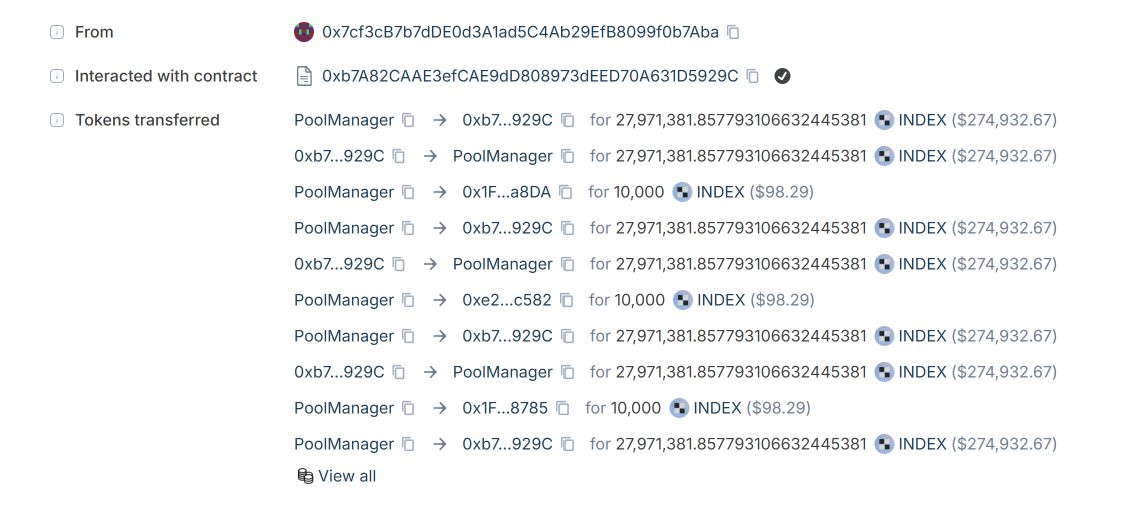
a linked address cluster used flash-borrowed $INDEX + 3 helper contracts to make the same recipient show up FOUR TIMES in a holder snapshot.
result: 4 identical payouts across all 18 stock tokens, cycle after cycle. i traced the 4x pattern across 42 payout cycles. the attacker's cut floated somewhere around 8-11% depending on the cycle.
proof:
manipulation tx:
0xad42e120117d64e8e4a96ec8f71fea85dc3d098ec60ed14297bfd2739e06f7e0
4x payout:
0x004884cb535842333537d908498ec99db60a9afc5724ce40c1f169b9df99d1ae
exploit contract:
0xb7A82CAAE3efCAE9dD808973dEED70A631D5929C
deployer wallet:
0x7cf3cb7b7dde0d3a1ad5c4ab29efb8099f0b7aba
recipient wallet:
0x24be7bab027f09b124108cc860d814a2e57293bc
is it fixed?
looks fixed but through migration, not by patching the old contract. old V1 is still on-chain, paused() is still false, but it's not distributing anymore.
a new verified USDGBuyerDistributorV2 is live:
0x39adb8acd07427d338b5f1afab436a04abfdb7c4
V2 adds address dedup per snapshot, keeper-only snapshots/distributions, and a live-balance recheck at payout that kills the returned flash-loan weight.
so to be clear - this is NOT a warning that the same exploit is still draining V2.
but the incident was real, and holders deserve:
- a public post-mortem
- аull accounting of affected distributions
how much was actually extracted
- whether any recovery or reimbursement is coming
i hate fudding my own bags of $index, but that's the whole point of web3 -- we're supposed to operate out in the open
shoutout @Kolot86692580 for the find
From what I'm seeing onchain:
The $INDEX exploit window:
- Jul 26, 22:37 UTC: the attacker deployed their exploit contract and started skimming
- Jul 28, 19:40 UTC: @TheIndexFi team deployed their V2 distributor (the fix)
Looks like the exploit ran live for roughly 45 hours before it was patched. Across that window the attacker hit ~42 payout cycles, skimming ~8%-11% of holder rewards each cycle. The deployer wallet stayed active until Jul 29, cashing out after the fix cut them off.
I'll let their team get their post mortem together but @0xCragHack - here's some of that data you were looking for.