Menso — AI personas testing real product journeys.
Replays + screenshots + friction reports for AI/SaaS teams.
Ex-Microsoft & IBM UX. DM for a free test.
Most AI product tests tell you whether a button worked.
Menso shows where a user stopped trusting the product.
We run AI personas through real product tasks and return replay, screenshots, a friction report, and what to fix first.
Building AI/SaaS? DM me for a free test.
Our AI tester failed the same task 3 times today. Turned out the bug wasn't ours.
Each run typed a question into a form builder's editor — the screenshot chain shows the text landing on canvas. Next frame: title and block gone. Empty editor. Three runs, three identical signatures.
Click-level forensics settled it in minutes: action dispatched ✓ element hit ✓ DOM confirmed the content ✓ — then the product's own view dropped it.
We logged a product finding, stopped retrying, moved on. Day total: 19 runs, zero system interruptions, 5/5 first-attempt green on the venues that worked.
Half the value of a testing harness is knowing when a failure isn't yours. #buildinpublic
@modelencecom UX read: in creation flows, the moment after the primary click is where trust is won or lost.
If the next screen is a detour (env setup, config, plan picker) — tell the user what already succeeded before asking for more.
#UXResearch#AIProducts#SaaS#buildinpublic
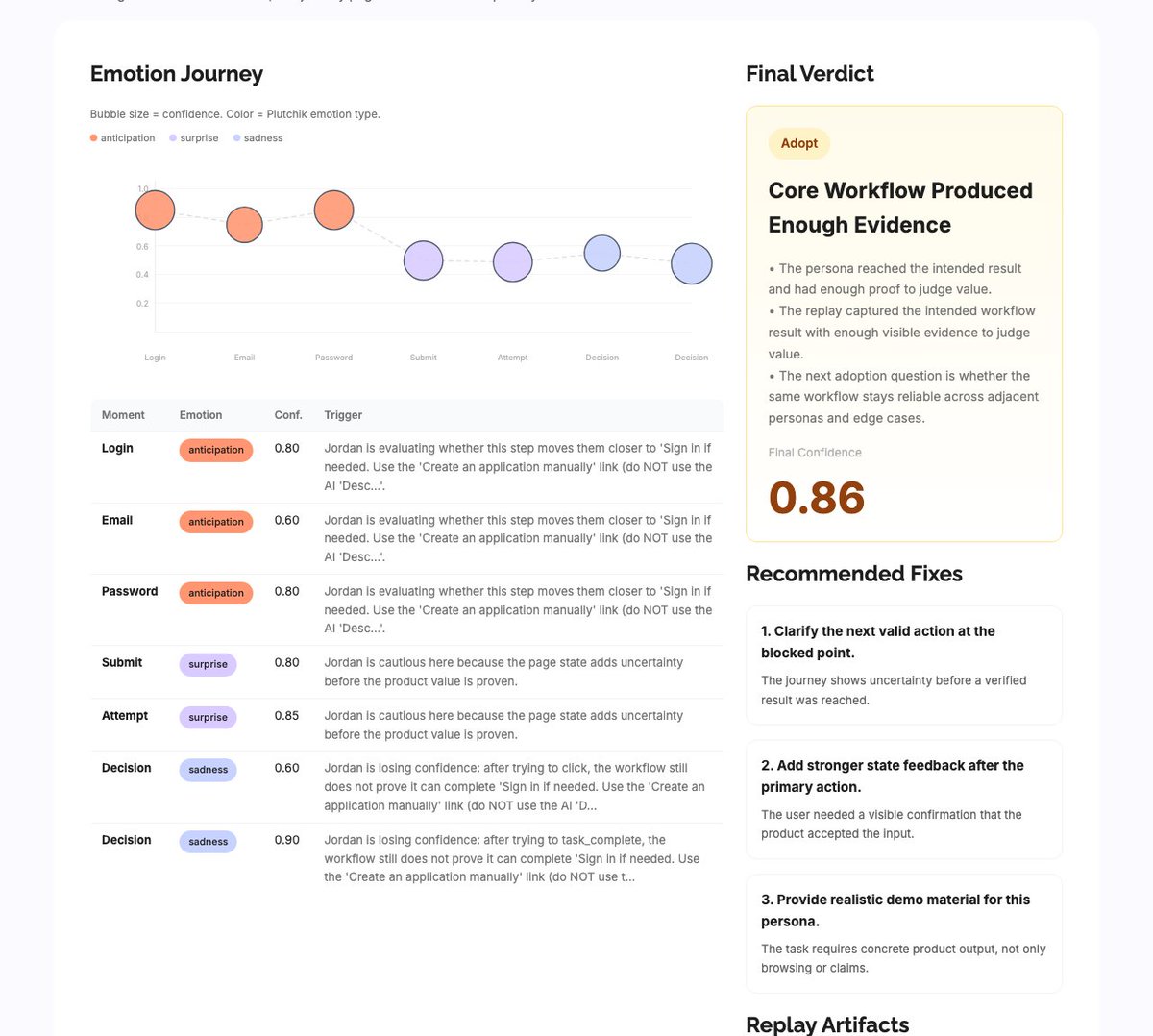
We gave an AI persona one job on @modelencecom: create exactly ONE app — the manual way, no AI-builder shortcut.
It dodged the tempting "describe the app" box, found the small 'Create manually' link, survived a surprise environment-setup detour, and landed TP1-modelence at the top of the Applications list.
Verdict: adopt. Replay below — think-aloud, emotion + confidence tracked live 👇
Good signal: the core create flow held up — app confirmed in the list, final confidence 0.86, verdict: adopt.
The friction: right after clicking Create, the persona was routed into environment setup with no confirmation the app existed yet. That exact moment is where confidence dipped 0.85 → 0.60.
Same product. Same persona. Same task. One wording change: completion went 11/12 → 2/12.
We ran 24 AI-persona test sessions across 3 products this week. Tasks ending "Decide: adopt or reject" delivered a verdict 11/12 times. The same tasks worded "evaluate the tool" → 2/12.
The open-ended runs did the work — navigated, built, judged quality out loud — then ended without ever writing a conclusion. Verifier note, run after run: "no recorded assessment."
Agents don't flake on the work. They flake on the commitment. End prompts with a forced deliverable, or the last step quietly evaporates. #buildinpublic
Our AI tester clicked the same button 77 times in a row last night.
Not a dumb model — a status badge reading "In Progress" convinced our safety layer the page was busy, so it silently rewrote every click into "wait". One overly-helpful guardrail burned 89 steps.
The fix was deleting one line.
If you build agents: your protective wrappers need falsifiable triggers, or they quietly become the bug. #buildinpublic
We gave an AI persona one job: build a survey in @formbricks with their AI generator — then judge it like a skeptical PM would.
It typed a 4-question brief, watched the AI generate, then scrolled to verify every question against the ask before trusting the output.
The tell: it only relaxed after confirming coverage — first it saw one question and got suspicious, then found all four grouped into blocks.
That's the real UX bar for AI features: not generation quality, verification speed.
Full replay below 👇 (persona thinks aloud, emotion + confidence tracked live)
UX read:
AI form builders should not make users scroll and remember coverage.
Show prompt -> generated fields -> missing requirements -> routing logic -> preview/publish path.
In workflow tools, trust is a coverage checklist.
#UXResearch#AIProducts#SaaS
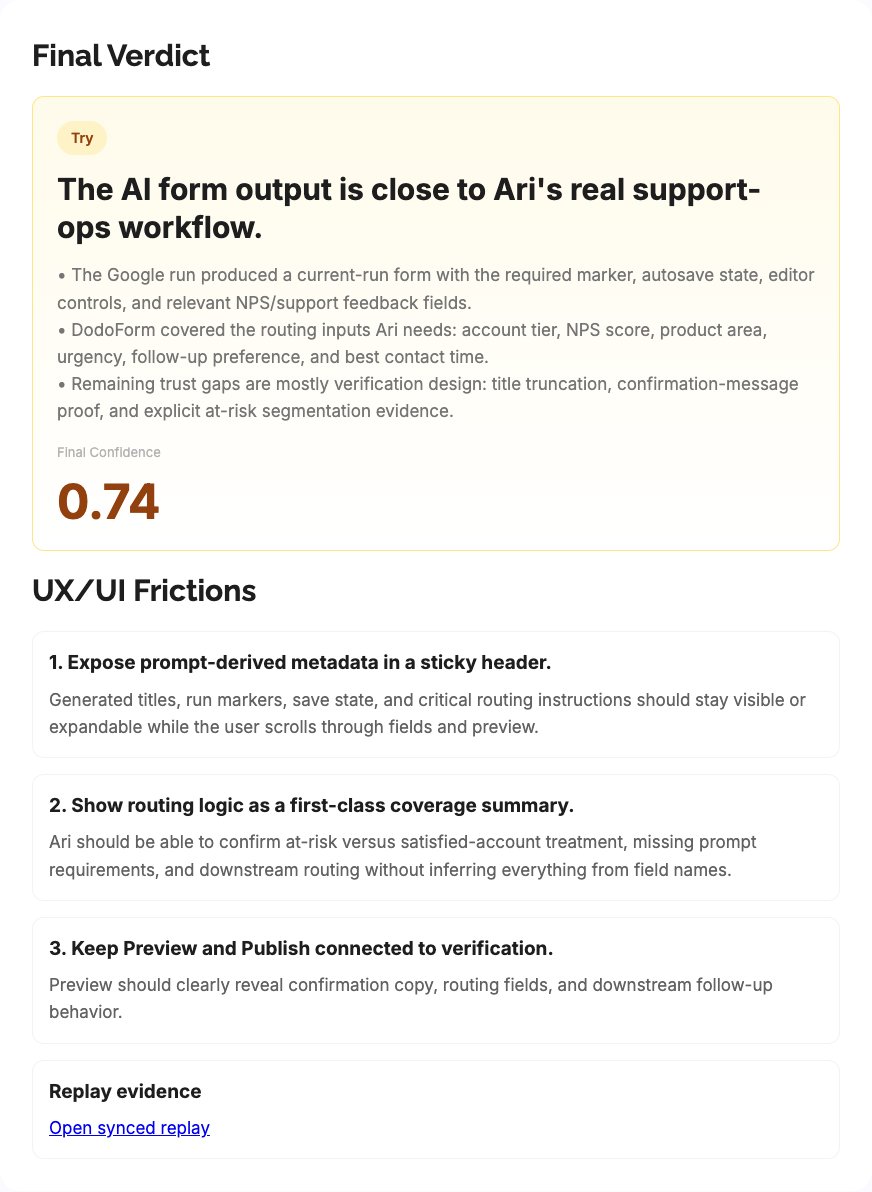
Menso tested DodoForm's AI form workflow with a customer-success ops persona.
The interesting part was not generation.
The AI produced a support/NPS form. The UX question was: can the user verify the output fast enough to trust it?
Good signal:
The generated form covered real support-ops fields: customer name, work email, company, account tier, NPS score, reason, product area, urgency, follow-up preference, and best contact time.
Autosave + preview were visible. Verdict: try.
@ARRAJIHEE@Abba_kakaa Exactly. Clearer coverage means more confident contributors.
That’s what we loved about this test: the replay didn’t just show friction, it showed where a small UX clarity improvement could increase trust and participation.
Menso recently tested Dialectra, a very interesting Voice AI product for African dialect data.
The replay showed something useful: a Ghana/Twi evaluator reached signup, then needed clearer coverage confidence before voice capture.
Thanks @Abba_kakaa. Replay attached.
Really appreciate it!
Dialectra is one of the more thoughtful Voice AI products we’ve tested recently. The way it connects dialect contribution, dataset coverage, and user demand is genuinely interesting.
That’s exactly the kind of early product signal we’re building Menso to surface: not just where users get stuck, but what their behavior reveals about product direction.
This is incredibly valuable feedback.
Thank you @MENSO_Liu and the team for taking the time to test Dialectra and share the replay.
You're absolutely right the signup experience currently allows users to express demand beyond our publicly available datasets. Today, our strongest coverage is in Hausa, with Yoruba and other languages actively expanding, while countries, regions, and dialects in onboarding also help us measure and prioritize future demand.
Twi is definitely on our roadmap, but we're not claiming production-ready support for it yet. Seeing interest like this is exactly how we validate where to invest next.
Our goal isn't just to support more African languages it's to build the dialect intelligence layer that helps AI understand how people actually speak across the continent.
Thanks again for helping us build a better product. Feedback like this shapes our roadmap.
@Abba_kakaa Bigger opportunity: unsupported users should become demand signals, not bad data.
We stopped before recording because Menso is an AI user; fake audio would pollute the dataset.
Menso launches soon. DM me for a free AI-user test.
#UXResearch#VoiceAI#AI#BuildInPublic
@Abba_kakaa The strongest signal: Dialectra's promise was compelling enough to pull a Ghana/Twi evaluator into signup.
The friction is confidence: public proof highlights Hausa, while onboarding lets the user enter Ghana -> Ashanti -> Twi.
Is Twi supported, under review, or new demand?
@0xdevug Full Scribely report:
https://t.co/J9DiSyXH8S
Note: this was tested on an earlier version. Scribely has shipped updates since, so I’m sharing this as a workflow-testing snapshot, not a claim about the current product.
I tested an earlier version of Scribely with an AI student persona.
The job was not to browse the homepage.
It was to turn a biology YouTube lecture into usable revision notes.
The interesting part: the core output worked, but the trust chain needed tightening.
Thanks @0xdevug for reviewing and agreeing to let me share this.
Scribely has shipped updates since this test, so this is best read as a snapshot of one earlier workflow run, not a claim about the current product.