People are acting as though cheap $XRP will be available forever.
It won’t.
Right now,
$XRP is still valued largely as an asset retail buys, sells and speculates on.
But if $XRP becomes a necessary part of how value moves through the world’s financial infrastructure, the entire basis on which it is valued changes.
If $XRP becomes a necessary part of global financial infrastructure,
it does not become expensive for one cycle.
It becomes expensive for good.
Here’s the reality with $XRP
$XRP was $0.006 in 2017 and no one believed it could hit $0.10 let alone $3
Why?
Because it was dubbed a “bankers coin”
And it went against everything that crypto stood for
People scoffed and said - “why would anyone want a crypto that it utilised by banks ?! “
Then, without warning
$XRP skyrocketed to $3 in 2018
From the end of 2018-2020 $XRP traded between $0.10-$0.19
And eventually skyrocketed from $0.19 to $1.65 in 2021 - only stopping there due to the Ripple VS SEC lawsuit and the delisting of $XRP from major exchanges
From 2021 - early 2024 the narrative around $XRP was
“It was dead”
“ $XRP will never rise above $1 again “
Late 2024 - 2025 $XRP skyrocketed from $0.50 to $3
The clear message here - the negative narrative / negative people have been wrong about $XRP every step of the way
The question then becomes - why would they suddenly be right about $XRP now ?
If these people have been 100% wrong about $XRP for 9 years
Why would anyone believe them when they say $XRP could never reach
$10
$100
$1,000
$10,000
Most people didn’t think $XRP could ever reach $1 - $3 until it did
That’s exactly what we will see with $XRP at prices like $10, $100, $1,000 - $10,000
And sadly,
most people need to see that type of price action before they believe in $XRP
Ripple CEO Brad Garlinghouse pointed to an $11 billion gold move by the Dutch central bank as proof that traditional finance is “too slow.” -Annika Masrani
#XRPL#Ripple#Evernorth#gold
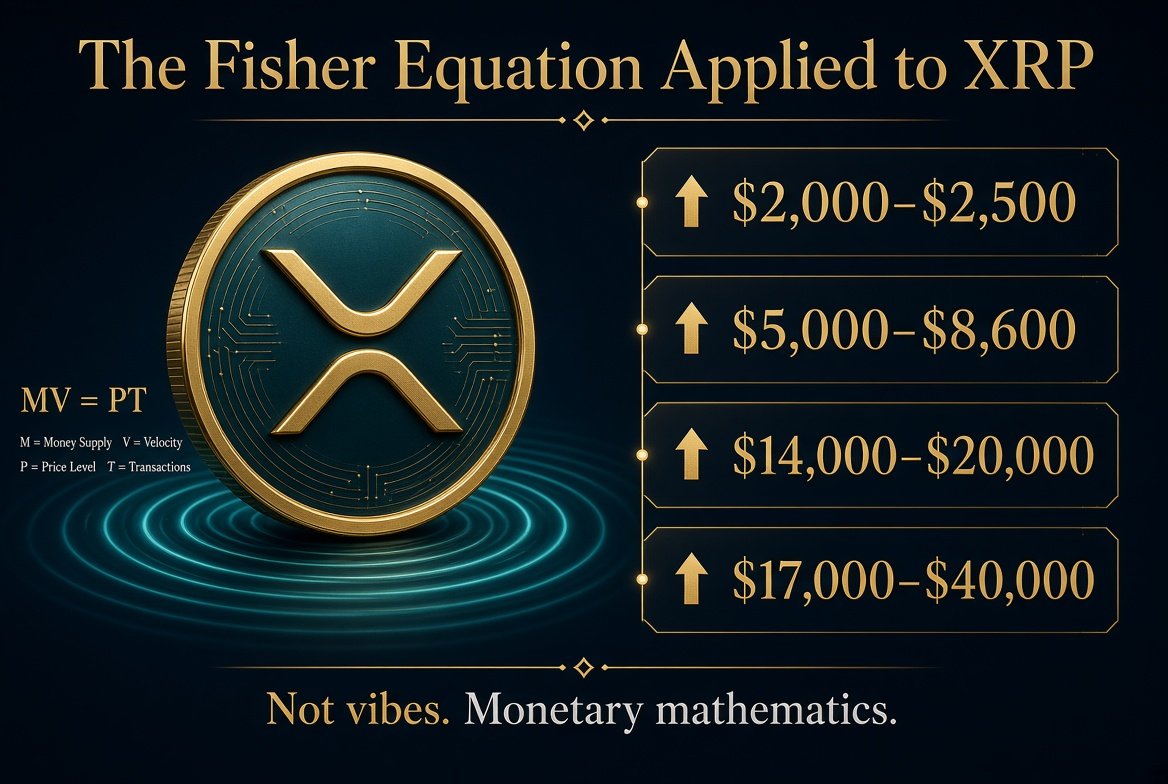
I did the math on ripple:native price. The results broke my brain a little
This is not a price prediction from some crypto influencer. An actual mathematical analysis using economic formulas from one and two centuries ago. The same formulas economists use to calculate the value of monetary assets. Not charts. Not vibes. Math.
The core formula is called the Fisher equation. You probably never heard of it but every serious economist knows it. It basically says that the price of a monetary asset is determined by how much economic value flows through it, divided by how many units exist, adjusted by how fast those units change hands per year. That last part is called velocity.
What happens when you apply this to XRP and you use real institutional numbers.
If 30 trillion dollars per year flows through the XRP network in institutional transactions, and each token only changes hands half a time per year because banks are holding them as collateral, and there are only 10 billion tokens available to absorb all that traffic…
The math gives you $6,000 per XRP.
And that is the conservative scenario. Like the most boring one.
I know. I had the same reaction. But the logic gets even more brutal.
The thing most people get completely wrong is thinking that more usage means more movement. It doesnt. When a bank uses XRP as collateral for 20 simultaneous operations it doesnt move between owners. It stays in the same custody account. The bank uses it but it doesnt go anywhere. So the token works harder but moves less. In economic terms velocity goes down even as processing capacity goes up. And lower velocity plus same volume plus less available supply equals price going up mechanically. Nobody decides this. The system forces it.
So here is the full price ladder this framework produces.
First 3 months after the Clarity Act gets signed. Banks start using XRP internally for treasury settlement. Not public yet. Internal pilots, capped channels, transfers only between entities of the same group. Price range in this phase is somewhere around $2,000 to $2,500.
From 3 to 6 months. The channels go semi public. Dollar to Mexican peso. Dollar to Indian rupee. Euro to pound. Liquidity providers start holding XRP structurally not just tactically. Velocity collapses. Available supply compresses dramatically. Price moves to $5,000 to $8,600.
From 9 to 15 months. Forex desks integrate XRP highways. Banks start reducing their nostro and vostro accounts which have 27 trillion frozen in them right now according to BIS documents. The reuse multiplier activates. At this point the price curve stops being linear. Range is $14,000 to $20,000.
After 18 months. Between $17,000 and $40,000 per token. When derivatives start settling on the network the ceiling moves toward $44,000 and $66,000 but that is outside the 18 month window so the analysis doesnt go there.
Why is the price one dollar if this math is real?
Because there is one piece missing.
The Clarity Act is not signed yet. Without it the compliance departments of banks cannot legally approve XRP as institutional collateral. Not because they dont want to. Because their legal teams wont sign off without a regulatory framework that defines what XRP is under federal law. The same reason a bank couldnt hold mortgage backed securities before the laws defining them existed.
The Clarity Act doesnt create the utility of XRP. That utility is already built and already running. JPMorgan already settled a live transaction on XRPL in May. Guggenheim already has Moodys Prime-1 rated commercial paper settling on XRPL. The DTCC already has Ripple Prime inside its clearing participant directory with code 0443. The infrastructure is there.
What the Clarity Act does is give the legal permission slip to turn it on at full scale.
And when it turns on the traffic doesnt grow slowly. It jumps. Because we are not in a stable world where banks can afford to wait. Hormuz has been closed 99 days. The nostro vostro model is breaking under geopolitical stress. The petrodollar is fragmenting. In a stable world banks tolerate trillions frozen in correspondent accounts, slow settlement, friction in forex, delays of several days. In a crisis world all of that becomes a fatal weakness. Banks dont wait for perfect regulation when the system is breaking. They move toward what works.
And XRP works.
The Clarity Act is on the Senate calendar since June 1st under Order Number 423. One scheduling decision by the Majority Leader and it goes to a floor vote.
When that happens the ladder doesnt go up slowly. It goes vertical. Not because someone says so. Because the Fisher equation applied to the volume that needs to flow through the network doesnt leave another mathematical option.
Verify the formula yourself. Fisher equation. Free in any monetary economics textbook for 100 years. The volume assumptions are the same ones the BIS and IMF use in their public documents. Everything checkable.
The numbers will come. The timing is uncertain. The direction is not. No Financial advise
The “New Global Monetary Order” is best understood as a transition in how money, banking, payments, & financial assets are issued, transferred, settled, & interconnected globally. XRP serves as the base layer of the new order. #Ripple#Evernorth
#XRP enables fast, low-cost cross-border payments and liquidity bridging between currencies. Designed for financial institutions, it settles transactions in seconds at minimal fees, improving efficiency over traditional systems like #SWIFT for remittances and int'l transfers.
People hear “$10,000–$50,000 $XRP ” and immediately scream:
“MARKET CAP!”
But they’re asking the wrong question.
The real question is:
How much value could each $XRP move if it were used for SWIFT-scale settlement?
SWIFT is associated with roughly $5–$7.5 trillion in payment instructions every day.
Now let’s break down the maths.
At $100 per $XRP:
$5T ÷ $100 = 50 billion $XRP required
$7.5T ÷ $100 = 75 billion $XRP required
That would demand an enormous amount of available liquidity.
At $1,000 per $XRP:
$5T ÷ $1,000 = 5 billion $XRP
$7.5T ÷ $1,000 = 7.5 billion $XRP
Better….. but still billions of $XRP required every day.
At $10,000 per $XRP:
$5T ÷ $10,000 = 500 million $XRP
$7.5T ÷ $10,000 = 750 million $XRP
Now the system becomes considerably more capital-efficient.
At $50,000 per $XRP:
$5T ÷ $50,000 = 100 million $XRP
$7.5T ÷ $50,000 = 150 million $XRP
The higher the value of each $XRP, the fewer units institutions require to move the same amount of money.
And $XRP does not need to move in whole units.
Every $XRP can be divided into 1,000,000 drops.
If 1 $XRP = $10,000:
1/10 $XRP = $1,000
1/100 $XRP = $100
1/10,000 $XRP = $1
1 drop = $0.01
If 1 $XRP = $50,000:
1/50 $XRP = $1,000
1/500 $XRP = $100
1/50,000 $XRP = $1
1 drop = $0.05
So a high $XRP price would not make it unusable.
Fractionalisation makes it practical.
A higher price means:
More value moved per $XRP
Fewer $XRP required for settlement
Deeper liquidity in fewer units
Greater efficiency for institutions
Then there is scarcity.
$XRP has a finite maximum supply.
Not every $XRP will be available for settlement.
Some will be held.
Some will be lost.
Some will remain in escrow.
Some will sit in private wallets.
And a small transaction cost is permanently destroyed with every XRPL transaction.
This does not prove $XRP must reach $10,000–$50,000.
It demonstrates how those prices could make mathematical sense if $XRP were required to provide bridge liquidity at SWIFT scale with only a limited portion of the supply available.
Retail looks at the price of one $XRP.
Infrastructure looks at how much value one $XRP can move.
That is the difference.
$10,000–$50,000 $XRP only sounds impossible when you still think it was designed to remain a cheap retail asset.
If the system needs $XRP
price must reflect function.
XRP will settle the back end of the stock mkt & provide liquidity for the global economy. XRP's price doesn't equal value. #Ripple is on-boarding most financial institutions onto its architecture. XRP isn't a stock, it's the global value transport system, >$10K per #XRP. #XRPL
@sentosumosaba Japanese IRs should rise more organically due to skepticism about short-term yen interventions. The BOJ should raise rates by another 2% over the next year, but fear the crushing pain of the Yen reverse carry trade. The global economy is slowly circling the drain.
Ripple has executed a classic "picks and shovels" strategy during a gold rush: while nations fight over reserve currency status, Ripple offers the infrastructure to move value regardless of which currency "wins." #XRP#Ripple#gold#IMF#WEF#ECB#VATICAN#Jesuit#Blackrock#BTC