mf trained a simple model to translate ada-002 embeddings back to text and found something interesting:
sentence embeddings have arithmetic properties
the classic "king - man + woman = queen" still works just like w/ token embeddings — but can go a few steps beyond that as well
FlashAttention is widely used to accelerate Transformers, already making attention 4-8x faster, but has yet to take advantage of modern GPUs. We’re releasing FlashAttention-3: 1.5-2x faster on FP16, up to 740 TFLOPS on H100 (75% util), and FP8 gets close to 1.2 PFLOPS!
1/
there was a good thread recently estimating the current upper bound of tokens in the world (including Gmail and other private repositories), but I can't find it
can anyone point me to it?
@atroyn ah i see i'm behind on the sota, i was under the impression folks were still training embedding models purely w/ unsupervised contrastive learning — but yup looks like BGE, Gecko, etc all mix in supervised Q-A pairs along with their unsupervised contrast pairs
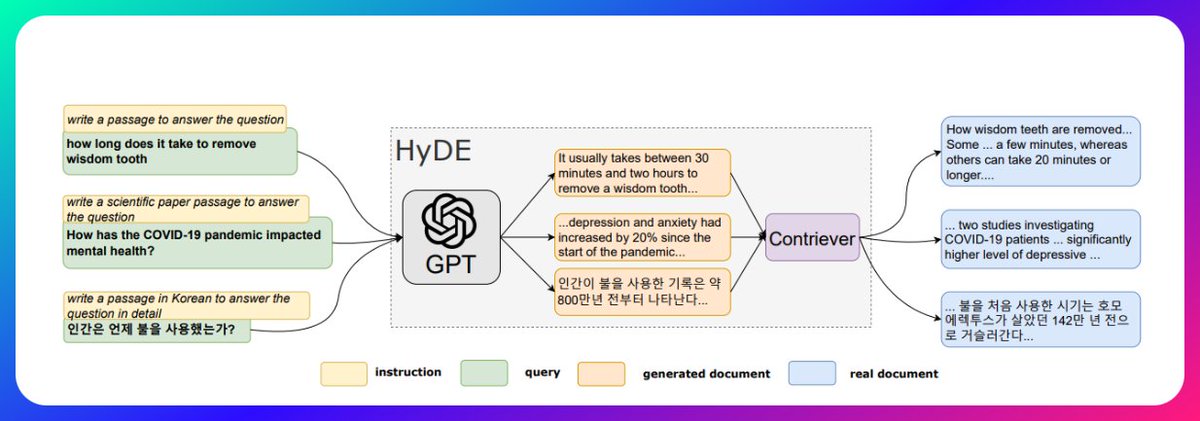
i find HyDE (hypothetical document embeddings) to be such an elegant and intuitive idea - like to improve your semantic search, you ask an LLM to generate a hypothetical answer to your query and then you use this query for embedding search. idea is the (embedding of) hypothetical query is going to be closer in latent/embedding space than your actual natural language query. it's funny how you are literally using a hallucinated answer to get better results.
@atroyn by 'they’re already trained this way,' you're saying contrastive pre-training already gives embedding models this property, or folks are already finetuning their embedding models on query-answer pairs in industry?
Contrast pairs are overpowered. Once you have them, you can use them to generate control vectors, and to initialize classifiers, and to do RL/DPO, and probably more
@xlr8harder my guess is because it's easier to have an animal known only for that one property (camouflage)
octopi are known for a whole bunch of things (intelligence, 8 legs, etc) — so could confuse kids to call someone an octopus expecting them to understand it's about camouflage
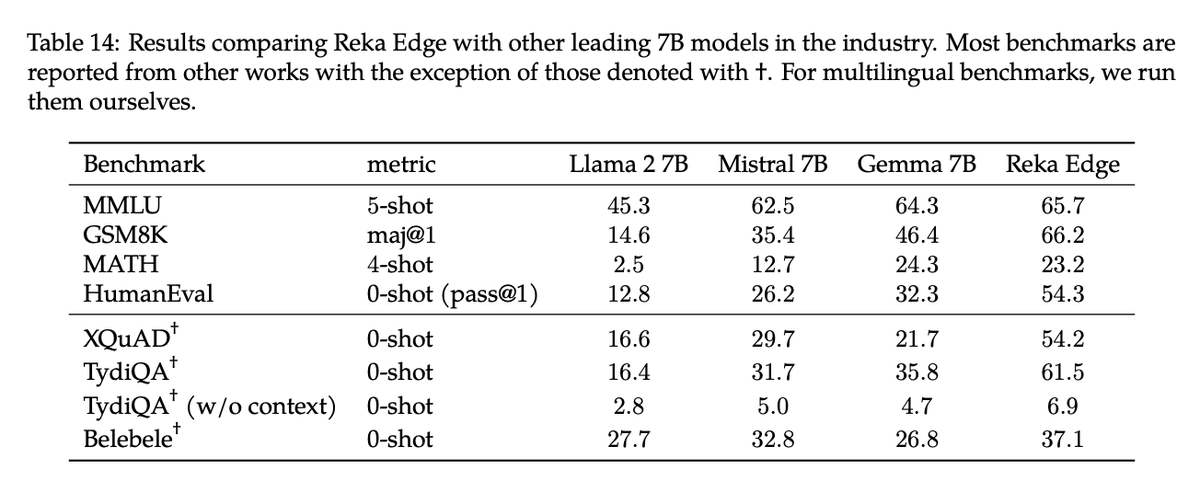
Along with Core, we have published a technical report detailing the training, architecture, data, and evaluation for the Reka models.
https://t.co/ROrakRAcPu
@haizelabs awesome work!
some questions about the 'Reducing Batch Size' section:
a) is batch size not essentially free to scale? each batch can be computed in parallel, even across multiple cards
b) what is the pareto optimal B you reccomend? or is this a Haize Labs secret hehe