One of the coolest things I’ve learned at Normandy is about Lt. Col. Robert “Bull” Wolverton, commander of 3rd Battalion, 506th Parachute Infantry Regiment, 101st Airborne Division, who said to his men before their jump 🪂:
Men, I am not a religious man and I don't know your feelings in this matter, but I am going to ask you to pray with me for the success of the mission before us.
And while we pray, let us get on our knees and not look down but up with faces raised to the sky so that we can see God and ask his blessing in what we are about to do.
God almighty, in a few short hours we will be in battle with the enemy.
We do not join the battle afraid.
We do not ask favors or indulgence but ask that, if You will, use us as your instrument for the right and an aid in returning peace to the world.
We do not know or seek what our fate will be.
We ask only this, that if die we must, that we die as men would die, without complaining, without pleading and safe in the feeling that we have done our best for what we believed was right.
Oh Lord, protect our loved ones and be near us in the fire ahead and with us now as we pray to you.
#LestWeForget
General Dwight D. Eisenhower asking 1LT Wallace C. Strobel where he's from on the day before D-Day. June 5, 1944.
Strobel repled, "Michigan, Sir."
Eisenhower: "Oh yes, Michigan, great fishing there. Been there several times and like it."
Sometimes, just a simple, lighthearted conversation is all a person needs to get them through tough times.
Strobel lived to be 77.
By the morning of June 5, all four Japanese carriers (Akagi, Kaga, Soryu, Hiryu) were gone, effectively ending the Battle of Midway.
Final Tally:
United States losses:
Ships: 1 fleet carrier (USS Yorktown), 1 destroyer (USS Hammann)
Aircraft: ~145–150 destroyed
Lives: ~307–340 killed
Japanese losses:
Ships: 4 fleet carriers (Akagi, Kaga, Soryu, Hiryu), 1 heavy cruiser (Mikuma)
Aircraft: ~248 destroyed (mostly carrier-based, including many elite pilots)
Lives: ~3,057 killed
These three days marked the military turning point in the war ... but more than two years of the most brutal fighting the world had ever seen remained on the horizon. We owe our respect to the brave men of the US armed forces especially Torpedo Squadron 8 (and Ensign Tex Gay), Bombing & Scouting Squadrons 6, Bombing Squadron 3, and the crews of USS Enterprise, Yorktown, and Hornet.
The calm before the storm. Pointe du Hoc. The most dangerous mission on D-Day, according to Omar Bradley. 225 men will fight here late tonight, US time. 77 will be killed, and more than 140 will be wounded.
"Think not of their passing. Remember the glory of their spirit." Company A, 116th Infantry Regiment, 29th Division. 34 of these men are from Bedford, Virginia. 19 Bedford Boys in gray here now have less than 24 hours of life left. #TheBedfordBoys. See more: https://t.co/kdNsJD04vx
14-year-old Lucille Hoback Boggess, waits in Bedford, Virginia, for news of an invasion. Both her brothers, two of 34 Bedford men scheduled to land in the first wave on Omaha Beach, will be killed within 24 hours. See more at https://t.co/EEg00P06y6
A few big picture things to consider as the first to fight get kitted up and prepare to jump into France in a few hours' time. This will help with my coverage today, tonight and tomorrow. You'll have to be up at 1.30 am on 6 June US time for first waves landing on the beaches. Here are the five phases to the operation. See below. The airborne drop, the first for most of the men, is already underway as C-47s and gliders are now being loaded. Almost every Allied commander is uncertain this will work.
Yorktown should not have been at Midway at all. A month earlier at Coral Sea, a Japanese bomb had torn through her decks, and the estimate to fix her ran to 90 days. Japan crossed her off as sunk. Admiral Nimitz gave Pearl Harbor's shipyard 72 hours. Some 1,400 workers swarmed her around the clock, welders still aboard as she steamed out to the ambush. Her presence at Midway was itself a kind of resurrection. She would need two more.
On the morning of June 4, her air group earned its keep: her dive bombers destroyed Soryu, and her torpedo squadron's sacrifice helped pull the Japanese fighters out of position for the killing blow. But by midday, one Japanese carrier was left alive. Hiryu, under the ferocious Admiral Yamaguchi, found Yorktown first.
The first strike came around noon: dive bombers, eighteen launched, most shot down on the way in, but three bombs got through. One burst near the island, one went down the smokestack and knocked out five of her nine boilers, one punched through the flight deck. Dead in the water and burning, she should have been finished.
She wasn't. Her damage control crews patched the deck with timbers and steel plate, relit the boilers, and within two hours she was making 19 knots and refueling fighters. The repair was so complete that when Hiryu's second strike arrived, the Japanese pilots reported attacking a different, undamaged carrier. Japan would end the battle believing it had knocked out two American carriers. It had hit the same unkillable ship twice.
That second strike was led by Lt. Joichi Tomonaga, whose plane's left fuel tank had been shot through that morning over Midway and could not be refilled. He led the mission anyway, knowing it was one way. His torpedo bombers bored in through everything Yorktown's escorts could throw at them, and two torpedoes slammed into her port side, jamming the rudder and cutting all power. Tomonaga did not return. Yorktown rolled into a 26-degree list, and with capsizing looking imminent, Captain Elliott Buckmaster gave the order no captain wants to give. The crew went over the side in good order. American doctrine, unlike the Japanese tradition that kept captains on burning bridges, expected Buckmaster to live; he left the ship last, sliding down a line into the sea.
And still she floated. All night, all the next day, the list never worsened. So on June 6 Buckmaster came back with a hand-picked salvage crew, the destroyer Hammann lashed alongside providing power, and they began to win: fires out, the list reducing, a tow rigged. Yorktown was coming home a third time.
Then, that afternoon, the Japanese submarine I-168, having slipped through the destroyer screen after a patient day-long approach, fired four torpedoes from inside the escort ring. One broke Hammann in half; she sank in four minutes, and as she went down her own depth charges detonated, killing men in the water. About 80 of her crew died. Two more torpedoes hit Yorktown.
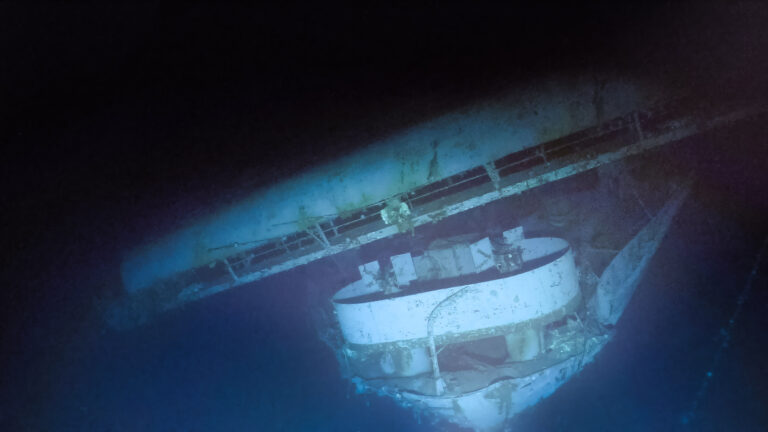
Even then she refused to go quickly. She lingered through the night, and at dawn on June 7 the men on the surrounding destroyers stood at attention, ships' flags at half mast, as she rolled onto her port side and sank into three miles of water. The battle had ended days of fighting with a strange symmetry: four Japanese carriers and one American, all on the same patch of ocean floor.
In May 1998, Robert Ballard, the man who found the Titanic, found her: upright, intact, her guns still trained skyward, her hull number still visible, three miles down and almost untouched by time.
I didn't post it on social media. I posted everything, including clarifications, on a premium message board that's the opposite of clickbait. Another account screenshotted it and took it to social media. The context is completely lost as this has gotten overblown.
D-Day is underway. Some would argue that what's happening right now is the most daring and ultimately successful operation in the history of military Alliances.
Note: the majority of troops are friends of the US from eight countries. Eisenhower has been told that three-quarters of the 23,400 airborne troops will be lost. He's hoping that the prediction will be wrong.
82 years ago today, eight American sailors jumped onto a sinking Nazi submarine in the middle of the Atlantic.
What they pulled out of it changed the war. And the Navy buried the whole story for years.
First, you need to know that U-505 was already cursed. German sailors called her the unluckiest boat in the fleet. In October 1943, during a brutal British depth-charge attack, her own captain shot himself in the head in the control room, in front of his crew. He remains the only submarine commander in history known to have killed himself underwater in combat. His second-in-command calmly took over, rode out the attack, and sailed her home.
Eight months later, her luck ran out completely.
June 4, 1944. Two days before D-Day. Captain Daniel Gallery's hunter-killer group, built around the escort carrier USS Guadalcanal, had been stalking U-boats off West Africa. Gallery had an idea his superiors considered borderline insane: don't sink the next one. Capture it. No US Navy crew had boarded and taken an enemy warship on the high seas since 1815.
The destroyer escort USS Chatelain caught U-505 on sonar and fired a salvo of hedgehog bombs. The U-boat broke the surface 700 yards away. Gunfire raked the conning tower, wounding her captain. He gave the order to abandon ship.
The Germans rushed out so fast they botched the scuttling. The sub was flooding, but her engines were still running. She was circling the battle at six knots, empty, sinking, and very possibly rigged with demolition charges.
So Lt. Albert David and eight men from USS Pillsbury chased her down in a whaleboat, leaped aboard, and climbed down the hatch into a dark, flooding submarine that could explode or go under at any second. They shut the scuttling valves, disarmed the charges, and stopped the flooding.
Down there they found the prize: Enigma cipher machines and roughly 900 pounds of codebooks and charts. Current settings. The keys to the German navy's secret communications.
But here's the catch. The treasure was only valuable if Germany never found out. One leak and Berlin changes every code overnight.
So the Navy ran one of the great cover-ups of the war. The sub was towed 1,700 miles to Bermuda and given a fake American name: USS Nemo. Around 3,000 sailors were sworn to total silence. The 58 captured German crewmen vanished into a POW camp in rural Louisiana, hidden even from the Red Cross. Germany declared U-505 lost with all hands and notified the families. The dead men were alive in Louisiana, and their boat was working for the US Navy.
The secret held until the war ended.
Lt. David received the Medal of Honor, the only one awarded in the Atlantic Fleet in all of WWII.
And the submarine? In 1954, Chicagoans raised $250,000 to bring her home. She was towed across Lake Michigan and dragged through the streets of Chicago to the Museum of Science and Industry.
She's still sitting there right now. You can walk through her.