Only 6% of US and 3% of German decision makers say all relevant systems are connected enough for employees and AI to coordinate actions across the entire customer journey.
This data point is part of why I joined SAP. Connecting front-end technology with back-end technology is still in its early stages — and it matters more than most organizations realize. A truly connected organization delivers delightful customer experiences and runs efficiently. AI makes that connection even more urgent: the more data and context it has from across the entire organization, the better the outcomes it delivers.
According to our latest research report, AI in Customer Experience Report 2027, 51% of Americans and 58% of Germans already use AI at some point in their shopping journey. AI-assisted discovery has reached critical mass. But discoverability is only half the equation. When a customer asks an AI agent about pricing, availability, delivery times, or resolves a service issue — that AI is only as good as the systems behind it. Our research shows these are exactly the things shoppers care most about. Yet most companies are focused elsewhere, pouring investment into personalization while the operational foundations remain disconnected.
The brands that win the AI era won't just be the ones customers can find. They'll be the ones that can actually deliver on what AI promises.
@juokaz Maybe it’s people starting their holiday shopping? I’ve seen deals start on November 12th. The travel spike may be people rebooking flights due to the ground stop or booking holiday flights.
Only 6% of US and 3% of German decision makers say all relevant systems are connected enough for employees and AI to coordinate actions across the entire customer journey.
This data point is part of why I joined SAP. Connecting front-end technology with back-end technology is still in its early stages — and it matters more than most organizations realize. A truly connected organization delivers delightful customer experiences and runs efficiently. AI makes that connection even more urgent: the more data and context it has from across the entire organization, the better the outcomes it delivers.
According to our latest research report, AI in Customer Experience Report 2027, 51% of Americans and 58% of Germans already use AI at some point in their shopping journey. AI-assisted discovery has reached critical mass. But discoverability is only half the equation. When a customer asks an AI agent about pricing, availability, delivery times, or resolves a service issue — that AI is only as good as the systems behind it. Our research shows these are exactly the things shoppers care most about. Yet most companies are focused elsewhere, pouring investment into personalization while the operational foundations remain disconnected.
The brands that win the AI era won't just be the ones customers can find. They'll be the ones that can actually deliver on what AI promises.
Brands that tailor their customer experience and loyalty strategies by generation will be better positioned to retain customers in 2026 and beyond. Learn more here: https://t.co/LWWkdLWkFr
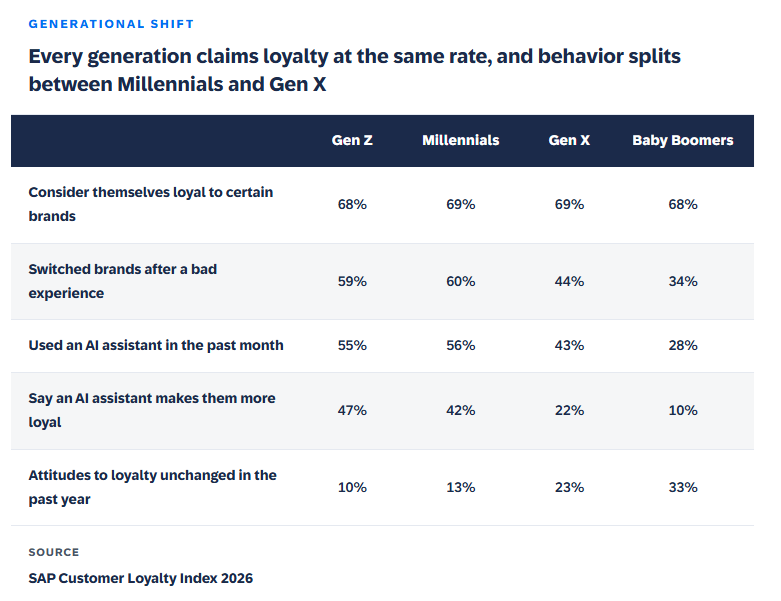
SAP's latest Customer Loyalty Index 2026 data reveals a clear generational divide: younger consumers are much more willing to leave brands after a just one poor experience.
The takeaway: loyalty isn't one-size-fits-all.
Gen Z values consistency, relevance, and cultural relevance. Millennials prioritize rewards and value exchange. Older generations tend to be more resilient to individual bad experiences.
In May, I joined the board of directors for the non-profit, Digs for Dignity. Digs provides secondhand furniture for those placed into housing. Since its founding in 2019, Digs has furnished more than 300 homes for 1,000+ Chicago neighbors, diverted more than 330,000 pounds of furniture from landfills and helped families achieve lasting housing stability.
Our annual gala fundraiser is Thursday, October 22nd. I would love to see you there! It's a great evening filled with music, food and dancing.
https://t.co/tm9G5V9tTE
Loyalty programs need more than points.
SAP surveyed 10,000+ consumers for its 2026 Global Customer Loyalty Index—and the data shows a shift.
Incentivized loyalty has fallen from 56% in 2022 to just 38% in 2026.
What drives loyalty today?
• Better deals — 46%
• Great customer service — 43%
• Priority delivery & free returns — 30%
• Priority support — 24%
The gap between deals and customer service is just 3 points.
And, unsurprisingly, one of my favorite topics—fast delivery—is #3.
The bigger takeaway: 50% of consumers have switched brands because of a bad experience.
Price gets customers’ attention. Experience can determine whether they stay.
Read the report here: https://t.co/GyYQf2nPk5
What happens when customer experience + store operations work as one?
That’s the question that led me to SAP—and now you can experience the answer in NYC.
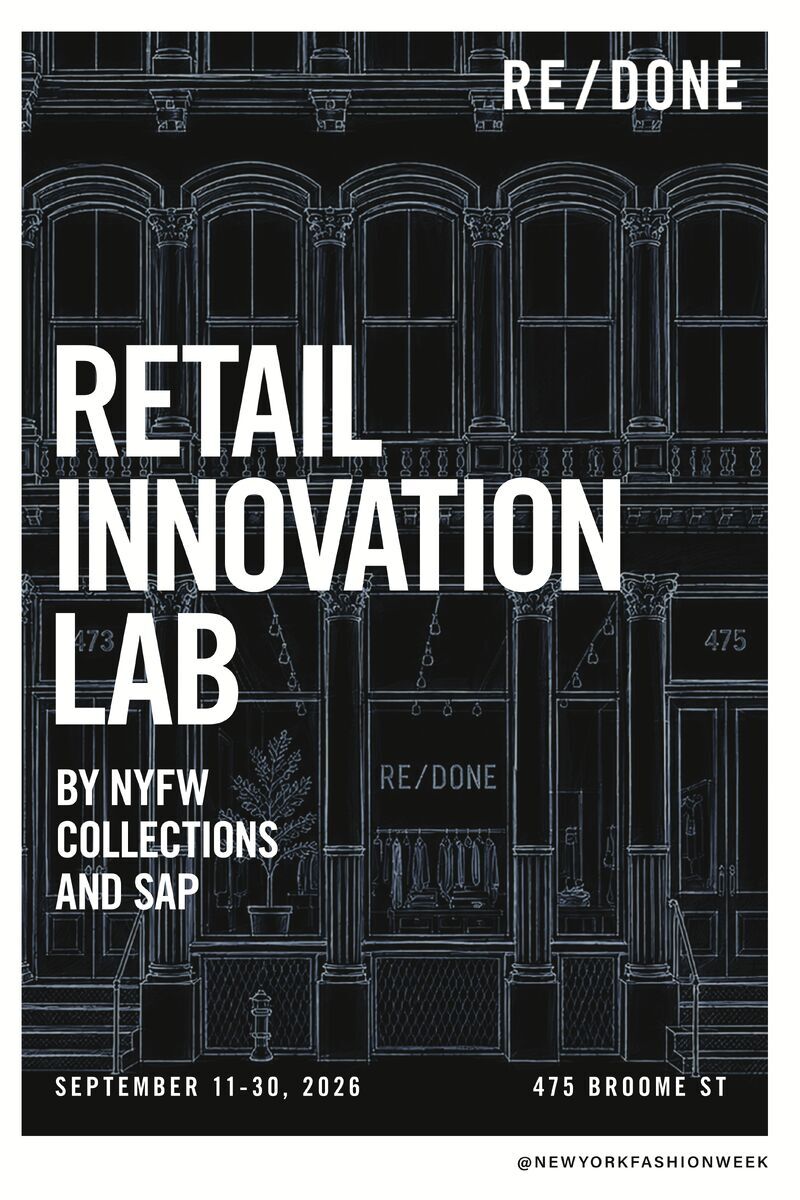
We partnered with NYFW Collections to create a Retail Innovation Lab featuring RE/DONE, where customer engagement, fitting-room activity, sizing, inventory and sales signals flow from the store floor into a live Command Center.
The result: connected retail where insights move from signal → action, enabling more personalized experiences, real-time visibility, faster decisions and AI-powered experiences.
📍475 Broome St, SoHo
🗓️ Through Sept. 30
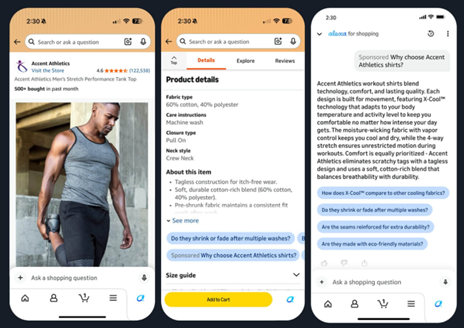
Amazon shared an interesting data point on its Q2 earnings call: customers who've tried Alexa+ are signing up for Prime at nearly 25% higher rates.
Last year, Amazon estimated Rufus (now Alexa for Shopping) was driving an incremental $12B in annualized sales. If Alexa+ is also increasing Prime subscriptions, it strengthens the business case for investing in agentic shopping—not just as a sales driver, but as a customer acquisition and loyalty engine.
Are people subscribing because Alexa+ is more valuable as a Prime benefit? Or are Alexa+ users simply Amazon's most engaged shoppers? And what role do Echo Show devices play in making these experiences habitual?
A couple of other notable stats:
• Conversational commerce continues to gain steam: 350M+ customers used Alexa for Shopping over the past year. Active users nearly doubled, and interactions grew 5x YoY in Q2.
• Retail media networks can monetize these surfaces: Shoppers who clicked sponsored prompts were 48% more likely to convert and spent 21% more on average.