To kick off my blog article series on adversarial examples and adversarial training, I just published the first three articles that lay some of the foundations: monitoring training and good clean performance - 2.56% test error on CIFAR10. Start here: https://t.co/S7OXjxEvD9
Do you want to know how to generate fluent text from structured data and vice versa by leveraging heterogeneous data sources?👀
Don’t miss the opportunity to discuss it with @songdng today at @aistats_conf🙌
⏰Auditorium 1 Foyer 6 - 4:30pm - 7pm
https://t.co/0bl75NVyO1
#aistats23
🥳🎉 Our paper "Exponential Smoothing for Off-Policy Learning" has been accepted at #ICML2023@icmlconf for an *Oral Presentation*.
Many thanks to my co-authors David Rohde (@CriteoAILab), Victor-Emmanuel Brunel and @Korba_Anna (@Ensaeparis/@CrestUmr). 🤩🤩 See you in Hawaii!
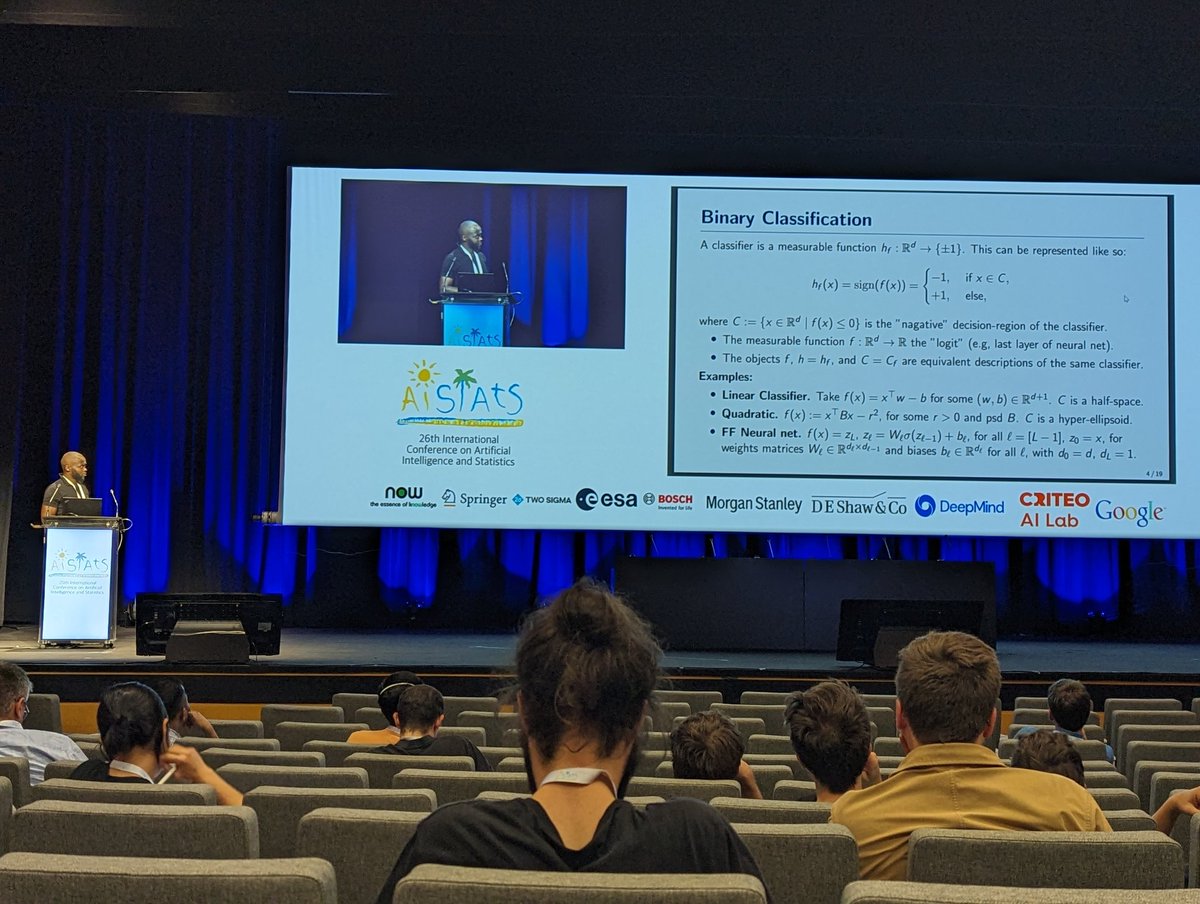
Today at @aistats_conf, @dohmatobelvis will present our paper "Origins of Low-Dimensional Adversarial Perturbations" in Oral session 2😃
Check it here 👉 https://t.co/mSfVL9jaWc
The paper studies the conditions under which low-dimensional black box attacks succeed 😎
@qberthet@cjdamato As an AC, do you have statistics about that (eg ratio of replies before any intervention from you, etc.) over a sufficient nb of reviewers? 🧐 This would be very interesting to conduct such a study to get a broader view. On my paper, I got just one reply over 3 reviews.
If the reviewers for my paper that asked for clarifications/experiments that we indeed provided in the rebuttal (after working quite a lot during a week-end, remember this very good timeline from @icmlconf ) could see this...😅
If you are reviewing for ICML, please pay attention to the rebuttals of papers you gave low scores to and engage with the authors.
It takes 5 min of your time to correct a misunderstanding that will save someone else's 1-year worth of work.
#ICML2023
If you are reviewing for ICML, please pay attention to the rebuttals of papers you gave low scores to and engage with the authors.
It takes 5 min of your time to correct a misunderstanding that will save someone else's 1-year worth of work.
#ICML2023
@Pseudomanifold@LogConference My experience with reviewers has never been great, but clearly, #ICML2023 has been really horrible😤 I don't know to fix it (bad/good incentives to reviewers?), anyway as a young researcher, the only incentive I get is to avoid being a reviewer as much as possible. Sad🫤
🥇Results: much better accuracy on underspecified problems 🔥even in cases where labels are completely correlated with spurious features🔥
👉 Such an OOD setting is quite similar to the adversarial one. I wonder if such strategies can be adapted to it 🧐
Morning read [1/3]
💡Training multiple NNs heads while enforcing diversity of predictions ensure great accuracy results for out-of-distribution or underspecified problems.
👉https://t.co/JUW6mu2uT3 from @yoonholeee@HuaxiuYaoML@chelseabfinn at #iclr2023
Main strength 🔥 the "Diversify" stage 👉 heads are forced to be different because of a term minimizing mutual information between predictions from different heads in the training loss, simple and effective👌
The best head is then selected in the "Disambiguate" stage😊
Awesome website summarizing our latest TMLR paper demonstrating how deep networks pruning can be easily explained/visualized and improved simply by formulating it in terms of the DN's spline partition!
Paper: https://t.co/30CXYmAWKM
Code: https://t.co/heGXelObVh
@Pseudomanifold@shortstein I also include a well-written comment only when it was particularly easy to follow (especially when I don't really know some concepts used in the paper😅). It's so much easier as a reviewer compared to papers that don't make any efforts on that side 😑
[3/3] The exps are done on NNs with large filters as it is harder to see something on smaller ones.
I'm curious if some structure can still be extracted (but how?) from smaller filters🧐
Anyway, very interesting to see that structure is once again important for #deeplearning 😊
[Morning read 1/3]
💡Better accounting for the structure of NNs conv filters NNs improves performance 👉 https://t.co/7fHmb6f6IG by @ashertrockman & al. @iclr_conf
They found that conv filters are highly structured, and designed a new initialization method to improve NNs perf
[2/3] The strength of their initialization is that it's a simple Gaussian one where just the covariance matrix is carefully crafted, meaning it's very easy to implement 🤩
Results 🧐
1⃣Improved accuracy and 2⃣faster convergence 🔥







![MGoibert's tweet photo. Morning read [1/3]
💡Training multiple NNs heads while enforcing diversity of predictions ensure great accuracy results for out-of-distribution or underspecified problems.
👉https://t.co/JUW6mu2uT3 from @yoonholeee @HuaxiuYaoML @chelseabfinn at #iclr2023 https://t.co/Mf7x6BEUti](https://pbs.twimg.com/media/Fr5NbGkXgAIKidV.jpg)


![MGoibert's tweet photo. [3/3] The exps are done on NNs with large filters as it is harder to see something on smaller ones.
I'm curious if some structure can still be extracted (but how?) from smaller filters🧐
Anyway, very interesting to see that structure is once again important for #deeplearning 😊 https://t.co/2yEwVUCBqp](https://pbs.twimg.com/media/FrPpQVhWwAAHelv.jpg)
![MGoibert's tweet photo. [Morning read 1/3]
💡Better accounting for the structure of NNs conv filters NNs improves performance 👉 https://t.co/7fHmb6f6IG by @ashertrockman & al. @iclr_conf
They found that conv filters are highly structured, and designed a new initialization method to improve NNs perf https://t.co/R08wwsWlTQ](https://pbs.twimg.com/media/FrPmHeKX0AILUNP.jpg)
![MGoibert's tweet photo. [2/3] The strength of their initialization is that it's a simple Gaussian one where just the covariance matrix is carefully crafted, meaning it's very easy to implement 🤩
Results 🧐
1⃣Improved accuracy and 2⃣faster convergence 🔥 https://t.co/zyJel7hyhg](https://pbs.twimg.com/media/FrPn4ANWcAAXBe9.jpg)


